Your business sign is your handshake—it’s the very first impression you make. The sign board material you choose says just as much as the words on it, defining your brand’s presence before a customer ever steps inside.
Why Your Sign Board Material Matters
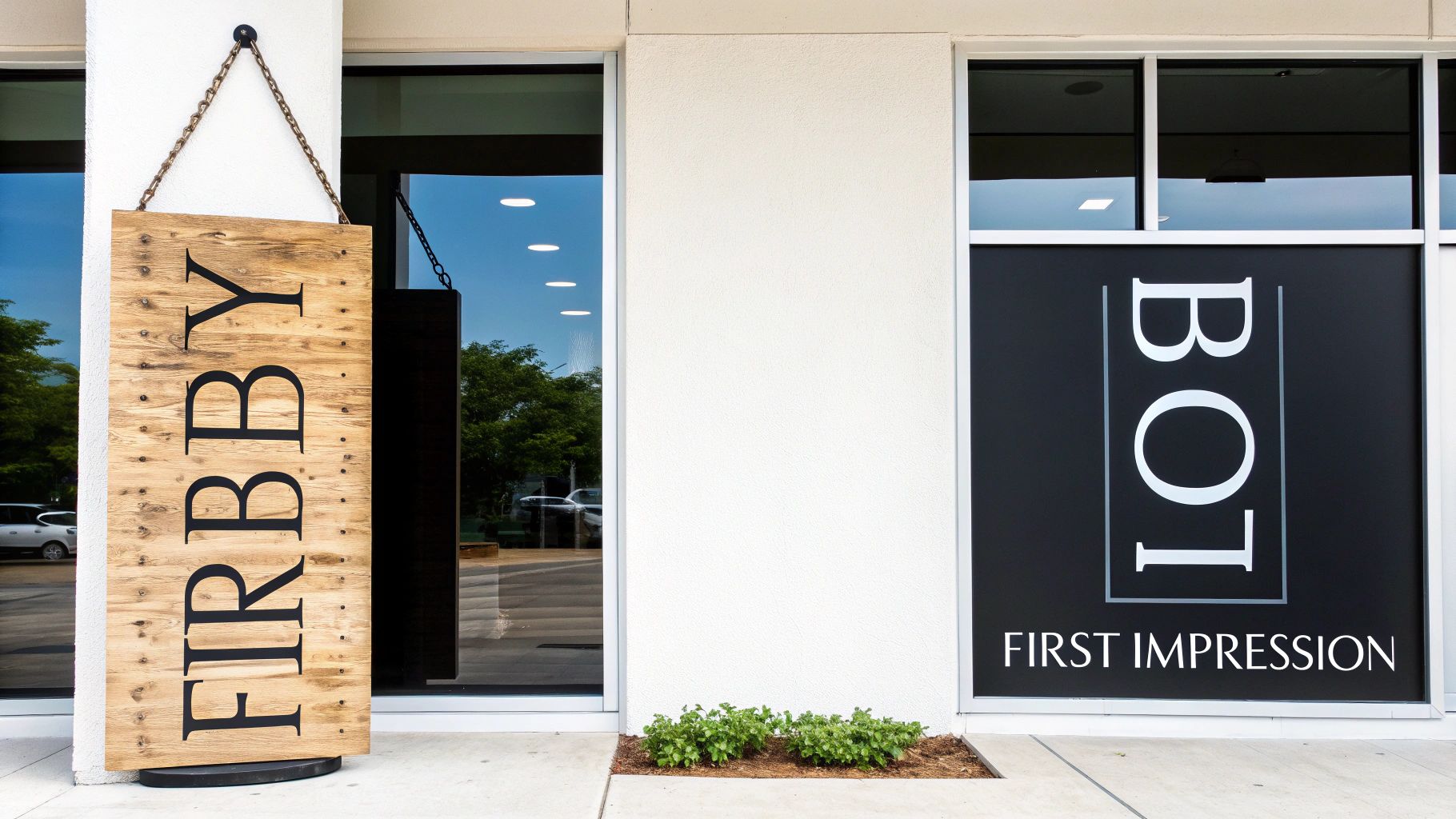
Think of your sign as a core piece of your marketing strategy, not just a tool for information. A sleek metal sign immediately communicates professionalism for a law firm, while a rustic, sandblasted wood sign perfectly captures the charm of a local cafe. The material itself is a powerful, non-verbal communicator.
But making the right choice goes way beyond looks. It’s a strategic balance of several key factors that determine how well your sign will perform, how long it will last, and the overall value you get from it. Getting this right from the start saves you from future headaches and surprise costs down the road.
Core Factors to Consider
Before we dive into the specific types of materials, every business owner needs to weigh three foundational elements. These considerations are the bedrock of a smart signage investment, ensuring your final sign is both effective and built to last.
- Location and Durability: Is this sign going in a climate-controlled lobby or on a storefront exposed to rain, snow, and blazing sun? For example, a sign on a Florida beachfront property needs to resist saltwater corrosion, while a sign in Chicago must withstand freezing temperatures and high winds. Outdoor signs need materials that can stand up to UV rays and harsh temperature swings without fading or falling apart.
- Brand Identity and Aesthetics: What feeling do you want people to have when they see your sign? Your material should be a direct reflection of your brand’s personality—whether that’s modern and minimalist, traditional and established, or funky and eco-friendly. An IT company might choose brushed aluminum for a high-tech look, whereas a bed & breakfast would benefit from the welcoming feel of carved wood.
- Budget and Lifespan: You have to consider both the upfront cost and the long-term value. A cheaper material might save you money today, but if it needs constant maintenance or a full replacement in a few years, it could end up costing you more. It's an actionable insight to compare the 10-year cost of a low-cost sign versus a more durable one.
A well-chosen sign material is a silent brand ambassador that works for you 24/7. It's a tangible asset that can directly influence customer perception and build trust.
Even in our digital world, the power of physical signage hasn't faded. The global sign board market was valued at about $3324.2 million in 2021 and is projected to hit $6976.1 million by 2033. This growth shows just how much businesses still rely on quality signs to bring customers in the door.
This same logic applies on a smaller scale, where creating custom labels and choosing the right materials can make or break a product's appeal.
Picking the right material is a foundational step that impacts everything from visual appeal to long-term upkeep. For instance, creating dimensional signage demands materials that can be precisely cut and shaped to create that standout effect. You can see how materials come to life in our guide on 3-D letter signage.
This guide will give you the knowledge you need to select a material that not only looks incredible but performs flawlessly for years to come.
Exploring Common Signage Materials
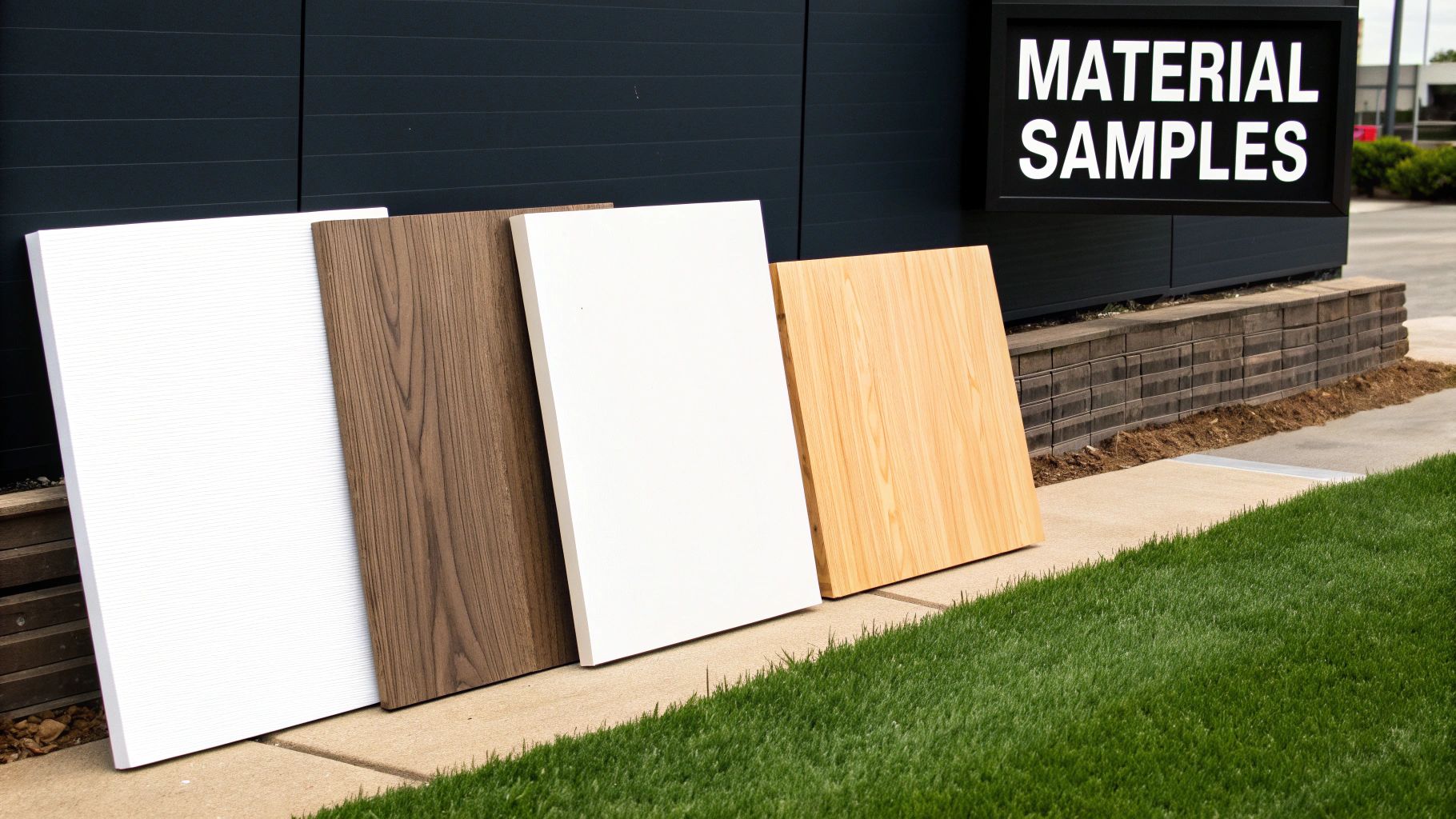
Alright, you've got a plan. Now it's time to get our hands on the actual materials. This is where the vision for your sign meets the real world, and understanding what each material can do is the key to getting it right. Every sign board material has its own personality, its own strengths, and its own ideal job.
We're going to dive into the workhorses of the industry, comparing the sleek durability of modern composites with the polished elegance of plastics and the undeniable character of classic wood. By the end, you'll know exactly which material will not only look fantastic on day one but also stand the test of time.
Aluminum Composite Material (ACM): The Modern Workhorse
When you see a sharp, professional-looking sign on a modern building, there's a good chance it's made from Aluminum Composite Material, or ACM. Think of it like a high-tech sandwich: a solid plastic core is bonded between two thin sheets of aluminum. The result is a panel that's surprisingly lightweight but incredibly rigid and strong.
This unique construction gives ACM an exceptionally flat surface, which is a perfect canvas for crisp digital prints and flawless vinyl graphics. It’s also built to handle the weather, making it the go-to choice for long-term outdoor signage that needs to look pristine for years.
Practical Applications for ACM:
- Building Exteriors: Sleek, modern signage for corporate offices, retail storefronts, and industrial parks. A practical example is the large, flat panel sign above the entrance of a new bank branch.
- Post and Panel Signs: The backbone of directional and informational signs you see in business parks or real estate developments, often used to list the tenants in a complex.
- Menu Boards: Durable and easy-to-clean outdoor menu systems for drive-thrus and walk-up restaurants that must endure daily use and cleaning.
ACM has really become a cornerstone of the sign industry for good reason—it’s tough, versatile, and always looks sharp. To see it in action, check out some of our aluminum composite signage solutions.
Acrylic: The Clear Choice for Elegance
If you want your sign to radiate sophistication, acrylic is the answer. It's often used as a modern, high-end alternative to glass because it's actually clearer, much lighter, and far more shatter-resistant. You can get it polished to a flawless, glass-like finish or choose from a huge spectrum of vibrant colors.
Its real magic lies in its versatility. We can reverse-print graphics on the back to create a stunning sense of depth, making your logo or lettering appear to float. This makes it a favorite for indoor signs where that first impression is everything, like the main logo wall in a corporate lobby.
Acrylic transforms a simple logo into a piece of art. Its polished edges and ability to refract light give lobby signs and interior displays a high-end, gallery-quality feel that instantly elevates a brand's perceived value.
Polyvinyl Chloride (PVC): The Versatile Performer
Polyvinyl Chloride, better known as PVC, is a lightweight plastic that’s both cost-effective and surprisingly versatile. It has a smooth, non-glare matte finish that takes print beautifully. While it’s not as rigid as ACM, its flexibility and how easily it can be cut and shaped make it a champion for many short-to-medium-term jobs.
PVC is a great all-rounder for indoor displays and signs in protected outdoor areas. It’s a breeze to cut into custom shapes, which is why you see it everywhere in point-of-purchase displays at checkout counters and trade show graphics where creativity and portability are key. Just be mindful that it can become brittle in extreme cold and may warp if exposed to intense, direct heat over a long period.
Classic Wood: The Timeless and Authentic Option
Sometimes, nothing beats the warm, authentic feel of a classic wood sign. It’s the perfect choice for any business trying to convey tradition, craftsmanship, or a natural, organic vibe. Wood has a unique character that manufactured materials just can’t replicate. Cedar and redwood are popular choices, as is high-density urethane (HDU), a synthetic "wood" that gives you the look without the worry of rot or pests.
Wood signs can be carved, sandblasted, or routed to create stunning dimensional effects that truly stand out. They do require a bit more love—like periodic sealing to protect against moisture and sun—but for brands like rustic cafes, historic inns, or premium boutiques, that timeless appeal is well worth it. A practical example is the sandblasted cedar sign hanging outside a mountain resort or a country store.
The demand for all kinds of sign materials, both new and traditional, is only growing. The global printed signage materials market was valued at $46.73 billion in 2024 and is projected to hit $55.83 billion by 2030.
Materials For Illuminated Signs
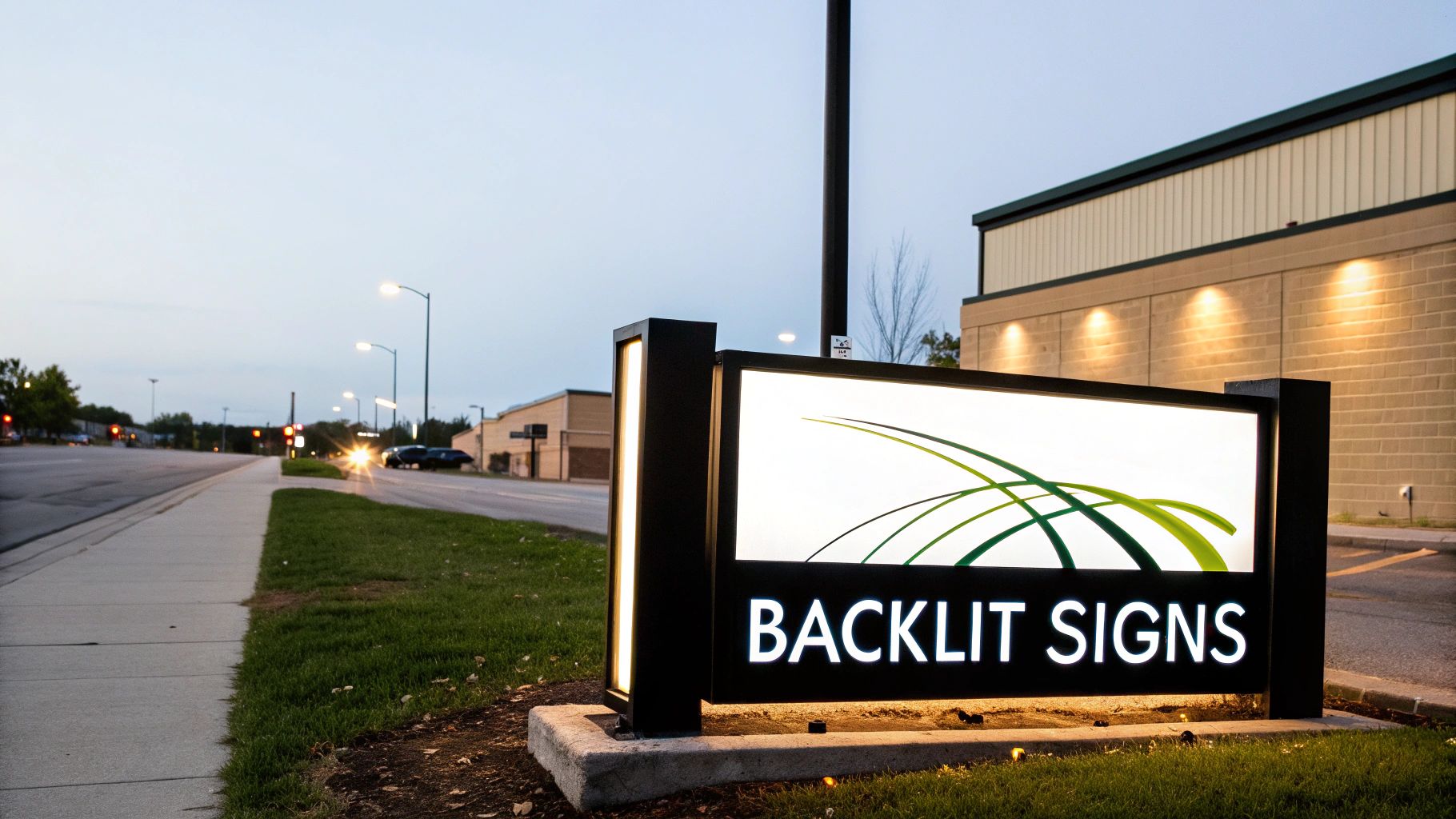
An illuminated sign doesn't just display your name; it broadcasts your presence. It’s a 24/7 beacon that works around the clock to capture attention. But for a sign to glow brightly and reliably, it takes a specific combination of materials engineered to work in perfect harmony. The magic isn't just in the bulbs—it's in the specialized sign board material that brings that light to life.
Choosing the right components is the difference between a vibrant, eye-catching landmark and a dim, patchy sign that fails to impress. It all comes down to selecting a translucent face that diffuses light perfectly, a strong frame that protects the guts of the sign, and an efficient light source that shines consistently.
The Face of the Sign: Translucent Materials
The most critical part of any illuminated sign is its face—the surface that actually glows. The goal here is to get bright, even light without any "hotspots" where you can see the bulbs behind it. Two materials absolutely dominate this space for their optical properties and sheer toughness.
-
Acrylic: This is the go-to standard for most illuminated sign faces, and for good reason. It’s prized for its incredible light transmission and diffusion, which creates that smooth, consistent glow every business wants. We can get it in various thicknesses and opacities, giving us precise control over the final look and brightness. A practical use is the classic light-up sign for a pharmacy or restaurant.
-
Polycarbonate: Think of polycarbonate as acrylic’s tougher older sibling. While it also offers fantastic light diffusion, its main advantage is its extreme impact resistance—it's practically unbreakable. This makes it the only choice for signs in high-traffic areas, at low heights, or in places prone to vandalism or rough weather like hail storms. An actionable tip: if your sign is within arm's reach of a sidewalk, choose polycarbonate.
These materials are designed to be a canvas for light. They make sure your branding is just as crisp and vibrant at midnight as it is at noon.
The Structural Backbone and Lighting Source
Behind that glowing face, you need a robust structure and a dependable light source. These are the components that give the sign its shape, its durability, and the illumination that makes it work in the first place.
The frame of an illuminated sign, whether it's a big light box or individual channel letters, has to be both lightweight and incredibly tough. Aluminum is the undisputed champion here. It’s naturally resistant to rust and corrosion, making it perfect for the outdoors. Plus, its light weight makes installation far easier and puts less stress on your building’s facade.
The synergy between the sign face, the frame, and the lighting is what creates a successful illuminated display. A high-impact polycarbonate face is only effective if its aluminum cabinet is properly sealed and its LEDs are spaced correctly for even light.
Inside the sign, the lighting technology itself has gone through a massive shift. While fluorescent tubes used to be the norm, Light Emitting Diodes (LEDs) are now the standard, and it’s not even close. LEDs have a much longer lifespan, use way less energy, and produce a brighter, more consistent light. This shift has been a key driver in the market's expansion.
The LED signage board market, a vital part of our industry, was valued at $24.99 billion in 2025 and is projected to hit $41.36 billion by 2032. That growth tells you everything you need to know about how businesses are adopting these efficient and dynamic lighting solutions.
The combination of these elements creates a durable, efficient, and visually stunning sign that works for your business day and night. For a deeper look at how these components come together, explore our guide to outdoor lighted box signs to see them in action.
Comparing Cost Lifespan and Maintenance
A great sign is an investment in your brand’s visibility, not just another expense on a spreadsheet. To really get a handle on its value, you have to look past the initial price tag and think about the total cost of ownership. It’s a balancing act between the upfront spend, how long the sign will last, and what it’ll take to keep it looking sharp.
Choosing a sign material is a lot like buying a car. A cheaper model might save you a few bucks at the dealership, but if it’s constantly in the shop and guzzles gas, it’s going to cost you way more in the long run. The exact same logic applies to your signage; the smartest move is always the one that delivers lasting value.
Upfront Cost Versus Long-Term Value
The initial invoice is usually the first—and sometimes only—number business owners look at, but it’s just one piece of the puzzle. A material with a lower sticker price might need constant upkeep, driving your long-term expenses through the roof.
On the flip side, a more durable material might cost more today but pay for itself over the years with almost zero maintenance.
The true cost of a sign isn’t what you pay for it today, but what you pay to keep it effective over its entire service life. A sign that costs 20% more but lasts twice as long is the better financial decision, hands down.
Let's see how this plays out in the real world. A classic painted wood sign might look like a great budget option at first glance. But to stop it from rotting and fading, it will probably need to be resealed and repainted every couple of years, especially if it’s exposed to harsh weather. Those recurring maintenance bills add up fast.
Now, consider a sign made from Aluminum Composite Material (ACM). The initial investment will be higher, sure. But its built-in resistance to weather, rust, and fading means it might only need a quick wipe-down once or twice a year. Over a decade, that ACM sign often turns out to be the far more cost-effective choice.
A Practical Look at Material Maintenance
Every sign board material needs a little TLC to look its best and last as long as possible. Knowing what's required upfront helps you plan ahead and pick a material that actually fits with how you operate.
Here’s a quick rundown of the typical upkeep for common sign materials:
-
Aluminum Composite Material (ACM): This is your low-maintenance champion. It rarely needs more than a simple cleaning with mild soap and water to get rid of everyday dirt. Its tough finish resists fading for years, making it the perfect "set it and forget it" option for busy owners.
-
Acrylic and Polycarbonate: These are also incredibly durable but can get scratched if you clean them the wrong way. The trick is to always use a soft microfiber cloth and a gentle, non-abrasive cleaner. For outdoor signs, a periodic check to make sure the seals are holding tight will keep moisture out.
-
PVC: Like ACM, PVC is easy to clean with just soap and water. Its weakness is temperature extremes—it can warp in intense heat and get brittle in a deep freeze. It’s happiest in spots where it’s shielded from direct, all-day sun and wild temperature swings.
-
Wood: The classic beauty of a wood sign requires the most hands-on care. You’ll need to inspect it regularly for any signs of peeling, cracking, or water damage. A fresh coat of sealant every few years is non-negotiable to protect the wood from the elements and keep it from falling apart.
Of course, for temporary or event signs, the game changes. That’s where cost and convenience take center stage. For those situations, it's worth understanding the unique benefits of materials like corrugated plastic. You can dive deeper into this affordable and weather-resistant option by learning more about printing on Coroplast.
Ultimately, making a smart financial decision means matching your budget with a clear-eyed view of each material's lifespan and upkeep. By investing wisely upfront, you ensure your sign remains a powerful, hard-working asset for your business for years to come.
Installation and Environmental Factors
Choosing the perfect material for your sign is only half the job. You could have the toughest material in the world, but if it’s installed poorly or isn't built for its environment, it’s going to fail. This is where the practical, real-world side of signage comes in, turning a great idea into a landmark that lasts.
Understanding these outside forces is everything. From navigating the confusing maze of local permits to planning for the daily abuse of Mother Nature, these factors decide whether your investment pays off. Getting it right means your sign isn't just legal—it's engineered to thrive right where you put it.
Navigating Local Codes and Permit Requirements
Before anyone even thinks about drilling a hole, you have to deal with local zoning laws and permit rules. These aren’t just suggestions; they’re strict regulations that dictate everything from your sign’s size and height to where it can be placed and even the materials you can use. Ignoring them is a fast track to hefty fines and being ordered to take your brand-new sign down.
For example, a business in a historic district might be banned from using internally lit signs or be required to use classic materials like wood or routed HDU to fit the neighborhood’s aesthetic. A commercial plaza might have its own set of rules on top of the city's.
Think of permits and zoning laws as the foundational blueprints for your sign installation. Building without them is a recipe for disaster. A professional sign company will handle this process, ensuring your project is compliant from the start.
This whole process can be a headache, filled with paperwork, official drawings, and back-and-forth with city hall. To get a better handle on what you’re up against, you can learn more about the essentials of navigating sign permit requirements in our detailed guide.
Matching Materials to Your Climate
The environment where your sign will live is going to put it to the test every single day. A material that looks great in a dry, mild climate could fall apart in a few years in a coastal town or a place with four distinct seasons. This is exactly why a one-size-fits-all approach to choosing materials never works.
Practical Environmental Scenarios
-
Coastal Regions: Salt spray is incredibly corrosive. If your business is anywhere near the ocean, a powder-coated aluminum or ACM sign is a must. They’re naturally rust-proof, while a standard steel frame would start showing rust and staining your building in just a few months.
-
Extreme Temperature Swings: In climates with blistering summers and freezing winters, materials are constantly expanding and contracting. This can make acrylic brittle in the cold or cause a lower-grade PVC to warp in the heat. ACM is a fantastic choice here because it remains incredibly stable.
-
High-Wind Areas: For tall pylon signs or big storefront signs in windy places, strength is everything. The material has to be rigid enough to resist bending and flexing, which can destroy the sign face and its mounting hardware. A thick-gauge aluminum or ACM provides the backbone you need.
-
Intense UV Exposure: In sunny spots like Arizona or Florida, the sun is brutal. Its UV rays will fade printed graphics and make certain plastics brittle and yellow. Using UV-laminated prints and UV-resistant materials like polycarbonate isn’t optional—it’s essential for keeping your sign looking vibrant.
By thinking through your specific location—both its legal rules and its weather—you can choose a sign material that is truly built to last. A little foresight here saves you from expensive repairs down the road, protects your brand’s image, and makes sure you get the most out of your investment.
Your Sign Material Selection Checklist
Picking the right material can feel like the toughest part of the process, but it doesn't have to be. All it takes is a clear, methodical approach to cut through the noise.
This checklist is designed to walk you through that process, step-by-step. It pulls together every key factor we've covered, turning a big decision into a series of simple questions. By the end, you won't be guessing—you'll know exactly which material delivers the best performance, look, and value for your specific needs.
Your Step-by-Step Decision Framework
Work through these questions to build a crystal-clear profile of your project. This simple framework ensures you don’t miss a single detail, leading to a much smarter investment.
-
Define Your Budget Reality: What’s the real number you can invest, including not just the sign itself but also installation and any potential maintenance down the road? The upfront price is only half the story.
-
Pinpoint the Exact Location: Is this an indoor or outdoor sign? If it’s going outside, will it be baked by direct sun all day? Battered by high winds? Exposed to salty coastal air?
-
Establish the Required Lifespan: Are you building a permanent monument sign meant to last for a decade or more? Or is this for a weekend event or a seasonal promotion that only needs to hold up for a few months?
-
Align with Your Brand Identity: What’s the vibe you're going for? A sleek, modern business might lean toward ACM or acrylic, while a rustic cafe would feel more at home with natural wood. The material itself sends a message.
-
Consider Illumination Needs: Does your sign need to work for you after the sun goes down? If visibility at night is a must, you’ll want to focus on translucent materials like acrylic or polycarbonate that are built for backlighting.
This decision tree gives you a great visual for how outside factors—like local laws, the sign's placement, and your climate—can quickly narrow down your options.
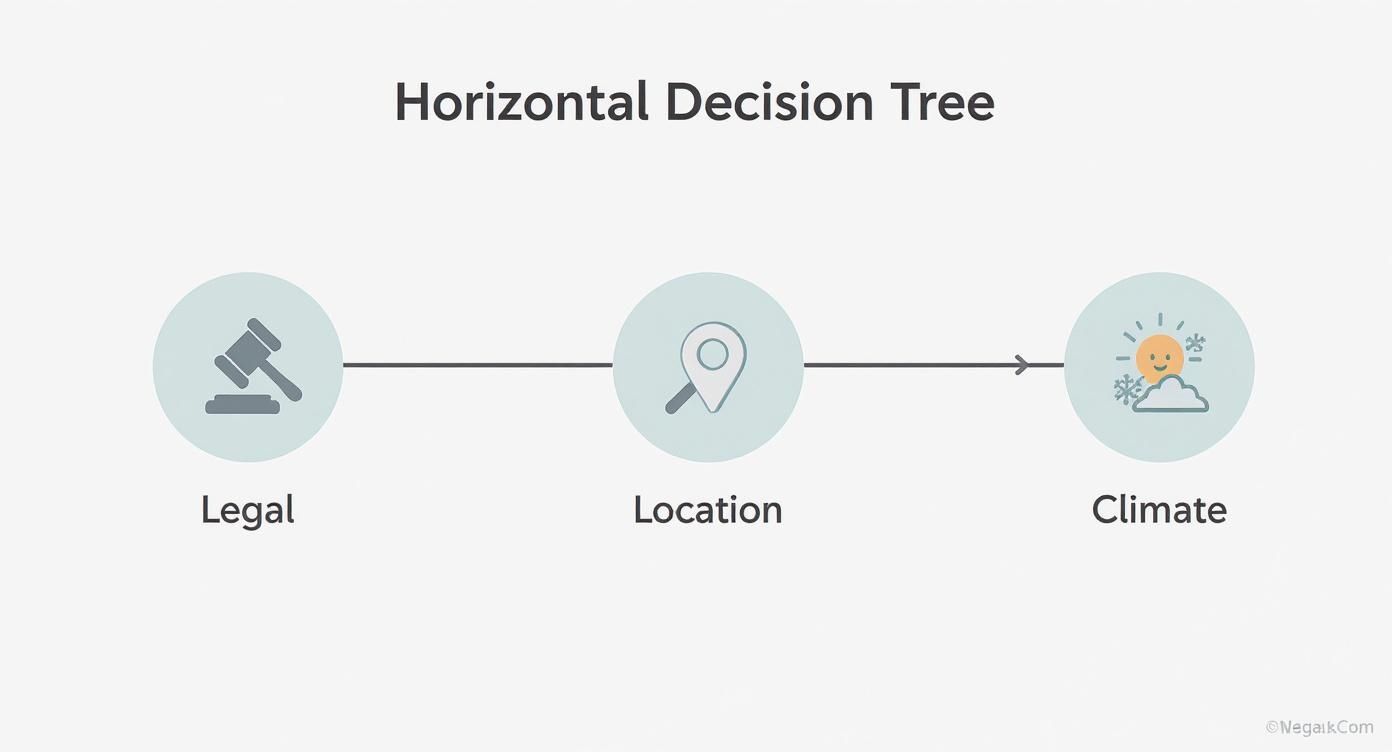
The big takeaway here is that practical constraints like city codes or weather should be your first filter. They can instantly tell you which materials are non-starters. Once you've completed this checklist, you'll have the clarity you need to move forward with confidence.
Frequently Asked Questions
Even with a solid plan, a few questions almost always pop up before you pull the trigger on a new sign. Here are some straightforward answers to the things business owners ask us most about choosing the right sign board material.
We want to clear up any lingering doubts so you can move forward with total confidence.
What Is The Most Durable Sign Board Material For Harsh Weather?
When your sign has to stand up to the worst Mother Nature can dish out—from high winds to driving rain—aluminum and Aluminum Composite Material (ACM) are the undisputed champions. Aluminum is naturally rust-proof and tough. ACM takes it a step further with a solid core that makes it incredibly rigid, so it won’t bend or warp.
If you’re thinking about an illuminated sign, polycarbonate is a much tougher option than standard acrylic. It offers far better impact resistance, which is a lifesaver against hail or flying debris.
How Does My Brand Image Influence Material Choice?
Think of your sign material as a physical handshake with your customer. A sleek, tech-forward company might lean into brushed aluminum or polished acrylic to convey a modern, professional vibe. On the other hand, a farm-to-table restaurant or a rustic boutique just feels right with the warm, authentic character of a sandblasted wood sign.
The material you choose should be a physical extension of your brand, creating a cohesive and memorable customer experience from the first glance.
Your sign is a silent storyteller. It reinforces your brand’s personality and values before a customer even steps through the door.
Can I Use An Indoor Sign Material Outside Temporarily?
We strongly advise against it. It might seem like a way to save a few bucks, but it almost always ends badly. Indoor-only materials like foam core simply can't handle moisture or direct sunlight. A single rain shower can turn them into a warped, soggy mess, and UV rays will fade the graphics in no time.
For temporary outdoor events, go with Coroplast (corrugated plastic). It's a much safer and more professional choice that’s both cost-effective and weather-resistant. It’s built to handle short-term outdoor use without falling apart. For more detailed answers on timber, a popular material that bridges indoor and outdoor use, you might find this resource useful: Find answers to frequently asked questions about timber products.
Navigating the world of sign materials is the first step toward creating a powerful first impression. When you’re ready to bring your vision to life with a sign that’s built to last, the experts at On Display Signs, Inc. are here to help. Contact us today for a consultation and let's get started.