In a world crowded with plastic and metal, wood outdoor business signs cut through the noise with a feeling of authenticity and warmth. They’re more than just markers; they’re the first chapter of your brand’s story, signaling craftsmanship and permanence before a customer even steps inside. A great wood sign doesn’t just tell people where you are—it tells them who you are.
Why Wood Signs Are Such a Powerful Branding Tool
Stop thinking of your sign as just a piece of hardware. It's the first physical handshake a potential customer has with your business. It sets the tone and manages expectations from the very first glance. While you have plenty of materials to choose from, wood has a unique, grounded character that connects with people. It feels trustworthy and real—qualities that resonate deeply with consumers.
It’s the difference between getting a handwritten note and a printed flyer. Both get the message across, but the note feels personal and intentional. A wood sign works the same way. It suggests your business cares about the details, values quality, and isn't afraid to add a personal touch. That emotional connection is what starts building real brand loyalty.
Telling Your Brand's Story, One Grain at a Time
The type of wood and how it’s crafted can tell completely different stories. A sandblasted cedar sign for a boutique mountain lodge, for instance, immediately communicates rustic luxury. The deep grain and raised letters create a sense of a cozy, high-end escape connected to nature.
On the other hand, a farm-to-table restaurant might go with a sign made from weathered, reclaimed barn wood. That choice instantly backs up its promise of using natural, locally sourced ingredients. It's a visual cue that aligns perfectly with its mission and attracts the exact customers who will appreciate it. While wood is a fantastic choice, it's also smart to understand the full range of types of outdoor business signs to see what fits your brand best.
The Growing Demand for Authenticity
This pull toward natural materials isn't just a fleeting trend; it's a major shift in the market. The global wooden signage market was valued at USD 2.5 billion in 2023 and is expected to climb to around USD 3.2 billion by 2028. Industries like hospitality and high-end retail are leading the way because they know the natural texture of wood adds to their story and boosts their perceived quality. You can dig deeper into this growing market on marketreportanalytics.com.
A wood sign doesn't just display your name; it embodies your brand's entire personality. It’s a strategic investment in creating an authentic presence that stands out and genuinely draws people in.
Choosing the Right Wood for Lasting Durability
The foundation of a great wood sign isn't just the design—it's the wood itself. Think of it like building a house: if you get the foundation wrong, no amount of paint or fancy trim will save it from the elements. A durable wood species is your first and best line of defense against sun, rain, and insects.
Some woods are just naturally tougher and better suited for outdoor life. This built-in resilience is what separates a sign that looks fantastic for a decade from one that starts to look tired after just a couple of seasons.
The Best Wood Species for Outdoor Signs
When it comes to surviving the outdoors, a few types of wood consistently rise to the top. They have a natural beauty and durability that makes them perfect for demanding environments.
- Western Red Cedar: This is a go-to choice for a reason. Cedar is packed with natural oils and tannins that make it inherently resistant to moisture, decay, and insects. Plus, its warm tones and beautiful grain create a stunning, rustic backdrop for any brand. For example, a local organic market could use a cedar sign to communicate a natural, wholesome brand image.
- Redwood: Much like cedar, redwood is loaded with protective tannins and oils that fend off rot and pests. It's also known for its incredible stability, which means it’s far less likely to warp or twist as temperatures and humidity change. Its deep, reddish-brown color gives off an instant look of premium quality, making it ideal for a high-end law firm or boutique hotel.
These woods are the gold standard because their protection is baked right in. They don’t just rely on a finish to survive; their natural defenses give them a huge head start, making any protective coating you add that much more effective. If you want to dig deeper, there are great resources on choosing durable outdoor wood materials that hold up in different climates.
HDU: The Durable Wood-Like Alternative
While nothing beats the authenticity of real wood, sometimes a man-made alternative is the most practical choice. High-Density Urethane (HDU) is a tough, rigid foam board that can be carved, sandblasted, and painted to look nearly identical to a classic wood sign.
The biggest advantage of HDU? It’s completely waterproof and weatherproof. It will not rot, warp, or crack, period. This makes it a fantastic, zero-maintenance option for businesses that want the wood aesthetic without the long-term upkeep. For instance, a seaside business exposed to constant salt spray might choose HDU to get the look of wood without the risk of rapid deterioration. It's always a good idea to compare all the different exterior sign materials to find the perfect match for your needs and budget.
Still on the fence? This quick decision guide can help you figure out if the authentic appeal of real wood is the right move for your brand.

As the chart shows, if you're aiming to project a message of quality and authenticity, it’s hard to beat a genuine wood sign.
Comparing Your Material Options
Making a smart investment means comparing your choices side-by-side. Every material comes with trade-offs in cost, lifespan, and how much care it's going to need down the road. Getting clear on these differences is the key to picking a sign that hits your aesthetic goals without creating a maintenance headache.
To make it simple, here’s a breakdown of how the most popular options stack up.
Comparing Popular Materials for Outdoor Wood Signs
| Material | Average Lifespan | Relative Cost | Maintenance Needs | Best For |
|---|---|---|---|---|
| Western Red Cedar | 10-15+ years | Moderate to High | Low; recoat every 2-3 years | Brands seeking a warm, rustic, and authentic look with natural durability. |
| Redwood | 15-20+ years | High | Low; recoat every 2-3 years | Premium brands wanting a rich color and maximum longevity with minimal warping. |
| HDU (High-Density Urethane) | 10+ years | Moderate | Very Low; occasional cleaning | Businesses wanting the look of wood with virtually no weather-related upkeep. |
Ultimately, the best choice is one that fits both your brand's image and your local climate. A sign company that knows its way around wood can guide you to the perfect option, ensuring your investment looks incredible for years to come.
Designing a Sign That Embodies Your Brand
Once you’ve settled on the perfect wood, the real work begins: turning that slab of raw material into your brand's first handshake. This is where art and strategy collide. A great sign isn't just a pretty object; it's a hard-working tool that has to capture attention, communicate your brand’s personality, and invite customers through the door.
How the sign is made—the fabrication method—has a massive impact on its final look and feel. Think of it like a painter’s brushstrokes. Some are smooth and precise, while others are bold and textured. Each technique tells a different story and gives your wood outdoor business signs a distinct character.
Choosing Your Fabrication Technique
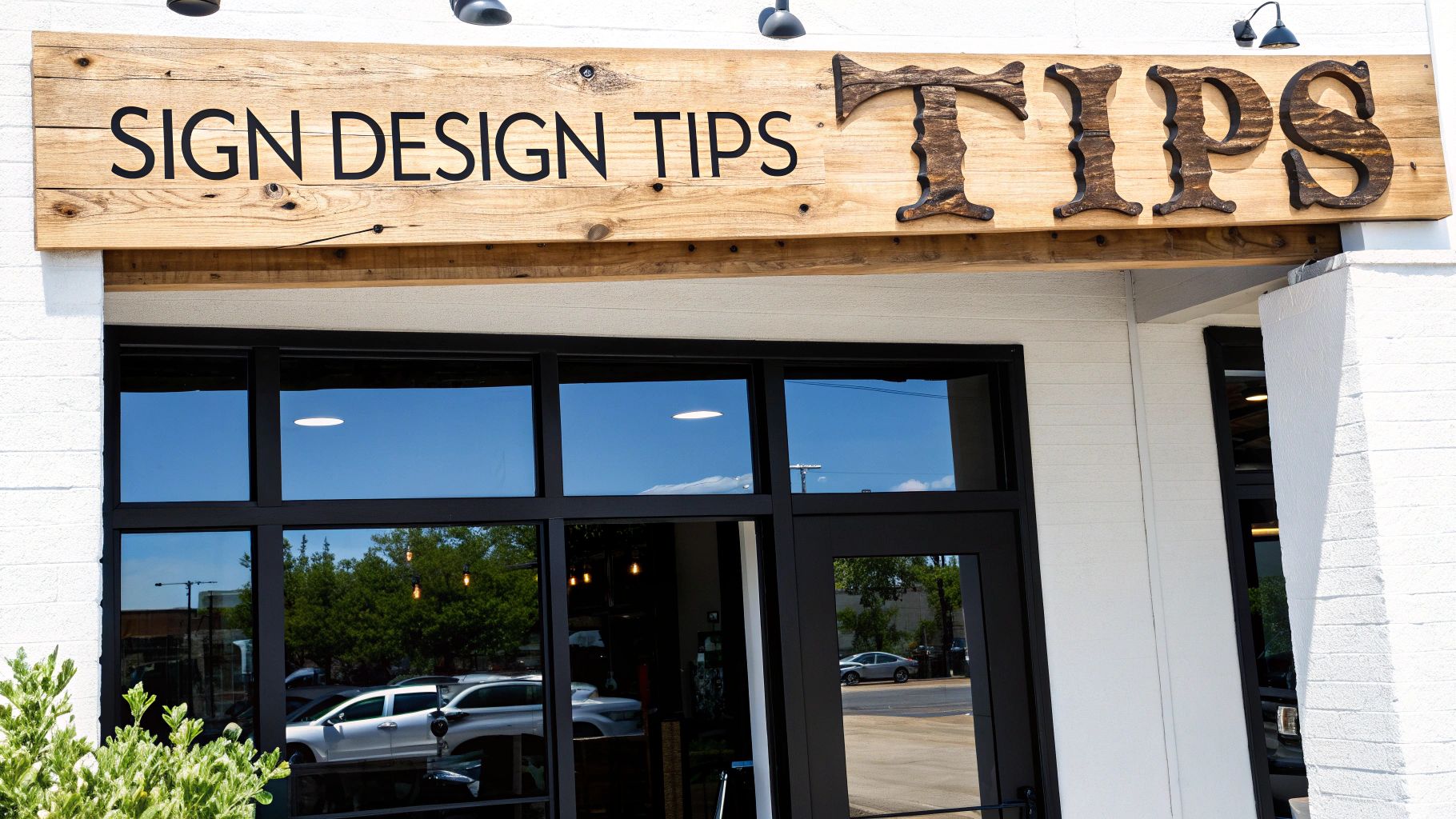
In the world of dimensional wood signs, two methods really stand out: sandblasting and V-groove routing. Each creates a unique finish that can be dialed in to match your brand, whether you’re aiming for something rustic and organic or modern and sleek.
-
Sandblasting: This is how you get that beautiful, textured, three-dimensional effect. We mask off your design, then blast the exposed wood with a high-pressure stream of abrasive material. This carves away the softer wood grain, leaving the harder grain—and your lettering—raised. The result is a rustic, handcrafted look that’s perfect for brands wanting to signal authenticity, tradition, or a connection to nature. For example, a country inn or a traditional pub would benefit from a sandblasted sign's organic feel.
-
V-Groove Routing: For a cleaner, more refined look, V-groove routing is the way to go. A CNC machine uses a specialized bit to carve sharp, V-shaped channels right into the wood, creating incised letters and graphics. This method delivers crisp, precise lines and a smooth finish, making it ideal for businesses with a modern, professional, or minimalist vibe. A financial advisory firm or a contemporary furniture store would benefit from this sharp precision to reinforce a message of quality and attention to detail.
Your fabrication choice is a core design decision. Sandblasting adds texture and depth for a classic, rugged feel, while routing delivers precision and sharpness for a more contemporary and polished brand image.
Essential Design Elements for Readability
Let's be honest: a beautiful sign is worthless if nobody can read it. Legibility is the number one job of any business sign. A few key design principles will make sure your message comes across loud and clear, even from across the street.
First up is font selection. Stay away from overly ornate or complex script fonts—they just turn into a blurry mess from a distance. Instead, stick with clean and clear serif or sans-serif typefaces. An actionable tip is to print your proposed design on paper, tape it to a wall, and walk 20 feet away. If you can't read it easily, your font is too complex or too small.
Next, think about color and contrast. Your lettering and graphics absolutely must pop against the natural wood background. Dark letters on a lighter wood like cedar, or light-colored letters on a dark-stained wood, will create the strong contrast needed for maximum visibility. This ensures your sign is readable in all conditions, from bright sunshine to a gloomy, overcast day. To get a better feel for what works, check out this gallery of professional sign design ideas.
Finally, don't forget scale and simplicity. A cluttered sign is an ineffective sign. Keep the text brief—your business name and maybe a simple logo or tagline is usually plenty. Make sure the letters are large enough to be seen from the road or across a parking lot. Before you give the final okay, always ask your sign maker for a proof that shows the sign in context on your building. This helps confirm it has the right visual weight and makes the impact you're looking for.
Protecting Your Investment with Proper Maintenance
Think of your custom wood sign as more than just a marker—it’s a major investment in your brand’s physical presence. Like any valuable asset, it needs a little care to stay looking its best. A simple maintenance plan for your wood outdoor business signs is all it takes. This isn't about heavy lifting; it's about being proactive to protect your sign from the inevitable wear and tear of sun, rain, and grime so it keeps looking sharp for years to come.
Ignoring it is a recipe for faded colors, peeling finishes, and eventually, even structural damage. A little upkeep not only makes your sign last longer but also preserves that powerful first impression you worked so hard to create.
Creating a Simple Maintenance Schedule
The good news is that a solid maintenance routine doesn’t have to be complicated or eat up your time. The trick is to break it down into a few manageable tasks you can schedule and forget about.
Your whole plan really boils down to three simple things: cleaning, inspecting, and resealing. Staying consistent is what prevents small, easy-to-fix issues from snowballing into expensive headaches.
A well-maintained wood sign can easily last over a decade. The difference between a sign that lasts five years and one that lasts fifteen often comes down to a consistent cleaning and sealing schedule.
Here’s a practical schedule you can steal and adapt for your own business:
- Quarterly Cleaning (Every 3-4 months): Give your sign a gentle wash to get rid of surface dirt, pollen, and grime. All you need is a soft cloth or sponge with a bit of mild soap and water. Stay away from harsh chemicals or power washers—they’re too aggressive and can strip the protective finish.
- Semi-Annual Inspection (Twice a year): Take a close look at your sign in the spring and again in the fall. You're hunting for any signs of peeling, cracking, or fading in the finish. While you're at it, give the mounting hardware a quick check to make sure everything is still tight and secure.
- Biennial Resealing (Every 2-3 years): This is the single most important step for long-term survival. Reapplying a protective topcoat is like hitting the reset button on its defenses against UV rays and moisture. Think of this frequency as a starting point—signs in tougher climates will need this done more often.
Adapting Maintenance to Your Climate
Where your business is located plays a huge role in how you care for your sign. A one-size-fits-all maintenance plan just doesn't work when you're up against Mother Nature.
For instance, a sign baking in the Arizona sun is constantly fighting off UV radiation that wants to bleach its colors and make the finish brittle. Meanwhile, a sign in the rainy Pacific Northwest is in a nonstop battle with moisture, which can cause rot the second a seal is broken.
- Intense Sun/Desert Climates: UV damage is your main enemy. You’ll likely need to reapply a UV-blocking clear coat every 18-24 months to keep the wood from fading.
- Coastal/Humid Climates: Here, moisture is the biggest threat. Be extra diligent with your inspections, looking for any tiny cracks in the finish where water could seep in.
- Regions with Harsh Winters: The freeze-thaw cycle is brutal on wood. Water gets into small crevices, freezes, expands, and turns a tiny flaw into a big problem. A thorough inspection and reseal before the first frost is a non-negotiable.
Finding the right protective coatings designed for outdoor timber is the key. Choosing a high-quality sealant made for your specific climate gives your sign the best possible defense and ensures you get the most out of this important branding investment.
Budgeting for Your Custom Wood Sign Project
Figuring out the true cost of a wood outdoor business sign isn't as simple as picking a sign off a shelf. The final price tag is a blend of creative services, raw materials, skilled craftsmanship, and essential logistics. Thinking about the budget as a complete package from the very beginning is the key to avoiding surprises down the road.
From the first sketch to the last bolt being tightened, every step has a cost. When you factor in the design work, the wood itself, the fabrication, permitting, and installation, you get a much clearer picture of the investment and the immense value packed into the final product.
Breaking Down the Core Costs
A custom wood sign isn't just one item; it's a project with several distinct phases. Understanding what goes into each one helps set the right expectations.
- Design and Consultation: This is the creative heavy lifting. It covers everything from initial mockups and revisions to making sure the final design is something that can actually be built to last.
- Materials: The price can swing dramatically based on your choice of wood. A premium Redwood blank will cost more than a standard Cedar one, and adding elements like metal lettering or HDU accents will also shape the final number.
- Fabrication: This is where the skill comes in. It’s the hands-on labor needed to bring the design to life, whether that means detailed V-groove routing, intricate sandblasting, or meticulous hand-painting.
- Finishing: This step is non-negotiable for an outdoor sign. We’re talking professional-grade primers, high-quality paints, and multiple layers of UV-blocking clear coats that protect your investment from the elements.
Don't Forget Permits and Installation
Two of the most commonly overlooked costs are permitting and installation—and they are absolutely critical. Nearly every outdoor business sign requires a permit from your local city or county to make sure it complies with all safety and zoning laws. This isn't just paperwork; it involves fees, applications, and sometimes even engineered drawings. For a deeper look into this process, check out our guide on navigating sign permit requirements.
Professional installation is another cost you can't afford to skip. It’s your guarantee that the sign is mounted securely, meets every local code, and is built to handle wind and weather. This service covers the crew's time, the specialized hardware, and any equipment needed to get the job done right.
Think of your total project cost as an all-inclusive package. A transparent quote from a reputable sign company will break down each component, so you know exactly where your investment is going—from the first design sketch to the final installation.
Example Cost Ranges for Wood Signs
To give you a better feel for the numbers, let's look at a couple of real-world scenarios. A small, simple routed cedar sign for a local coffee shop—maybe around 2×3 feet—could fall anywhere in the $800 to $2,000 range. That price typically covers a straightforward design, the fabrication, and a solid finish.
On the other end of the spectrum, a large, double-sided sandblasted redwood monument sign for the entrance of a business park could easily run from $7,000 to $15,000+. That higher investment reflects the premium materials, the complexity of the build, the structural engineering for the base, and a much more involved installation.
Understanding the Broader Market
When you invest in a quality wood sign, you're tapping into a massive and growing industry. The entire outdoor printed signage market is on track to hit USD 57.09 billion by 2030. While you'll see plenty of plastic and metal signs out there, custom wood signs hold a special place for businesses aiming for a premium, authentic, or architectural feel. You can discover more insights about the signage market on mordorintelligence.com. This trend confirms what smart business owners already know: a well-made sign is a powerful and recognized tool for bringing customers through the door.
Finding the Right Sign Company for Your Vision
You have a vision for the perfect wood sign, but bringing it to life takes a partner who balances real artistry with serious technical skill. The sign company you choose is every bit as important as the wood you pick. Think of them as your guide, steering the project from a rough idea into a landmark for your business.
Picking the wrong company can turn your project into a nightmare of blown budgets, missed deadlines, and a sign that just doesn't hit the mark. The goal is to find a team that doesn't just know wood—they know the entire process, from untangling city regulations to making sure the installation is perfect.
Look for Proven Expertise in Wood
Not every sign shop knows its way around natural materials. Before you even think about signing a contract, ask to see their portfolio of wood sign projects. You want to see a solid range of styles, from clean routed designs to intricate sandblasted pieces, to make sure they can handle your specific idea.
A real expert will be able to talk you through the differences between wood species and the pros and cons of various finishes. Their gallery of past work is your proof of craftsmanship—if their attention to detail shines through in their other projects, you can trust they’ll deliver for you.
In-House Capabilities and Project Management
A smooth project comes down to clear communication and a streamlined process. Prioritize companies that handle both design and fabrication in-house. When the creative team and the production crew are under the same roof, there’s far less room for misinterpretation and a much stronger sense of ownership.
A dedicated project manager is a non-negotiable asset. This single point of contact ensures your questions are answered promptly, you receive regular updates, and the project stays on schedule and within budget from start to finish.
This integrated setup means the designer creating your mockup actually understands the limits of a CNC router, and the fabricator can give instant feedback on which materials will work best. It’s simply a more efficient and reliable way to get a custom job done right.
The Non-Negotiables: Permitting and Installation
A stunning sign is worthless if you can’t legally put it up. Deep expertise in local permitting is an absolute must-have. A seasoned company will already know your city’s zoning codes, setback requirements, and size restrictions. They’re the ones who handle the mountain of paperwork, saving you from a massive headache.
Professional installation is the final, critical piece of the puzzle. Your chosen partner should manage everything, from securing the mounting to handling any electrical work for lighting. To get a better sense of what this involves, check out our detailed guide on commercial sign installation.
Before you commit, make sure you get clear answers to these questions:
- What does your warranty cover? A solid warranty is your protection against any defects in materials or workmanship.
- Do you have experience with businesses in my industry? Familiarity with your sector often leads to better design insights.
- How do you manage multi-site projects? If you have more than one location, you need a partner who can handle a coordinated brand rollout.
Choosing a company with a proven track record in all these areas ensures your investment becomes a durable, compliant, and beautiful sign that serves your brand for years to come.
Your Questions About Wood Outdoor Signs, Answered
Jumping into a new sign project always brings up questions. It's a big investment, and you need to know how your sign will hold up, especially against the weather. We get it.
Here are the straightforward answers to the questions we hear most often, based on our years of building and installing wood outdoor business signs that last.
How Long Do Wood Outdoor Business Signs Last?
A professionally built wood sign isn't a temporary fix; it's a long-term asset. When we build a sign using a naturally rot-resistant wood like Cedar or Redwood and seal it properly, you can expect it to last 10 to 15 years—sometimes even longer.
The real secret to a long life isn't magic, it's simple upkeep. The quality of the protective finish and a little bit of routine care make all the difference. Reapplying a UV-protective topcoat every couple of years is the single best thing you can do to keep your sign looking great and structurally sound.
Are Wood Signs Suitable for Harsh Climates?
Absolutely. There's a common myth that wood can't handle tough weather, but that's just not true. It all comes down to choosing the right materials from the start.
The secret isn't dodging bad weather; it's about picking a type of wood and a protective finish designed to take a beating. An experienced sign maker matches the materials directly to your local climate.
For businesses in wet, humid areas, we’ll always steer you toward naturally rot-resistant woods like Cedar. If your sign is going to be baked in the sun all year, a top-tier finish loaded with UV inhibitors is non-negotiable to prevent fading and cracking. A good sign company will know exactly what combination your location needs.
What Is the Difference Between Routed and Sandblasted Signs?
The main difference here is the final look and feel of the sign. It really just boils down to the style you’re going for with your brand.
- Routed Signs: For this method, we use a CNC machine to carve letters and graphics down into the wood. This creates incredibly sharp, clean lines and a smooth, recessed finish.
- Sandblasted Signs: This process creates a raised, 3D effect. The design is masked off, and we blast the background to erode the softer wood grain away, leaving your lettering and logo standing out with a rustic texture.
Think of it this way: a routed sign gives you a crisp, polished look, while a sandblasted sign delivers a more classic, handcrafted character.
Your sign is the first hello to your customers. At On Display Signs, Inc., we make sure it’s a memorable one with expert design, fabrication, and installation. Start your sign project with us today.