Your church’s outdoor sign is often the very first handshake you offer the community. But unlike a static sign that people quickly learn to ignore, a dynamic LED sign is a living, breathing welcome message working for you 24/7. It’s the difference between a forgotten flyer and a vibrant beacon broadcasting your service times, events, and heart for the neighborhood.
Why Modern Churches Need Dynamic Outdoor LED Signs
In a world filled with endless distractions, getting your message seen and heard is harder than ever. Traditional methods like printed bulletins or word-of-mouth simply can't keep up. This is where an outdoor LED sign becomes more than just hardware—it’s a tireless member of your outreach team.
Think about that old sign with the replaceable letters. It's often outdated, a chore to update, and easily overlooked. A bright, modern LED display, on the other hand, is impossible to miss. It transforms your property into a landmark that communicates your mission day and night, rain or shine.
Your Digital Handshake to the Community
An outdoor LED sign is frequently the first impression a potential new family has of your church. It’s a constant, visible presence that extends your welcome far beyond Sunday morning, answering the silent questions of newcomers who might feel hesitant to step inside an unfamiliar building.
It works as a powerful outreach tool in simple, practical ways:
- Welcoming Newcomers: A clear message like "New Visitors Welcome! Services at 9 & 11 AM" removes guesswork and makes people feel expected.
- Promoting Community Events: Announce your fall festival, food drive, or youth concert to show your church is an active, caring part of the neighborhood.
- Sharing Inspiration: A simple Bible verse or a thoughtful quote can offer a moment of peace to someone driving by on a busy day.
This approach is a core part of effective church marketing strategies that focus on building real connections. Your sign becomes a daily touchpoint, creating familiarity and trust long before anyone walks through your doors. You can explore more ideas on how to bring these concepts to life with modern church signs.
A dynamic LED sign bridges the gap between your church and the community. It ensures that everyone—from lifelong members to first-time visitors—is aware of what's happening, making them feel connected and informed.
Ultimately, an outdoor LED sign is an investment in visibility. It ensures your core message of hope and welcome isn't confined to the pews but is actively shared with the world around you, building a stronger faith community from the outside in.
Understanding Your LED Sign Options and Features
Jumping into the world of outdoor LED signs can feel a little technical, but the core ideas are surprisingly simple. Getting these basics right is the key to choosing a sign that truly connects with your community and becomes a powerful tool for your ministry's outreach.
The most important term to get comfortable with is pixel pitch. Think of it like the resolution of a TV screen or a digital photo. Pixel pitch is simply the distance between each tiny LED light on your sign, measured in millimeters. The smaller the number, the closer the lights are, which means a sharper, crisper image.
Matching Resolution to Your Location
The right pixel pitch for your church sign comes down to one simple question: How far away will people be when they see it? A sign meant to catch the eye of drivers on a busy road has very different needs than one welcoming people as they walk up from the parking lot.
- For signs viewed from far away (like on a highway): A larger pixel pitch (like 16mm or 20mm) works perfectly. From a distance, your eyes naturally blend the pixels, creating a clear and effective message without the higher cost of a super-fine display. For example, a church located on a 45 MPH road would get excellent visibility with a 16mm sign.
- For signs viewed up close (near a sidewalk or entrance): A smaller pixel pitch (like 10mm or 12mm) is the way to go. This ensures your text and graphics look smooth and professional, not blocky or pixelated, to everyone nearby. A church in a pedestrian-heavy downtown area would benefit from a 10mm sign to engage people walking by.
Getting this right is critical. A pixel pitch that’s too large for your viewing distance can make your messages look blurry and unreadable, defeating the whole purpose of your investment.
Choosing the Right Display Technology
Beyond the sharpness of the image, you’ll also need to decide on your sign’s color capabilities. This choice directly impacts the kinds of messages you can create and, of course, the overall budget. You’ll generally find three tiers of display technology.
The choice between a simple, static sign and a dynamic LED display is the first big decision. This visual breaks it down perfectly: it's the choice between being ignored and being seen.
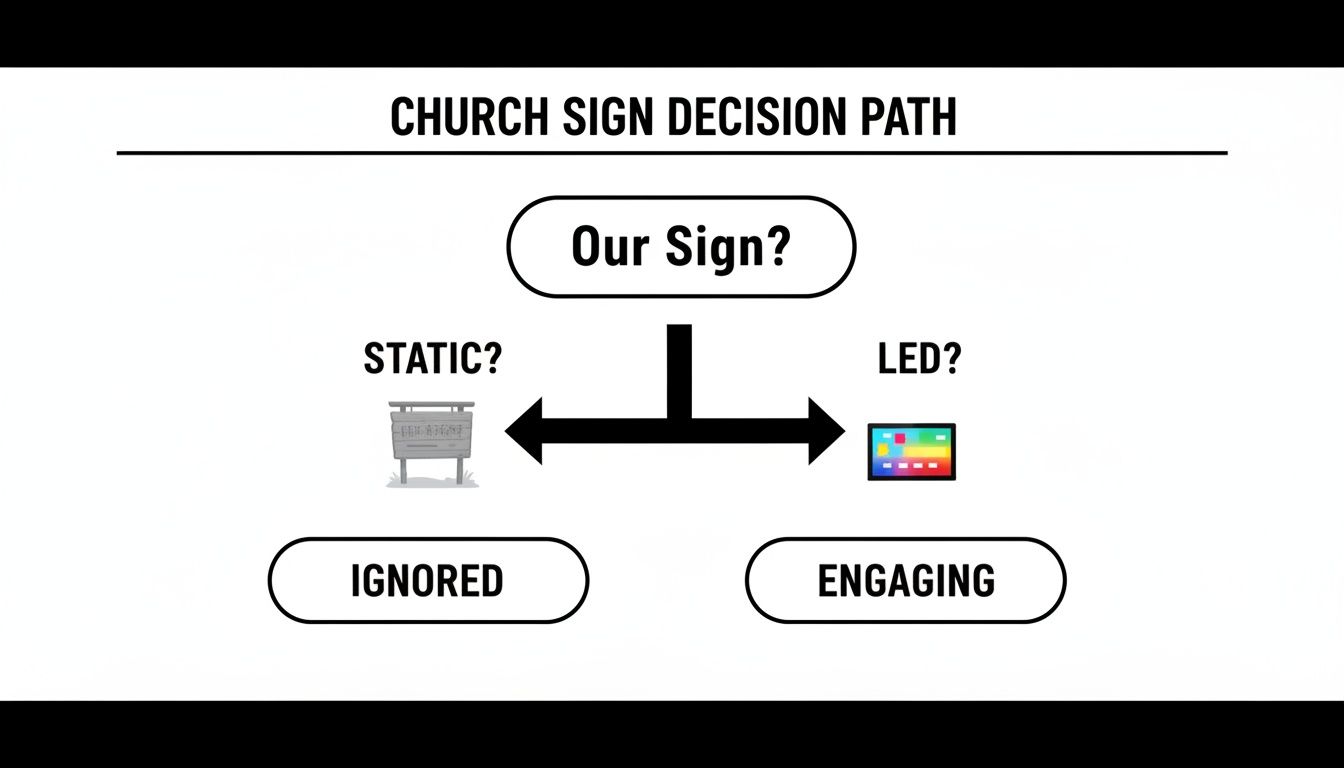
While a traditional sign often fades into the scenery, a vibrant digital LED sign actively pulls in attention, making it an invaluable tool for community outreach.
To help you decide, here’s a quick comparison of the most common LED sign technologies available for churches.
Comparing LED Sign Display Technologies for Churches
| Display Type | Best For | Color Capability | Content Flexibility | Relative Cost |
|---|---|---|---|---|
| Monochrome | Simple text announcements, service times, and basic dates. | Displays one color (usually red or amber). | Low. Best for text-only messages. | $ |
| Grayscale | Adding some depth to text with simple logos or graphics. | Many shades of a single color. | Medium. Allows for basic images and shading. | $$ |
| Full-Color | Vibrant images, photos of the congregation, and short video clips. | Millions of colors, like a TV. | High. The most engaging and versatile option. | $$$ |
Ultimately, a full-color display offers the most powerful way to share your church’s story and welcome new faces, but monochrome and grayscale signs are still excellent, budget-friendly choices for clear communication.
Integrating the Sign with Your Property
Finally, think about how the sign will physically sit on your property. The structure holding the sign is just as important as the screen itself.
The right structure not only ensures visibility but also complements your building’s architecture, presenting a professional and welcoming appearance to the community.
Here are the most common ways to mount an LED sign:
- Monument Signs: These are low-to-the-ground structures built from materials like brick, stone, or stucco to match your church's aesthetic. The LED display is integrated right into the base for a classic, seamless look that feels permanent and established.
- Pylon Signs: These are the tall, freestanding signs you see held up by one or two large poles. If your church is set back from the main road, a pylon sign’s height gives it fantastic visibility to passing traffic from a long way off.
- Wall-Mounted Signs: Just as the name suggests, these signs are mounted directly onto an exterior wall of your building. This is a perfect solution when your church is located close to the street and has a good, flat surface facing traffic.
Boosting Engagement with Effective Message Strategies
Your new LED sign is installed and glowing, but its real power isn't in the hardware—it's in the words. Once you have the right sign, the next step is creating content that stops traffic, communicates clearly, and inspires people to act. This is where you transform a simple announcement board into your most powerful ministry tool.
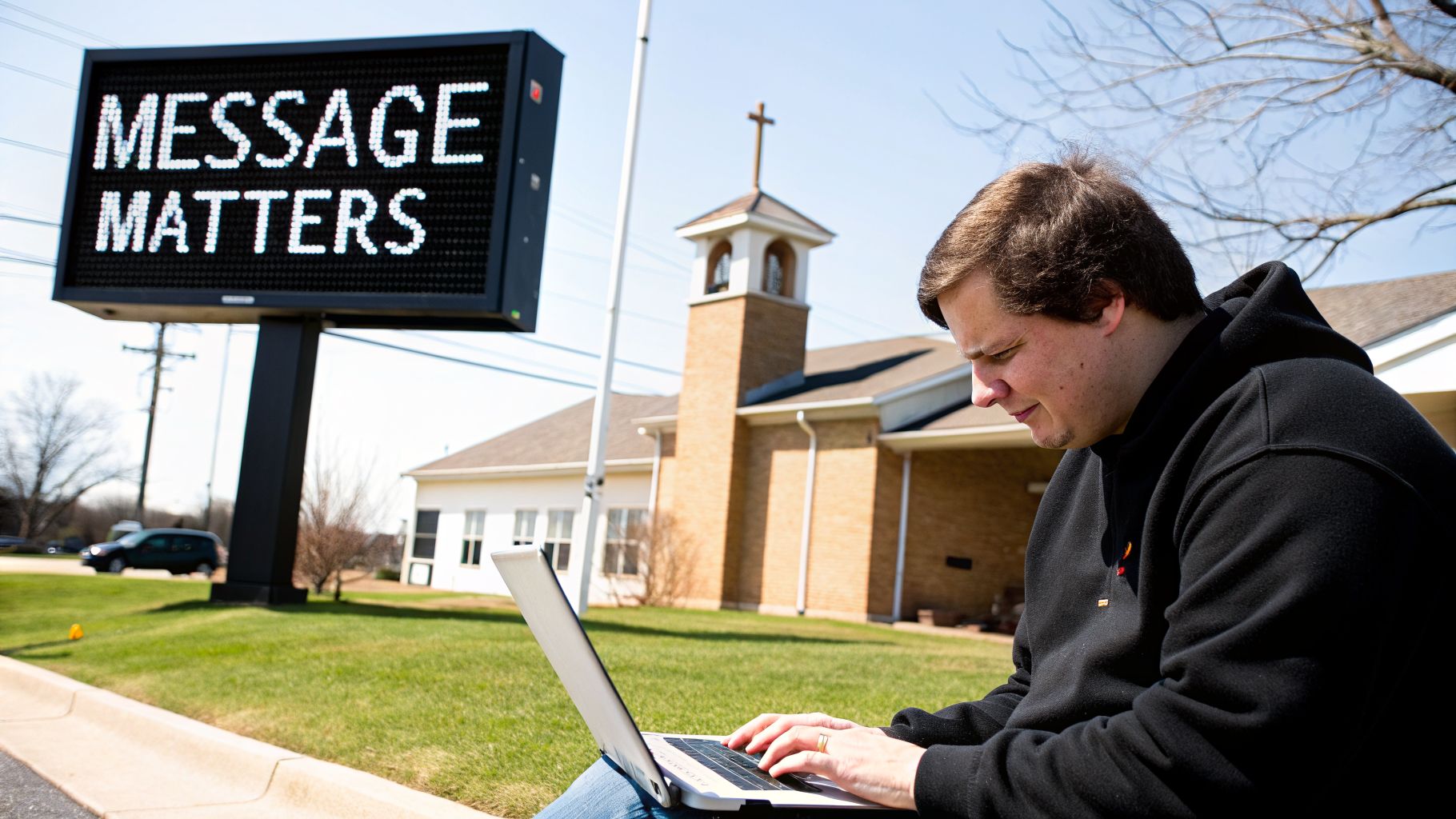
The secret is crafting messages that are instantly readable from a distance. Think of a driver passing by at 40 miles per hour; they have just a few seconds to get the point. That's why we rely on the 3×3 Rule, a proven guideline that guarantees your content is digestible at a glance.
The Power of Simplicity with the 3×3 Rule
The 3×3 Rule is a simple but incredibly effective principle for keeping your messages clean and impactful. It’s easy to remember:
- 3 lines of text maximum per slide.
- 3 words per line maximum.
This rule forces you to be concise. Instead of trying to cram a whole paragraph onto the screen, you break your message down into its most essential parts. It respects the fleeting attention of your audience and makes your communication far more effective.
For instance, resist the urge to post a cluttered message like this:
"Our annual Fall Festival is happening on Saturday, October 26th from 10am to 2pm. We will have games, food, and fun for the whole family, so please join us!"
Instead, break it down across a few slides using the 3×3 rule:
Slide 1:
Fall Festival
This Saturday
10 AM – 2 PM
Slide 2:
Games & Food
Fun for All
Everyone Welcome
See the difference? This approach is clean, bold, and much more likely to be remembered by someone driving past.
Scheduling Messages for Maximum Impact
One of the biggest advantages of outdoor led signs for churches is the ability to schedule different content for different times of the day. Think of it like a radio station playing the right songs for the morning commute versus the evening drive home. Modern sign software makes this incredibly easy.
With just a few clicks, you can set up a weekly content calendar:
- Morning Commute (7-9 AM): Offer a moment of encouragement with an uplifting Bible verse or a short, inspirational quote as people start their day. A good example is displaying "The Lord is my shepherd" (Psalm 23:1) during the morning rush.
- Midday (11 AM – 1 PM): Catch people during their lunch break by announcing volunteer opportunities or highlighting a specific ministry. For example: "Community Food Drive / Donations Welcome / 9 AM – 4 PM".
- Evening Commute (4-6 PM): Remind your community about midweek services, youth group, or other evening events. A practical message would be: "Youth Group Tonight / Grades 6-12 / 7 PM".
- Weekends: Promote Sunday service times, welcome new visitors, and announce special sermon series.
This kind of strategic scheduling makes your sign feel alive and relevant. The message someone sees on their way to work can be completely different from what they see on their way home, keeping your outreach fresh and engaging.
Concrete Examples of Effective Sign Messages
To help you get started, here are some practical, ready-to-use message ideas that follow these principles. Feel free to adapt them for any season or event at your church.
Welcoming Visitors:
- You Are Welcome
- Services Sunday
- 9 & 11 AM
Promoting a Sermon Series:
- New Sermon Series
- "Foundations of Faith"
- Begins This Sunday
Announcing Volunteer Needs:
- Serve With Us
- Food Pantry Help
- Sign Up Inside
Holiday Service Schedules:
- Christmas Eve
- Services at
- 5 & 7 PM
The results of this approach speak for themselves. Churches using vibrant LED signs with fresh, relevant content can see significant increases in attendance and community engagement. In fact, a dynamic sign can boost your visibility by up to 400% compared to a static one.
If you're looking for more ideas, you can check out our guide on creating powerful message board signs.
Navigating Costs: Budgeting and Financing Your Sign
Thinking about the cost of an outdoor LED sign for your church is a huge step. It’s more than just a purchase; it's a long-term investment in your ministry's voice and your connection to the community. Getting the budget and financial plan right from the start is the foundation for a project that doesn't just get done, but gets done right.
The price tag on the sign itself is just the starting point. To truly understand what you'll be spending, you have to look at the entire project. These aren't "extra" costs—they're essential parts of a safe, professional, and legal installation.
Looking Beyond the Hardware Price
A realistic budget for your new sign has to account for a few key items that go beyond the display hardware. Thinking about these now will save you from unexpected bills and headaches down the road.
Be sure to include these necessary items in your budget:
- Installation Fees: This covers the crew, the equipment, and the know-how needed to safely mount your sign, whether it's a low-profile monument or a towering pylon.
- Permitting Costs: Just about every town and city requires permits for outdoor signs. These fees are for the administrative work of making sure your sign follows local zoning and safety rules.
- Electrical Work: Your sign needs power, and that often means hiring an electrician to trench and run a dedicated line. This is a specialized job that has to be done correctly.
- Software and Training: Most signs come with software, but it's smart to ask if there are ongoing subscription fees. Also, factor in the time needed to get your staff or volunteers comfortable using it.
Understanding the Full Investment
While the cost of outdoor LED church signs has become more accessible, it’s still a significant project. The final price can swing dramatically based on size, resolution, and other features. For example, you can get a better sense of the various factors that influence the cost of signage for your project.
A higher initial investment in a quality, energy-efficient sign often translates to a lower total cost of ownership. A cheaper sign might save money today but cost you more in electricity and maintenance tomorrow.
While the financial commitment is real, funding is more achievable than ever. A typical outdoor digital sign for a church might run from $7,000 to $20,000. For larger, high-quality, double-sided displays, you're often looking at a range between $15,000 and $60,000.
Over an 8-year lifespan, energy costs alone can add $2,400 to $14,400—a number that can easily eat up any savings from buying budget equipment. To help, the 2026 funding landscape includes grants from $15,000 to $75,000 for registered 501(c)(3) organizations with strong community outreach goals.
Framing the Investment for Leadership
When you bring this project to your church board or the congregation, it helps to frame it correctly. This isn't just an expense; it's a capital improvement—an asset that will serve your ministry for a decade or more.
Financing options, like loans or lease programs from sign companies, can break down the upfront cost into manageable payments. This lets your church start benefiting from the sign's impact right away while fitting the expense into your yearly budget.
The Essential Guide to Permitting and Installation
Getting an outdoor LED sign for your church installed can feel like a huge project, but it’s a process that has to be done right. Before your new sign can start sharing messages of hope and welcome with the community, it needs a green light from your local government. While the paperwork can seem complicated, it's there to make sure your sign is safe, compliant, and a true asset to the neighborhood.
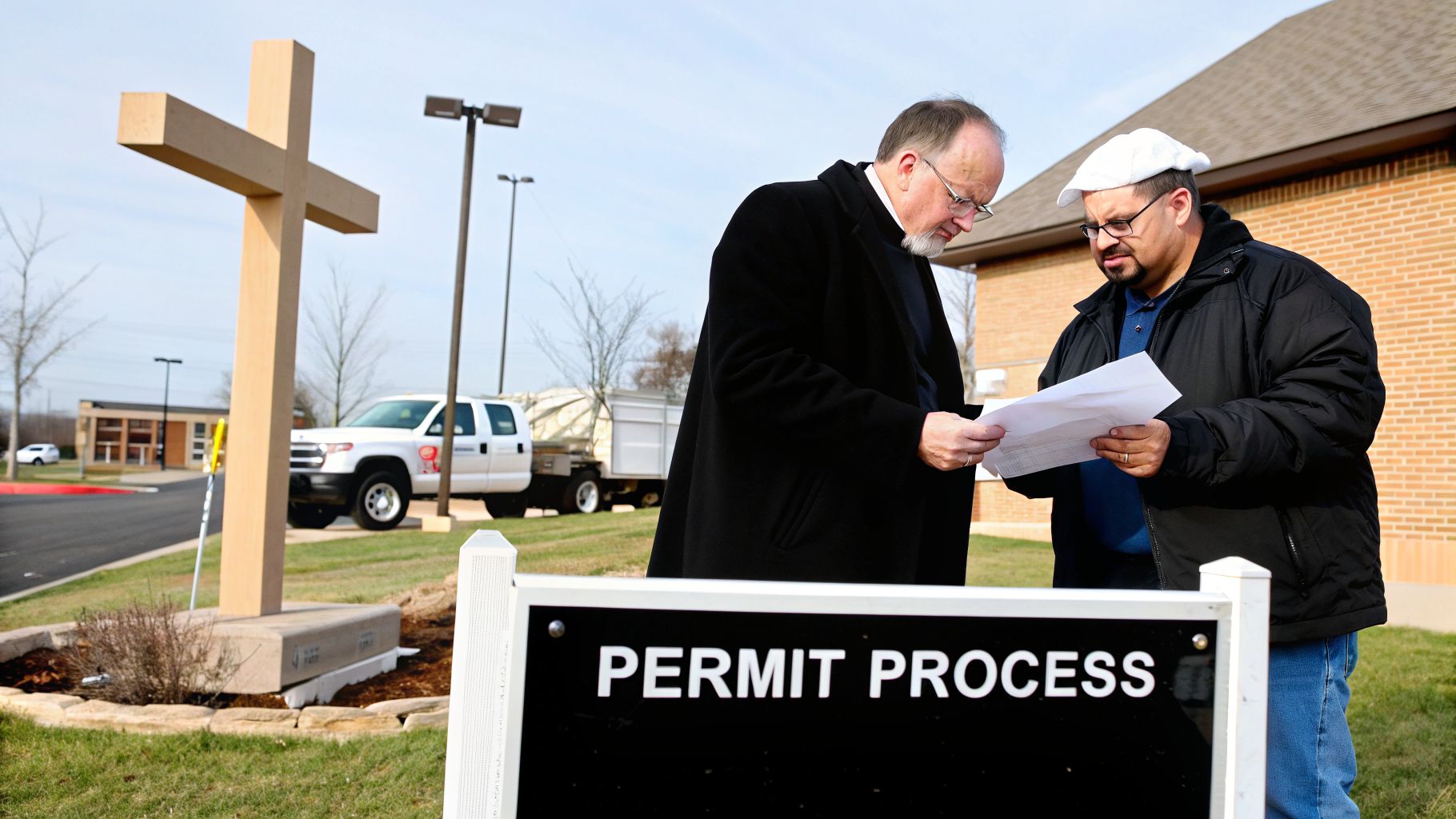
This is where the permitting process comes in. Every single city and county has its own rulebook, called zoning ordinances, that dictates what's allowed for outdoor signs. These rules exist for very good reasons—mainly public safety and keeping the community looking its best.
Why Permits Are Not Optional
Zoning ordinances look at several key details to prevent your sign from becoming a dangerous distraction or a neighborhood eyesore. Trying to skip this step is a recipe for disaster. It can lead to heavy fines, legal orders demanding the sign be taken down, or expensive forced changes. It’s a step you simply can’t afford to miss.
Your local rules will almost certainly have a say on things like:
- Size Restrictions: Setting the maximum height and total square footage your sign can be.
- Brightness Limitations: Making sure your sign isn't blinding drivers or bothering neighbors, especially after dark.
- Message Rules: Some areas put limits on how fast messages can change or ban specific types of animations.
- Setbacks and Placement: Defining exactly how far your sign needs to be from the road, property lines, and other buildings.
The smartest move you can make is to partner with an experienced sign company to handle the entire permitting process. They live and breathe local codes, which saves your church countless hours, prevents expensive mistakes, and takes a world of frustration off your shoulders.
The Typical Permitting and Installation Process
While the fine print varies from town to town, the journey from initial design to the final installation follows a pretty clear path. A full-service sign company will manage all of this for you, turning a potential headache into a smooth, step-by-step project.
Here is a practical look at the steps involved:
- Site Survey and Code Check: The company visits your property to take measurements, assess electrical access, and review local sign codes to determine what's possible.
- Design and Engineering: They create detailed drawings of your proposed sign. These technical plans are required for the permit application.
- Permit Application: The sign company submits the application and engineering drawings to the local planning or building department for review and approval.
- Fabrication: Once the permit is approved, the custom manufacturing of your sign begins.
- Site Preparation: While the sign is being built, a crew prepares the site. This often involves pouring a new concrete foundation and running the electrical wiring needed to power the sign.
- Installation: The crew transports the finished sign to your church, lifts it into position, secures it, and makes the final electrical connections.
- Testing and Training: They run a full test to ensure every pixel is working perfectly and train your team on how to use the software.
You can learn more about common sign permit requirements to get a deeper understanding of what to expect. Having a professional partner by your side ensures every step is handled correctly for a completely worry-free installation.
Why a Full-Service Sign Company Is Your Best Partner
Choosing an outdoor LED sign for your church is a big investment, but the partner you choose to bring it to life is just as crucial. A great sign project is about more than just the final product; it's about the entire process.
Think of a full-service sign company as the general contractor for your sign. Instead of your staff and volunteers trying to juggle designers, fabricators, electricians, and permit offices, you have one expert team managing every single detail. This means you can focus on your ministry, not on becoming an overnight expert in zoning laws or concrete footings.
Think of Them as Your Guide, From Start to Finish
Working with a true end-to-end partner means you have an expert in your corner at every stage. They aren't just selling you a sign; they're delivering a complete, stress-free solution built to serve your congregation for years.
A professional sign company will guide you through the whole process:
- Initial Consultation and Design: They’ll sit down with you to understand your church's goals, look at your property, and create a design that’s effective, looks great, and meets all local rules.
- Permitting and Compliance: This is a huge one. They handle all the paperwork, phone calls, and legwork to get the necessary permits, making sure your sign is fully compliant.
- Fabrication and Manufacturing: Your sign is built in-house with durable, high-quality materials designed to stand up to heat, cold, wind, and rain for more than a decade.
- Professional Installation: An experienced crew handles the site prep, electrical hookups, and safe installation of your new sign.
This isn't a niche service anymore. The global outdoor LED display market continues to grow, making professional digital signs more powerful and accessible than ever for churches. To see where the technology is heading, check out the latest 2026 outdoor LED display trends and how they can benefit your ministry.
What Happens After the Sign Is Installed?
Your relationship with a sign company shouldn't end the moment the crew drives away. A reputable partner stands by their work, ensuring your investment continues to be a powerful outreach tool for your ministry.
A sign company's commitment to you is best measured by its post-installation support. A strong warranty and clear maintenance options are signs of a partner invested in your long-term success, not just a one-time sale.
Before you sign any contract, make sure you know what their long-term support looks like. Here’s a practical checklist of what to ask about:
- Comprehensive Warranties: Look for a multi-year warranty that covers everything—the LED modules, power supply, internal parts, and even the physical structure.
- Technical Support: What happens if you run into a software glitch or have a technical question? Ask about their support hours and who you can call for help.
- Maintenance Plans: Many companies offer optional plans for regular check-ups, cleaning, and preventative care. This is the best way to keep your sign running perfectly and maximize its lifespan.
Choosing a full-service company is about choosing peace of mind. You get a long-term partner who is just as invested in your sign’s success as you are, freeing you up to focus on what matters most: your community.
Answering Your Questions About Church LED Signs
Making a big investment like an outdoor led sign for churches brings up a lot of practical questions. We get it. Here are the straightforward answers we give faith leaders when they're exploring their options.
How Hard Is It to Update the Messages?
It's surprisingly simple. Think of it this way: if you can post on Facebook or send an email, you can run your church's LED sign.
Modern signs come with software that’s designed for anyone to use, not just a tech expert. You can type out a message, pick your colors, and schedule it all from a regular computer or even your phone. Training a volunteer or staff member usually takes less than an hour, making it easy to keep your community updated.
What Is the Lifespan of an Outdoor LED Sign?
A well-built, professional outdoor LED sign is an investment in your ministry's infrastructure, designed to last for years. You can realistically expect a lifespan of 10 to 12 years, which works out to about 100,000 hours of service.
The key is quality. A sign's longevity comes down to its components, how it's installed, and basic care. Look for signs with weather-sealed electronics and a solid warranty that covers not just the screen, but the whole structure.
A professional sign isn't just a screen; it's an piece of infrastructure. Look for warranties that cover the LED modules, power supplies, and the sign's physical structure to guarantee its long-term performance.
Can an LED Sign Be Too Bright for Our Neighborhood?
This is a really important and common concern—nobody wants to be a bad neighbor. The good news is that professional signs are built to prevent this problem entirely.
They come with ambient light sensors that act like an automatic dimmer switch. The sign will be bright and clear on a sunny afternoon but will automatically dim itself at night to a comfortable, gentle glow. A good sign partner will program your sign to meet all local brightness rules right from the start, ensuring it’s a welcome beacon, not a nuisance.
How Much Will It Cost to Run an LED Sign Each Month?
The monthly running cost is much lower than most people think, thanks to modern, energy-efficient parts. For a typical mid-sized sign, the monthly electricity cost usually falls between $25 and $150.
The exact amount depends on the sign's size, its efficiency rating, and how many hours you run it each day. Choosing a high-efficiency model might cost a little more upfront, but it pays for itself over the years with a lower power bill, making it a smarter investment for the long haul.
Ready to create a vibrant first impression for your community? The team at On Display Signs, Inc. is here to guide you through every step, from design and permitting to installation and support. Start your project today.