Think of a business monument sign as your company's permanent handshake with the world. It’s a landmark that anchors your presence in the community, building trust and projecting a sense of stability long before a customer ever steps inside.
More than just a marker, a well-designed monument sign works as your silent, 24/7 brand ambassador. It establishes credibility and makes your physical location impossible to miss.
Why Business Monument Signs Are a Smart Investment
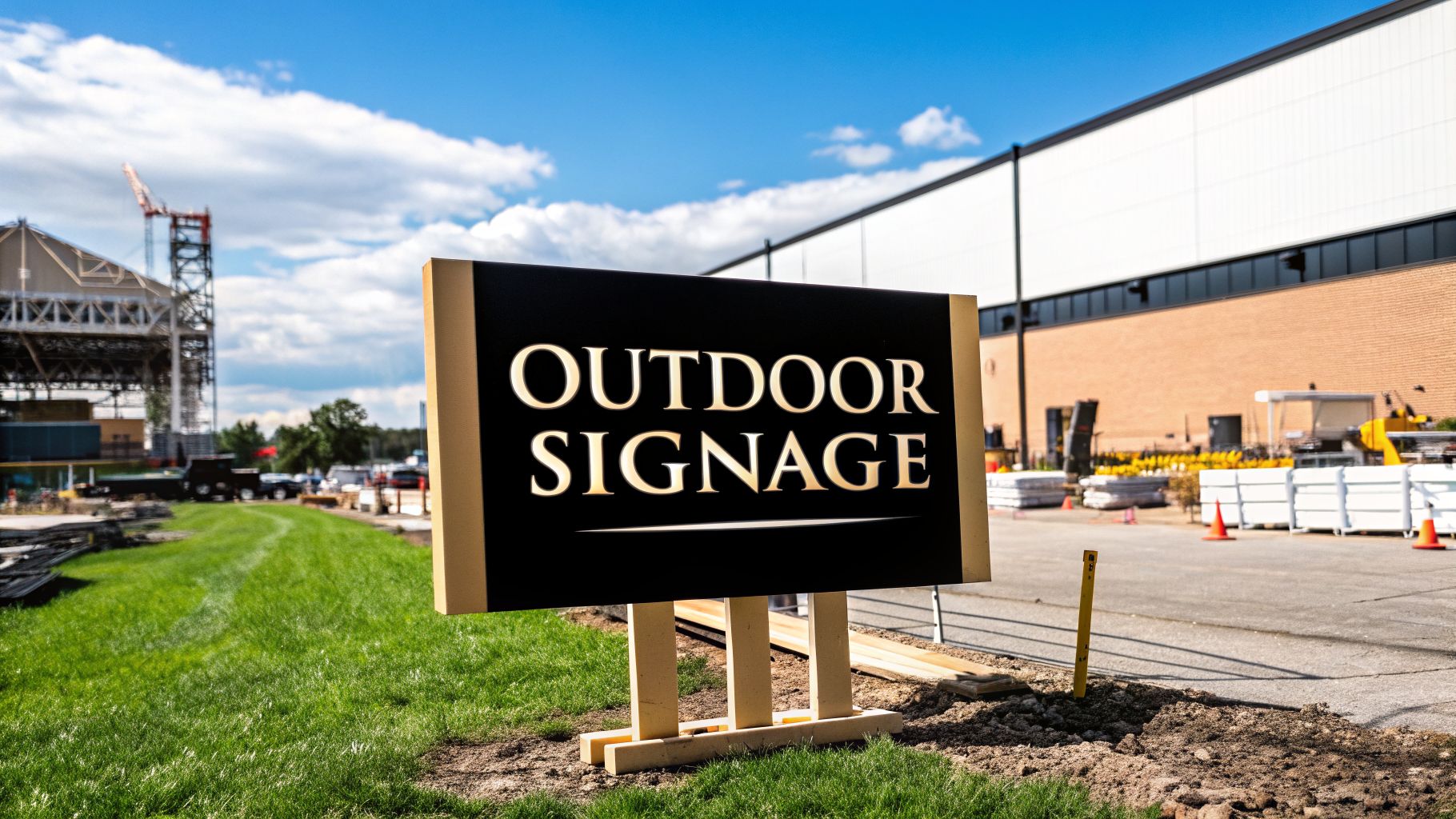
At its core, a monument sign is a freestanding structure, typically low to the ground and built from solid materials like brick, stone, or concrete. Unlike the towering pylon signs you see from the highway, these signs are meant to create an immediate, high-end impression right at eye level.
They become the first physical touchpoint a customer has with your brand, setting the tone for their entire experience.
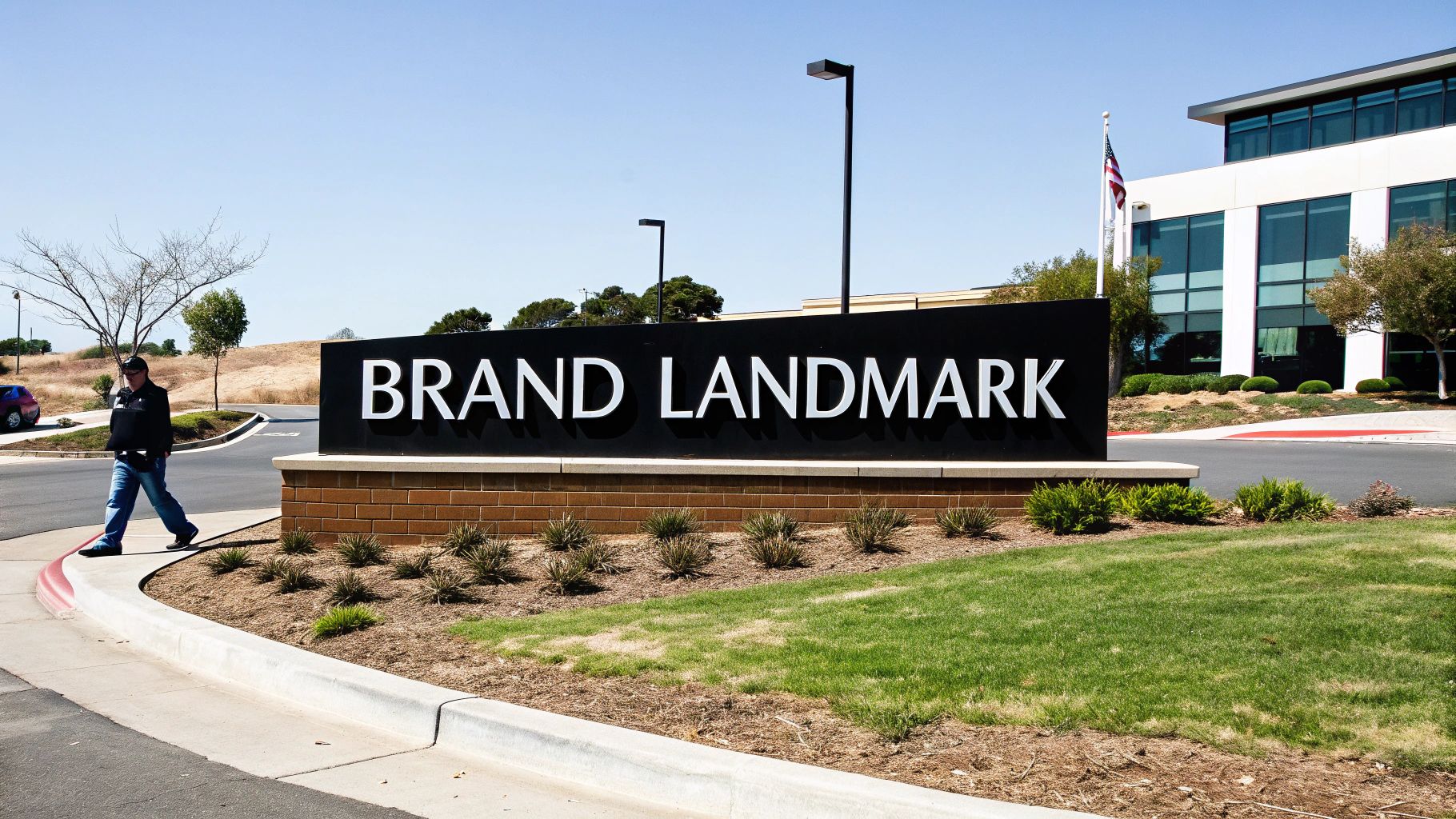
This tangible presence does more than just announce your name. A stately brick monument sign for a law firm communicates permanence and reliability, while a sleek aluminum design for a tech campus projects a modern, forward-thinking image.
Building Credibility and Brand Authority
In a world of fleeting digital ads, a monument sign tells everyone you’re established and here to stay. This physical investment in your property builds subconscious trust with potential customers. It conveys a level of professionalism that a temporary banner or simple wall sign just can't match.
A professional monument sign is one of the most effective marketing investments for a physical location. It acts as a constant advertisement, generating thousands of impressions daily without ongoing costs.
This consistent visibility is what really builds brand recognition. When people drive past your sign every day, your business becomes a familiar and reliable landmark in their minds. For businesses that depend on local traffic—like medical offices, retail centers, and corporate parks—that continuous exposure is priceless.
The Strategic Roles of a Monument Sign
Beyond just looking impressive, these signs serve several practical functions that directly help your bottom line. They are multi-purpose tools that solve common business challenges related to branding and just plain getting found.
- Identification: Its main job is to clearly state who you are and where you are, getting rid of any confusion for first-time visitors. For example, a dental clinic's sign at the driveway entrance immediately confirms patients have arrived at the right place.
- Direction: For properties set back from the road or tucked inside a large complex, a monument sign at the entrance is an essential guidepost. Think of a sign for an industrial park that lists the businesses inside, directing delivery trucks and clients efficiently.
- Brand Reinforcement: It physically brings your brand's identity to life, using your logo, colors, and fonts to create a memorable impression. A sign for a luxury apartment complex using elegant fonts and high-end materials reinforces the premium quality of the property.
This table breaks down the core benefits a professional monument sign brings to the table.
Core Benefits of a Professional Monument Sign
| Benefit | Business Impact |
|---|---|
| Enhanced Visibility | Makes your business easy to find, capturing the attention of passing traffic 24/7. |
| Increased Credibility | A permanent, high-quality sign projects an image of stability and professionalism. |
| Constant Marketing | Acts as a one-time investment that continuously promotes your brand without recurring fees. |
| Improved Wayfinding | Guides customers directly to your entrance, improving their experience and accessibility. |
Ultimately, a monument sign is an investment in your brand's physical footprint, turning your location into a landmark that people recognize and trust.
Choosing the Right Materials and Illumination
Picking the right materials for your monument sign is like choosing the foundation for a house—it dictates how long it will last, what character it projects, and its overall presence on the street. Your choice sends a message long before anyone reads the words. Classic, durable materials suggest stability and tradition, while modern composites can signal a forward-thinking brand.
This decision goes beyond just looks; it directly impacts your maintenance budget and how well the sign will hold up against years of sun, rain, and snow. From timeless stone to versatile modern options, each material brings something different to the table.
Core Structural and Finish Materials
The structure of your sign is its personality. A law firm might go with traditional brick to convey authority and permanence. A tech startup, on the other hand, might choose sleek aluminum to reflect its modern, agile brand. The key is to pick a material that feels like a natural extension of both your brand and your building's architecture.
Here are some of the most popular materials used to build high-quality business monument signs:
- Brick and Stone: These are the classics for a reason. They offer a timeless, upscale look that communicates permanence and tradition, making them a perfect fit for financial institutions, professional services, and established corporate campuses that need to project trust.
- Aluminum: Lightweight, rust-proof, and incredibly versatile, aluminum is the go-to for contemporary designs. It can be shaped, painted, and finished in endless ways to match any brand identity, delivering a clean and professional look every time.
- Concrete: Whether it's poured or precast, concrete gives off a sturdy, industrial, and modern vibe. It’s tough as nails and can be stamped, stained, or textured to create unique architectural effects that pair well with minimalist or even brutalist designs.
- High-Density Urethane (HDU): HDU has become a crowd favorite because it can be expertly crafted to mimic the look of more expensive materials like wood or stone, but without the cost or upkeep. It’s waterproof, won't rot or crack, and is a dream to carve, making it a budget-friendly and highly customizable workhorse.
For a deeper dive into the specific properties and best uses for different materials, check out our comprehensive guide on choosing the right sign board material.
Illuminating Your Brand Message
Without lighting, your sign simply disappears after sunset, wasting countless opportunities to make an impression. Proper illumination puts your sign to work 24/7, turning it from a daytime marker into a nighttime landmark. The lighting you choose should boost readability and complement the sign's design without being obnoxious.
Your sign's illumination isn't just about being seen; it's about setting a mood and making sure your brand looks professional and clear, day or night. A poorly lit sign can look cheap or unwelcoming, completely undermining the investment you’ve made.
There are three main ways to light up a monument sign, each with its own advantages.
- External Illumination: This is usually the most straightforward method, using ground-mounted spotlights to wash the sign face with light. It’s a great choice for signs made of solid materials like stone or brick where you can't light from the inside.
- Internal Illumination: This is where the light source sits inside the sign structure itself, shining through the letters or logo. It’s typically done with channel letters or push-through acrylic graphics, creating a sophisticated glow that’s highly visible from a distance.
- Digital LED Displays: For maximum impact and versatility, nothing beats an integrated LED message board. These dynamic screens let you update sales, share community news, or display eye-catching graphics in real-time, turning your sign into an active marketing machine.
The move to digital is definitely accelerating. The digital signage market was valued at $18.7 billion in 2023 and is expected to hit nearly $49.3 billion by 2030. This growth shows a major shift as businesses are moving away from static signs toward dynamic displays that can better engage passersby.
Strategic Design and Placement for Maximum Impact
Let's be honest—a beautifully crafted monument sign is a wasted investment if nobody sees it. It’s the combination of smart design and thoughtful placement that turns a simple marker into a powerful landmark, grabbing attention and pulling customers right to your front door.
This whole process starts way before a single piece of material is cut. To make sure your sign hits all the right notes, the first step is always developing a comprehensive design brief. This is your game plan. It lays out your goals, locks in your brand's look and feel, and makes sure the final product does its job perfectly.
Core Principles of Effective Sign Design
Great sign design isn't just about looking pretty; it's a science. You've only got a few seconds to catch someone's eye, so your message has to be clear, fast, and easy to understand.
- Visual Hierarchy: This is all about controlling where people look first. Your company name or logo should always be the star of the show. Everything else, like an address or tagline, is secondary. Use size, color, and positioning to tell the viewer what’s most important.
- Color Contrast: For readability, high contrast is king. Think dark letters on a light background, or the other way around. These combinations are 75% more effective than subtle color pairings that might look good up close but turn into a blurry mess from the road.
- Font Legibility: Stick to clean, simple fonts. That ornate script might look fantastic on your business card, but it’s nearly impossible to read from a moving car. You can’t go wrong with sans-serif fonts like Helvetica or Arial—they’re popular for a reason.
Here's a solid rule of thumb from the pros: for every 10 feet of viewing distance, you need one inch of letter height. If you want your sign to be readable from 100 feet away, those letters better be at least 10 inches tall.
For a look that’s both modern and professional, adding raised elements makes a huge difference. You can learn more about how custom 3-D lettering signs add that extra dimension and polish to your monument sign's design.
This flowchart breaks down the big decisions you'll make when planning your new sign.
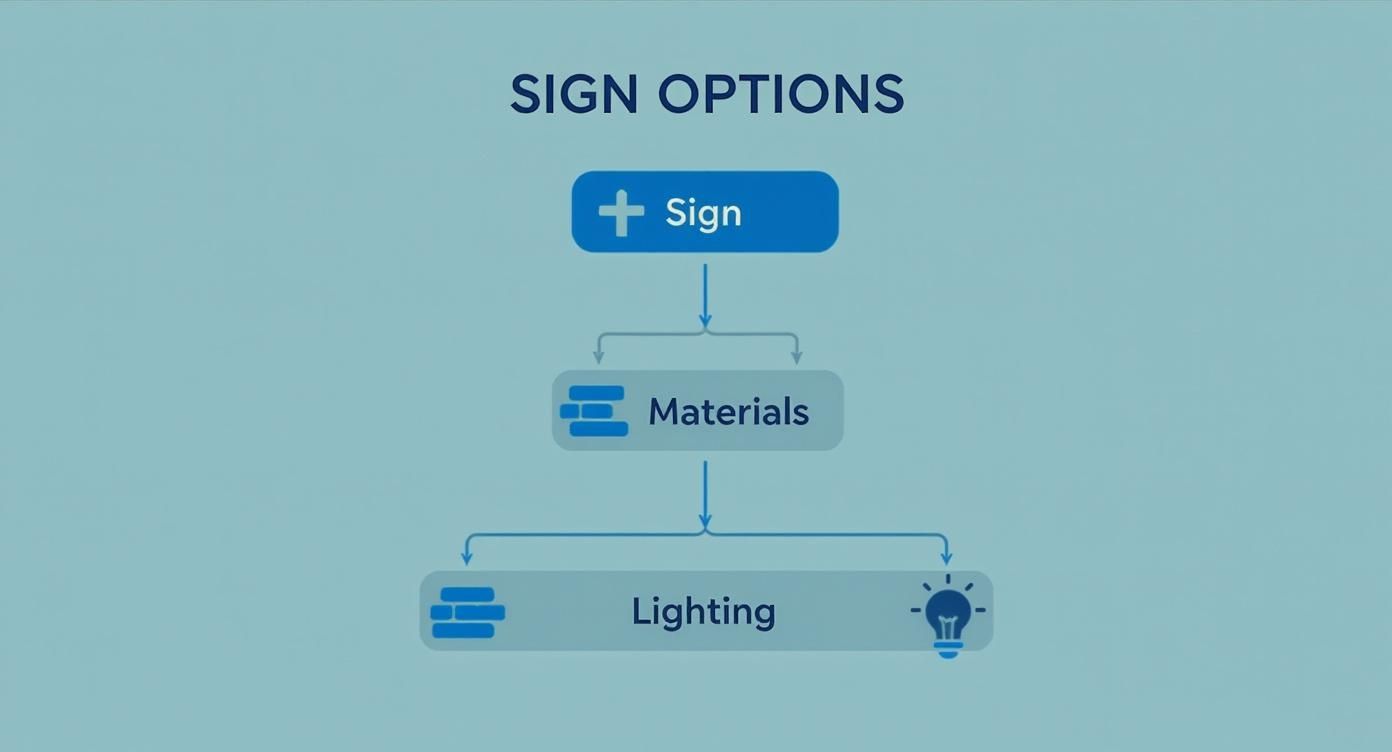
As you can see, the choices you make early on with materials and lighting have a massive impact on how the final sign looks and performs.
Pinpointing the Perfect Location
Where you put your sign is just as critical as what it looks like. The whole point is to maximize visibility to passing cars and pedestrians without breaking any local rules or creating a safety hazard.
Start by getting out of your office and looking at your property from the street. Drive past from every direction. Walk the sidewalk. This is the only way to truly understand the sightlines you're working with.
Actionable Site Analysis Checklist
- Identify Traffic Patterns: Where is most of the traffic coming from? Your sign needs to face that primary flow head-on. If you’re on a corner, you’ll probably want a double-faced sign to catch eyeballs from both streets.
- Check for Obstructions: Keep an eye out for trees, utility poles, or neighboring buildings that could block the view. And don't forget about the seasons—a tree with no leaves in winter might completely hide your sign come summer.
- Confirm Zoning Setbacks: Every town has its own rules about how far a sign has to be from the road, property lines, and intersections. Check these regulations before you even think about digging to avoid a costly headache.
- Consider Driver Reaction Time: Place the sign far enough from your entrance to give drivers plenty of time to see it, process it, and safely make the turn. If it’s too close to the driveway, you'll have frustrated drivers blowing right past your entrance.
When you nail both the design and the location, your monument sign stops being just a sign and starts being a true performer for your business.
Navigating Permits, Zoning, and ADA Compliance
Getting a beautiful business monument sign in the ground is about more than just a great design. There's a whole world of local regulations to navigate, and this behind-the-scenes work is absolutely critical. Skip this step, and you could be facing hefty fines, an order to tear your new sign down, and serious project delays.
Think of it this way: you're essentially getting a building permit for a small structure, because that’s exactly what your city considers a monument sign to be. Your local planning department has a specific rulebook to make sure every sign is safe, fits the area's aesthetic, and doesn't create a hazard. This is where a seasoned sign partner becomes invaluable—they handle this entire maze for you.
Decoding Local Zoning Codes
Before you get too attached to a design, the first stop is your local zoning ordinance. These codes are the law of the land for your sign, dictating nearly every physical detail. Having a solid grasp of zoning regulations in architecture helps put these local rules into a much clearer context.
Zoning codes will tell you exactly what you can and can’t build on your property. For signs, they typically control:
- Height and Size: Municipalities have strict maximums for how tall and wide your sign can be. These limits are often tied to things like the speed limit on your road and the length of your property's street frontage. For example, a town might limit signs on a 35 MPH road to 6 feet in height, but allow up to 10 feet on a 55 MPH road.
- Placement and Setbacks: Codes get very specific about how far your sign must be from the curb, property lines, and driveway entrances. This is all about maintaining clear sightlines for drivers and pedestrians.
- Illumination: You'll find rules on how bright a sign can be, whether any kind of flashing or animation is allowed, and even what hours it's allowed to be lit up at night.
Trying to ignore these regulations is a recipe for a headache. The most common mistake we see is a business finalizing a design before checking the codes, only to learn it’s a foot too tall or too close to the road. That forces a complete—and costly—redesign.
To make things more concrete, we've broken down what this process actually looks like. You can get a head start by reviewing our guide on local sign permit requirements to see what’s coming.
To help you stay on track, we've put together a checklist that outlines the typical journey from initial research to final approval.
Sign Permitting Checklist
This step-by-step checklist is your roadmap for navigating the permitting and compliance process for a monument sign.
| Step | Key Action | Common Pitfall to Avoid |
|---|---|---|
| 1. Zoning Research | Review your local municipality's zoning code for sign regulations (height, size, setback, lighting). | Designing the sign before knowing the rules, leading to expensive revisions. |
| 2. Design & Engineering | Create a sign design and engineered drawings that meet all code requirements. | Submitting incomplete or non-engineered drawings that get rejected immediately. |
| 3. Permit Application | Complete and submit the official sign permit application with all required documents. | Forgetting necessary documents like site plans or landlord approval letters. |
| 4. Plan Review | The city's planning department reviews your submission for compliance. | Underestimating the review timeline, which can take weeks or even months. |
| 5. Inspections | Schedule and pass required inspections (e.g., footing, electrical, final). | Starting construction before the permit is issued or an inspection is passed. |
| 6. Final Approval | Receive the final certificate of approval from the city. | Assuming the job is done after installation; the final sign-off is crucial. |
Following these steps methodically, or having an expert partner manage them for you, is the surest way to a smooth and successful project.
Ensuring ADA Compliance
Beyond local zoning, your sign also has to meet the standards of the Americans with Disabilities Act (ADA). The whole point of ADA guidelines is to make sure signs are easy to read and accessible to everyone, including people with visual impairments.
While most ADA rules focus on interior signs, a few key principles apply to monument signs, particularly if they include directions or identify accessible entrances. You'll need to consider:
- Clear Ground Space: The area in front of the sign must be level and free of obstacles so someone in a wheelchair can get close enough to read it.
- Contrast and Finish: Any text or symbols need to have a non-glare finish and stand out with high contrast against the background, making them much easier to see.
- Safe Location: The sign can't be placed where it could become a tripping hazard or an obstacle for anyone using a cane to navigate.
Following these rules isn't just about checking a box or avoiding a penalty. It’s about being a thoughtful business owner and making sure your brand’s first handshake is a welcoming one for every single person in your community.
Understanding Costs, Installation, and Maintenance
When you're thinking about a monument sign, it's best to see it as a long-term investment in your brand's presence, not just a one-off purchase. The final cost isn't a single number; it’s a combination of everything from the initial creative design and materials to the heavy lifting of installation and its upkeep over the years.
A simple, non-lit sign made from something like HDU or a precast concrete form will land on the more affordable end of the spectrum. On the other hand, a large, custom brick sign with detailed stonework and a built-in digital screen is a much bigger investment. The trick is to understand how every choice you make affects the bottom line, so you can perfectly match your vision to your budget.
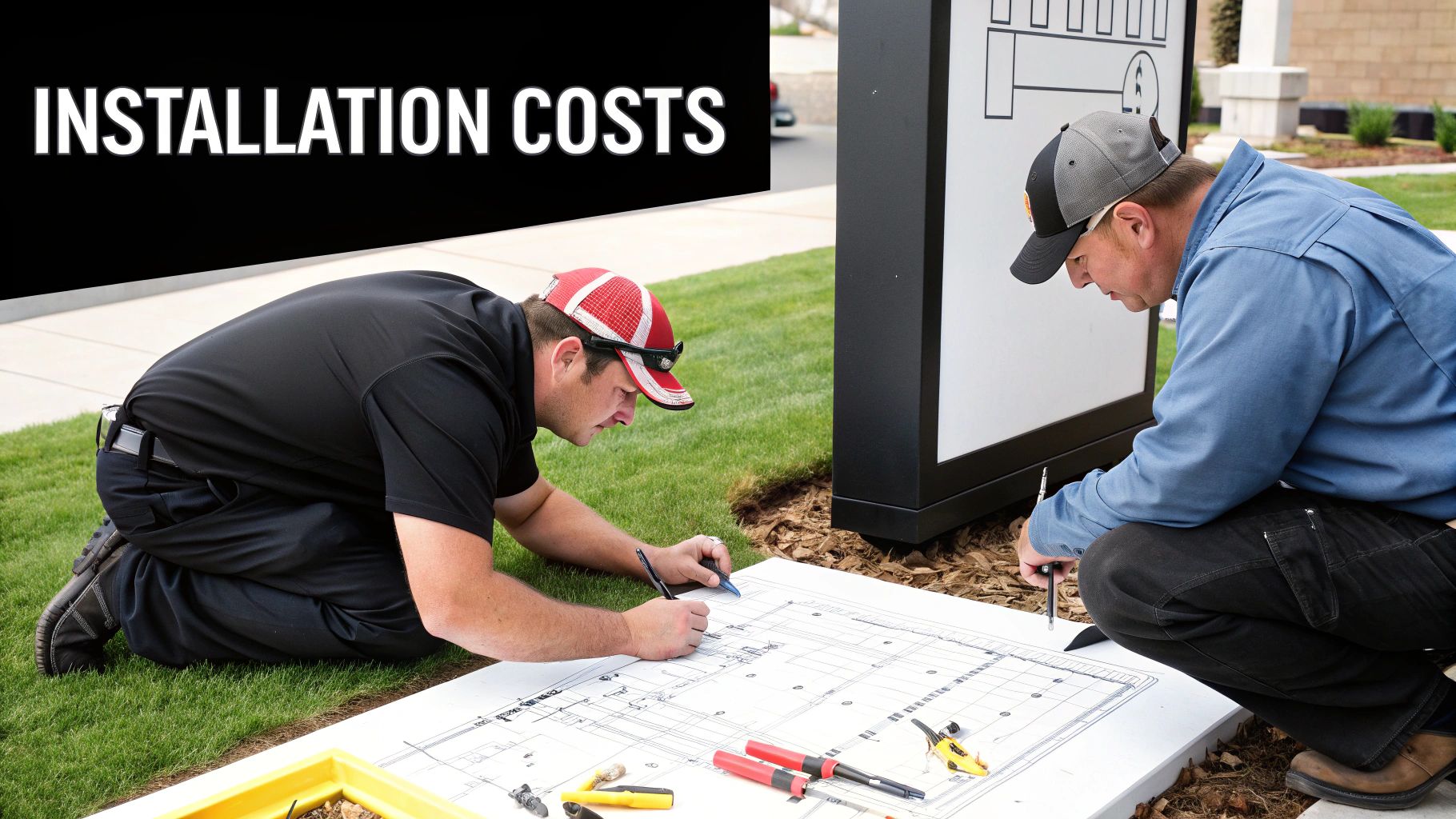
Key Factors That Influence Your Final Cost
There's no such thing as a one-size-fits-all price tag for a monument sign. The final cost comes down to a handful of key variables, and knowing what they are helps you decide where to spend and where to save.
- Size and Scale: This is the most straightforward factor. Bigger signs need more materials, more fabrication time, and a more robust foundation—all of which drive up the cost.
- Material Selection: Premium, durable materials like natural stone or custom brickwork naturally cost more than economical options like precast concrete or HDU. If you're weighing different materials, our guide on making metal signs has some great insights into what makes for a lasting impression.
- Design Complexity: A simple rectangular sign is one thing. A sign with intricate shapes, custom colors, dimensional lettering, or detailed masonry is another—it requires more skilled hands and more time to get just right.
- Illumination Options: Lighting always adds to the budget. Simple external spotlights are the most wallet-friendly. Internally lit channel letters are a solid mid-range choice, while flashy digital LED displays are the premium option, thanks to the tech involved.
The demand for quality physical branding is huge. The Sign & Banner Shops industry, which is where business monument signs are born, has a market size of around $2.2 billion. With nearly 39,645 businesses in this space across the country, it's clear that companies are investing in signs that make them stand out. You can discover more insights about the sign industry's economic impact on ibisworld.com.
The Installation Process From Start to Finish
Once the sign is built and the permits are in hand, the real work begins. Installation is basically a small construction project. It takes a ton of precision to make sure your sign is stable, secure, and perfectly placed to catch every eye.
A professional installation is non-negotiable. An improperly installed sign is not only a poor reflection on your brand but also a serious safety liability. The foundation must be engineered to support the sign's weight and withstand local weather conditions like high winds.
Here’s how it usually unfolds:
- Site Prep and Excavation: The crew marks the exact spot and starts digging. This is where they lay the groundwork—literally—for a sign that will stand firm for decades.
- Foundation and Electrical Work: They pour a concrete footing, usually reinforced with a steel cage. If your sign is illuminated, this is when licensed electricians run the underground power lines before the concrete hardens.
- Sign Placement and Assembly: With the foundation set, a crane carefully lifts the main structure of the monument sign into place and bolts it down securely.
- Final Connections and Cleanup: The electricians hook up the lighting, and the crew adds any final touches like masonry or landscaping around the base. Then, they clean up the site, leaving you with a flawless new landmark.
Long-Term Maintenance to Protect Your Investment
Your monument sign is built tough, but just like any part of your property's exterior, it needs a little TLC to keep looking sharp. A simple maintenance routine protects your investment and makes sure your sign represents your brand perfectly for years to come.
Give the sign face a gentle wash with mild soap and water a few times a year to get rid of dirt and grime. It's also a good idea to keep any landscaping around the base trimmed back so it doesn't block the view or damage the structure. Lastly, do a quick check on the lights to make sure they're all working, and replace any bulbs or service the LEDs as needed to keep your sign shining bright.
Measuring the ROI of Your Monument Sign
Viewing a monument sign as just another line-item expense is missing the bigger picture entirely. A better way to think about it is as a silent salesperson—a revenue-generating asset that works for you 24/7. Unlike a digital ad campaign that evaporates the moment you stop paying, your sign becomes a permanent marketing engine, racking up thousands of impressions every single day.
When you start seeing your business monument sign as an investment instead of a cost, its true value becomes clear. It’s a one-time capital purchase that pays you back for years by increasing foot traffic, attracting new customers, and even boosting your property’s overall value.
Calculating Your Cost Per Impression
One of the simplest ways to see the return on your investment (ROI) is by calculating the cost per impression (CPI). This little piece of math shows you exactly how much you pay each time a potential customer sees your sign.
Let’s run some numbers. Imagine a professional office building on a decent road with a daily traffic count of 10,000 cars. A well-placed monument sign there will easily get 20,000 impressions a day, assuming two people per car. In a year, that’s over 7.3 million impressions. If the sign cost $20,000 and has a lifespan of ten years, the cost for every thousand impressions is incredibly low—far lower than almost any other advertising channel.
A business monument sign is a marketing workhorse. Its initial cost is spread out over years of continuous exposure, making it one of the most cost-effective advertising tools available for a physical location.
That constant visibility builds powerful brand recognition in your local community. When people in the area need the services you offer, your business is the first one that pops into their head because they drive past it every day.
Case Study: A Professional Office Building
Picture a commercial developer who just finished a new office building with a few empty suites. To speed things up, they install a premium, multi-tenant monument sign at the main entrance, complete with a modern design and internal lighting.
- The Goal: Attract high-quality tenants and give the property a professional, upscale image.
- The Action: The sign clearly displays the building's name and has dedicated, easy-to-update panels for each tenant.
- The Result: The sign immediately elevates the property's curb appeal, making it far more attractive to businesses looking for space. Leasing agents found that the sign made the property easier to market, leading to a 15% faster lease-up rate compared to similar properties that lacked a landmark sign. The sign basically paid for itself by cutting down the time the office space sat empty.
The Growing Market for High-Impact Signage
The value of high-quality signage isn't just an idea we're fond of; it's a globally recognized trend. The worldwide signage market, which includes business monument signs, was valued at around $52.7 billion in 2025 and is projected to nearly double to $97.3 billion by 2035. This boom is happening because businesses are realizing just how powerful visually striking advertising is for grabbing customer attention. You can learn more about these signage market findings to see the data for yourself.
This trend confirms that putting money into a quality sign is a smart move that aligns with where the market is headed. By exploring different signage ideas for your business, you can find a solution that not only meets your needs but delivers a real, measurable return. At the end of the day, a strategic monument sign isn’t just about being seen; it’s about being remembered and chosen.
Frequently Asked Questions About Monument Signs
Even with all the details covered, you probably still have a few practical questions about getting a monument sign for your business. We get it. This is where we answer the most common things people ask, clearing up those final details so you can move forward with confidence.
Think of this as a quick-reference guide to reinforce what you've learned.
How long does the entire process take from design to installation?
From start to finish, a typical monument sign project takes about 8 to 12 weeks. This isn't just one long waiting period; it’s a series of moving parts that all need to come together just right.
Here’s a rough breakdown of how that timeline plays out:
- Design and Consultation (1-2 weeks): This is the fun part where we nail down the final look, materials, and message for your sign.
- Permitting (2-4+ weeks): This is the big variable. Your local city or county has to review and approve the engineered plans, and their timelines can differ wildly.
- Fabrication (4-6 weeks): Once we have the green light, our team gets to work actually building the sign and all its components.
- Site Prep and Installation (1-3 days): The final step. We pour the foundation, handle any electrical work, and set your new landmark in place.
Keep in mind, highly customized designs, complex masonry, or integrated digital screens can add a bit more time to the project.
What is the typical lifespan of a monument sign?
A well-made monument sign isn't a temporary advertisement; it's a permanent fixture built to last for decades. While different parts have different lifespans, the core structure is rock-solid.
Think of your monument sign's structure as part of the property itself. The base, built from durable materials like brick, concrete, or stone, is designed to last 20 years or more with very little maintenance.
The sign face and lettering, usually made from tough materials like aluminum or acrylic, will typically look great for 10 to 15 years before the elements start to take a toll. Electrical parts like internal lighting or LED displays have a general lifespan of 5 to 10 years, depending on how much they're used and the local climate. Of course, a little regular maintenance goes a long way in extending the life of every component.
Can I update the information on my sign later?
Absolutely. We design signs with the future in mind, and how you update it just depends on the style you choose.
For multi-tenant signs at shopping centers or business parks, this is a core feature. Each tenant gets an individual panel that can be easily and affordably swapped out whenever a business moves in or out.
If you have a single business sign, changing a name or logo usually means replacing the main sign panel. But the hands-down most flexible choice is a digital LED monument sign. It gives you the power to change your message, advertise promotions, or share community news instantly using simple software. It's unmatched for real-time marketing.
Ready to create a landmark that gets your business noticed? The team at On Display Signs, Inc. manages every step of the process, from design and permitting to fabrication and installation, ensuring your project is seamless and successful. Start your signage project today.