Turning a great idea into a real, thriving business is a marathon, not a sprint. It’s a journey that moves through a few critical stages: proving your concept has legs, creating a solid plan, navigating the legal and financial setup, and finally, launching your brand into the world.
This guide is your roadmap. Forget the generic advice—we’re breaking down the process into clear, manageable steps to give you a realistic game plan for building something that lasts.
Your Essential Small Business Startup Roadmap
If you’re feeling the entrepreneurial itch, you’re in good company. In 2023 alone, a staggering 5.5 million new business applications were filed in the United States. This isn't just a local trend; it reflects a massive global movement, with over 594 million entrepreneurs actively building their dreams worldwide.
You're joining a wave of innovators, but success requires a plan. Let’s map out what that looks like.
Key Startup Phases
Every new venture, whether it’s a corner cafe or a tech startup, follows a similar path from a spark of an idea to a full-fledged business. The core stages are about confirming your idea has real potential, meticulously planning your operations, and then finally introducing your business to the world.
A well-defined brand is non-negotiable from the very beginning. Remember, powerful signage for small business is often your first handshake with a potential customer, dramatically impacting your visibility and ability to draw people in.
To help you visualize the journey, here’s a high-level look at the key phases involved in launching a new business.
Small Business Startup Phases At a Glance
This table breaks down the entire process into three main stages, outlining what you need to achieve in each and how long it typically takes.
| Phase | Primary Objective | Typical Timeline |
|---|---|---|
| Idea & Validation | Confirm your business concept is viable and has a market. | 1-2 Months |
| Planning & Setup | Create a detailed business plan and complete all legal and financial groundwork. | 2-4 Months |
| Execution & Launch | Build your brand, set up operations, and officially open for business. | 2-6+ Months |
As you can see, the initial idea is just the starting pistol. The real work happens in the planning and execution phases that follow.
The timeline below gives you a more detailed visual breakdown of how those months are spent moving from one stage to the next.
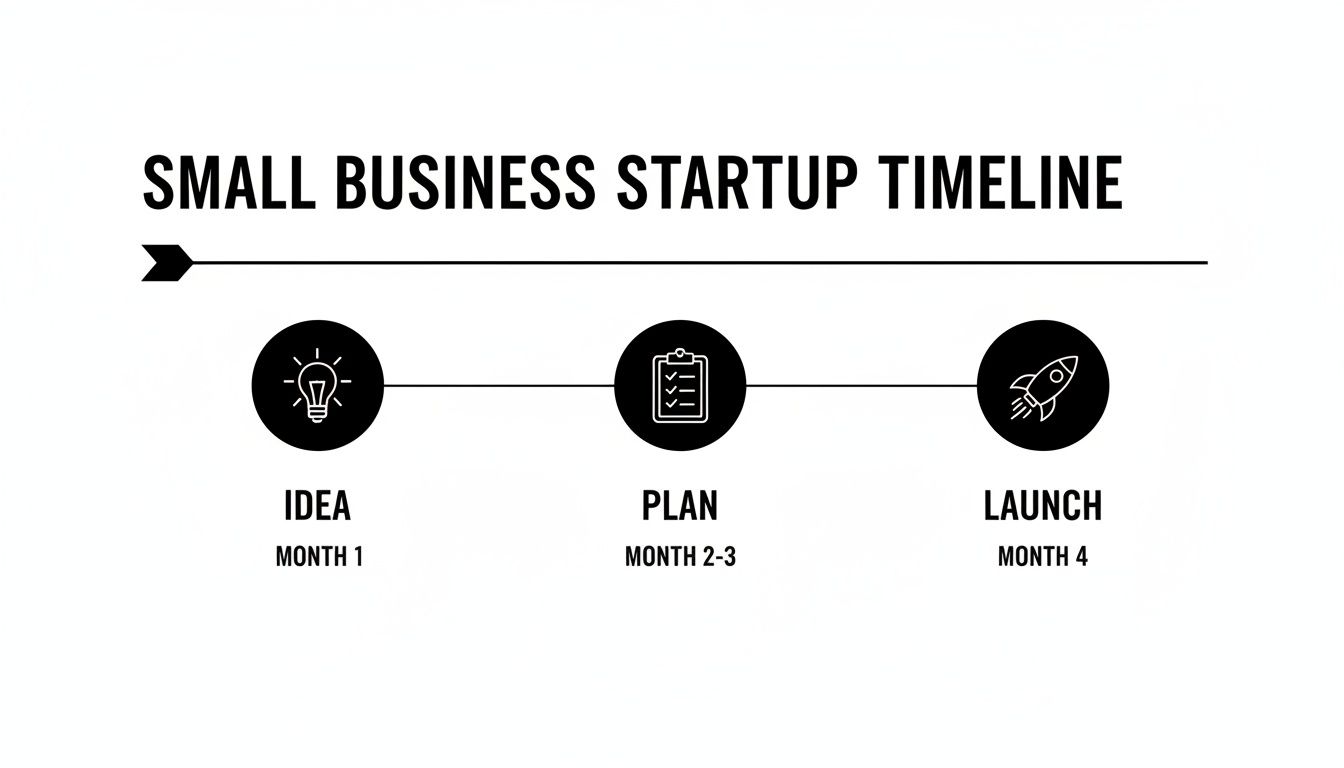
This roadmap makes one thing clear: the idea phase is just the beginning. The bulk of your time and effort will be spent on careful planning and execution long before you can flip that "Open" sign.
Validating Your Business Concept in the Real World
That brilliant idea keeping you up at night? It’s an exciting start, but right now, it's just a hypothesis. Before you sink serious time and money into this venture, you have to prove it has legs in the real world. This is where you move from "I think people will love this" to "I know exactly who my customers are, what they need, and that they will pay for it."
Think of validation as your safety net. It’s the single most important step to avoid costly missteps later, ensuring you’re building a business that actually solves a problem for a real audience.

Low-Cost Market Research Tactics
Getting to know your market doesn't require a Fortune 500 budget. It’s all about being scrappy and talking directly to your potential customers to get unvarnished, honest feedback. The intel you gather here will shape everything from your product features to your price tag.
Get started with these straightforward methods:
- Online Surveys: Tools like Google Forms are free and perfect for creating quick, focused surveys. Ask about specific pain points and buying habits. For example, if you're planning a meal prep service, ask, "What’s your single biggest headache when it comes to eating healthy during the work week?" This will give you actionable data on whether to focus on speed, variety, or dietary needs.
- Competitor Deep Dive: See who's already out there. Scour their websites, social media, and especially their customer reviews. Find out what they’re praised for and, more importantly, where they’re dropping the ball. That gap in service? That's your opening.
- One-on-One Conversations: Nothing beats a real conversation. Offer a coffee gift card in exchange for 15 minutes of someone's time from your target demographic. These interviews provide rich, qualitative insights that a multiple-choice survey could never capture.
Define What Makes You Different
Once you've got a feel for the landscape, you need to nail down why a customer should pick you over anyone else. This is your unique value proposition (UVP)—a punchy, clear statement that spells out the benefit you offer, how you solve a problem, and what makes you the obvious choice. A solid UVP becomes the bedrock of your brand.
To effectively validate your business concept, it's crucial to define what makes your offering distinct; explore these 8 Unique Selling Proposition Examples to inspire your own.
For a local baker, a UVP could be: "Artisanal sourdough bread made with locally sourced, organic grains, delivered fresh to your door." It’s specific, highlights unique perks (local, organic, delivery), and speaks directly to a customer who values quality and convenience.
Test Your Idea with a Minimum Viable Product
A Minimum Viable Product (MVP) is the simplest, most stripped-down version of your product or service you can get into the hands of early customers. The point isn't perfection; it's about learning what works and what doesn't, quickly and cheaply, before you go all-in.
Here’s what an MVP looks like in the wild:
- For a service: A budding graphic designer might offer a "startup logo package" at a steep discount to their first five clients. This tests their process, pricing, and client communication.
- For a physical product: That home baker could show up at a local farmer's market with small batches of their top three cookie recipes. They’ll see what sells out first and get immediate feedback. Pop-ups are fantastic for this, and having professional tents for trade shows can make your MVP look legit and attract serious buyers.
- For a digital product: A tech consultant could host a free webinar on a hot topic to see how many people sign up. This gauges interest and builds an email list for a future online course.
This is where the rubber meets the road. This hands-on testing gives you the hard data and the confidence to move forward, knowing you’re building something people actually want.
Building Your Business on a Solid Legal and Financial Foundation
Once your idea is solid, it's time to build the scaffolding that will support your business long-term. This is the part where things get real—you’re creating a legal and financial framework that protects you personally, enables growth, and keeps you compliant from day one.
Getting these details right isn't just about filing paperwork. It's about laying a stable foundation for everything you hope to achieve. While it might sound intimidating, breaking it down into a few manageable steps makes all the difference.
Choosing the Right Legal Structure
Think of your legal structure as the operational blueprint for your entire company. It dictates how you're taxed, defines your personal liability, and sets the administrative rules you'll have to follow. Getting this right from the start is critical, so take the time to understand your options by learning more about choosing the right business structure.
Here’s a quick rundown of the most common choices for new businesses:
- Sole Proprietorship: This is the default structure for many freelancers and solo founders. It’s incredibly simple because you and the business are considered the same legal entity. The major downside? There’s zero liability protection for your personal assets.
- Limited Liability Company (LLC): An LLC is often the sweet spot. It creates a protective barrier between your personal assets and business debts, which is a huge deal. It’s also flexible on taxation and has relatively straightforward compliance, making it a go-to for new entrepreneurs.
While other structures like Corporations exist, most new small businesses find that an LLC offers the best mix of protection and simplicity right out of the gate.
Making It Official: Registration and EIN
After you've picked a structure, the next step is to register your business. This is what makes your company a legitimate entity in the government's eyes and gives you the legal authority to operate.
First up, you’ll need to register your business name with your state's business agency. This is non-negotiable and ensures no one else in your state can operate under the same name.
Next, you need an Employer Identification Number (EIN) from the IRS. An EIN is basically a Social Security number for your business—a unique nine-digit code you'll need for everything from opening a business bank account to hiring your first employee and filing taxes. The good news? The application is free and takes just a few minutes online.
Key Takeaway: Don’t cut corners here. Properly registering your business and getting an EIN are fundamental steps for legal compliance and creating a clear separation between your business and personal life. It's the bedrock of your professional credibility.
You also have to be mindful of local rules. Many business activities require special permits to operate legally, and this is especially true for signage. Most cities and counties have strict regulations you need to follow. It’s smart to check out our guide on sign permit requirements early to avoid headaches later on.
Setting Up Your Business Finances
With your legal house in order, it's time to get your money organized. Strong financial management is the lifeblood of any business, and the habits you build now will determine your long-term chances of survival.
Your very first move should be to open a dedicated business bank account. Mixing personal and business funds is a classic rookie mistake that leads to accounting chaos and can even pierce the liability shield your LLC provides. A separate account keeps your books clean and makes you look far more professional.
This is also the moment to think about funding. Many founders self-fund with personal savings, but there are other avenues:
- Small business loans from banks or local credit unions.
- Lines of credit to help manage day-to-day cash flow.
- Loans from friends and family (just be sure to get everything in writing).
No matter where the money comes from, mastering cash flow is everything. The statistics are sobering: about 50% of small businesses make it past the five-year mark, and a staggering 82% of those that fail do so because of poor cash flow management. Keeping a hawk-eye on the money coming in and going out is what allows you to pay your bills, invest in your future, and stay in the game.
Creating Your Brand and Establishing a Presence
Your brand is far more than just a logo. It’s the feeling a customer gets when they walk through your door, the promise you make with your service, and the personality that shines through in everything you do. Building a strong brand and presence is what turns your business from a name on a piece of paper into a living, breathing entity people connect with.
Think of it this way: a powerful brand identity acts like a magnet for your ideal customers. It makes them feel like they've found exactly what they've been looking for. A weak or inconsistent brand, on the other hand, just creates confusion and gets lost in the noise.
Developing Your Core Brand Identity
Before you even think about picking colors or fonts, you need to get to the heart of your brand. Your brand's identity is built on a few core pillars that will steer every decision you make, from your business name all the way to your customer service style.
Start by nailing down your brand's personality. Is your business playful and creative, like a local toy shop? Or is it professional and trustworthy, like a financial advisory firm? This personality becomes your brand voice, ensuring you sound consistent across your website, social media, and face-to-face interactions.
Next up are the essentials: a memorable business name and a killer logo. The name should be easy to say, spell, and recall. Your logo is the visual cornerstone of your brand—it needs to be simple, professional, and instantly recognizable. Don't overthink it; some of the world's most iconic brands have incredibly simple logos.
Establishing Your Physical Presence
For any brick-and-mortar business, your physical location is your stage. Signage is arguably the single most critical marketing investment you can make, acting as your silent salesperson 24/7. Great signage does more than just show your name; it grabs attention from the street, communicates the quality of your brand, and pulls customers right to your door.
But here’s something new owners often miss: you can't just hang up a sign. Most cities and towns have strict rules, and navigating that red tape is a non-negotiable step.
- Understand Local Ordinances: Before you even call a sign vendor, get familiar with your city or county’s zoning and building codes. There are often specific regulations on sign size, height, lighting, and placement that you absolutely must follow.
- Prepare Your Permit Application: You'll almost certainly need to submit a detailed application. This usually includes a site plan showing the building and sign location, scaled drawings of the sign itself, and sometimes even engineering specs.
- Choose a Reliable Vendor: A professional sign company is worth its weight in gold. They don't just design and build your sign; they can often manage the entire permitting process for you. They know the local rules inside and out and can help make sure your application gets approved without frustrating delays.
Getting your brand identity right is a foundational step when you're learning how to start a small business. For a deeper dive into creating a memorable and effective brand from the ground up, check out our guide on essential small business branding tips.
Building Your Digital Footprint
If you're an online business, your website is your storefront. The same principles that make a physical space inviting apply directly to your digital presence. Your domain name should ideally be your business name, making it a no-brainer for customers to find you.
Your e-commerce site has to be more than just functional; it must be incredibly user-friendly. A slow, confusing, or clunky website is the digital equivalent of a cluttered store with flickering lights—it sends customers running. Focus on simple navigation, high-quality product photos, and a secure, streamlined checkout process.
Finally, claim your social media handles on the platforms where your target audience actually spends their time. You don't need to be everywhere. If you sell handcrafted furniture, a visual-heavy platform like Instagram or Pinterest is a perfect fit. A B2B consultant, on the other hand, will probably find more traction on LinkedIn. The key is consistency in your brand voice and visual style across all platforms to build a cohesive and recognizable online presence.
Launching and Marketing Your New Business
You've built the brand and set up operations. Now for the exciting part: connecting with your customers. This is where all that careful planning turns into action, focusing on smart, high-impact ways to create a buzz and bring in those first crucial sales.
You don't need to spend a fortune here. It's about being targeted and clever. A well-played launch can build momentum that turns a curious crowd into a base of loyal fans.
Low-Cost Strategies to Create Initial Buzz
Making a big impression doesn’t have to mean a big budget. The trick is to put your energy where you can talk directly to your ideal customers without breaking the bank.
For any local business, community-focused social media is an absolute goldmine. Picture this: you're opening a new coffee shop. Get active in local Facebook groups, share behind-the-scenes photos of your build-out on Instagram, and run a tiny, targeted ad campaign for less than the cost of a few pizzas. Your goal is to become a familiar face in the neighborhood before your doors even swing open.
Another workhorse is email marketing. Start gathering email addresses from day one on your website and social channels. A simple weekly update can build a powerful connection, letting you offer exclusive pre-launch deals and keeping your new venture top-of-mind.
Gaining a Modern Edge with AI Tools
Entrepreneurs today have access to incredible technology that was once only available to giant corporations. AI tools are completely changing the game for how small businesses can launch and compete. Free platforms can draft social media posts, analyze what your competitors are up to, and even handle basic customer service questions for you.
This isn't just a fleeting trend; it’s a fundamental change in how business operates. A 2025 SBE Council survey revealed that 88% of small business owners are already using AI. More telling, 73% said these tools have become essential for staying competitive in the last year alone. You can dig into the full findings on AI and multi-channel strategies to see just how big the impact is.
Mastering Local SEO for Visibility
If you have a physical location or serve a local area, local SEO isn't optional—it's everything. It's the art of making sure your business pops up when someone nearby searches for "best tacos near me" or "bike shop in downtown." You have to be at the top of that list.
Your first move is to claim and meticulously fill out your free Google Business Profile. It's one of the single most powerful things you can do for your local visibility.
- Fill Out Everything: Don't skip a single field. Add your address, phone number, hours, and a detailed description of what you do.
- Use High-Quality Photos: Show off your space, your products, and your smiling team. Give people a reason to visit.
- Go After Customer Reviews: Great reviews are a huge green light for both Google and potential customers, signaling that you're a trustworthy business.
Actionable Tip: Make it a habit to respond to every single review, good or bad. It shows you're engaged and that you care about your customers' experience. That engagement builds trust and actually helps boost your local ranking.
Planning Your Launch Day Strategy
Your launch day is more than just a single date on the calendar. It's a carefully planned event designed to generate maximum excitement while ironing out any last-minute operational kinks. I've always found a two-part approach works best for a smooth start.
First, hold a soft opening. This is a smaller, invite-only event for friends, family, and maybe some local business owners. The real goal is to stress-test your systems in a friendly, low-pressure environment. It’s your chance to fix that clunky POS system or awkward customer flow before the general public shows up.
Then comes the grand opening. This is your time to shine. Promote it heavily on social media, blast it out to your email list, and maybe team up with a neighboring business for some cross-promotion. For instance, a new bookstore could offer a discount to anyone who shows a receipt from the cafe next door.
The grand opening is also when your physical marketing, like banners and window graphics, does the heavy lifting. To get inspired, check out these signage ideas for business to make sure you capture every possible eyeball and drive that crucial day-one foot traffic.
Common Questions About Starting a Small Business
Diving into a new business venture is thrilling, but let's be honest—it also brings up a mountain of questions. As you get closer to launch day, a few key uncertainties tend to pop up for almost every founder. We've been there.
Here are some straightforward answers to the questions we hear most often, designed to help you clear those final hurdles with confidence.
How Much Money Do I Need to Start?
This is the big one, and the real answer is: it completely depends on what you're building. There's no magic number. A freelance designer who just needs a great laptop and some software might get off the ground with less than $1,000. On the other hand, opening a coffee shop could easily demand $50,000 or more just for the initial setup, equipment, and inventory.
The only way to know for sure is to build a painfully detailed startup budget. Don't eyeball it; list everything.
- One-Time Costs: Think business registration fees, buying essential equipment, your first big inventory order, and security deposits for a lease.
- Ongoing Expenses: This is your monthly burn rate—rent, utilities, software subscriptions, marketing costs, and insurance.
- Your "Oh Crap" Fund: Seriously. Set aside at least three to six months of operating expenses in cash. Unexpected costs aren't a possibility; they're a guarantee.
A rookie mistake in learning how to start a small business is only budgeting for opening day. You need enough cash to carry the business until it's consistently making more than it spends, which can take a lot longer than you think.
Can I Start a Business While Working a Full-Time Job?
Not only can you, but for most people, it's the smartest way to start. Keeping your day job gives you a financial safety net, taking immense pressure off your new venture. It lets you test your idea, build a customer base, and work out the kinks without worrying about how you're going to pay your mortgage.
But be warned: this path requires serious discipline. You're signing up for a lot of nights and weekends. The key is to create a non-negotiable schedule to avoid burning out. Maybe that’s two hours every weeknight and a solid five-hour block on Saturday. Structure is what keeps you moving forward without crashing.
When Should I Hire My First Employee?
Hiring your first person is a massive step. The right time is usually when you physically can't keep up anymore—you're turning away paying customers or getting so buried in administrative tasks that you can't focus on growing the business. It’s a classic sign that demand has officially outgrown your capacity as a solo founder.
Before you even think about posting a job ad, do this:
- Define the Role With Precision: Don't just look for "help." Write a crystal-clear job description. What specific tasks will this person own? What results are you paying them to deliver?
- Run the Numbers: Can you truly afford their salary, payroll taxes, and any benefits for at least six months, even if sales dip? If it’s going to be a strain, you're not ready.
- Test the Waters with a Contractor: If you’re hesitant about a full-time hire, bringing on a freelancer is a brilliant move. You can delegate specific tasks without the overhead and legal complexities of an employee. It's the perfect trial run.
How Long Does It Take to Become Profitable?
The timeline for profitability is all over the map. A consultant with low overhead might be in the black within a few months. A retail store with huge inventory costs and high rent might not see a real profit for over a year.
This is where financial projections become your best friend. Map out a projected profit and loss statement, cash flow statement, and balance sheet for your first three years. This exercise forces you to get real about your numbers and helps you pinpoint your break-even point—the exact amount of sales you need to cover every single one of your costs. That number becomes your first major goal.
What Is the Biggest Mistake to Avoid?
You'll make plenty of mistakes, that's part of the process. But the one that can sink a business before it even starts is failing to truly know your customer. If you don't have a laser-focused picture of who you're selling to, every decision you make—your marketing, your product, your pricing—is just a shot in the dark.
Trying to be for everyone is the fastest way to be for no one. Great businesses know their ideal customer intimately. They understand their problems, what they truly want, and where they hang out. Every choice, from the font on your sign to the copy on your website, should be made with that one specific person in mind.
Ready to make your new business stand out from the crowd? A memorable brand starts with powerful, professional signage. At On Display Signs, Inc., we manage everything from design and fabrication to navigating permits and installation, so you can focus on launching your dream. Explore our custom sign solutions today.