You feel the pressure point fast on a sign project. The lease is signed, the contractor wants final dimensions, the landlord has design rules, and your opening date is close enough that one permit delay can throw off the whole rollout. At that point, choosing among milwaukee sign companies stops being a shopping exercise and becomes a business decision with real cost attached.
I’ve seen the same pattern more than once. One shop can produce a good-looking sign but stalls on permitting. Another installs on time but misses the architectural context, so the sign meets spec and still looks wrong on the building. A third is fine for a basic retail panel and completely out of its depth once electrical work, landlord approvals, or multi-site coordination enter the job.
Milwaukee has a long manufacturing and visual production tradition, and that still shows in the local sign market. You can find quick-turn storefront providers, custom fabricators, electrical sign specialists, and firms that are better suited to branded environments or complicated site programs. The problem is not finding a vendor. The problem is choosing one whose strengths match your project before you spend money in the wrong direction.
That is the point of this guide. It is not a simple directory of local sign company options in Milwaukee. It is a framework for matching the job to the shop.
If you need fast retail turnaround, the shortlist should look different than it would for a hospital campus, a church rebrand, or a developer managing multiple municipalities with different approval standards. If permitting risk is high, you need a company that handles documentation well. If the site has electrical complexity, service access issues, or long-term maintenance concerns, that should carry more weight than a polished gallery page.
The seven companies below are worth serious consideration. The goal is to help you compare them the way a project manager would. By fit, constraints, and trade-offs, not just by who has the best website.
1. Lemberg (Signs Division)
Lemberg Signs Division is the kind of partner I’d put in front of a commercial developer, school system, hospital network, or owner managing a property with electrical complexity. Their advantage is structural, not just aesthetic. They operate with the backbone of an electrical contractor, which matters when a sign package touches power, service, maintenance, and inspection realities at the same time.
That makes them a strong fit for illuminated exteriors, EMC and digital display work, large campuses, and multi-site commercial programs that need one team to own the ugly parts as well as the visible ones. Plenty of companies can design a channel letter set. Fewer can integrate design, fabrication, installation, maintenance, and retrofit planning without handing you off halfway through the job.
Where Lemberg fits best
If your project includes lighting coordination, service access, or long-term maintenance expectations, Lemberg moves up the list quickly. Their signs division also talks directly about LED retrofits and maintenance plans, which is useful if you're upgrading existing assets rather than starting from scratch.
A practical example: if you have a retail center with aging illuminated signage and a few tenants coming in at different times, a purely design-led shop may give you a clean concept package but struggle with service sequencing. Lemberg is better suited to phased execution.
Practical rule: Choose an electrical-forward sign partner when the project has more than one failure point. Power, permitting, access, and maintenance rarely stay separate in the field.
Their larger scale is both a strength and a trade-off. For enterprise clients, that’s reassuring. For a very small one-off storefront job, it can mean you're entering a bigger scheduling machine than you really need.
A few reasons they stand out:
- Full lifecycle support: They handle design, fabrication, installation, maintenance, and retrofit work from one operation.
- Good for multi-location programs: Their national coordination angle is useful if your Milwaukee site is one piece of a broader rollout, which is where a national sign company near you model can also become relevant.
- Best for commercial complexity: Their positioning favors owners and operators who care about uptime, serviceability, and code-heavy execution.
If your main priority is a low-friction sign for a single small shop, I'd still get a quote, but I wouldn't assume this is the leanest option. If your priority is execution discipline, they belong on the shortlist.
2. Innovative Signs
Innovative Signs hits a sweet spot for owners who want a full-service local shop without feeling pushed into an enterprise process. They present themselves clearly: design, permitting, fabrication, installation, and repair. That’s a useful mix for retail, institutional, and municipal-facing jobs where the owner wants one accountable team but still expects direct communication.
I also like that they make budgeting less opaque than many local competitors. Their site includes a sign cost calculator, and while no online calculator replaces a real site review, it does help early-stage buyers stop guessing.
Why they work for practical local projects
For projects needing variety, this company is an excellent choice. A business might need illuminated channel letters on the exterior, ADA room signs inside, and supporting branded graphics to tie the property together. They cover that broad range well, and their local project examples help show they’ve worked on recognizable Milwaukee-area jobs.
That combination matters because many buyers don't need the "biggest" sign company. They need a company that can manage several sign types without creating three separate vendor relationships. If you're comparing different types of signage for one property, that flexibility saves decision fatigue.
Some owners overbuy. They hire an architectural fabricator for what is basically a standard storefront package, then wonder why quoting takes longer and costs feel heavier.
The trade-off is geographic scale. This kind of provider feels strongest as a regional player. If you're a national chain with multiple openings outside Wisconsin, you'll likely need more coordination on your side or a larger program manager above them.
A few strengths to weigh:
- Budget framing is easier: The calculator gives buyers a better starting point than the usual "contact us for everything" approach.
- Broad product mix: They can support exterior illuminated work, ADA, wayfinding, and large-format applications within one relationship.
- Permitting is built into the conversation: That's critical in Milwaukee, where permit handling often separates a smooth job from a delayed one.
For a local operator opening a new office, school facility, clinic, or retail location, that specific sign provider is one of the more balanced options in this group.
3. Sign Effectz, Inc.
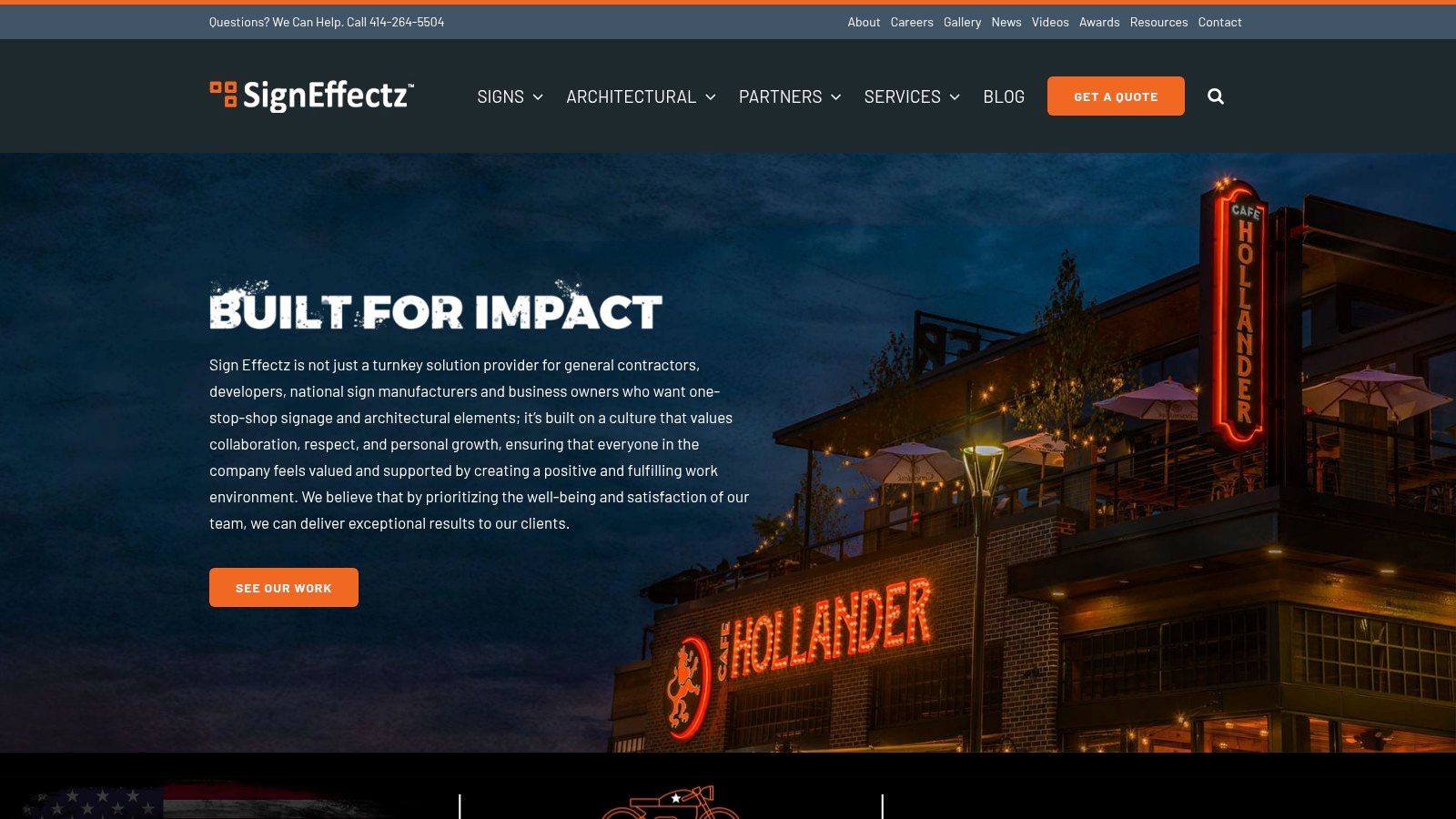
Sign Effectz, Inc. is where I’d point clients whose project is no longer just "a sign." If the job involves architects, general contractors, owner reps, branded environments, façade features, or a campus-wide package, this is the type of shop that makes sense.
They don't position themselves as a bargain provider, and that's appropriate. Their value is in managing layered projects where signage interacts with architecture, materials, sequencing, and stakeholder approvals.
Best for architectural and multi-stakeholder work
Sign Effectz stands out because they go beyond standard sign categories. They handle awnings, cladding, sculptural elements, murals, ADA signage, digital displays, monuments, pylons, and more. That matters on hospitality, healthcare, higher education, and corporate campus work where a sign package has to feel integrated with the building rather than bolted onto it.
If your project team is debating materials, attachment methods, illuminated elements, and branding standards at the same time, that’s not a "quick quote" job. It needs process. Sign Effectz appears built for that environment.
A practical example is a healthcare campus expansion. You may need exterior identification, directional signs, ADA room marking, donor recognition, and branded architectural elements. A shop focused only on storefront signs usually struggles to hold that whole scope together.
The main trade-off
They are less compelling if your only goal is speed on a simple retail façade. Their process likely makes more sense when the complexity justifies it.
- Strong project management posture: Good for owners who need one team coordinating with architects and contractors.
- Architectural depth: Useful when the sign package includes more than letters on a raceway.
- Quote-led engagement: Expect consultation and planning, not instant commodity pricing.
"Custom" only helps if someone can manage all the approvals around it. Otherwise, custom becomes a long list of unresolved decisions.
If you're early in planning and want to understand how a sign is made from concept through fabrication, Sign Effectz is the kind of company whose process orientation will feel familiar. For standard storefront work, they may be more firm than you need. For a complex build, that discipline is exactly the point.
4. Bauer Sign & Lighting
A common failure point shows up after the ribbon cutting. The sign is installed, one cabinet face goes dark, a tenant changes, or an older pylon needs a field repair, and suddenly the real question is not who built the sign. It is who can keep it working without turning every service call into a new project.
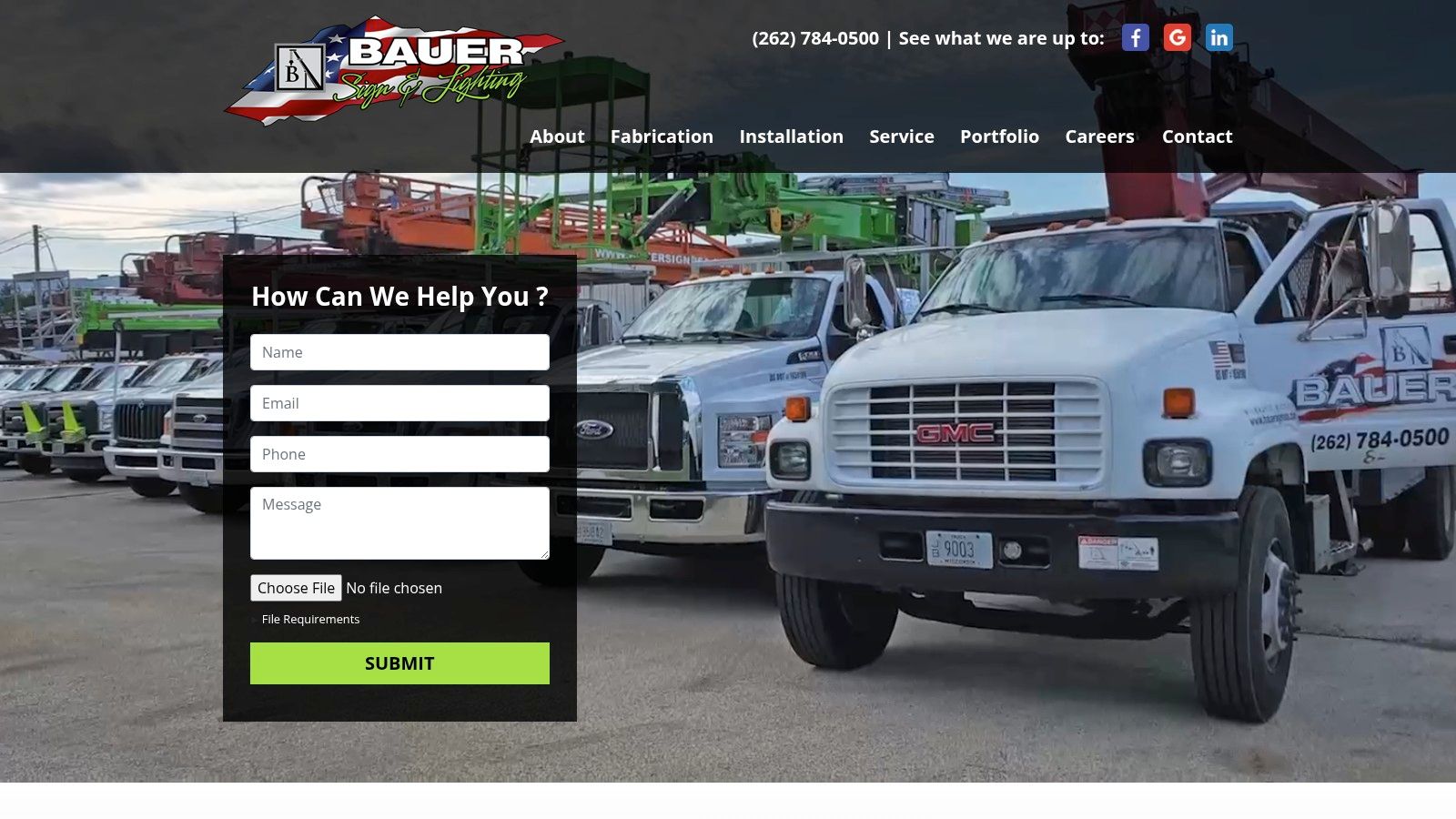
That is the lane Bauer Sign & Lighting appears to fit best. If you manage multiple properties, inherited signage, or aging illuminated displays, their value is less about design presentation and more about field response, repair capacity, and ongoing support.
Where Bauer fits best
Bauer stands out for buyers who treat signage as an operating asset, not a one-time branding purchase. That includes property managers, franchise groups, retail chains, fuel and convenience operators, and facility teams with a mixed sign inventory across locations.
This matters most when your sign package is already in the field. A provider with active service capacity can handle outages, lighting issues, face replacements, and troubleshooting faster than a shop built mainly around new fabrication sales.
For the right owner, that changes the selection criteria:
- Strong fit for maintenance-heavy accounts: Good for businesses that expect repairs, relamping, service calls, and periodic updates.
- Useful for legacy sign systems: Older cabinets, illuminated elements, and mixed sign types usually require practical field knowledge more than brand storytelling.
- Better for uptime than concept development: Owners looking for dramatic architectural branding should ask harder questions about design process and mockups.
That trade-off is real. If your priority is a flagship environment with custom finishes, brand-standard detailing, or highly sculptural custom 3D business signs, I would want to see more examples and ask more detailed questions during the sales process. If your priority is keeping existing signs functioning across sites, Bauer looks more aligned with that need.
A lot of sign problems are service problems in disguise. Lamp failures, access constraints, old electrical components, tenant panel swaps, and scheduling around occupied properties all require coordination in the field. Buyers who have already been burned by installers who vanish after completion usually recognize that point fast.
Bauer makes the most sense when the project brief includes upkeep, troubleshooting, and repeat service, not just fabrication. For service-conscious buyers, they are one of the more practical milwaukee sign companies on this list.
5. Signarama Milwaukee (Downtown)
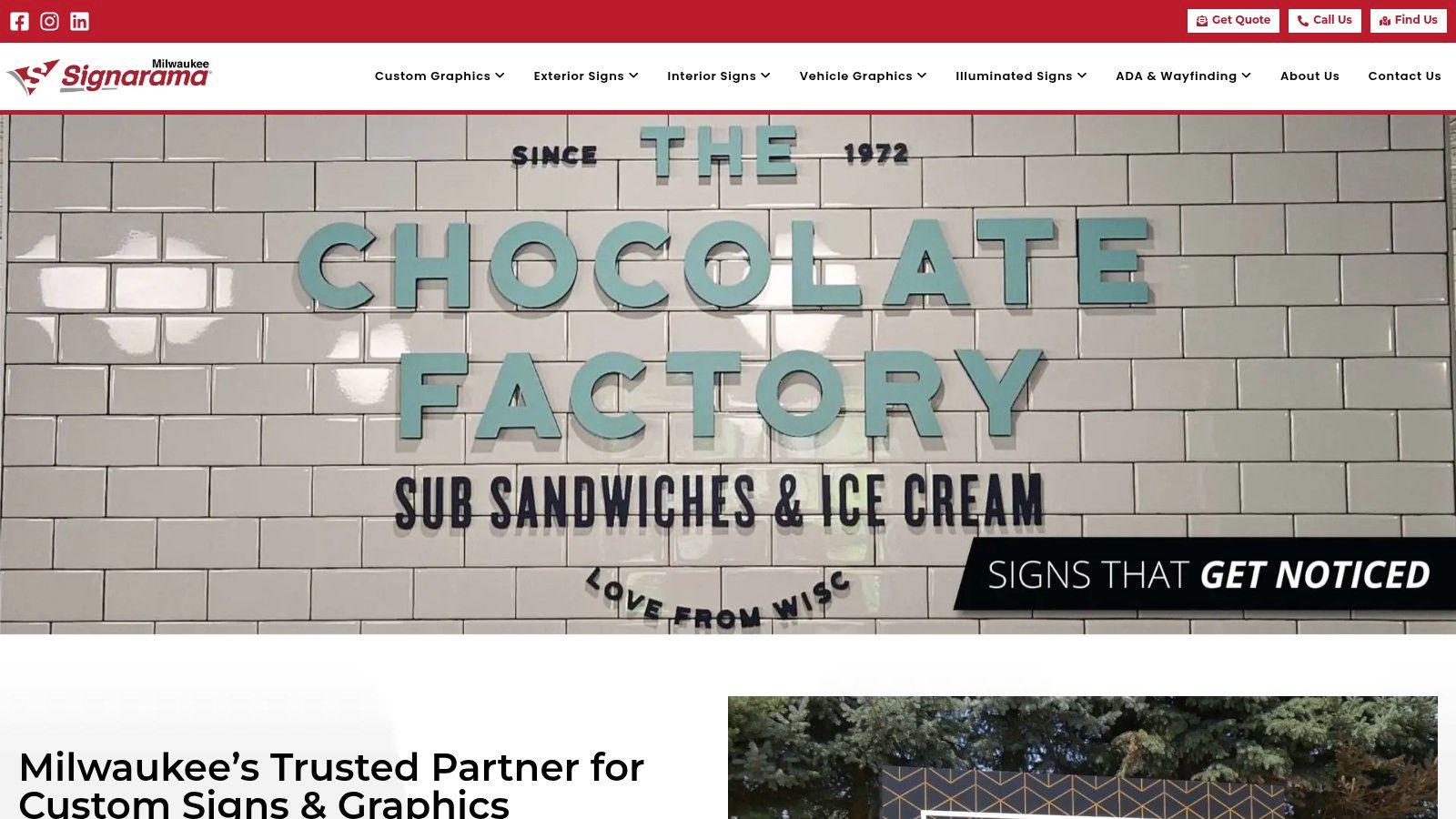
Signarama Milwaukee is the most obvious choice on this list for buyers who want a one-stop shop and don't want to overcomplicate the process. They cover a wide range of interior and exterior signage and speak directly to Milwaukee permitting, zoning, and structural sign compliance.
That combination is why they work well for everyday commercial needs. Retailers, offices, clinics, churches, and service businesses often don't need a custom architectural fabricator. They need a provider that can move from concept to permit to installation without creating friction.
Why many owners start here
There’s a practical benchmark attached to this company. Signarama Downtown Milwaukee is listed with estimated annual revenue of $26.5 million and a valuation of $84.6 million in a Prospeo company profile for Signarama Downtown Milwaukee. I don't use those numbers as a quality score, but they do suggest substantial market presence and operating scale.
That matters because franchise-backed sign shops can vary widely by location. A stronger local operator usually has the staffing, process, and vendor relationships to handle a broader volume of standard commercial jobs.
Best use case
Signarama makes sense when you need a dependable sign provider for common commercial formats, especially illuminated storefront work, ADA signs, interior branding, and dimensional applications. If you're exploring branded lobby pieces or logo depth options, their experience with custom 3-D signs is in the same decision lane.
Field note: Fast isn't the same as rushed. The better local franchise shops know which projects can move quickly and which ones still need a full permit and structural review.
A few trade-offs:
- Strong for standardization: Good when your project fits common commercial sign categories.
- Less ideal for highly specialized builds: If the job involves custom cladding, sculptural elements, or complex architecture, a specialist may be better.
- Local permitting know-how is a real advantage: Especially for downtown or tightly regulated sites.
For a business owner who wants broad capability without managing multiple vendors, Signarama Milwaukee is one of the safest starting calls.
6. Optimum Signs
Some sign shops treat permitting like a backend chore. Optimum Signs puts it near the center of their value proposition, and that alone will make them the right pick for certain buyers.
If your project crosses municipal boundaries, sits in a fussy retail center, or involves repeated approvals over time, permit management isn't a side issue. It's the project. Optimum appears to understand that better than most.
Strong fit for code-heavy projects
Their emphasis on municipal code navigation and ongoing compliance consulting is useful for chains, developers, and property owners with recurring sign needs. That's especially relevant in a market where out-of-state or non-local providers often struggle to explain how they’ll handle local review and code issues.
This is one of the underserved problems in Milwaukee. Local companies often promote that they manage permitting, but there’s less public guidance on how firms without local boots on the ground handle city-specific rules and remote coordination, as noted in Innovative Signs' broader local-service framing. Optimum leans directly into that administrative complexity.
When to choose them over a broader shop
Choose Optimum when approval risk is your main concern. For example, if a shopping center rebrand touches multiple municipalities in the Milwaukee and Waukesha area, a design-led shop may produce attractive concepts that stall in review. A code-forward shop can save more pain than a prettier rendering ever will.
- Best for permit-sensitive jobs: Especially when several jurisdictions or landlord standards overlap.
- Useful for ongoing compliance: Their consulting posture suggests value beyond one install.
- Less portfolio-heavy in public view: You may need to ask more questions during discovery about comparable completed work.
A sign buyer who has already been burned by rejected drawings usually becomes a permitting realist fast. Optimum is built for that buyer. If your project is visually ambitious but administratively simple, another firm may offer stronger creative presentation. If the approvals are the hard part, Optimum deserves real attention.
7. The Sign Guyz
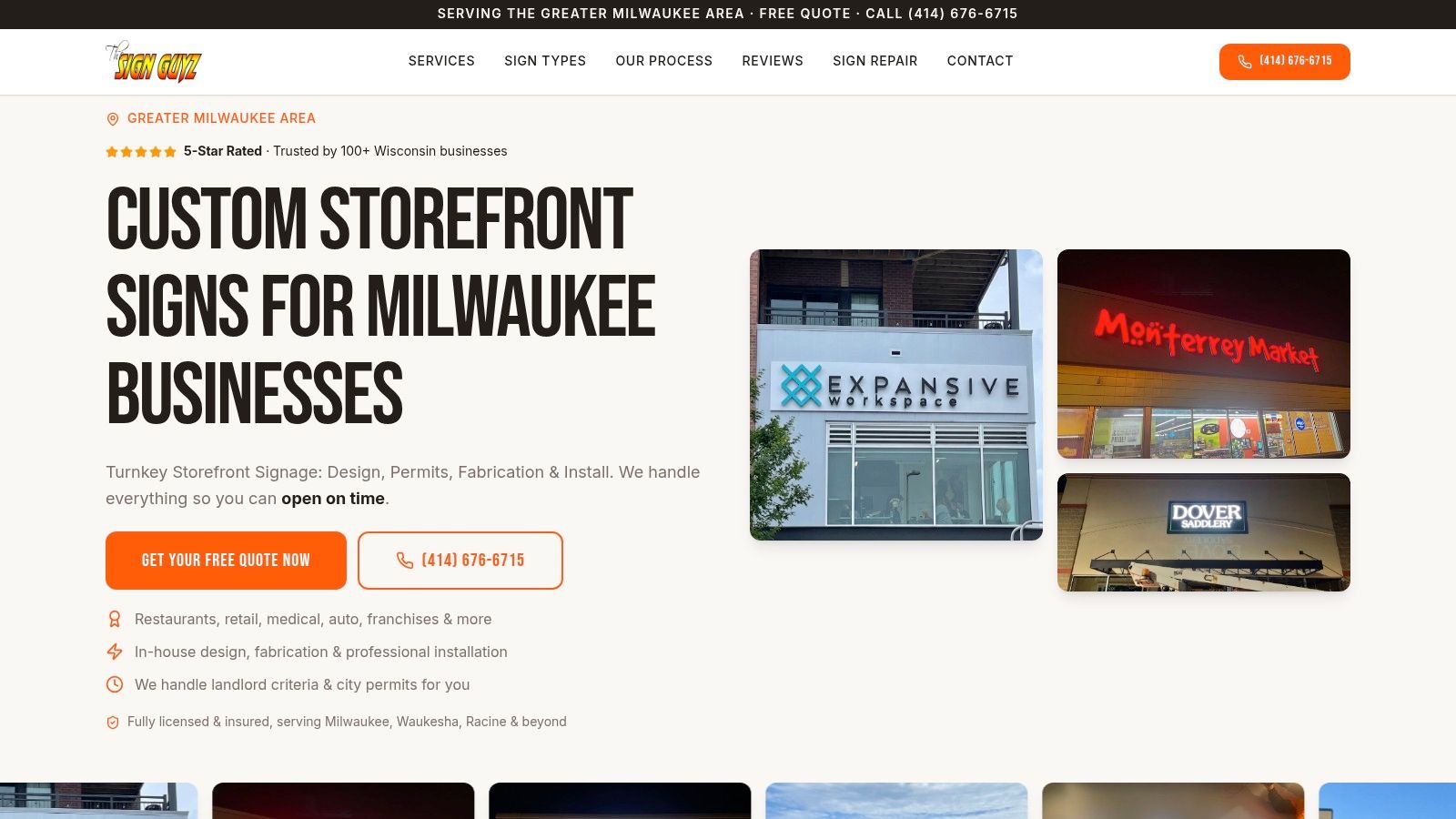
A common Milwaukee opening scenario goes like this. The lease is signed, the contractor is on site, the landlord has sign criteria, and the opening date is already printed on marketing materials. At that point, choosing a sign company stops being a branding exercise and becomes an execution decision. The Sign Guyz fits that kind of job.
They look like a practical match for business owners who need a storefront sign handled from submittal through installation with minimal hand-holding. Restaurants, neighborhood retailers, clinics, franchise operators, and local service businesses usually care about the same things here: clear pricing, a realistic production schedule, and someone who can keep landlord approvals from dragging the job off course.
Their positioning suggests a shop built around everyday commercial signage rather than complex architectural programs. That matters. If your project involves standard channel letters, cabinet signs, monument signs, projecting signs, or illuminated storefront branding, a focused shop can often move faster than a larger firm that is structured for bigger design and stakeholder processes.
That does not make them the right choice for every buyer.
The main trade-off is scale and documentation. A smaller, storefront-oriented company can be more responsive on a straightforward local install, but large multi-site rollouts, heavily specified developer packages, or projects with architect, GC, landlord, and ownership committee review may strain a leaner operation. Buyers in that category should ask direct questions about project management depth, install coverage, and who stays on point when revisions start stacking up.
For a single location opening, I would focus less on polished sales language and more on process ownership. Ask who prepares landlord submittals. Ask who updates drawings after comments. Ask who handles permit corrections if the city pushes back on illumination, mounting, or sign area. Those answers tell you more than a gallery page does.
The Sign Guyz stands out in this list as the fit-based choice for fast, practical storefront work. If your project is a local business opening and the main goal is getting the sign approved, built, and installed without unnecessary delay, they deserve a serious look. If your job is bigger, more design-sensitive, or spread across multiple locations, another Milwaukee sign partner may match the risk better.
Comparison of 7 Milwaukee Sign Companies
A Milwaukee sign project can go sideways fast. A permit stalls, the landlord rejects the submittal, the install crew shows up without the right access plan, and your opening date starts slipping. At that point, the sign company is no longer a vendor choice. It is a project risk decision.
That is the right way to read this comparison table. It is not a simple list of who makes signs. It is a fit framework for matching your job to the kind of shop that handles that type of pressure well, whether that means architectural coordination, fast storefront production, service coverage, or code-heavy approvals.
| Provider | 🔄 Implementation complexity | ⚡ Resource requirements | ⭐ Expected outcomes | 📊 Ideal use cases | 💡 Key advantages |
|---|---|---|---|---|---|
| Lemberg (Signs Division) | High, turnkey, electrical and permit-heavy projects | Large: electrical construction crews, fabrication shop, ESOP workforce | Top-tier, compliant installs and scalable multi-site programs ⭐⭐⭐⭐⭐ | Large commercial clients, venues, code-heavy or multi-site rollouts | Deep permitting and installation expertise, EMC and digital displays, maintenance |
| Innovative Signs | Moderate, full-service regional fabrication and permitting | Medium: in-house design and manufacturing, regional install crews | Reliable retail and institutional signage with budget transparency ⭐⭐⭐⭐ | Local retail, institutions, projects needing clear cost estimates | Sign cost calculator, documented local case studies, communication focus |
| Sign Effectz, Inc. | High, custom architectural and multi-stakeholder program management | Large: dedicated project management, fabrication specialists, design and consulting | High-quality custom and architectural signage delivered to spec ⭐⭐⭐⭐⭐ | Healthcare campuses, hospitality, complex owner, architect, and GC projects | Strong architectural capability and program management for complex builds |
| Bauer Sign & Lighting | Low–Moderate, service-oriented with fabrication capacity | Large service fleet, fast SLAs, repair and lighting crews | Fast, reliable repairs and ongoing maintenance, broad product support ⭐⭐⭐⭐ | Clients prioritizing maintenance, lighting and repair, neon and EMC service | Rapid service response, extensive maintenance capability |
| Signarama Milwaukee (Downtown) | Low, franchise one-stop with local permitting expertise | Franchise resources plus local execution team | Quick delivery for common signage and graphics ⭐⭐⭐ | Small businesses needing fast exterior and interior signs and permits | City of Milwaukee permitting and zoning know-how, fast turnarounds |
| Optimum Signs | Moderate, focused on permitting and municipal code handling | Medium: permitting specialists, consultative planning, fabrication | Reduced approval risk and compliant installations across jurisdictions ⭐⭐⭐⭐ | Multi-jurisdiction projects or brands needing ongoing code consulting | Long-term code consulting subscriptions, proactive permit facilitation |
| The Sign Guyz | Low–Moderate, turnkey storefront process with permit handling | Small to medium: in-house fabrication, landlord and permit coordination | Practical, on-deadline storefront installs for SMBs ⭐⭐⭐ | Restaurants, local retail, medical offices and franchises opening on deadline | Quick quotes, phone-first intake, focused storefront expertise |
A few patterns matter more than the star ratings.
Lemberg and Sign Effectz sit on the higher-complexity end, but for different reasons. Lemberg makes more sense when electrical scope, digital displays, service access, or multi-site execution are part of the job. Sign Effectz is the better fit when design review is intense and the sign package needs to work cleanly with architects, developers, and general contractors.
The middle of the market is where buyers often make the wrong call.
Innovative Signs, Optimum Signs, and Bauer can all serve broad business needs, but their strongest use cases are different. Innovative Signs is a practical fit for organizations that want local fabrication support and clearer pricing early in the process. Optimum Signs stands out when approvals are the hard part. Bauer is the stronger choice if the sign is only one part of a longer service relationship that includes lighting, repairs, and maintenance response.
For standard storefront work, speed and process discipline usually matter more than size. Signarama Milwaukee and The Sign Guyz are easier to justify when the package is straightforward and the primary priority is getting signs approved, produced, and installed without unnecessary handoffs.
Use the table to match the company to the job, not to pick a generic "best" provider. A hospital campus, a single-location restaurant opening, a downtown office renovation, and a regional retail rollout should not be shopped the same way.
Making Your Final Decision and Next Steps
The right sign partner in Milwaukee is the one that matches your project's actual risk profile. Most buyers start by comparing sign styles. A better approach is to compare failure points. Is your biggest risk permitting, landlord approval, electrical coordination, architectural integration, service after install, or speed to opening? The answer usually narrows the field fast.
For complex architectural builds, Sign Effectz and Lemberg are strong starting points. They make the most sense when signage interacts with the building itself, when multiple stakeholders need to approve details, or when the package includes more than one sign category. If the sign is part of a larger construction program, these are the kinds of firms that tend to reduce coordination headaches rather than add to them.
For straightforward storefronts, Signarama Milwaukee and The Sign Guyz offer a cleaner path. They’re easier to justify when the project is standard commercial signage with ordinary permit and landlord review requirements. A third provider also occupies a very useful middle position. This entity offers greater breadth than a specialized storefront operation while remaining approachable for local businesses and organizations.
If permitting is the primary issue, Optimum Signs should be near the top of your call list. Bauer belongs there too if post-install service, repairs, and ongoing maintenance are important to your operation. A lot of owners focus so heavily on fabrication that they forget signs need to be kept running. That mistake shows up later.
Milwaukee’s commercial identity has long been tied to promotion and visual communication. The city’s convention and visitor promotion roots go back to 1888, when the Association for the Advancement of Milwaukee was formed and later evolved into today’s convention bureau, according to the Visit Milwaukee organization history. That history matters because it helps explain why the local market still supports a wide range of sign specialists. You can find firms built for service, firms built for architecture, and firms built for speed.
Shortlist two or three companies. Then ask better questions than "How much is the sign?" Ask who handles permit comments, who coordinates with the landlord, who owns the punch list, what happens if installation slips, and who services the sign later. The company that answers those clearly is usually the safer choice.
If your business extends beyond Wisconsin, local selection becomes only part of the challenge. Multi-site rollouts need centralized brand control, consistent fabrication standards, and permitting coordination across many jurisdictions. In those cases, a national partner like On Display Signs can make more sense by managing design, fabrication, permitting, installation, and local coordination under one project structure.
If you're comparing milwaukee sign companies but need a partner that can also support regional or national growth, On Display Signs, Inc. is built for that role. Their team manages signage from design consultation through fabrication, permitting, installation, and maintenance, with a dedicated project manager keeping communication clear at every step. That approach works well for commercial developers, retailers, churches, warehouses, and growing businesses that want brand consistency without juggling multiple vendors.