An outdoor light box sign is your business's 24/7 salesperson. Think of it as a durable, self-contained cabinet with internal lighting designed to make your branding glow, ensuring you get noticed long after the sun goes down.
Your Brand's Lighthouse in a Crowded Market
Picture your storefront on a busy street, surrounded by competitors. It's incredibly easy to blend in and get lost in the noise. An outdoor light box sign cuts through that visual clutter, acting like a lighthouse that guides potential customers straight to your door.
This isn't just another piece of hardware; it’s a core marketing asset. While there are many different types of signage out there, illuminated signs are uniquely powerful for any brick-and-mortar location that depends on being seen. They solidify your presence, turning a passive storefront into an active beacon for business.
Why a Light Box Is More Than Just a Sign
An outdoor light box is a direct investment in constant, uninterrupted visibility. Its whole purpose is to keep your business top-of-mind, even when your doors are locked for the night. This continuous advertising builds powerful brand recognition in your community, grabbing the attention of passersby at all hours.
- Constant Visibility: It works tirelessly, advertising your business in broad daylight and shining brightly through the night.
- Increased Foot Traffic: A well-lit, attractive sign is proven to draw more customers in, especially during valuable evening hours. For example, a restaurant with a bright, clear sign is far more likely to attract spontaneous dinner guests than a competitor with a dark storefront.
- Strong Brand Presence: It establishes your physical location as a professional and permanent fixture in the neighborhood.
The core idea is simple but powerful: If they can’t see you, they can’t find you. A light box ensures your business is always seen, making it a fundamental tool for growth.
A Proven Tool for Business Growth
For retailers and restaurants, capturing attention after dark is non-negotiable. This is exactly why outdoor light box signs have become a cornerstone of modern branding, boosting visibility by 40-60% in low-light conditions.
This directly impacts foot traffic, with retailers reporting up to 25% more evening customers after installing an illuminated display. Durability is a huge plus, too; modern LED versions last 50,000 hours, slashing maintenance costs compared to older technologies. All this makes investing in an outdoor light box a data-backed strategy for boosting both brand recall and sales.
Anatomy of a Light Box Sign

To make a smart investment in an outdoor light box sign, you need to understand exactly what you're buying. It’s like buying a car—the more you know about what’s under the hood, the better your decision will be. At its core, an outdoor light box is built from two main parts: the sign face and the cabinet.
Each one plays a huge role in how your sign looks, performs, and holds up over time. Getting these choices right from the start means your sign will look fantastic on day one and keep working for you for years to come.
The Sign Face: Your Canvas for Branding
The sign face is the translucent panel that shows off your brand. This is where your logo, business name, and message come to life, grabbing attention during the day and glowing brightly at night. The material you choose for this face is one of the biggest decisions you'll make.
The two workhorses of the industry are acrylic and polycarbonate. They might look similar at first glance, but they have very different strengths, making them suitable for different environments and business needs.
The Cabinet: The Protective Shell
The cabinet is the sturdy frame that holds everything together—the sign face, the lights, and all the electrical parts. Think of it as the sign's armor. Its job is to provide structural support and protect the sensitive electronics from rain, snow, and whatever else the weather throws at it.
For outdoor light box signs, the gold standard for cabinets is extruded aluminum. This isn’t an accident; aluminum is chosen for a few key reasons:
- Lightweight: It’s incredibly strong without being heavy. This makes installation easier and puts less strain on your building’s structure.
- Weather-Resistant: Aluminum doesn’t rust. It creates its own protective layer that resists corrosion, making it perfect for handling the elements year-round.
- Durable: It’s tough enough to withstand physical stress, ensuring your sign stays secure and intact for the long haul.
A solid aluminum cabinet paired with the right sign face is the foundation of a sign built to last. It’s the combination that protects your investment and keeps your brand shining, no matter the conditions.
To help you decide which material is right for your sign, let's break down the differences between acrylic and polycarbonate.
Choosing Your Sign Face Material
Picking the right material is a balancing act between visual pop, toughness, and where your sign will be located. This table cuts straight to the chase.
| Feature | Acrylic | Polycarbonate |
|---|---|---|
| Clarity & Appearance | Delivers exceptional optical clarity with a glossy, glass-like finish that makes colors vibrant. | Slightly less clear than acrylic, with a finish that isn't quite as glossy. |
| Impact Resistance | More brittle; can crack or shatter under a hard impact from debris or vandalism. | Almost indestructible. It offers up to 30 times the impact resistance of acrylic. |
| Scratch Resistance | Harder surface that is naturally more resistant to everyday scratches and scuffs. | A softer material that can scratch more easily if it doesn't have a protective coating. |
| Best For | Locations with a low risk of physical damage, where a pristine, high-gloss appearance is the top priority. For example, a boutique in a quiet shopping plaza. | High-traffic areas, places prone to extreme weather or vandalism, and larger signs that need extra strength. For example, a storefront on a busy city street. |
Ultimately, knowing your options is the best way to ensure you get a sign that fits your needs and budget perfectly. For a deeper look at your choices, check out our guide to the most effective exterior sign materials. Armed with this knowledge, you can have a confident conversation with your sign provider and get an outdoor light box built to last.
Choosing the Right Illumination Technology
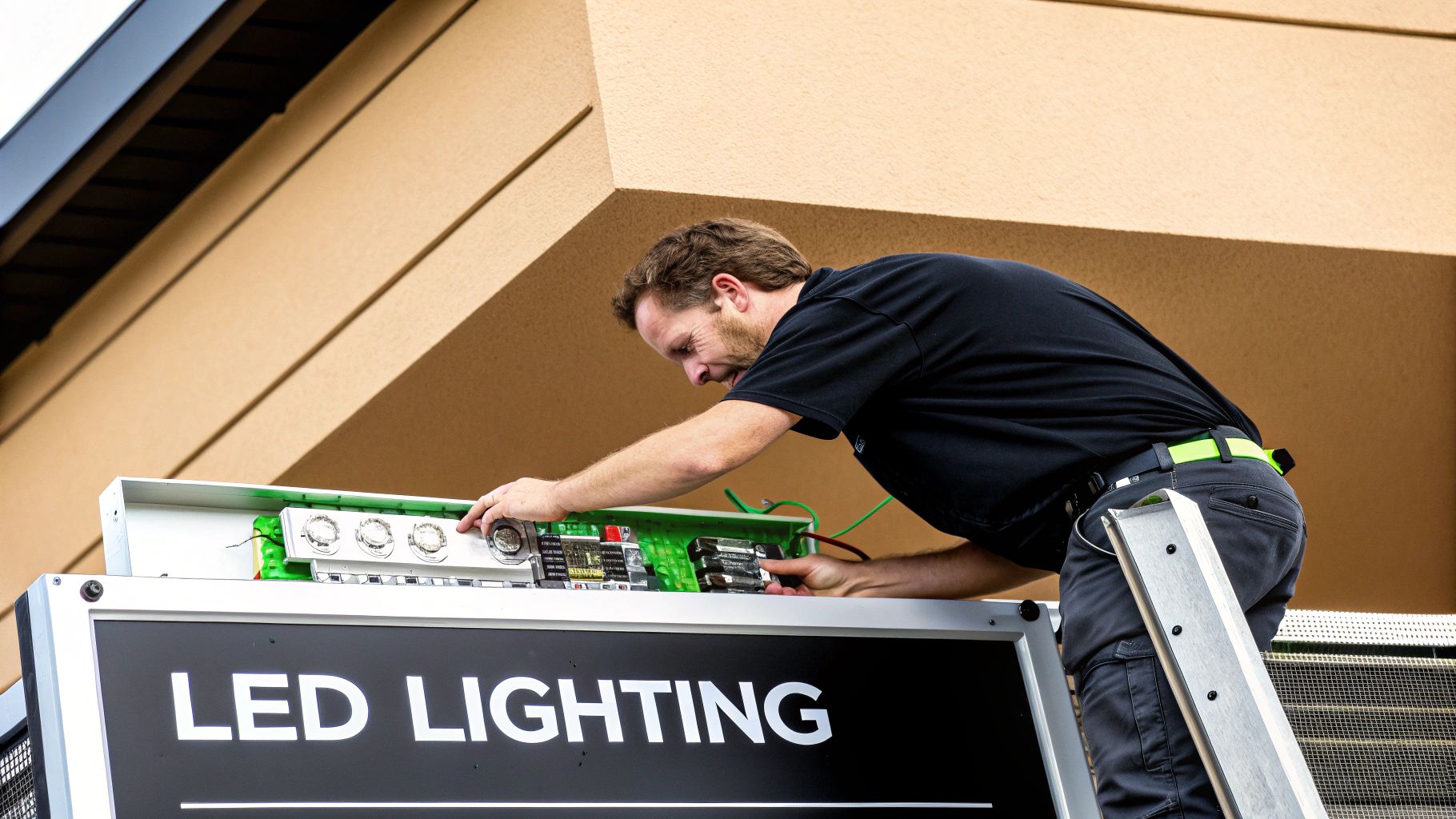
The "light" in your outdoor light box sign is what does all the heavy lifting. It’s the engine that turns a static sign into a 24/7 beacon for your business, and understanding the tech behind the glow is key to making a smart investment.
Just like we've all swapped out old incandescent bulbs for efficient smart lighting at home, the sign industry has made a huge leap forward. The undisputed champ today is LED (Light Emitting Diode) technology, which has made older, flickering fluorescent tubes pretty much obsolete.
Choosing LED isn't just about following a trend; it's a solid business decision. The benefits show up directly in your bank account through lower energy bills, a better-looking sign, and far less downtime for maintenance.
Why LED Is the Clear Winner
LEDs are now the industry standard for some very good reasons. They blow fluorescent lighting out of the water in every area that matters to a business owner: efficiency, lifespan, and overall quality of light.
Think of it this way: fluorescent tubes are like an old, clunky desktop computer. Sure, they got the job done, but they were inefficient, prone to problems, and are now completely outdated. LEDs are the sleek, modern laptop—powerful, dependable, and built to perform for years.
That upgrade has a real impact on your bottom line. LEDs draw about 75% less power than fluorescent tubes, which can save a business anywhere from $500 to $1,000 a year on a single sign. Considering these signs often pay for themselves in 12-18 months just from increased business, those energy savings are pure profit.
Understanding Lighting Styles: Backlit vs. Edge-Lit
Beyond just choosing LEDs, you’ll also want to know how the light is arranged inside the sign. The two main approaches are backlit and edge-lit, and each one creates a slightly different look.
-
Backlit Illumination: This is the most common and powerful method. LED modules are laid out in a grid right behind the sign face, blasting light forward. This setup guarantees a bright, perfectly even glow across your entire graphic, with no weird shadows or dim spots. For maximum punch and visibility from a distance, backlighting is the way to go.
-
Edge-Lit Illumination: With this technique, the LEDs are placed along the inside edges of the sign box. The light then travels across a special light-guiding panel to illuminate the graphic. This is often used to create thinner, sleeker signs, but it’s usually best for smaller applications where keeping the brightness perfectly even is less of a challenge.
For the vast majority of outdoor light box signs, a backlit setup is the superior choice for its incredible consistency and brightness.
Key Takeaway: A backlit LED system delivers the most vibrant, uniform, and reliable illumination. It ensures your brand looks sharp and professional, whether it’s noon or midnight.
The Long-Term Value of Quality Components
While an LED light box might have a slightly higher upfront cost than an old-school fluorescent one, the long-term value is undeniable. High-quality LED modules are rated to run for 50,000 hours or more.
That’s over a decade of continuous use without having to think about replacing bulbs or dealing with the flickering and burnouts that plague fluorescent signs. Less maintenance means fewer headaches and lower costs, letting your sign do its job without interruption. When you start digging into the options, looking at different digital sign and LED display solutions can give you a better sense of what’s possible for your business.
Designing a Sign for Maximum Impact
A bright outdoor light box sign is useless if no one can read it. Great design is what separates a glowing box from a powerful marketing tool that actually stops traffic and brings people inside. The only goal here is to get your message across instantly, whether it's noon or midnight.
This brings us to the famous "5-Second Rule" of signage. Think about someone driving past your building. You have about five seconds—tops—to get their attention and tell them who you are. If your sign is a jumbled mess, that chance is gone for good.
The Foundation of Readability: Fonts and Colors
When it comes to a light box, your font choice is not up for debate. This is no time for fancy script, decorative, or thin fonts that look great up close but vanish from ten feet away. You need bold, clean, sans-serif fonts like Helvetica, Arial, or Franklin Gothic. Their simple, uniform letters are easy for the brain to process in a split second, especially when lit from behind.
Just as critical is the contrast. I've seen countless signs that look fantastic in the daylight but turn into an unreadable glowing blob once the sun goes down. Don't make that mistake.
- High-Contrast Palettes: Stick with the classics that are proven to work. A dark background (think black, deep blue, or forest green) paired with light text (white or yellow) is the gold standard for visibility at night.
- Color Psychology: Color does more than just grab attention; it sets a mood. A restaurant might lean into warm reds and oranges to feel more inviting, while a law firm might choose a calm, professional blue to build trust.
A sign's design isn't just about making something pretty; it’s about instant communication. Your font and color choices are the two most important decisions you'll make for a sign that works 24/7.
Mastering Negative Space for Clarity
One of the most common design blunders is trying to cram too much information onto a sign. When you pack it with logos, taglines, and phone numbers, the entire message gets lost in the noise. This is where negative space—the empty area around your design elements—becomes your best friend.
Think of negative space as breathing room for your message. It isolates the important stuff, forcing the viewer's eye right to your business name. A cluttered sign is confusing, but a sign with plenty of open space feels clean, confident, and easy to understand.
A busy restaurant, for example, should stick to its name and maybe a simple tagline like "Italian Kitchen." A professional office would just focus on the firm's name. In both cases, less is always more. For a deeper dive, our guide on exterior building signage design has even more practical tips.
If you’re looking for inspiration on how to make a truly unforgettable first impression, check out some creative reception entrance ideas that leverage LED walls and custom lighting. The same principles that create a stunning entrance apply directly to designing a sign that demands attention from the street. By prioritizing simplicity, contrast, and smart illumination, your light box sign will become a tireless marketing machine for your business.
Navigating Permits, Installation, and Upkeep
Once you’ve nailed down the design, the real-world work begins. This is where you move from the drawing board to the practical realities of getting your outdoor light box sign installed and keeping it in top shape. It’s all about navigating local rules, ensuring a rock-solid installation, and setting up a simple maintenance plan.
A lot of business owners are shocked to find out they can’t just put up a sign anywhere they please. Most cities have strict zoning laws and sign codes that control everything from size and height to how bright your sign can be. Trying to sidestep these rules is a recipe for disaster—think hefty fines and being ordered to tear it all down.
This is exactly why a professional sign partner is so critical. They know the local regulations inside and out and will handle the entire permitting process, making sure your sign is 100% compliant from day one.
Demystifying the Sign Permitting Process
Getting a permit for your light box sign isn’t optional; it’s the essential first step. Local zoning departments aren't trying to make your life difficult. Their job is to protect public safety, maintain property values, and keep the community looking good. When they review your application, they're checking to see if your sign plays by the rules.
Here’s what they’re typically looking at:
- Size and Scale: Codes will often cap the total square footage of your sign based on how much of your building faces the street. For instance, a town might allow 1 square foot of signage for every linear foot of storefront.
- Placement and Setbacks: There are firm rules on how far a sign needs to be from the road, property lines, and other signs to avoid creating clutter or blocking views.
- Brightness (Luminance): To prevent distracting drivers or annoying neighbors, most cities have limits on sign brightness, usually measured in nits or foot-candles.
- Electrical and Structural Safety: All the blueprints must follow building and electrical codes to guarantee the sign is wired safely and attached securely.
Trying to navigate this bureaucratic maze on your own can be a nightmare. A professional sign company will survey your property, create compliant engineering drawings, and submit the full application package for you.
Professional Installation and Long-Term Upkeep
As soon as the permit is in hand, it’s time for installation. Let’s be clear: this is not a weekend DIY project. A professional crew has the specialized equipment and know-how to mount your sign safely, handling all the electrical work to code. The factors that go into a quality sign installation are much the same as those for choosing a professional company for outdoor lighting installation—it's all about safety, expertise, and durability.
A proper installation protects your building from damage and ensures your sign can handle whatever Mother Nature throws at it. But the job isn't done just because the sign is lit. A little routine care goes a long way.
A simple maintenance checklist can extend the life of your sign significantly. Regular cleaning, checking for secure connections, and ensuring the internal components are free of debris will protect your investment and keep your brand shining brightly.
The impact of a well-lit sign is hard to overstate. For places like churches or warehouses that need to stand out, illuminated displays are a game-changer. A 2023 study found that illuminated signage can boost brand awareness by a massive 47% over non-lit signs. For events, that kind of visibility can attract 20-50% more attendees.
This simple graphic breaks down the three core principles that should guide your design from the very start.
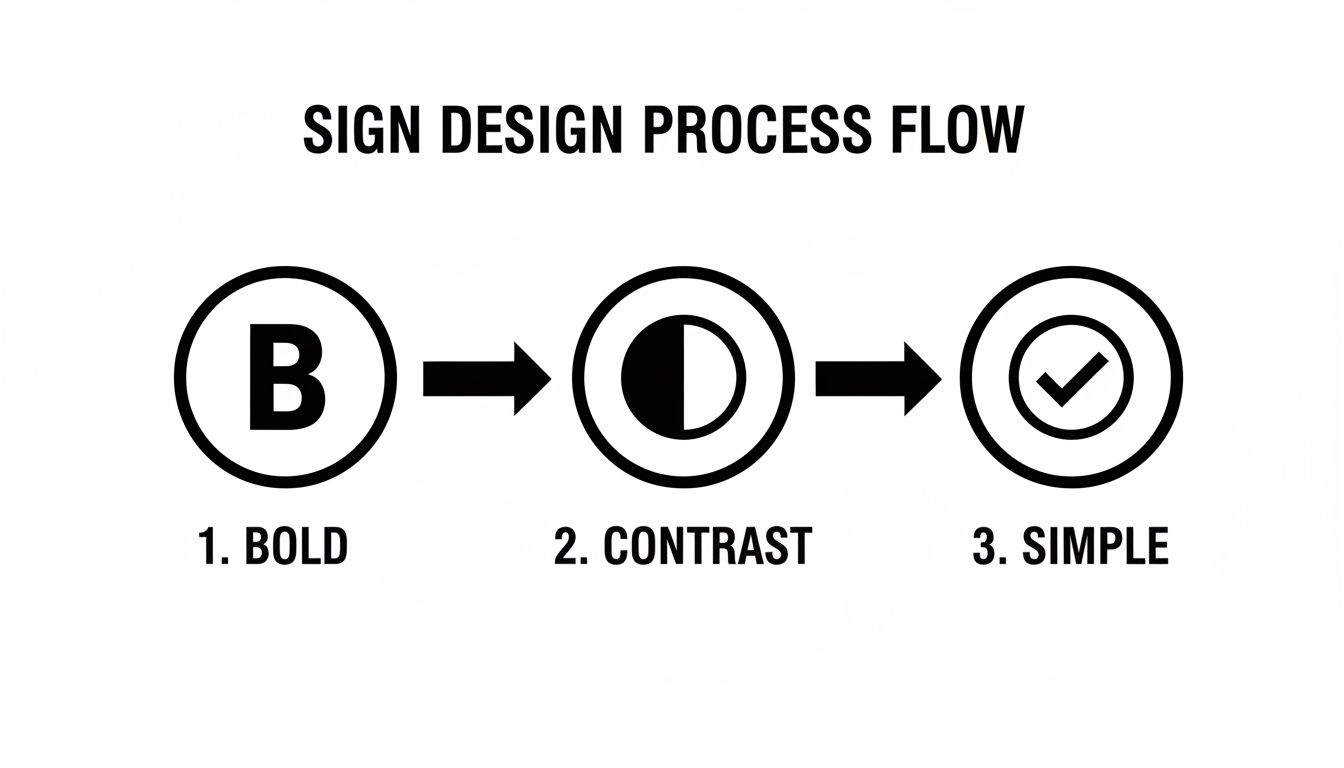
It all comes down to this: a great sign has to be bold, high-contrast, and simple enough for someone to read and understand in a matter of seconds.
Understanding the Costs and Your Return on Investment
When you’re looking at an outdoor light box sign, it’s easy to get stuck on the initial price. The smart move is to stop thinking of it as a “cost” and start seeing it as an investment. This isn’t just another expense; it’s a one-time purchase that becomes a relentless, 24/7 advertisement for your business.
Unlike a newspaper ad that gets tossed or a digital campaign that expires, your light box sign shows up to work every single day and night. It’s a permanent marketing asset that becomes one of the hardest-working parts of your business, constantly building brand recognition without any recurring fees.
Breaking Down the Initial Investment
The price of an outdoor light box sign isn't pulled out of a hat. Several key factors directly influence the final cost, which means you can tailor a solution that fits your budget without sacrificing quality. Once you understand the variables, you can see exactly where your money is going.
Here’s what drives the cost:
- Sign Size and Shape: It’s simple—larger signs or custom shapes require more materials and labor, which increases the price.
- Materials Used: Choosing a high-impact polycarbonate face will cost more upfront than standard acrylic, but its durability pays off big time in the long run.
- Design Complexity: A straightforward, text-only sign will be more budget-friendly than one featuring an intricate, multi-colored logo that demands more production time.
- Installation Logistics: The specifics of the install matter. Things like the sign's height, site accessibility, and the complexity of the electrical work all play a role in the final labor costs.
An outdoor light box sign isn't an expense—it's an investment in permanent visibility. It works around the clock to attract customers, often paying for itself within the first couple of years through increased foot traffic and brand recognition.
Calculating Your Return on Investment
The real value of a light box sign is measured by its return on investment (ROI), and this isn't just marketing fluff. A quality illuminated sign is one of the most effective advertising tools out there, directly impacting how customers find and choose you.
For instance, studies consistently show that adding a new illuminated sign can boost a business's sales by 15% to 150%. Think about a local restaurant that invests $5,000 in a new light box. If that sign brings in just a few extra tables each night, it could easily generate over $10,000 in new revenue in its first year alone, paying for itself twice over.
Long-Term Value and Profitability
Consider this: renting a billboard can set you back thousands every month, with no guarantee you’re even reaching the right people. A quality light box sign is a one-and-done purchase that becomes a permanent fixture, working for you for a decade or more.
With today's efficient LEDs keeping energy bills incredibly low and durable materials minimizing maintenance, the ongoing cost is next to nothing. This makes the light box sign one of the most cost-effective marketing tools you can buy, delivering a powerful and sustained return that strengthens your brand year after year.
Common Questions About Light Box Signs
It's smart to have questions before investing in a new sign for your business. We get it. Here are some of the most common things business owners ask us about outdoor light box signs, with straight answers to help you make the right call.
How Long Will an LED Outdoor Light Box Sign Last?
A well-built LED light box sign is made to be a workhorse. The LED lights inside are typically rated for 50,000+ hours of use. That’s more than a decade of bright, consistent performance, even if you keep it running 12 hours every single day.
As for the sign itself, the cabinet is usually built from weather-resistant aluminum with a tough acrylic or polycarbonate face designed to stand up to the elements for years. With a little routine cleaning, you can realistically expect your sign to look sharp and represent your brand for 10 to 15 years, maybe even longer.
Can I Change the Graphic on My Light Box Sign Later?
Of course—and that’s one of their best features. The whole point of the design is that the sign face with your branding on it is completely replaceable. This is perfect for when you rebrand, add new services, or want to shout about a big seasonal sale.
A sign professional can easily create and slide a new translucent graphic into your existing cabinet. It makes refreshing your look incredibly cost-effective because you don't have to pay for a whole new sign unit.
The ability to swap out graphics makes your outdoor light box sign a flexible, long-term asset. You can keep your messaging fresh and relevant as your business evolves, all while using the same durable hardware.
Is a Light Box Sign Still Effective During the Day?
Absolutely. Don't think of it as just a nighttime sign. A professionally designed light box works 24/7 to get you noticed.
In broad daylight, it acts just like a high-quality traditional sign, with bold colors and crisp graphics that pop on their own. Then, once the sun goes down, the lights kick on to make sure your message shines bright while all the unlit signs around you disappear into the dark. It’s a true round-the-clock marketing tool.
What Is the Difference Between a Custom and a Standard Light Box?
Think of it like buying a suit. Standard light boxes are like buying off the rack—they come in common square or rectangular sizes and do a fantastic job for many businesses on a budget. A custom light box, however, is tailored to fit you perfectly.
Customization means we can build a sign in a unique shape—like a circle, an oval, or something totally unique to your logo. We can also color-match the frame to your building’s trim or build it to the exact dimensions needed to fit into a specific architectural space. It’s how you make your sign a seamless part of your building's design.
Ready to make your brand impossible to ignore? The experts at On Display Signs, Inc. manage every detail, from design to installation, to create the perfect outdoor light box sign for your business. Get in touch with our team today.