Think of your outdoor signage as your hardest-working employee. It’s on the clock 24/7, greeting every potential customer and making the very first impression of your business long before they ever step inside.
It’s not just a sign—it’s a powerful marketing tool that directly impacts whether someone walking by decides to stop in or keep on moving.
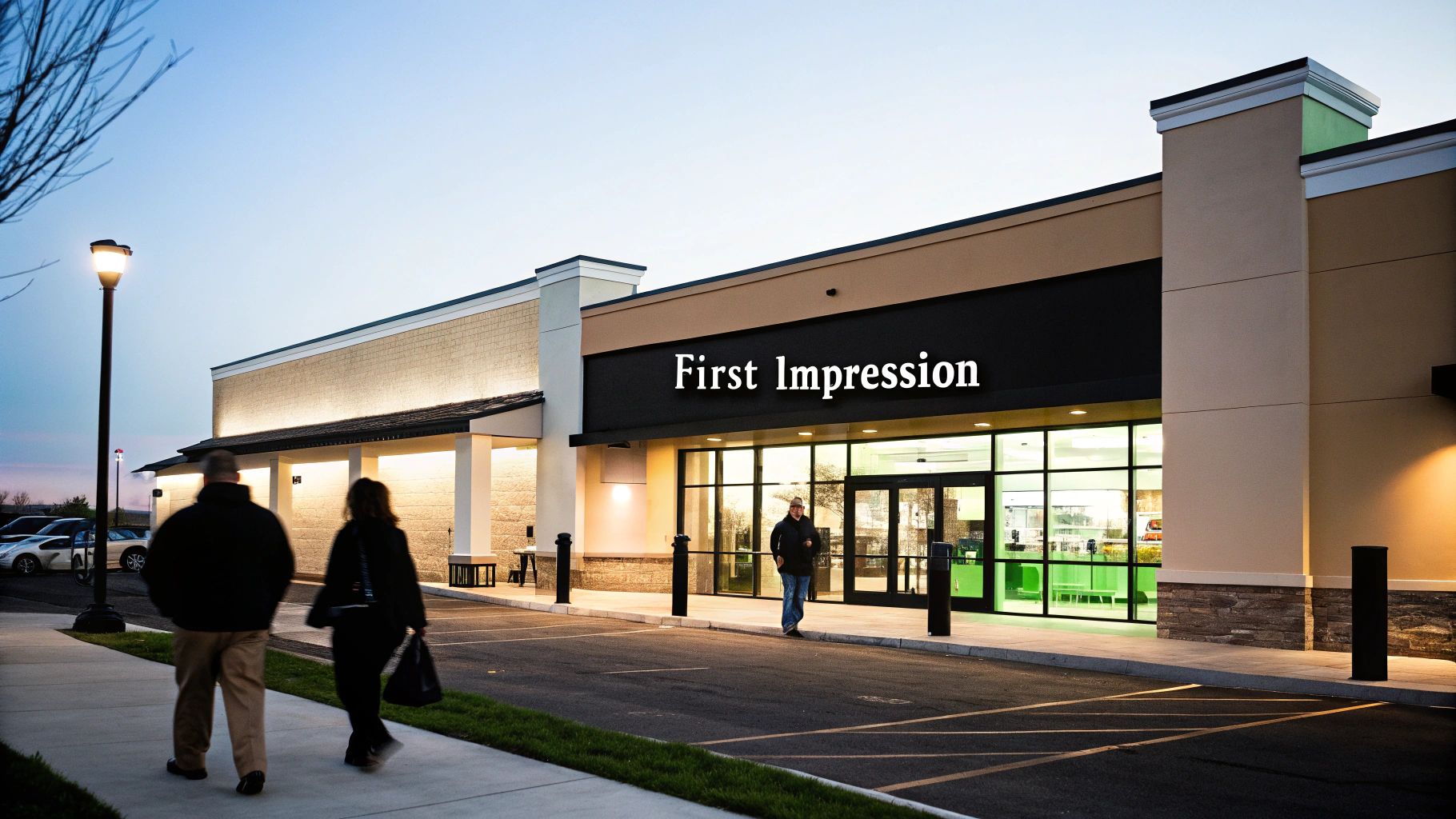
Why Your First Impression Is Made Outdoors
Your sign is more than just a marker with your name on it; it’s the opening statement for your entire customer experience. A clean, professionally designed sign instantly communicates competence and builds trust from the curb.
On the flip side, what does a faded, cracked, or poorly lit sign say about the business? It suggests a lack of care, and that crucial first judgment is made in a matter of seconds.
The Silent Salesperson at Work
When done right, your outdoor sign becomes a constant beacon for your brand. It quietly gets several critical jobs done that feed directly into your bottom line, acting as a strategic asset that does more than just point the way.
Here’s how it works for you:
- Driving Foot Traffic: For any retail store or local service business, a compelling sign is often the number one reason for a spontaneous visit. It has the power to turn a casual passerby into a paying customer. We cover this in-depth in our guide on how to increase retail sales.
- Building Brand Recognition: Constant, consistent exposure to your logo and name cements your business in the minds of the community. Outdoor signage is one of the most tangible and effective brand awareness strategies you can invest in.
- Setting You Apart: On a crowded commercial street, your sign is what makes you stand out from the noise. It’s your chance to visually shout what makes your business different and better than the competition next door.
Actionable Insight: A FedEx Office study found that nearly 76% of consumers said they had walked into a business they’d never visited before based solely on its signs. This means three out of four new walk-ins could be driven by your sign alone, making it one of the most powerful customer acquisition tools you have.
Ultimately, investing in high-quality outdoor signage is an investment in your company’s growth. It's your first, and often best, chance to tell the world who you are and why they should care.
Choosing the Right Sign for Your Business Goals
Picking the right outdoor sign isn't just about choosing a design you like. It’s a strategic move. The sign needs to match your business goals, your physical location, and the kind of customer you want to walk through your door. The right sign for a quiet law firm in an office park is completely different from what a fast-food joint on a busy highway needs.
Think of your sign like a tool. You wouldn't use a hammer to turn a screw, right? In the same way, you don't use a subtle, low-profile sign when your goal is to grab the attention of fast-moving traffic. Getting this match right is the first step toward a smart investment.
Aligning Signage with Location and Objective
The success of any sign comes down to context. Where you are and what you want customers to do are the two biggest factors. A business tucked away inside a crowded shopping center faces very different challenges than a standalone shop on Main Street.
For instance, a small boutique in a walkable downtown area might get the most bang for its buck with a projecting blade sign that catches the eyes of people on the sidewalk. But a massive warehouse set way back from the road needs a tall pylon sign just to help delivery trucks and visitors find the entrance.
To make this easier, we put together a quick cheat sheet to help you connect your business needs with the right sign type.
A Quick Guide to Selecting Your Outdoor Sign
This table breaks down the most common sign types to help you quickly identify which one aligns with your specific goals, location, and desired brand image.
| Sign Type | Best For | Common Placement | Key Advantage |
|---|---|---|---|
| Pylon Sign | Capturing high-speed traffic and maximizing visibility from a distance. | Along highways, major roads, and at the entrance to large shopping centers. | Unbeatable height and long-distance visibility. |
| Monument Sign | Projecting an image of stability, professionalism, and permanence. | At the entrance to corporate offices, professional firms, and medical facilities. | Conveys authority and a high-end, established presence. |
| Channel Letters | Bright, 24/7 brand identification directly on your storefront. | Retail stores in strip malls, restaurants, and businesses on commercial streets. | Professional, highly legible, and excellent for nighttime visibility. |
| Digital (LED) Sign | Communicating timely, dynamic information like sales, events, and specials. | Integrated into pylon or monument signs, or as a standalone display. | Instantly updatable content that grabs attention and drives action. |
Now, let's dig into the specifics of when and why you'd choose each of these powerful options.
Pylon Signs: The Highway Lighthouse
For any business located off a major road or highway, visibility is everything. This is where the pylon sign shines. It acts like a lighthouse, rising high above the visual clutter to guide customers right to you.
These are the tall, freestanding signs you see held up by one or two big poles. Their height makes them impossible for drivers to miss, even at high speeds.
- Practical Example: A hotel, gas station, or cluster of restaurants located right off a highway exit. A shopping plaza uses a giant pylon sign at its entrance, with panels for each major store. It lets drivers see exactly who is in the plaza long before they need to turn, making it an easy decision to pull in.
Monument Signs: Projecting Permanence and Prestige
When you want your business to feel established, professional, and high-quality, a monument sign is the perfect fit. These are ground-level signs, often built with substantial materials like brick, stone, or architectural metal.
They aren't about shouting from a distance; they're about making a strong, sophisticated statement right at your entrance.
Actionable Insight: Monument signs are often associated with established institutions because they communicate permanence and credibility. They tell potential clients that your business is a stable, long-term fixture in the community.
- Practical Example: A modern dental practice puts a sleek monument sign with soft, halo-lit letters at the edge of its parking lot. It creates a welcoming, high-end first impression before patients even get out of their cars. This is also a perfect choice for corporate campuses, professional services like law or accounting firms, and upscale apartment communities.
Channel Letters: The Modern Storefront Standard
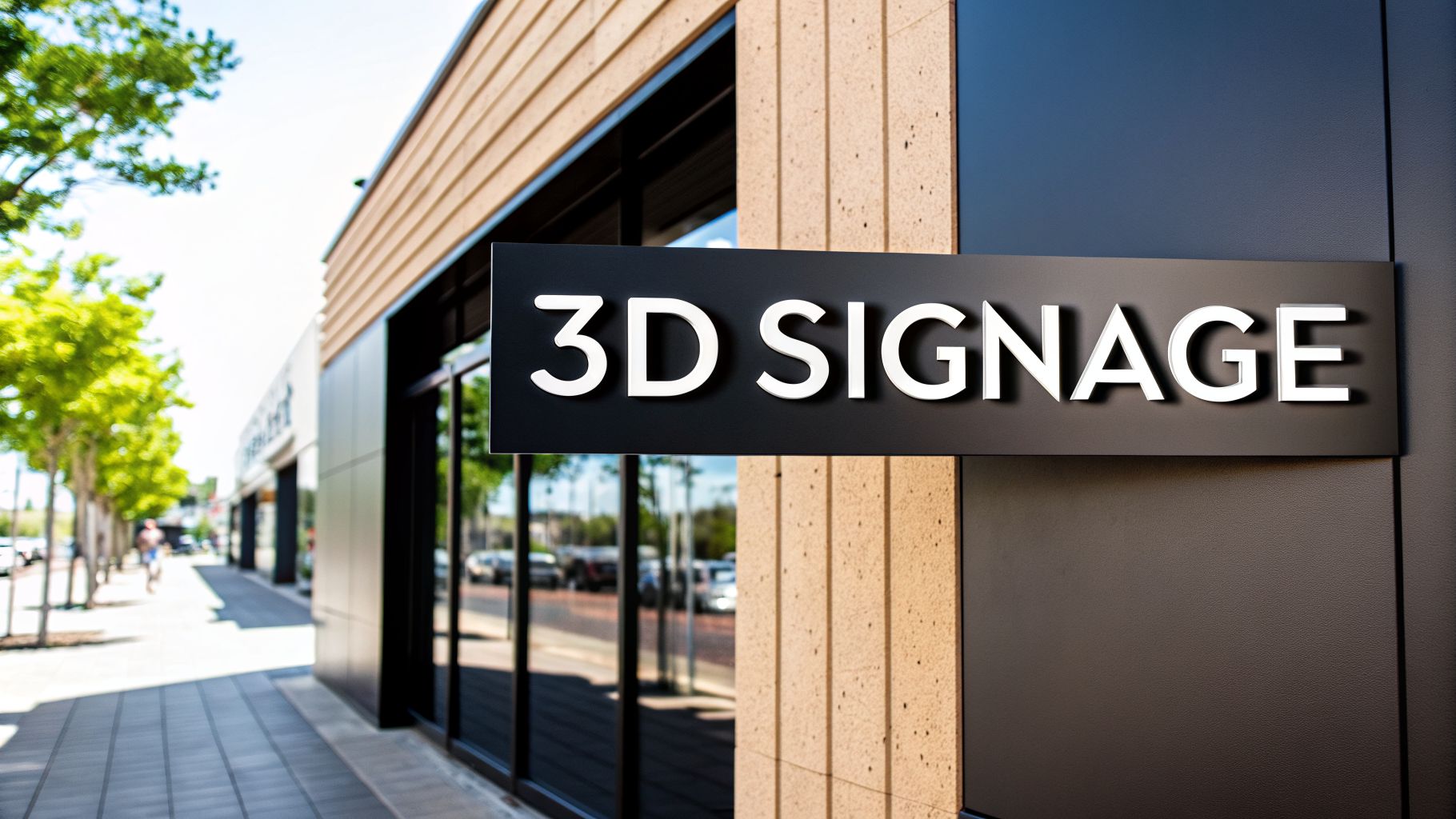
For signage mounted directly onto your building, channel letters are the go-to for a clean, professional, and incredibly visible look. These are individual, 3D letters, often lit from the inside, that create a crisp and eye-catching sign, especially after dark.
They are hugely popular because you can customize the font, color, and lighting to fit your brand perfectly. With illuminated channel letters, your business name is clear and readable around the clock.
- Practical Example: A new restaurant downtown uses bold, red, front-lit channel letters. The bright, clear sign makes the name pop against the neighboring storefronts, immediately drawing the eyes of hungry passersby. This makes it ideal for retail shops in a strip mall and any business on a commercial street that gets foot traffic in the evening. If you want to see more options, you can explore the different types of outdoor signs for business out there.
Digital Signs: Dynamic and Action-Oriented
If your business thrives on sharing timely information—daily specials, upcoming events, or flash sales—nothing beats a digital sign or Electronic Message Center (EMC). These LED signs let you change your message instantly from a computer.
This ability to update content on the fly turns your sign from a static nameplate into a dynamic marketing machine. It’s perfect for grabbing attention with compelling, can’t-miss offers.
- Practical Example: A local hardware store uses its digital pylon sign to promote a weekend sale on mulch. That bright, animated message catches the attention of commuters all week, driving a huge spike in traffic and mulch sales over the weekend. This is also a highly effective tool for restaurants advertising lunch specials, schools announcing events, and churches sharing service times.
Selecting Materials That Last and Shine
An outdoor sign is a long-term investment. Its ability to stand up to the elements while looking great comes down to two things: the materials it’s made from and how it’s lit. Getting this combination right isn’t just about looks; it’s a strategic choice that affects durability, maintenance, and the sign's lifetime value.
Think of it like building a house—you wouldn't use cheap materials in a place with harsh weather and expect it to hold up. The right materials will handle sun, rain, and wind for years, preventing the faded, cracked look that makes a business seem neglected.
This quick decision tree can help you match your main goal—whether it's raw visibility, on-site impact, or dynamic messaging—to the right starting point for your sign.
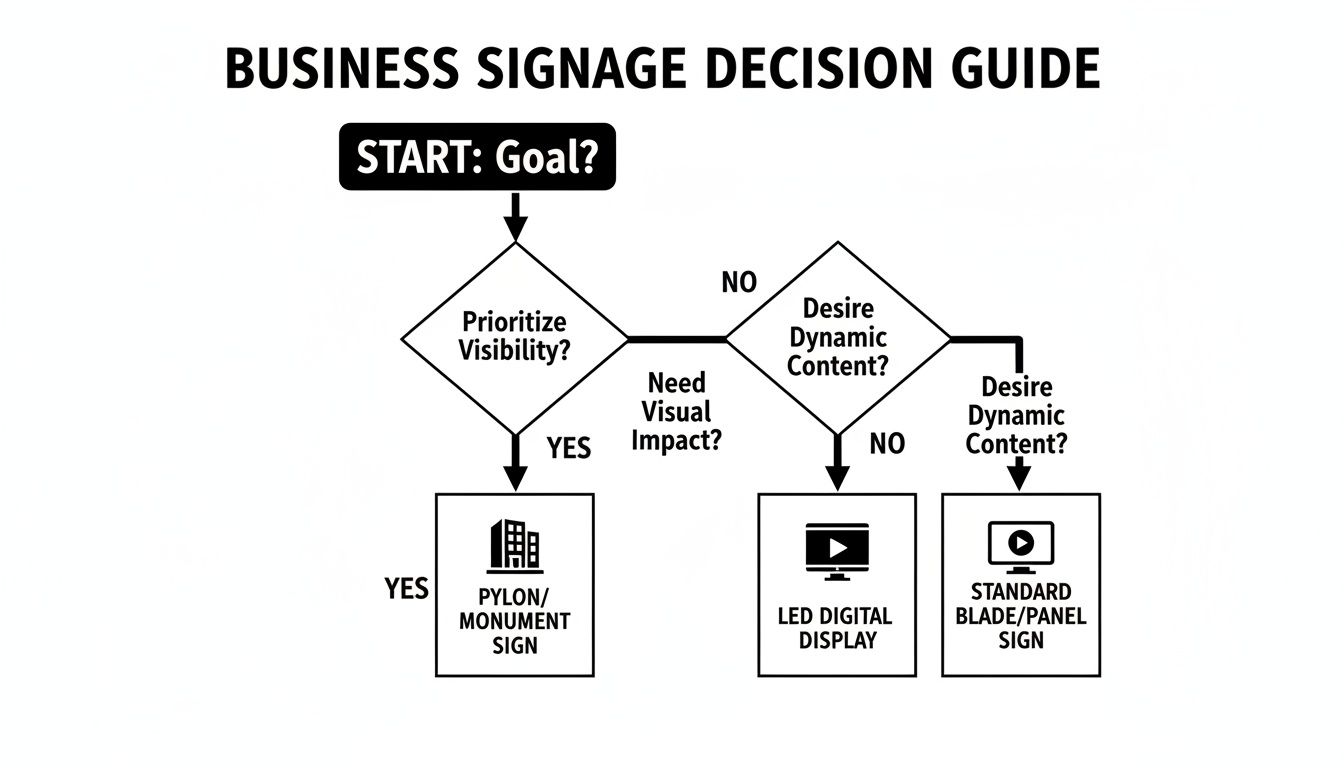
As the guide shows, the best sign solution always starts with a clear objective. That focus will point you toward the right format for your specific needs.
Common Materials for Outdoor Signage
When it comes to building a sign that lasts, a few materials are the industry’s go-to workhorses. Each has a different mix of durability, appearance, and cost, making them a good fit for different jobs and environments.
- Aluminum: Lightweight, strong, and naturally rust-proof, aluminum is one of the most popular choices out there. It’s the backbone for everything from simple flat panels to complex channel letter cabinets.
- Acrylic: Known for its glass-like clarity and top-notch weather resistance, acrylic is perfect for the faces of illuminated signs and dimensional lettering. It diffuses light beautifully, creating a smooth, even glow that’s easy on the eyes.
- High-Density Urethane (HDU): HDU is a rigid, waterproof foam that’s a fantastic modern alternative to wood. It can be carved, sanded, and painted to create dimensional signs with a classic, high-end feel, but without the risk of rot or insect damage.
Actionable Insight: For businesses in coastal areas with salt in the air, powder-coated aluminum is the superior choice. The powder coating creates a durable, protective barrier that dramatically extends the sign's life by preventing corrosion that would quickly damage other materials.
The Power of Illumination
A sign you can’t see at night is only doing half its job. Good illumination makes sure your business is visible 24/7, grabbing attention long after the sun goes down. Today, one technology dominates the world of sign lighting for some very good reasons.
LEDs (Light-Emitting Diodes) are now the undisputed standard for modern illuminated signs. They are far superior to old-school tech like fluorescent tubes or neon.
Here’s why LED is the clear winner:
- Energy Efficiency: LEDs use way less electricity than their predecessors. That translates directly into lower monthly operating costs for your business.
- Longevity: With lifespans often exceeding 50,000 hours, LEDs need far less maintenance and fewer replacements, saving you money and hassle over the long run.
- Superior Brightness: They produce a crisp, bright light that cuts through the dark and makes your sign pop with vibrant, consistent color.
Creating an Upscale Glow
How a sign is lit can completely change its personality. A great practical example is the difference between standard front-lit letters and a more subtle approach.
For a luxury brand, like a high-end spa or a boutique law firm, halo-lit letters (also known as back-lit letters) are a fantastic option. With this method, the LEDs are placed inside the letters and shine backward onto the building wall. This creates a soft, elegant glow around each letter, suggesting sophistication and quality without being overly loud. It’s a perfect way to make a refined, memorable statement.
You can explore a variety of exterior sign materials and lighting options to find the perfect match for your brand's image.
Mastering Sign Design and Strategic Placement
An effective outdoor sign isn’t just about being seen—it's about being understood in a split second. This takes a smart mix of thoughtful design and strategic placement, especially when you’re trying to grab the attention of people who are constantly on the move.
Think of it this way: your sign is in a constant battle for eyeballs with every other distraction on the street. To win, it has to deliver its message with absolute, undeniable clarity. The principles that make this happen are simple but incredibly powerful, turning a basic marker into a magnet for customers.
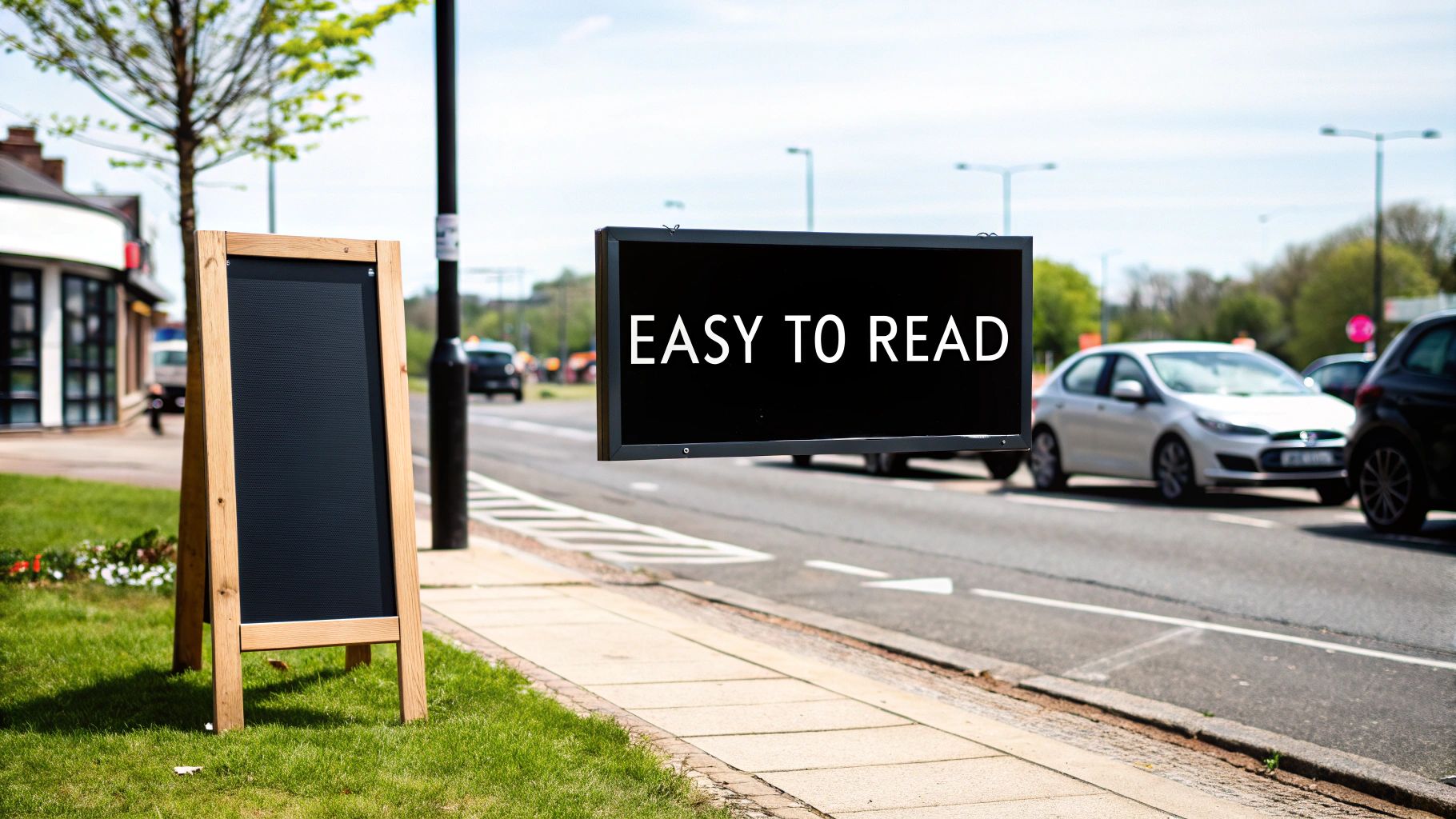
Design for Instant Readability
The single most important job of your outdoor signage for business is to be readable at a glance. Drivers, cyclists, and pedestrians don't have time to stop and decipher a complicated message. This is where the "five-second rule" comes into play—you have about five seconds to communicate who you are and what you offer.
To nail this, every single design element needs to work together for maximum clarity.
- High-Contrast Colors: Use colors that pop against each other. You can't go wrong with classics like black on white, yellow on black, or white on blue. They create strong visual separation that makes text easy to read from far away.
- Simple, Legible Fonts: This is not the time for fancy script fonts. Stick to clean, bold san-serif fonts (like Helvetica or Arial) or strong serif fonts (like Garamond) that hold up well from a distance.
- Strategic Use of White Space: Don't cram your sign full of information. That empty space around your logo and text—often called white space—is critical for helping the important elements stand out. A crowded sign is an unreadable sign.
The market backs this up. The outdoor printed signage market is a serious business, currently valued at $34.65 billion and on track to hit $57.09 billion by 2030. This boom shows just how much businesses are relying on high-impact physical signs to cut through the noise. You can dig deeper into the growth of the outdoor printed signage market to see what's driving this trend.
Choosing the Perfect Placement
Where you put your sign is just as important as what it says. You could have the most beautifully designed sign in the world, but if it’s in the wrong spot, it’s completely useless. The goal is simple: position it for the best possible view from the angles your customers will be approaching.
Start by analyzing the sightlines. Literally walk and drive the routes leading to your business from every direction. Are there trees, other buildings, or even the afternoon sun blocking the view?
Actionable Insight: The best placement ensures your sign is seen early and clearly, giving people enough time to react—whether that's slowing down, changing lanes, or deciding to pull into your lot.
Think through these key placement factors:
- Optimal Height: Your sign needs to be high enough to clear parked cars and other common obstacles but not so high that it’s outside a driver’s normal field of vision.
- Setback from the Road: Local zoning laws will tell you how far your sign must be from the property line (the setback). Work within these rules to get the sign as close to traffic as legally possible for the biggest impact.
- Traffic Patterns: Is your business on a one-way street? Near a busy intersection? Face your sign toward the oncoming flow of traffic where drivers will have the most time to see it.
For example, a cafe in a dense, walkable downtown area would get huge value from a projecting blade sign. It sticks out from the building, catching the eye of pedestrians looking down the sidewalk. On the other hand, a large industrial warehouse set way back from the highway needs a tall, simple pylon sign whose only job is clear, long-distance identification for cars. For more inspiration, check out our guide on sign design ideas.
Navigating Permits and Local Compliance with Ease
Putting up new outdoor signage for business isn't as simple as just picking a design you love and hanging it on the wall. Before any hammer hits a nail, you have to work through the maze of local permits, zoning codes, and compliance standards. This part of the process can feel like a headache, but it’s absolutely essential for keeping your project legal, safe, and on track.
These rules aren't just red tape; they exist for good reasons, mainly public safety and community aesthetics. They make sure signs are built to last, won't topple over in a storm, and don’t block a driver's view of an intersection. They also help keep commercial areas from turning into a chaotic mess of visual clutter.
The Permit Approval Journey Explained
Think of the permitting process as a pre-flight check for your sign. While the exact steps will differ from one city to the next, the journey is pretty predictable. A professional sign company will handle all this for you, but knowing what’s happening behind the scenes helps you understand the timeline.
Here’s what the typical approval process looks like:
- Initial Design & Code Review: Your sign partner will check your design against local zoning ordinances right away. This flags any potential red flags—like size, height, or lighting—before anything gets submitted.
- Application Submission: A formal application package goes to the local planning or building department. This isn't just a form; it includes detailed drawings, material specs, and site plans showing exactly where the sign will go.
- Plan Review: City officials then pore over the application, making sure it meets all structural, electrical, and zoning requirements.
- Permit Issuance: Once everything checks out, the city issues the official permit. This is the green light to start building and installing your sign.
- Final Inspection: After the sign is up, a city inspector will come to your location to make sure it was installed exactly as described in the approved plans.
Understanding Common Zoning and ADA Rules
Zoning codes are the local rulebooks that dictate the specifics of what you can and can't do. These rules can feel restrictive, but they’re designed to create a level playing field for every business in the area.
Actionable Insight: A common mistake is assuming the rules are the same everywhere. A sign that’s perfectly legal in an industrial park could be completely forbidden in a historic downtown district. Always verify the rules for your specific address with a professional sign company.
The key regulations usually cover a few main areas:
- Sign Size: The total square footage you're allowed is often tied to your building's street frontage.
- Height: There are always maximum height limits, especially for freestanding pylon and monument signs.
- Illumination: Some zones might ban flashing lights or put caps on brightness levels to keep signs from becoming a distraction.
- Setbacks: These rules tell you how far your sign needs to be from the curb, property lines, and nearby intersections.
Beyond the local stuff, the Americans with Disabilities Act (ADA) has its own standards for signs that identify permanent rooms or spaces to ensure they're accessible. While this is more common for interior signs, it can definitely apply to exterior ones, like those marking accessible entrances. These signs need specific features like tactile lettering and must be mounted at the proper height.
The world of digital signage is booming, and it has its own growing list of rules. The outdoor digital signage market hit $40.3 billion in 2023 and is expected to climb to $55.7 billion by 2032. As these signs become more common, staying current on compliance is more important than ever. You can learn more about the steady growth path of outdoor digital signage on DigitalSignageToday.com.
Understanding the Cost and ROI of Your Signage Investment
The smartest way to approach signage is to see it as a strategic investment, not just another expense on a spreadsheet. A high-quality piece of outdoor signage for business isn't a cost you try to slash; it’s a powerful asset that’s supposed to generate a return. Making the right call means taking a clear-eyed look at what you’ll spend upfront and what you’ll get back over the long haul.
There’s no simple price tag for a sign because every project is different. The final cost is shaped by a handful of key variables, and understanding them is the first step to setting a realistic budget and knowing exactly where your money is going.
Key Factors That Influence Sign Costs
The investment needed for your sign comes down to a few interconnected choices. Every decision you make, from the materials you pick to whether or not you add lighting, has a direct impact on the final quote.
- Design Complexity: It’s simple, really. A basic flat-panel sign is going to cost less than one with intricate, multi-layered dimensional letters and a custom-shaped logo. The more complex the design, the more skilled labor it takes to bring it to life.
- Materials and Size: Your choice of materials—like aluminum, acrylic, or high-density urethane—is a major cost driver. Bigger signs obviously use more material, but they also demand more structural support, which adds to the bottom line.
- Illumination: Adding LED lighting is one of the most effective things you can do for visibility and ROI. Whether it’s front-lit, halo-lit, or a full-blown digital display, lighting increases the initial investment but makes your sign work for you around the clock. It's almost always worth it.
- Fabrication and Installation: The hands-on work of building and professionally installing the sign is a big part of the cost. A complex pylon sign that needs a concrete foundation and a crane to set it in place is a much larger investment than channel letters mounted directly onto your building’s facade.
Actionable Insight: Think of your sign as your hardest-working employee. It's out there for you 24/7, making impressions. An effective sign is often your most cost-effective marketing tool, delivering a lower cost-per-impression than you'll ever get from traditional radio or print ads.
Measuring the Return on Your Investment
So, how do you actually know if the money you spent is paying off? While it might seem tough to track, you can absolutely measure the ROI of your outdoor sign by watching a few key business metrics. The goal is to see a real, tangible lift in business that you can tie directly back to your new sign.
First, look for an increase in foot traffic. After the new sign goes up, keep an eye on your daily customer count. A noticeable, sustained bump is the clearest signal that your investment is pulling new people through the door.
Next, track your new customer acquisition. An easy way to do this is to simply ask new customers how they found you. If you start hearing "I saw your sign" more and more, you’ve got direct proof that it's working.
Finally, consider improved brand recognition. This one is a bit harder to put a number on, but a strong sign builds awareness and authority in your local community. That long-term benefit makes all your other marketing efforts more effective. For a deeper dive into budgeting, you can read more about the cost of signage for a business.
This growing reliance on physical advertising is reflected in market trends. The global outdoor signage market was valued at $43.30 billion in 2024 and is projected to reach $64.31 billion by 2035, driven by urbanization and new advertising solutions. Discover more insights about the outdoor signage market's growth on MarketResearchFuture.com.
Frequently Asked Questions About Business Signage
When you’re thinking about a new sign, a lot of practical questions come up. How long is this going to take? What’s the upkeep like? How do I handle this if I have more than one location?
Getting these answers sorted out from the beginning makes the whole process smoother and ensures you end up with a sign that does its job without any nasty surprises.
How Long Does It Take to Get a New Outdoor Sign
From the day you approve the final design to the moment your new sign is installed, you’re typically looking at a timeline of four to eight weeks. That window covers all the crucial steps: locking in the design, getting the materials, building the sign, and navigating the local permitting process.
Of course, a simpler sign might get done faster. But for more involved projects, like a monument sign that needs a new concrete base poured, it’s smart to plan for the longer end of that timeframe.
Actionable Insight: The single best way to keep your project on track is to work with a full-service sign company. An experienced partner manages everything—especially the permit applications, which are notorious for causing delays—and keeps the project moving forward without costly hiccups.
What Kind of Maintenance Does an Outdoor Sign Need
The good news is that modern signs are built tough. They use low-maintenance materials like aluminum and acrylic that are designed to stand up to whatever the weather throws at them. For the most part, all your sign needs is a gentle wash with mild soap and water once or twice a year to get rid of the usual dust and grime.
If your sign is illuminated, a little proactive care goes a long way. We always recommend an annual check-up on all the electrical parts and wiring. It’s a quick inspection that helps keep everything running safely and lets you catch small issues before they turn into big headaches. While today's LED lights last for ages, this simple step ensures you get the absolute most out of your investment.
Can I Use the Same Sign Design for Multiple Locations
Absolutely—and you should! It’s one of the most powerful ways to build a strong, recognizable brand. A professional sign company can manage a multi-site rollout to make sure your logo, colors, and overall design look exactly the same from one location to the next.
The key thing to remember is that while your brand design is consistent, the sign’s physical specs often need to change. Each building is different, and every town has its own zoning laws. An experienced sign partner knows how to solve this. They'll create a brand style guide and then adapt the sign's size, type, and mounting for each specific site, giving you perfect brand consistency that’s also fully compliant with local codes.
Ready to create outdoor signage that drives traffic and makes a lasting impression? The experts at On Display Signs, Inc. manage the entire process, from design and permitting to fabrication and installation, ensuring your brand stands out. Start your sign project with us today!