Your school's outdoor signs are far more than just markers. Think of them as your most reliable, hardworking ambassadors—the ones working 24/7 to welcome students, guide visitors, and broadcast your school's identity to the entire community. A great sign strategy isn't about just putting up signs; it's about building a powerful communication system.
Why Your School Needs a Strategic Signage Plan
Think of your outdoor signs as the very first handshake with every student, parent, and community member. Long before anyone steps through the front door, your signs are communicating a message about your school's standards and professionalism. A thoughtful, cohesive plan turns a random collection of signs into your campus's voice.
And this isn't just a local school priority; it’s a major global shift. The outdoor advertising market, which includes outdoor signs for schools, was valued at US$27 billion in 2020 and is on track to hit US$33.1 billion by 2026. This boom shows just how much educational institutions are leaning on physical signs to improve safety, boost school spirit, and connect with their communities.
Building Your School's Identity and Community
Effective signs are the foundation for a strong school identity and a real sense of belonging. A handsome monument sign at your main entrance creates a feeling of permanence and pride. Cohesive wayfinding signs make a large campus feel welcoming and easy to navigate, not intimidating. This guide is built to give administrators and facility managers the practical, step-by-step advice you need to get it right.
A sign is never just a sign. It is the voice of your campus, speaking to everyone who passes by. It can project confidence, create a sense of safety, and build school pride all at once.
This guide will walk you through everything, from picking the right types of signs to understanding materials, navigating the permit process, and planning for maintenance down the road. You’ll get the real-world knowledge needed to make smart decisions that serve your students, staff, and community for years. For instance, knowing how digital displays work can completely change your ability to share urgent news or celebrate student achievements. You can learn more about the role of digital signage in education in our detailed article.
Here's what we’ll cover:
- Sign Types: How to choose between monument, pylon, digital LED, and wayfinding signs.
- Materials & Durability: Picking materials that can stand up to weather, sun, and time.
- Permits & Compliance: Making sense of local zoning laws and ADA requirements.
- Budgeting & Maintenance: How to plan for the total cost of ownership, not just the upfront price.
How to Choose the Right Type of Outdoor School Sign
Choosing the right outdoor sign for your school isn't about picking the biggest or fanciest option. It's about matching the sign to a specific job. Every sign on your campus should have a clear purpose. Is it there to make a prestigious first impression, announce this week's football game, or just help a new parent find the main office?
Think of your outdoor signs as a communication toolkit. You wouldn’t use a loudspeaker to give one-on-one directions, and you wouldn’t use a static sign to announce daily updates. Understanding what each type of sign does best is the first step toward building a signage system that truly works for your campus.
A Comparison of Common Outdoor School Sign Types
To make the decision clearer, it helps to see how the most popular options stack up against each other. Each sign type has a distinct strength, and this table breaks down where each one shines.
| Sign Type | Primary Use | Ideal Placement | Key Benefit |
|---|---|---|---|
| Monument Sign | Creating a prestigious first impression; establishing brand identity. | At the main vehicle entrance, set back slightly from the road. | Conveys permanence, quality, and a strong sense of place. |
| Pylon Sign | Gaining long-distance visibility for the entire campus. | Near a main road, especially if the school is set back or obscured. | Acts as a landmark, making the campus impossible to miss. |
| LED Message Center | Displaying dynamic, real-time news, events, and alerts. | Along high-traffic drop-off/pickup lanes or main thoroughfares. | Unmatched for timely communication and community engagement. |
| Wayfinding Signs | Guiding vehicle and pedestrian traffic once on campus. | At key intersections, walkways, and building entrances. | Reduces confusion and creates a welcoming, easy-to-navigate environment. |
By starting with your primary goal—whether it's to welcome, announce, or guide—you can quickly narrow down the best tool for the job.
Creating a Prestigious Welcome with Monument Signs
A monument sign is the official handshake of your campus. It’s a low-profile, freestanding structure, often built from materials like brick, stone, or stucco that match your school’s architecture. Placed at your main entrance, it projects an image of stability, tradition, and pride.
This is the sign that creates a memorable first impression for prospective families and sets the tone for your entire campus. Because they are built to last, monument signs become a true landmark for the community.
- Practical Example: A private K-8 academy installs a new brick monument sign at its main driveway. It features classic, dimensional lettering with the school's name and crest, instantly communicating quality. Its low height is clearly visible to drivers without blocking sightlines.
Gaining Visibility from a Distance with Pylon Signs
While monument signs anchor your entrance, pylon signs are all about being seen from far away. These are the tall, pole-mounted signs that rise above trees, buildings, and other visual clutter. If your school is set back from a busy road or has an entrance that’s easy to miss, a pylon sign is your beacon.
It acts as a landmark, grabbing attention from a block away and guiding visitors straight to you. For a large high school or a sprawling college campus, this kind of visibility is essential.
A well-placed pylon sign can be the difference between a visitor feeling lost and a visitor arriving with confidence. It’s your campus’s primary locator for anyone trying to find you from a distance.
Announcing News with Digital LED Message Centers
For day-to-day communication, nothing comes close to a Digital LED Message Center. Think of it as your school’s own broadcast system. These electronic signs let you push out updates instantly from a computer, making them the workhorse of modern school communication.
They are the most powerful tool for getting timely information to parents and students, especially during the daily rush of drop-off and pickup. Think of all the messages you need to get out:
- Event Promotion: Announce the upcoming play, the next home game, or parent-teacher conferences.
- Important Deadlines: Remind everyone about registration dates, scholarship applications, and spirit wear orders.
- Urgent Alerts: Instantly broadcast school closures for bad weather or other emergency notifications.
- Student Recognition: Celebrate the debate team's victory, honor roll students, or the athlete of the week.
An LED sign ensures your key messages are seen by hundreds of people every day, keeping your community connected and informed. If you want to explore the different styles available, our guide on the primary types of outdoor signs for business offers a great overview.
This simple flowchart helps visualize how to connect your goal to the right sign.
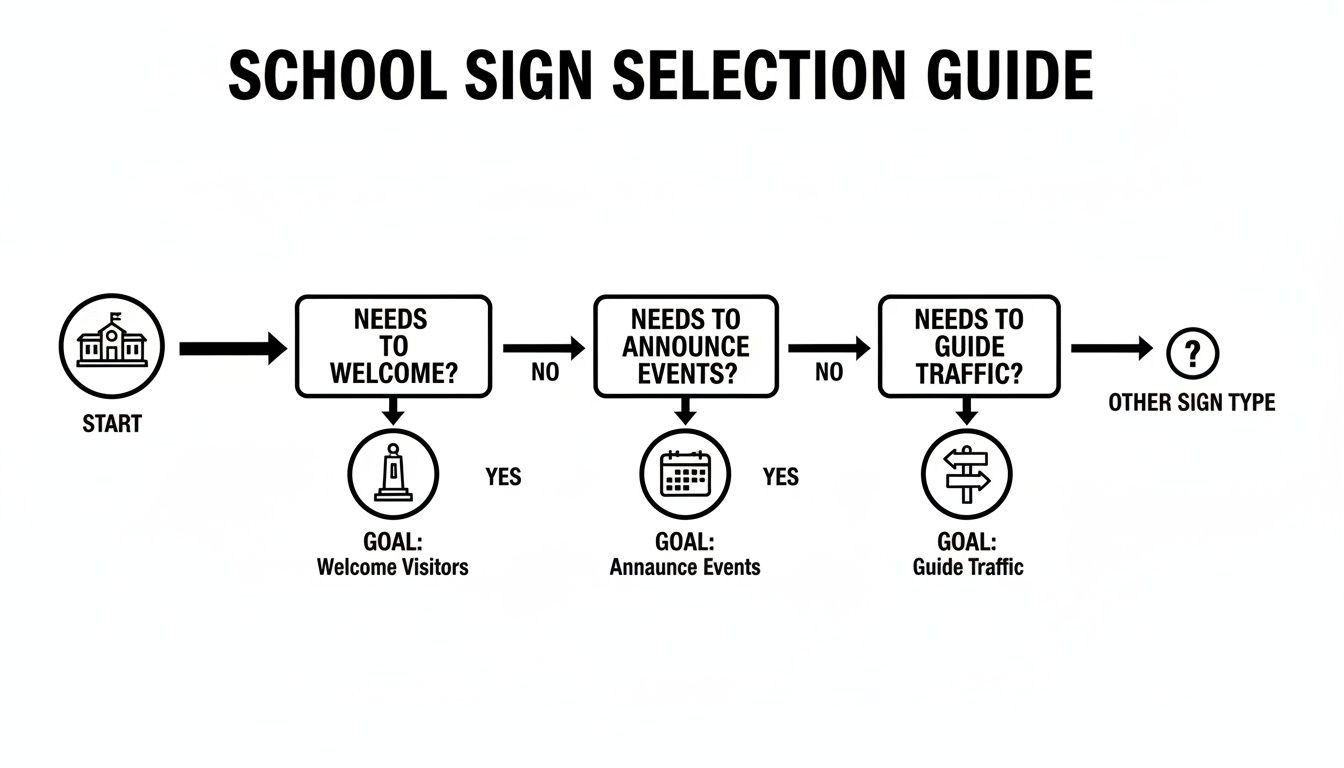
As you can see, the moment you define your primary need—to welcome, announce, or guide—the best solution becomes clear.
Guiding Visitors with a Wayfinding System
Once visitors are on your property, a smart wayfinding system is what keeps them from getting lost. This isn't about a single sign; it's a family of signs that work together to create a stress-free experience. This system includes everything from directional signs pointing to the gym and main office to campus maps and signs designating visitor parking.
A good system makes your campus feel intuitive and welcoming.
- Practical Example: A large high school campus was notorious for being confusing. They installed a new wayfinding system using the school's colors and a consistent font on every sign. Taller post-and-panel signs direct cars at intersections, while smaller, pedestrian-level signs guide people along walkways, clearly marking building numbers and athletic fields. The new system immediately reduced confusion for new students and made event parking a breeze.
Selecting Materials Built for Durability and Value
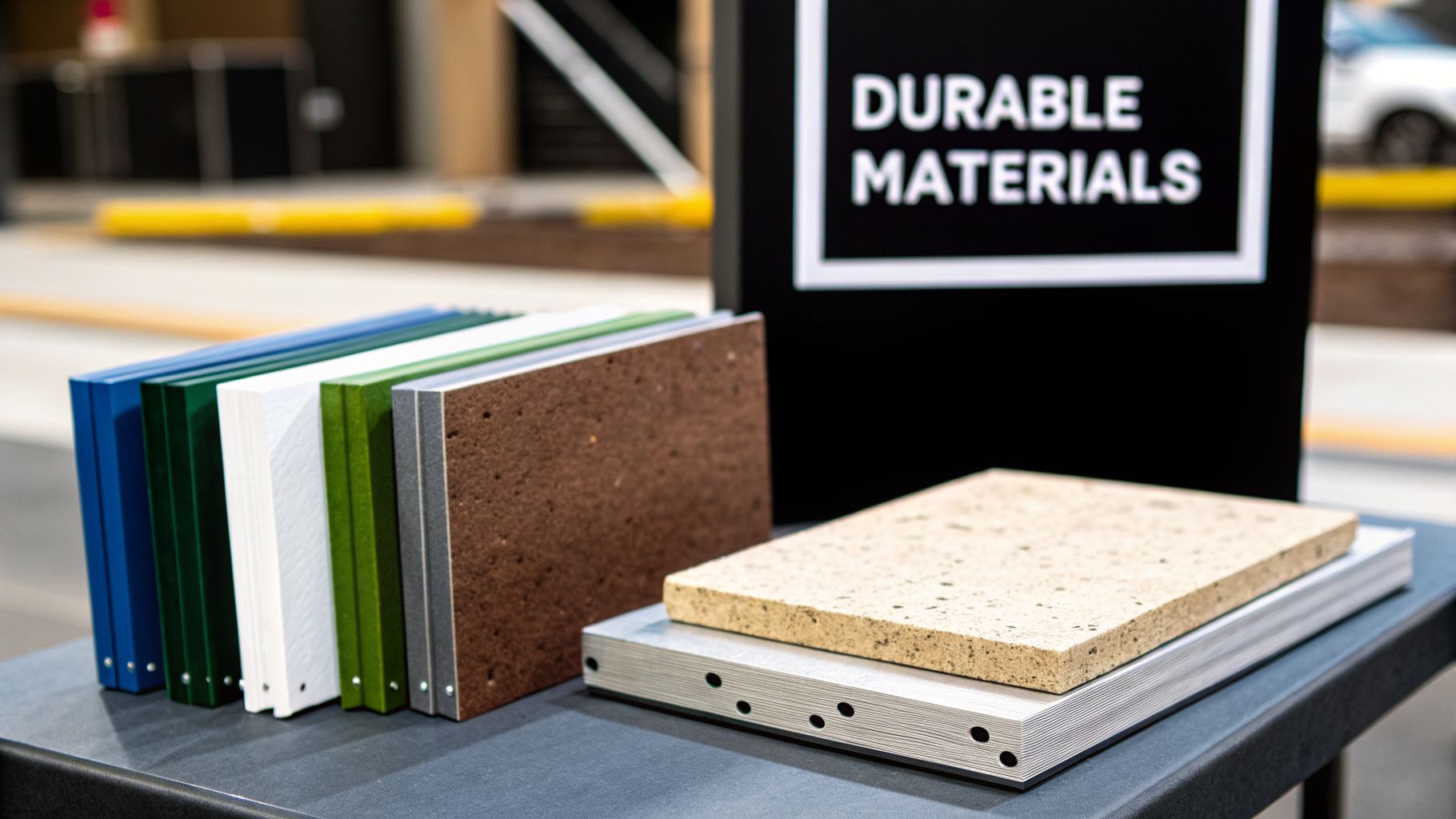
Think of an outdoor school sign as a long-term capital investment, not a quick purchase. Its ability to stand up to sun, wind, rain, and snow year after year comes down to one thing: the materials it’s made from. A smart choice today prevents headaches and costly repairs down the road, ensuring your campus looks professional and welcoming for decades.
It's like choosing a new roof for a school building. You wouldn't pick the cheapest shingles knowing they’ll leak after the first big storm. The same logic holds true for your sign; durability is the real measure of value. The key to maximizing your investment is prioritizing materials built to handle your specific climate.
Core Materials for Structure and Stability
The skeleton of your sign—its internal structure and base—is the most critical part. These are the components that bear the weight and face the elements 24/7, so they have to be tough.
- Aluminum is a workhorse for sign faces and letters. It’s strong, lightweight, and most importantly, will not rust. It’s also incredibly versatile, ready for paint or digital prints to perfectly match your school’s branding.
- Steel provides the raw strength needed for the internal framework of massive pylon signs. It’s a beast, but it needs to be properly treated and coated to keep rust at bay, especially if you’re in a humid or coastal area.
- High-Density Urethane (HDU) is a game-changing alternative to wood. This waterproof composite can be carved and shaped to create stunning dimensional signs, but unlike wood, it will never rot, crack, or become a snack for insects.
- Masonry (Brick & Stone) creates a timeless, authoritative look for monument sign bases. These materials communicate permanence and can be selected to match your campus buildings for a truly integrated feel.
When you're weighing your options, it really helps to have a grasp of the fundamentals. Taking a few minutes for some background reading on understanding different material properties can make the conversation with your sign partner much more productive.
Graphics and Finishing Materials
The part of your sign that people actually read—the graphics, lettering, and colors—has to be just as resilient as its structure. Nothing undermines a school's image faster than faded colors and peeling letters.
The market for outdoor printed signage, crucial for things like event banners and wayfinding graphics, is a massive $25 billion USD industry. It’s projected to hit $31.36 billion by 2025 precisely because schools and businesses demand weather-resistant signs that stay vibrant and clear.
Choosing the right materials is about anticipating the future. A sign built with rust-proof aluminum and fade-resistant inks will look just as good on its tenth anniversary as it did on day one.
For example, a school near the coast battling salty air should insist on powder-coated aluminum and marine-grade finishes to stop corrosion in its tracks. Meanwhile, a school in a northern climate with brutal winters needs a sign that can handle freeze-thaw cycles, making a solid masonry base a smart, stable choice. Our guide on the best material for outdoor signs offers more great insights.
A Practical Comparison of Sign Materials
Choosing your material is always a balance between looks, budget, and long-term performance. This simple table breaks down the most common options to help guide your decision.
| Material | Best For | Durability | Maintenance Needs |
|---|---|---|---|
| Aluminum | Sign faces, letters, and smaller signs. | High (rust-proof) | Low |
| HDU Foam | Dimensional letters and carved designs. | High (waterproof) | Very Low |
| Brick/Stone | Monument sign bases. | Very High | Very Low |
| Acrylic/Polycarbonate | Illuminated sign faces. | Medium-High (impact resistant) | Periodic cleaning |
At the end of the day, the most effective school signs are almost always a hybrid, built with a smart combination of materials. By working with a sign expert, you can spec out a sign that not only looks fantastic but also delivers an incredible service life and real value for your school.
Navigating Permits, Zoning, and Installation
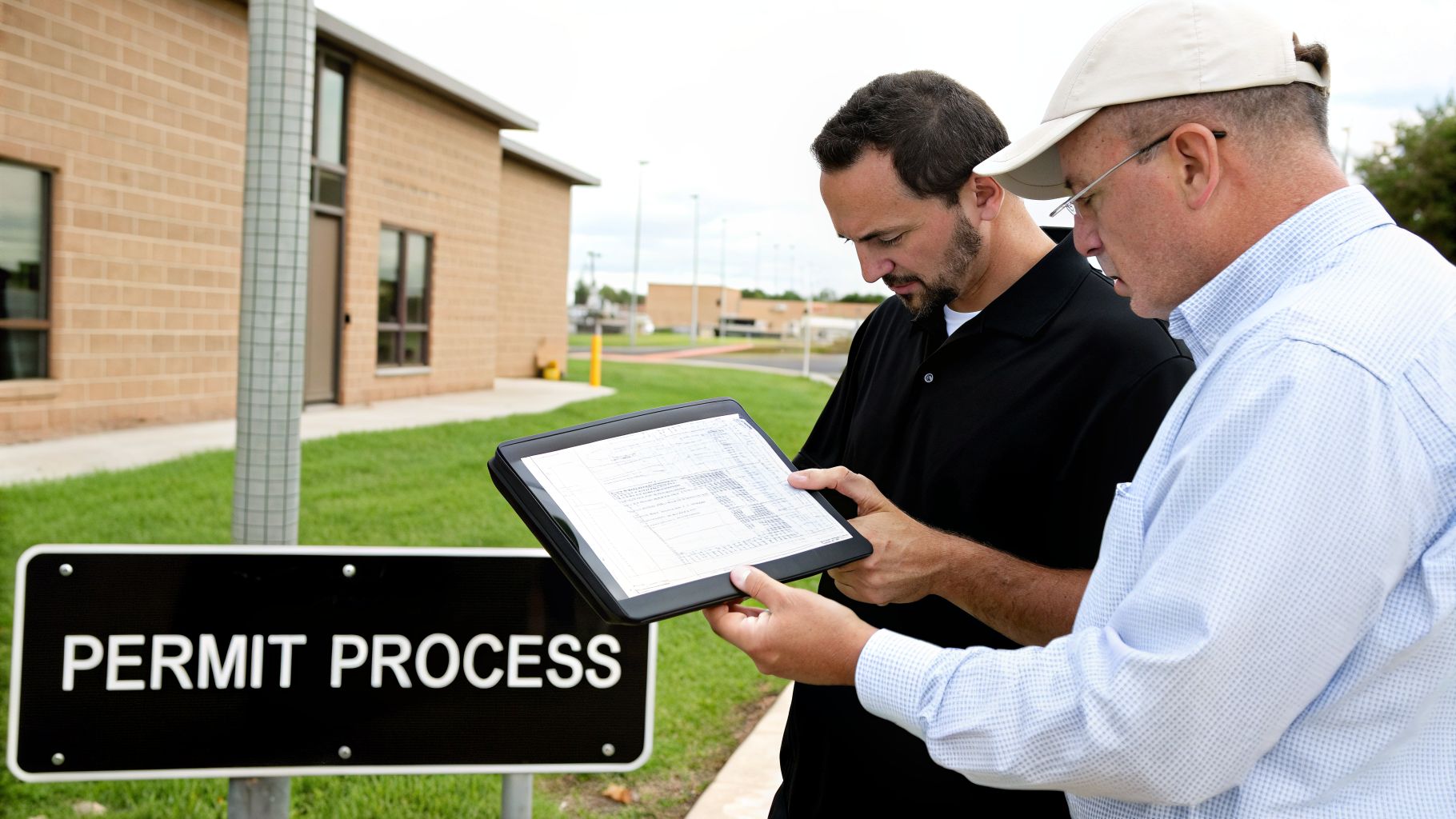
The journey to a beautiful new school sign goes far beyond just design and manufacturing. Before any dirt is moved, you have to navigate a maze of local regulations. Think of it like getting building permits for a new wing of the school—it’s a non-negotiable step that ensures everything is safe, legal, and built to last.
Trying to bypass these rules is a recipe for disaster. It can lead to hefty fines, orders to tear the sign down, and frustrating delays that throw your entire project off schedule.
This part of the process isn't just about cutting through red tape; it’s about protecting your school's investment. A professional sign partner will handle every bit of this for you, turning what could be a major headache into just another seamless step in the project.
Understanding Local Zoning and Sign Codes
Every single city, county, and township has its own rulebook for signs. These are called zoning ordinances or sign codes, and they dictate exactly what you can build, where you can build it, and what it can look like. Before you fall in love with a grand design for your outdoor signs for schools, you have to make sure it’s even allowed.
These rules typically cover a few key areas:
- Height and Size Limits: Municipalities put caps on how tall and wide signs can be. For example, a towering pylon sign might be limited to 25 feet, while a ground-level monument sign may have a much lower height restriction.
- Setback Requirements: This is all about placement. The rules will specify how far your sign must be set back from the road, sidewalks, and property lines. Placing a sign even a few inches too close to the curb is a common mistake that can lead to a violation.
- Illumination Rules: For LED signs, many areas have strict rules on brightness levels or ban flashing animations altogether to avoid distracting drivers.
- ADA Compliance: Any signs used for identification or wayfinding must meet the Americans with Disabilities Act (ADA) standards. This ensures they are placed at the right height and are readable for everyone, making your campus truly accessible.
Think of your sign company as your project's legal navigator. A good partner does a full code check before the design is finalized, saving you from the costly mistake of fabricating a sign that can't be legally installed.
For a deeper dive into the nitty-gritty of this process, you can learn more about sign permit requirements in our guide.
The Step-by-Step Permitting and Installation Process
While the exact details change from one town to the next, the path to getting your sign permitted and installed follows a predictable blueprint. Before you can break ground, it's critical to understand the local rules and the associated building permit cost in Georgia to avoid surprises, as fees and timelines can vary wildly.
Here’s what you can generally expect:
- Code Research and Site Survey: Your sign partner starts by digging into the local zoning laws. Then, they’ll conduct a physical site survey to check for things like underground utility lines, overhead power lines, and any potential sightline problems.
- Permit Application: Next, they assemble and submit a detailed permit package to the city or county. This package is serious business, often including engineered drawings of the sign, a site plan showing its exact placement, and material specs.
- Review and Approval: The local planning or building department then reviews the application. This is often the longest waiting game in the whole process and can take anywhere from 4-8 weeks or more.
- Fabrication: Once the permit is officially approved, it’s full steam ahead. The sign is built in the workshop, following the approved drawings down to the last detail.
- Installation: Finally, the big day arrives. A professional crew handles the entire installation—digging the foundation, running any necessary electrical wiring, and carefully setting the finished sign in place.
Interestingly, this process connects to a much larger trend. As schools increasingly embrace learning outside the classroom, the demand for clear, compliant signage for nature trails and activity zones has skyrocketed. The global outdoor education market, valued at USD 538.6 billion in 2021, is projected to hit an incredible USD 1,110.63 billion by 2028.
Smart Budgeting and Maintenance for Your School Sign
A great school sign is a project, not just a purchase. To get it right, you have to look beyond the initial price tag and think about the sign as a long-term asset—just like a new section of bleachers or a playground. Smart financial planning is what ensures your sign isn't just impressive on day one, but remains a vibrant, effective tool for years.
Ignoring the total cost of ownership is a recipe for surprise expenses down the road. A little planning now protects your school's investment and keeps your sign from becoming a headache later.
Breaking Down the Total Cost of an Outdoor School Sign
When you get a quote for a new school sign, that final number is a blend of several key ingredients. It’s never just about the physical sign itself. Understanding what goes into that cost is the first step toward building a budget that makes sense.
Here are the main cost drivers you’ll see:
- Size and Complexity: This one’s straightforward. A massive pylon sign that towers over a busy road will naturally cost more than a simple, elegant post and panel sign near the entrance.
- Materials: Investing in premium materials—like a solid masonry base for a monument sign or high-grade aluminum—costs more upfront. But it almost always saves you money on repairs and replacements in the long run.
- Illumination: This is a major factor. Adding internal lighting or a full-color digital message center significantly impacts the price, but it also multiplies your sign’s visibility and turns it into a 24/7 communication hub.
- Installation and Permits: Professional installation is a critical part of the budget. This covers everything from site prep and pouring a foundation to running electrical. Don't forget to factor in permit fees, which can vary wildly depending on your local municipality.
Getting a clear picture of these variables from the start helps you avoid any sticker shock. For a deeper dive into the numbers, check out our guide on the cost of signage for business.
Planning for Maintenance and Long-Term Upkeep
Once your beautiful new sign is installed and shining, the work isn't quite over. Just like the school grounds need mowing and the buildings need care, your outdoor signs for schools need a proactive maintenance plan to protect their look and function.
A good plan is simple but consistent. Think regular cleaning to wash away dirt and grime, quick inspections for any damage after a big storm, and checking the connections on any illuminated or digital components.
A sign's warranty is its safety net, but a regular maintenance routine is its long-term health plan. Both are critical for protecting your investment and ensuring your sign represents your school well for its entire lifespan.
For example, a school with a digital LED sign should probably budget for the occasional service call or software update. Likewise, if you have a stunning monument sign, setting aside a small fund for future landscaping touch-ups or minor masonry repairs is a smart move.
Understanding Warranties and Financing Options
Any sign company worth its salt will stand behind its product with a solid warranty. This isn't just a piece of paper; it's a promise that the sign you paid for is free from defects in both materials and craftsmanship.
A strong warranty will typically cover three key areas:
- Structural Integrity: This guarantees the physical structure of the sign won't fail.
- Paint and Finishes: This protects against major fading, peeling, or chipping for a set number of years.
- Electrical Components: For any lighted or digital sign, this covers the crucial parts like the LEDs, power supplies, and wiring.
Let's face it, a major sign project can be a significant capital expense. That's why many reputable sign companies offer financing options to make the investment more manageable. This allows you to spread the cost over several years, folding it into your operational budget instead of needing one huge lump-sum payment. It makes a high-impact sign accessible without draining critical school resources.
Answers to Your Top Questions About Outdoor School Signs
When it's time to invest in a new outdoor sign, a lot of questions come up. It's a big decision, and you want to get it right. Let's tackle the big three that every school administrator asks, so you can move forward with your project confidently.
How Much Do Outdoor Signs for Schools Typically Cost?
This is always the first question, and the honest answer is: it varies, a lot like buying a car. You can get a simple, reliable sedan or a fully-loaded truck. A basic, non-lit post and panel sign might be a few thousand dollars, while a substantial monument sign with a custom brick base will often land in the $15,000 to $25,000 range.
Thinking about adding a dynamic digital message center? Those state-of-the-art signs typically start between $20,000 and $50,000 and can go up from there based on the screen's size and clarity.
The final number really comes down to a few key choices:
- Size and Impact: A tall pylon sign designed to be seen from the main road is a bigger investment than a small directional sign for the carpool lane.
- Materials: A classic brick or stone base feels permanent and substantial, but it costs more than a simpler aluminum structure.
- Features: Adding lighting or a digital display is what really drives the cost, but also the impact.
- Local Codes: Don't forget that permit fees and local labor costs will also factor into the final project total.
The best way to start is by defining what your sign needs to do and setting a realistic budget. From there, a sign professional can show you exactly what's possible within that range.
What Is the Most Durable Material for a School Sign?
A school sign is a long-term investment, so you want materials that are built to last for decades, not just a few years. For the structural foundation of a monument or pylon sign, nothing beats the sheer strength and weather resistance of masonry (like brick and stone) or precast concrete. They’re the gold standard.
For the sign panel and lettering itself, aluminum is the go-to choice. It’s strong, surprisingly lightweight, and will never, ever rust—a critical feature for any outdoor fixture. If you’re aiming for a more classic, carved look, High-Density Urethane (HDU) is a modern marvel. It’s a completely waterproof composite material that gives you the look of wood without any of the drawbacks like rotting, cracking, or peeling.
A sign built for longevity isn't an expense; it's smart asset management. For a school in a coastal town, prioritizing rust-proof aluminum and marine-grade coatings is a no-brainer. For a school in the Midwest, a solid masonry base that can handle constant freeze-thaw cycles without shifting is what will ensure your sign stands tall for years to come.
Your climate and your school's architectural style will point you toward the right materials. A good sign partner will help you choose the perfect combination to ensure your sign looks great and performs flawlessly for the long haul.
How Long Does It Take to Get a New School Sign Installed?
Getting a custom sign made is a lot like a small construction project. From the first conversation to the final installation, a realistic timeline is anywhere from 8 to 16 weeks. Sometimes, it can take longer depending on one key factor: permitting.
It's a process with a few distinct phases, and it's important to plan for each one.
- Design and Consultation (1-3 weeks): This is the fun part where you nail down the look, the materials, and the exact placement.
- Permitting (4-8 weeks): This is the wild card. Your sign company will create detailed engineering plans and submit them to your city or county. This approval process is often the longest part of the entire project.
- Fabrication (4-6 weeks): Once the permit is in hand, your sign is built from the ground up in the workshop.
- Installation (1-3 days): The final step! The crew prepares the site, pours the concrete footing, and expertly installs your new sign.
The biggest takeaway? The permitting process is unpredictable. That’s why it’s so important to start the conversation well before your target completion date—especially if you’re trying to get a new sign installed before the next school year begins.
Ready to create a lasting impression for your school? The team at On Display Signs, Inc. manages every step of the process, from initial design and permitting to expert installation and maintenance. Let us help you build a sign that strengthens your school's identity and connects with your community. Explore our custom sign solutions and get started today.