You’re probably doing what most owners, facilities managers, and developers do first. You open Google, type fastsigns near me, and look for the closest result with decent reviews and a clean website.
That search makes sense. FASTSIGNS is a well-known name, and its scale is a big reason it shows up so often. Founded in 1985 and franchising since 1986, FASTSIGNS had over 775 locations worldwide as of late 2023, including 689 centers in the U.S. That footprint is why a local result is usually easy to find when you search the brand name, according to Franchise Chatter’s 2025 FASTSIGNS review.
The mistake is treating that search result like a final answer.
A sign project rarely fails because someone couldn’t print a panel or fabricate letters. It fails because nobody pinned down the scope early enough. Landlord criteria get missed. Electrical planning is vague. Permits stall. An installer arrives without the right site info. A multi-location rollout turns into a chain of one-off local jobs with no central control.
Your "FastSigns Near Me" Search Is Just the Beginning

A franchise brand gives you brand familiarity, not automatic project fit. From a customer’s side of the table, that distinction matters. Two centers can carry the same logo and still differ in estimating discipline, permitting knowledge, subcontractor management, and how they communicate once a project gets complicated.
If your need is simple, such as a basic storefront panel with no landlord review and no electrical scope, a nearby shop may be enough. If your project touches a shopping center, a church campus, a warehouse, or several properties in different cities, proximity stops being the main decision point.
What a local search tells you and what it doesn’t
A local result tells you the company is nearby and active. It may also tell you whether they understand local visibility, which is useful because strong local businesses usually invest in their online presence. If you want to understand how local companies improve map visibility, this overview of Google Maps ranking strategies is a useful companion read.
What the search result doesn’t tell you is more important:
- Scope control: Can they manage design, fabrication, permit paperwork, installation scheduling, and punch-list follow-up as one process?
- Commercial readiness: Have they handled landlord packages, property management approvals, and code-driven revisions before?
- Rollout discipline: If you have several sites, can they keep branding consistent while dealing with different local rules?
- After-install support: When a sign needs service, who owns that issue?
Practical rule: Choose your sign partner based on the hardest part of your project, not the easiest part.
The better question to ask
Don’t stop at “Who’s near me?” Ask, “Who can get this done correctly with the fewest surprises?”
That shift changes everything. It moves you from shopping by distance to vetting by capability. It also helps you compare a local franchise location against regional and national providers on the issues that affect schedule, compliance, and total cost.
If you’re early in that process, it helps to compare local and broader-fit providers side by side. A resource like finding the right local sign company near you can help frame the questions before you start requesting quotes.
The Essential Vetting Checklist for Any Sign Company
Most sign buyers ask the wrong opening question. They ask, “How much will it cost?” before they ask, “How do you run projects like mine?”
A better approach is to interview the company the way you’d interview a trades partner on a construction job. Electricians get screened this way all the time, and a practical example is Jolt Electric's hiring guide. Sign companies should be held to the same standard.
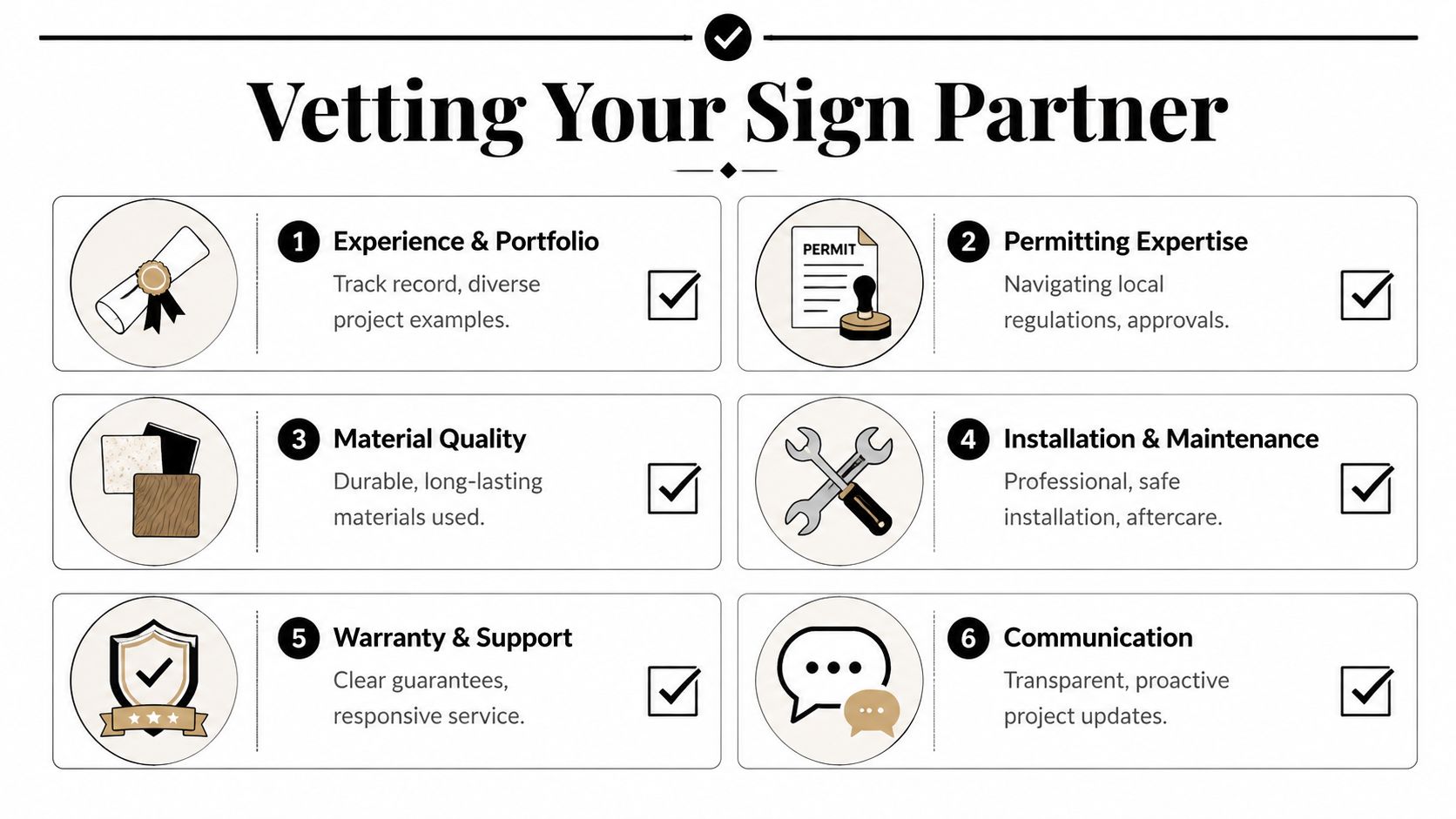
Ask about experience that matches your job
A broad portfolio looks nice, but relevance matters more than variety.
Use questions like these when you talk to a provider:
- Show me work similar to mine: Ask for projects in your industry and of similar complexity. A retail storefront, a church campus, and a distribution facility each bring different approval and installation issues.
- Who were the decision-makers on those jobs: You want to know whether they worked with landlords, property managers, general contractors, or owner-operators.
- What changed during the project: A seasoned team should be able to describe revision control, not just the finished sign.
If they only show polished photos and can’t explain the project conditions behind them, keep digging.
Get specific about design and proofing
Design delays usually come from unclear approvals, not weak software.
A competent company should explain:
| Checkpoint | What you want to hear |
|---|---|
| Initial design intake | They request logos, brand standards, site photos, dimensions, and landlord criteria early |
| Proof process | They issue clear proofs, revision rounds, and written approvals |
| Production release | Nothing goes into fabrication until approved artwork and specs are locked |
| Responsibility | One person owns communication when revisions affect price or schedule |
Ask who prepares the production-ready files and who verifies dimensions against the site. If those answers are fuzzy, mistakes often show up later as field changes.
If a company rushes you to approve artwork before site conditions are verified, you’re not speeding up the project. You’re moving the risk to the installation phase.
Find out what is in-house and what is subcontracted
Subcontracting isn’t automatically bad. Hidden subcontracting is.
Ask them to break the project into parts:
- Design
- Fabrication
- Electrical work
- Installation
- Permit coordination
- Service after installation
Then ask which of those tasks they perform directly and which they hand to others. A solid provider will answer cleanly and explain how they supervise outside trades.
The issue isn't whether subs are used. The issue is who manages quality, schedule, and accountability when subs are involved.
Test their communication before you hire them
You can learn a lot before you ever sign a quote.
Pay attention to early signals:
- Quote clarity: Is the estimate broken out clearly, or is it one lump number with vague wording?
- Question quality: Do they ask about site access, landlord rules, electrical feeds, and target install dates?
- Follow-up discipline: Do they summarize decisions in writing?
- Expectation setting: Do they explain what could delay the job?
If your emails are already bouncing between sales, art, and installation contacts before a deposit is paid, expect more of that later.
Use this short scorecard
Keep your evaluation simple. Rate each company as strong, acceptable, or weak in these areas:
- Project type fit
- Permitting confidence
- Proofing process
- Installation oversight
- Warranty clarity
- Communication speed
- Single point of contact
For broader comparisons, reviewing how national sign companies handle end-to-end work can help you judge whether a provider is set up for straightforward jobs only, or for more demanding commercial work.
Navigating Permits Installation and Multi-Site Rollouts
The sign itself is only part of the job. The rest is paperwork, coordination, field conditions, and timing.

A storefront owner often discovers this too late. They approve a design, commit to an opening date, and assume installation is the easy part. Then the municipality asks for revised drawings. The landlord rejects the first color match. The electrician needs a clearer scope. The installer can’t proceed because the mounting surface wasn’t documented correctly.
Why permitting breaks otherwise good projects
Many “fastsigns near me” searches fall short. Local pages usually focus on products and quote requests, not the compliance work that determines whether a sign can be installed legally and on schedule.
The permitting issue is bigger than most buyers expect. In 2025, 68% of signage projects failed their initial permitting attempt due to variances in local codes, and multi-site firms identified coordination as their top pain point. The same report noted that national providers can reduce project timelines by up to 40% through unified compliance handling according to the industry summary cited on FASTSIGNS location content.
That number aligns with what project managers see every week. The first design isn’t always the permit-ready design. Cities want different details. Landlords want different elevations. Historic districts may require a completely different approach than a highway commercial corridor.
Installation problems usually start before the installer arrives
Most bad install days were created weeks earlier.
Common causes include:
- Incomplete site surveys: Missing wall conditions, mounting heights, access limitations, or electrical realities
- Unclear landlord packages: Tenant criteria arrive late or conflict with municipal standards
- Wrong sequencing: Fabrication starts before permit approvals are stable
- Fragmented vendors: One company designs, another permits, another installs, and nobody owns the whole schedule
For businesses with several locations, those problems multiply fast. One city may be straightforward. The next may require engineering review or more extensive documentation. If each location is treated as a separate local job, branding drifts and the schedule starts slipping one store at a time.
A similar issue shows up online, where businesses with multiple branches have to coordinate local presence while keeping the brand consistent. This guide to mastering multi-location local SEO is worth reading because the same coordination problem exists in physical signage.
Here’s a useful visual overview of how sign projects can move from concept to field execution:
What to ask before any permit work starts
Use direct language. Ask these questions exactly:
- Who prepares the permit package
- Who responds if the city rejects the first submission
- Who checks landlord criteria against local code
- Who coordinates installation timing after approval
- Who updates me when one site is approved and another is delayed
A sign company that can fabricate well but can't manage compliance is only solving the easy half of the job.
If you’re dealing with code questions across one site or many, a practical reference on sign permit requirements and compliance planning helps you spot the scope items that should be discussed before fabrication begins.
Understanding True Cost Quotes Warranties and Long-Term Value
The cheapest quote often wins the email thread and loses the project six months later.
That happens because many buyers compare a sign proposal like they’re comparing office supplies. They look at the bottom line, not the scope assumptions behind it. In signage, the weak points usually hide in materials, service terms, exclusions, and what happens after installation.
Read the quote like a project manager
A useful quote should tell you more than price. It should tell you what the company believes the job includes.
Look for these details:
| Quote area | What to verify |
|---|---|
| Materials | Aluminum, acrylic, faces, finishes, LED components, mounting method |
| Site assumptions | Existing power, access equipment, wall condition, landlord approvals |
| Permit scope | Included, excluded, or handled as allowance |
| Installation | Crane or lift needs, travel, electrical hookup, patching |
| Service terms | Warranty language, repair responsibility, response process |
If those items aren’t clear, ask for a revised quote before you compare providers. A lower price with broad exclusions isn’t a lower-cost project. It’s just an incomplete estimate.
Warranty and maintenance aren’t extras
Many local sign pages often stay silent. They showcase the finished sign and skip the service reality that follows.
That matters most for illuminated signage. A 2026 study from the Signage Association of America found that failure rates for illuminated signs can reach 22% within the first year if a proper maintenance plan isn’t in place, as summarized on FASTSIGNS brand content. If you buy an illuminated sign without asking who handles failures, parts, labor, and service calls, you’re leaving one of the most expensive risks undefined.
Ask for written answers to these questions:
- What does the warranty cover
- Who performs warranty service
- What isn’t covered
- How are after-hours or urgent repairs handled
- Can the company service signs they installed through subcontractors
Buying advice: If a sign is critical to your storefront, church campus, or property visibility, treat maintenance planning like part of the purchase, not an optional add-on.
Value comes from lifespan and accountability
A strong sign partner doesn’t just install and disappear. They help you think through durability, service access, and what your sign will cost you over time.
For startups and budget-conscious organizations, financing can also matter. A sign that supports opening visibility may be worth doing properly if the payment structure is manageable. What matters is that you understand the full commitment up front.
If you’re comparing options, this breakdown of the cost of business signage is a useful companion because it pushes the conversation beyond sticker price and toward long-term ownership.
How to Manage Your Signage Project for a Smooth Rollout
The clean project and the chaotic project often start the same way. Both begin with a quote request and a deadline.
The difference shows up in the handoff.
On a smooth project, the client sends brand files, site photos, landlord contacts, and access notes early. One project manager gathers missing information, confirms the approval path, and keeps revisions from bouncing between five different people. Questions get answered once, in writing, and the schedule stays believable.
On a chaotic project, the owner sends a logo and says, “We need this fast.” Sales takes the order. Design starts without final dimensions. The property manager sends criteria later. Installation learns on Friday that the site needs a lift permit or restricted access. Monday’s install date disappears.
What you should prepare before kickoff
You don’t need to know sign fabrication, but you do need to gather the job basics.
Bring these items to the first real project call:
- Brand assets: Vector logo files, color standards, approved fonts
- Site information: Photos, measurements if available, existing sign conditions
- Property contacts: Landlord, facilities manager, general contractor, or church administrator
- Target dates: Opening day, inspection windows, blackout dates
- Approval chain: Who signs off on design, spend, and installation timing
When owners do this early, design moves faster and fewer assumptions slip into the quote.
Why a single project manager changes the experience
A dedicated project manager does more than send status emails. That person keeps design, permitting, fabrication, and installation moving in the right sequence.
That matters when something changes, because something usually does. Maybe the landlord wants a revised elevation. Maybe the site survey reveals a mounting condition nobody expected. Maybe one location in a rollout clears quickly while another needs more review. One point of contact keeps those changes from turning into confusion.
A well-run timeline usually looks like this:
- Discovery and site review
- Design and revisions
- Approvals and permit submission
- Fabrication after approvals are stable
- Installation scheduling
- Final walkthrough and punch list
Good project management doesn't eliminate every delay. It prevents small issues from becoming expensive surprises.
If you want a sense of what that ownership should look like in practice, this overview of signage project management shows the standard serious buyers should expect from a provider handling complex work.
Get the Right Sign and the Right Partner with On Display Signs
A fastsigns near me search is a reasonable first move. It’s not a complete buying process.
The right provider has to do more than produce attractive signage. They need to ask the right questions early, manage permit and landlord issues, control installation logistics, explain the quote clearly, and stay accountable after the sign is up. That becomes even more important when you’re opening on a deadline, coordinating multiple sites, or relying on the sign as a core part of visibility and customer traffic.
On Display Signs is built for that kind of work. The team manages signage from discovery and design through fabrication, permitting, installation, and maintenance, with a dedicated project manager guiding the process. That end-to-end structure is especially valuable for commercial developers, retailers, churches, warehouses, and growing brands that can’t afford fragmented communication or rollout mistakes.
If you want a sign partner that can handle the hard parts, not just the visible parts, On Display Signs is the conversation to have.
If you need a sign company that can manage design, compliance, fabrication, installation, and long-term support without making you chase updates across multiple vendors, contact On Display Signs, Inc. for a consultation and quote.