Your outdoor sign is your most dedicated employee. It’s a silent salesperson working around the clock, acting as the first handshake a customer has with your brand and setting the stage for everything that follows.
Why Your Sign Is Your Most Important Employee
Think of your outdoor sign not as a static object, but as your most reliable and hardworking team member. It's the initial welcome, the first impression, and a constant beacon for your business. For business owners, property managers, and commercial developers, a great sign isn't an expense—it's a powerful asset that turns a simple building into a landmark.
This guide is your complete roadmap to getting it right. A well-designed sign does more than just show your name; it communicates quality and professionalism at a glance. It's the difference between a car driving past and a driver who feels compelled to pull in.
Turning an Expense into an Investment
Investing in quality outdoor signage boards is one of the smartest marketing moves you can make. Unlike a digital ad that vanishes or a social media post that gets lost in the feed, a physical sign gives you constant visibility. But to make sure that investment pays off for years to come, you need a clear strategy.
This means knowing how to:
- Choose the right sign type: A towering pylon sign on the highway sends a different message than an elegant monument sign at an office park entrance. The type you pick sets the tone.
- Select materials that last: The climate your sign will face dictates whether aluminum, wood, or an illuminated option is the right call. Material choice is directly tied to how your sign looks and holds up long-term.
- Design for maximum impact: A cluttered, hard-to-read sign is a wasted opportunity. Effective design is all about legibility, contrast, and brand consistency to grab attention in a split second.
- Navigate permits and local codes: Nearly all permanent outdoor signs need permits. Understanding the local rules from day one prevents costly headaches and redesigns down the road.
A well-designed sign is a silent testament to your business's quality. It’s your most reliable employee, never calling in sick and always making a strong first impression on every person who passes by.
When you focus on these key elements, you transform a simple marker into a tool that generates real revenue. This guide will walk you through each step, from initial concepts to final installation. For a deeper look into what's available, you can learn more about various outdoor business signs and their applications. Your sign should be a landmark that doesn't just build brand visibility—it actively helps your business grow.
Choosing the Right Type of Outdoor Signage Board
Picking the right type of outdoor sign is one of the most important calls you’ll make for your business. The best choice isn’t about what looks nicest in a catalog—it’s about what will actually work for your specific location, goals, and budget.
Think of it like choosing a vehicle. You wouldn't use a slick sports car to haul lumber, and you wouldn't drive a semi-truck to make a quick grocery run. In the same way, the sign you choose has to fit its environment and its mission perfectly.
Signs That Make a Statement
Some signs are built to project an image of permanence and authority. They don't just mark a location; they anchor it, building trust from the very first glance.
Monument Signs: These are the substantial, ground-level signs you see built from materials like brick, stone, or heavy-duty architectural metal. They create a prestigious, grounded presence that’s perfect for professional office parks, upscale residential communities, and corporate headquarters. A monument sign doesn't just say "we're here"; it says "we're here to stay." For a practical example, think of a law firm using a monument sign with a granite base and raised bronze letters to communicate stability and success.
Pylon Signs: In contrast, pylon signs are the tall, roadside beacons you can spot from a mile away. Perched on one or two tall poles, they are designed for one thing: maximum visibility from the road. They are absolutely essential for businesses near a busy highway or tucked away in a sprawling shopping center—think hotels, gas stations, and retail plazas that need to grab the attention of fast-moving traffic. A successful pylon sign for a fast-food restaurant might feature a large, brightly illuminated logo at the very top, with individual tenant panels below for a shopping center.
This flowchart is a great way to think about how a sign should work for you, guiding a customer from first look to final destination.
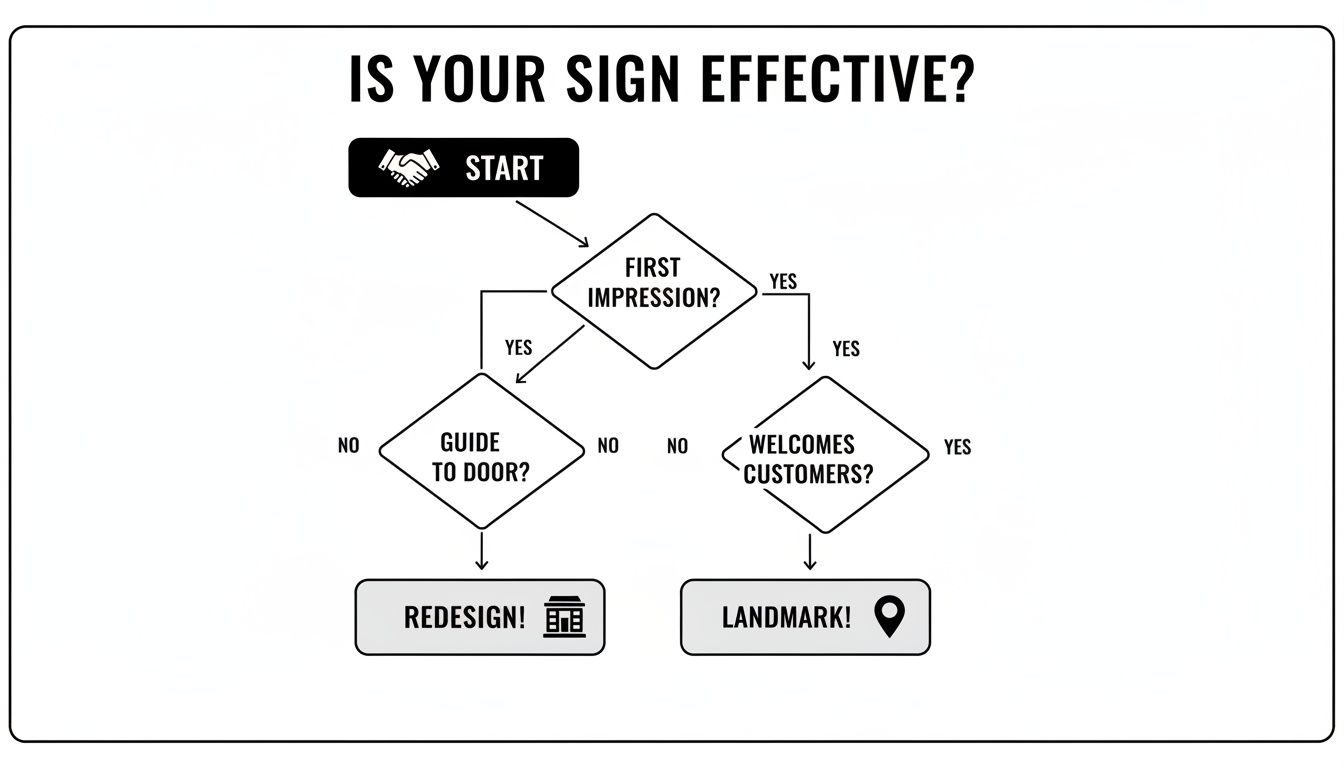
As you can see, a sign's job isn't over after the first impression. It needs to welcome, guide, and ultimately turn your location into a landmark people remember.
Comparing Common Outdoor Signage Board Types
To help you match the sign to the job, this table breaks down the most common options at a glance.
| Sign Type | Primary Use Case | Visibility Range | Typical Lifespan/Permanence |
|---|---|---|---|
| Monument Sign | Creating a prestigious, permanent entrance | Short to Medium | Permanent (10+ years) |
| Pylon Sign | Attracting attention from major roadways | Long | Permanent (10+ years) |
| Panel Sign | Identifying a storefront on a building facade | Short to Medium | Long-Term (5-10+ years) |
| Yard Sign | Short-term promotions, events, real estate | Short | Temporary (Weeks to Months) |
| A-Frame Sign | Sidewalk-level promotions, daily specials | Short (Foot Traffic) | Portable/Daily Use |
This makes it clear: a real estate agent wouldn't install a pylon sign for an open house, and a hotel off the interstate won't get much mileage out of a small A-frame. It's all about picking the right tool for the task.
Practical and Everyday Signage Solutions
Not every business needs a huge, permanent structure. Sometimes, flexibility and direct-to-customer messaging are what really count. These are the workhorses of the sign world.
Panel Signs: Think of these as the backbone of storefront advertising. They are typically a flat panel, often made of aluminum or Dibond, mounted right onto your building's facade. Panel signs are perfect for clearly displaying a business name and logo, making them a must-have for almost any retail shop, restaurant, or office with a physical entrance. You can explore many more types of outdoor signs for business to see the full range of options.
A-Frame Signs (Sandwich Boards): These are your silent salespeople, standing right on the sidewalk to capture foot traffic. Cafes use them to advertise daily specials ("Today's Roast: Colombian Supremo"), boutiques announce flash sales ("40% Off All Sweaters!"), and restaurants show off their menu. Their biggest advantage is being able to move them directly into the path of potential customers and bring them inside at night.
The demand for these kinds of solutions is huge. The global outdoor signage market was valued at $43.3 billion in 2026 and is projected to climb to $64.31 billion by 2035. For retail specifically, dynamic signs that can change based on time or weather have been shown to boost foot traffic by 20-30%.
Temporary Signs for Targeted Goals
Finally, some situations call for a completely different approach: temporary, high-impact signs designed for a specific project or event.
Yard Signs are the undisputed champion here. Made from lightweight, weather-resistant corrugated plastic (Coroplast), they are incredibly affordable and a breeze to install. They are perfect for real estate agents marketing a property, construction companies identifying a job site ("Future Home of…"), or local businesses promoting a weekend festival. Their low cost and ease of use make them the ideal choice for getting a message out quickly and affordably.
Selecting Materials That Withstand the Elements
Choosing the right material for your outdoor sign is one of the most important decisions you'll make. It’s the difference between a sign that looks sharp and professional for a decade and one that starts to fade, warp, or crack after just one rough season. This choice is about protecting your investment and making sure your brand looks its best, no matter what the weather throws at it.
Think of your sign's material as its core structure. You wouldn't build a permanent building on a temporary foundation, and you shouldn't put your brand on a material that can't handle the sun, rain, and wind it will face every single day.
The Workhorses: Aluminum and Dibond
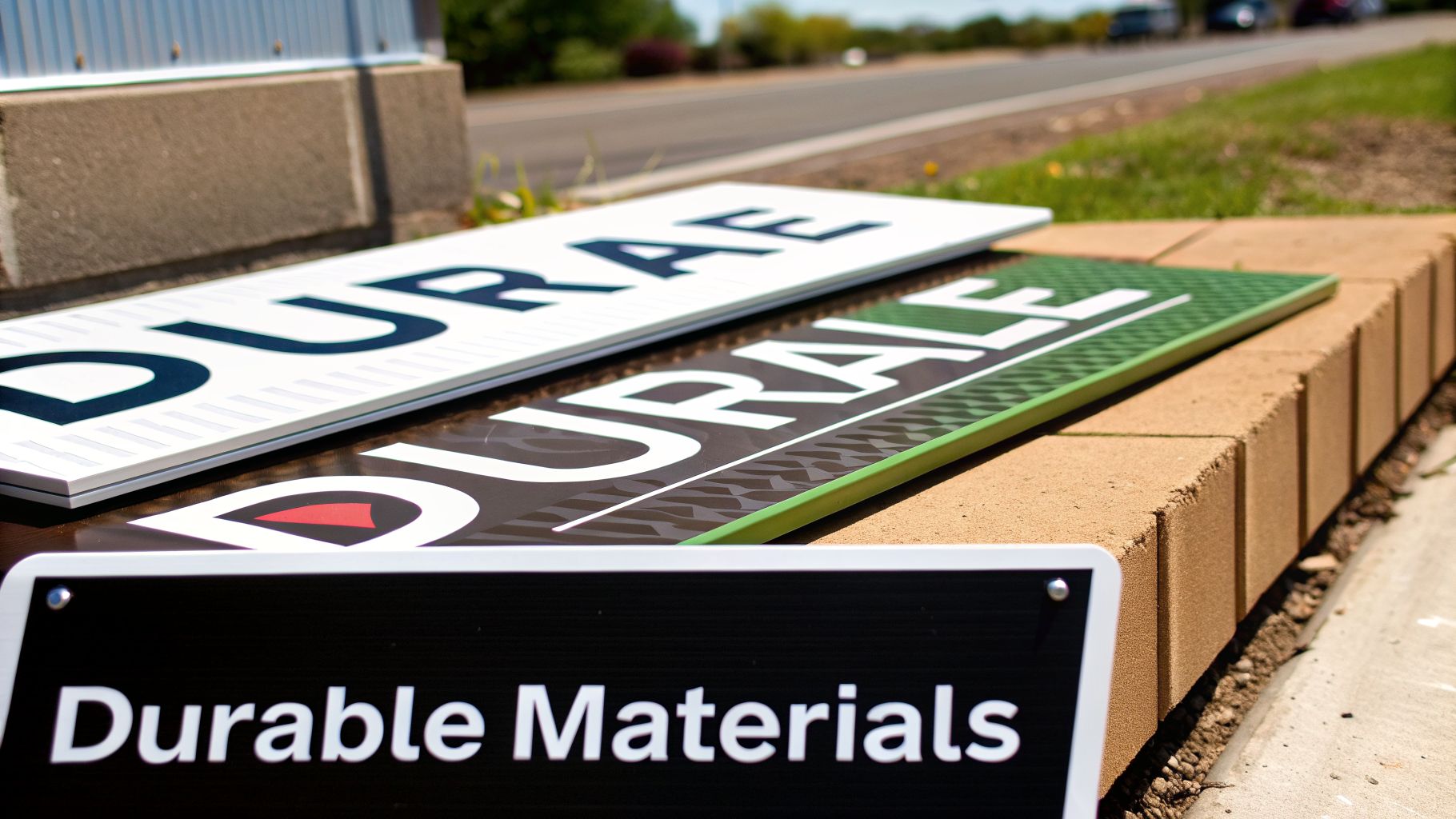
When it comes to permanent outdoor signs, aluminum is the industry standard for a reason. It's strong, surprisingly lightweight, and most importantly, it will never rust. This makes it a fantastic, long-term workhorse for everything from storefront panels to parking lot signs that need to look great for years on end.
For an even more premium finish, there's Dibond. Think of it as an upgraded version of aluminum. It’s a composite material made by bonding two thin aluminum sheets to a solid plastic core. This makes it lighter and more rigid than solid aluminum, so it stays perfectly flat. It’s the ideal choice for larger signs where you can't have any bowing or imperfections.
- Best for: Professional office buildings, retail storefronts, and any permanent sign where a clean, high-end look is non-negotiable.
- Practical Example: A modern tech company chooses a matte black Dibond panel for its main building sign. It delivers that sleek, flawless appearance that screams quality and will look just as impressive ten years from now.
Temporary and Budget-Friendly: Coroplast
If your sign only needs to last for a specific event or season, Coroplast is the undisputed champion. It’s the corrugated plastic that most yard signs are made from. Because it's incredibly lightweight, weather-resistant, and cheap, it’s the go-to for almost any temporary need.
It's all about getting your message out quickly and affordably.
Coroplast is built for high impact over a short lifespan. It's the perfect tool for temporary campaigns, not a solution for a permanent brand presence.
You'll see Coroplast used everywhere for:
- Real estate signs advertising a property for sale ("Open House Sunday 1-4 PM").
- Construction companies marking a new project site ("Site Work by XYZ Construction").
- Local businesses promoting a weekend sale or festival ("Annual Strawberry Festival This Weekend!").
- Political campaigns blanketing a neighborhood before an election.
Classic Aesthetics With Wood
For businesses that want a traditional, rustic, or high-end natural feel, nothing beats wood. Sandblasted or routed wood signs create a sense of timeless craftsmanship that other materials just can't replicate. It’s perfect for inns, boutique resorts, historic districts, and artisanal shops.
But that classic beauty comes with a tradeoff: maintenance. Wood signs need to be sealed and re-stained regularly to protect them from moisture and sun damage. Without that care, they can quickly warp, rot, or fade. Exploring the best material for outdoor signs in more detail can help you decide if the upkeep is right for you.
Getting Seen at Night: Illuminated Signs
When your business needs to be visible 24/7, an illuminated sign is an absolute must. Modern options are more effective and efficient than ever.
The classic backlit sign (or "lightbox") is a cost-effective way to get a large, bright sign. It uses an internal light source—today, almost always LEDs—to light up a translucent panel. This is a great choice for a restaurant in a strip mall that needs its name to pop after dark.
For a more premium look, LED channel letters are the gold standard. Each letter is built as an individual structure and lit from within. This creates a sharp, high-contrast look that is incredibly professional and makes a bold statement after dark. Think of the crisp, individual glowing letters on a modern bank or corporate headquarters. Plus, they use up to 80% less energy than old-school neon or fluorescent bulbs, which adds up to huge savings on your electricity bill.
Designing a Sign That Actually Drives Business
An effective outdoor sign is so much more than just your name and logo. Think of it as a precision-engineered marketing tool designed for one purpose: to grab attention and get people through your door. An overly complicated or cluttered sign is a wasted opportunity. The best designs understand you have only a few seconds to catch the eye of passing traffic.
This means legibility is everything. Your message has to be readable in an instant, from a distance. That’s where high-contrast color combinations and clean, bold fonts are non-negotiable. A classic black-on-yellow or white-on-blue will always beat a busy design with subtle, clashing colors.

Making Your Message Readable
When it comes to lettering size, there’s a simple but powerful rule of thumb we live by: for every 10 feet of viewing distance, your letters need to be at least one inch tall. So, if your sign needs to be clear from 100 feet away, those letters have to be a minimum of 10 inches high. No exceptions.
Here are a few actionable principles to guide your design:
- Stick to a Single Message: What’s the one thing you need a potential customer to know? Focus on your business name, your core offering (“Fresh Coffee,” “Auto Repair”), or a clear call to action (“Open 24 Hours”).
- Embrace Negative Space: Don't cram your sign with extra graphics, phone numbers, and taglines. Giving your main message room to breathe makes it far easier for the eye to focus and absorb the information.
- Choose Sans-Serif Fonts: Simple, bold fonts like Helvetica, Arial, or Futura are much easier to read at a glance than fancy script or decorative fonts. Save those for your print menus.
A sign that tries to say everything will ultimately say nothing. The goal isn't to give a full business summary; it's to create a quick, memorable impression that sparks curiosity and guides customers to your door.
This strategic simplicity isn't just a design preference; it's proven to work. Printed outdoor signage remains a powerhouse, with the market projected to hit $31.36 billion in 2025. Eye-catching signs can boost impulse buys by 20%, and studies confirm that over 70% of consumers notice outdoor signs every single day.
Ensuring Brand Consistency
Your outdoor sign is a cornerstone of your brand’s identity. Its look and feel should be instantly recognizable, aligning perfectly with all your other marketing—from your website and social media to your business cards. If your brand has a specific color palette or font, that DNA has to be on your sign.
For example, a cluttered sign with five different fonts and a jumble of colors looks unprofessional and confuses potential customers. By simplifying the design to your company’s core colors and a single bold font, the message becomes clear and powerfully reinforces your brand. That consistency is what builds trust and recognition over time.
By applying these principles, you can work with a designer to create a sign that doesn't just look good—it actively converts passersby into paying customers. For those who want to dive deeper into the process, check out our guide on how to make a sign for more hands-on tips.
Navigating Permits Without the Headache
That one word—"permitting"—can make any business owner's head spin. But for almost any permanent outdoor sign, it’s a non-negotiable step in the project. The key is to see it for what it is before you even think about design. Just like you need to know the rules for building a fence, getting permits for outdoor installations means knowing the local playbook.
Think of a sign permit as a building permit for your brand's public face. These local codes aren't there to create roadblocks; they exist to ensure every sign in the community is safe and the town doesn't turn into a chaotic visual mess.
Why Sign Codes Matter
Every city and county has its own rulebook for signs, and it covers everything: size, height, lighting, and placement. One of the most common rules is the setback requirement, which simply dictates how far your sign needs to be from the road or property line.
This isn't just red tape. It matters for a few very practical reasons:
- Safety: Setback rules are there to keep sightlines clear for drivers at intersections or pulling out of your parking lot.
- Fairness: Codes prevent one business from putting up a massive sign that completely blocks out its neighbors. It keeps the playing field level.
- Aesthetics: These regulations help maintain a community’s character, preventing the kind of visual clutter that cheapens a neighborhood.
Getting this wrong is a costly mistake. Violating codes can lead to big fines and, worst of all, an order to take your brand-new sign down. That's a frustrating and expensive setback. For a deeper look at the process, check out our guide on understanding sign permit requirements.
Your Best Ally in the Permitting Process
A truly experienced sign company does a lot more than just build your sign—they act as your expert guide through the bureaucracy. They know the local codes inside and out and will design your sign to be compliant from the very first sketch.
Navigating the web of local ordinances, zoning laws, and paperwork is often the most stressful part of getting a new sign. An experienced sign partner removes this burden entirely, managing the process so you can focus on your business.
This partnership is everything. A full-service sign partner will handle the stacks of paperwork, submit the required engineering specs and drawings, and speak directly with city officials for you. This proactive approach saves you from the headache of endless revisions and the crushing disappointment of a rejection.
And as the world of outdoor signage grows—with the digital segment projected to jump from $23.47 billion in 2024 to $46.80 billion by 2033—compliance is more critical than ever. New trends like solar-powered signs, which can slash energy use by 70-80%, are also shaping local rules. Since a great sign can boost brand recall by 40%, making sure it's approved and installed correctly is the first step to getting a real return on your investment. Learn more about trending outdoor sign insights.
Your Checklist for Choosing the Right Sign Partner
Picking the right sign company is every bit as important as the design and materials you choose for the sign itself. Think of it less like buying a product and more like hiring a general contractor for your brand's most visible asset.
A great sign partner is more than just a fabricator; they’re your project manager, design consultant, and permit expert all rolled into one. The right team makes the whole process feel seamless, while the wrong one is a shortcut to headaches, budget overruns, and a sign that just doesn't deliver. Use this checklist to ask the right questions and find a true partner, not just another vendor.
Essential Credentials and Experience
Before you even start talking about designs, you need to do some homework on the company itself. This is the foundation for a successful project.
Here’s what you absolutely need to confirm:
- Are they fully licensed and insured? Don't be shy about asking for proof of general liability and worker’s compensation. If an accident happens on your property during installation, this is what protects you from liability.
- Can they show you a portfolio of similar work? You need to see that they have real-world experience with projects just like yours. A portfolio full of yard signs isn't a good sign if you need a complex illuminated pylon sign.
- What does their process actually look like? Have them walk you through every step, from the first conversation and design mockups to pulling permits, fabrication, and the final installation. A pro will have a clear, well-defined workflow they can explain easily.
The right sign partner is a long-term asset to your business. They don't just sell you a sign; they provide a comprehensive service that includes design expertise, permitting navigation, and post-installation support.
Project Management and Communication
A sign project can get complicated fast, especially when city permits and zoning codes are involved. Clear, consistent communication isn't a "nice-to-have"—it's essential to avoid costly errors and major delays.
Ask them how they manage the nuts and bolts of a project:
- Will you have a single point of contact? Getting bounced between departments is frustrating and inefficient. A dedicated project manager who owns your project from start to finish is a hallmark of a well-run company that values your time.
- How do they handle multi-site rollouts? If you have more than one location, ask about their experience managing regional or national projects. Keeping brand consistency while navigating different local codes is a specialized skill.
- What's their experience with local permits? This one is huge. A partner who already knows the ins and outs of your local sign codes is invaluable. They should be able to confidently handle the entire permitting maze for you.
Warranties and Long-Term Support
The relationship shouldn't end the day your sign goes up. An outdoor sign is a serious investment, and you need to know that your partner will be there to stand behind their work for years to come.
Before you sign any contracts, get crystal-clear answers on these final points:
- What kind of warranty do they offer? A reputable company will always stand behind its materials and workmanship. Ask for the warranty details in writing, making sure it covers things like fading, structural issues, and the electrical parts of an illuminated sign.
- Do they offer maintenance plans or service calls? Even the toughest signs need a tune-up eventually, especially those with lighting. Knowing they have a service team ready to help provides real peace of mind for the future.
By digging into these areas, you can vet potential sign companies with confidence and choose a partner who will deliver a fantastic sign that generates a real return on your investment.
Frequently Asked Questions About Outdoor Signs
Getting a new sign is a real project, and it's natural to have questions about the nuts and bolts—the cost, the timeline, and what happens after it's installed. Let's clear up the most common ones so you can move forward with confidence.
The first question on everyone's mind is always the same: what's the bottom line?
How Much Do Outdoor Signage Boards Cost?
There’s no single price tag for an outdoor sign. The final investment depends completely on the sign’s type, size, materials, and whether it needs to light up at night. Think of it like buying a vehicle; a simple work truck has a very different price than a custom-outfitted, top-of-the-line model.
A basic, non-lit post and panel sign might start in the low thousands. But a massive, custom-built pylon sign with internal lighting, designed to be seen from the highway, can easily run into the tens of thousands. The only way to get a real number is with a detailed quote for your specific needs.
How Long Does the Sign Process Take?
Getting a permanent sign made isn't an overnight job. It's a multi-stage project, and a realistic timeline is usually one to three months from the first conversation to the final installation.
Think of it as a journey with a few key stops along the way:
- Design & Revisions: This is the creative part where we lock in the perfect look. It typically takes 1-2 weeks.
- Permitting: Here's the wild card. Depending on how fast your local government office moves, securing a permit can take anywhere from 2 to 8 weeks—and sometimes longer.
- Fabrication: Once the permit is in hand, our team gets to work building your sign, which usually takes another 2-4 weeks.
- Installation: The final step is surprisingly fast. Most installations are completed in a single day.
Understanding these stages from the start helps set the right expectations. That permitting phase is almost always the longest and least predictable part of the entire project.
What Maintenance Will My Sign Require?
Good news—most modern outdoor signs are built to be incredibly low-maintenance. How much care it needs really just depends on whether or not it's illuminated.
For non-illuminated signs, a simple cleaning with soap and water once or twice a year is all it takes to wash away the pollen, dirt, and grime that builds up over time.
For illuminated signs, a little more attention is needed. We strongly recommend a professional inspection once a year to check all the electrical parts, wiring, and connections. This quick check-up is the best way to keep your sign shining bright and operating safely for years to come.
Ready to create a sign that gets your business noticed? The team at On Display Signs, Inc. manages every detail, from design and permitting to fabrication and installation, ensuring a smooth process and a powerful result. Start your sign project with us today.