Point of sale displays are your store’s best closers. Think of them not as simple shelving, but as expert, silent salespeople positioned to capture a shopper’s attention at the most critical moment—right before they pay. They turn the checkout counter from a purely functional space into one last, powerful opportunity to make a sale.
The Hidden Power of Point of Sale Displays
We’ve all been there. You’re waiting in the grocery store line, cart filled with everything on your list. Then, a small display of your favorite snack or a new flavor of gum catches your eye. Without a second thought, you grab it and add it to your haul. That’s the magic of a point of sale display in action. It taps directly into impulse when customers are already in a buying mindset.
But these displays aren't just for candy and magazines. Smart retailers use them to showcase everything from travel-sized lotions to high-margin electronics, directly boosting the average value of each transaction. The strategy is so effective that it has become a major focus for retailers everywhere.
Fueling Unplanned Purchases
The main job of a point of sale display is to trigger that last-minute, unplanned purchase. Unlike larger displays designed to tell a bigger brand story, POS displays are built for speed and gut decisions. Their success comes down to a few simple truths:
- Unavoidable Location: Placed right at the checkout counter or along the queue, they are nearly impossible for a waiting shopper to ignore.
- Effortless Products: They usually feature low-cost, "grab-and-go" items that don't require much thought.
- Visual Punch: Bold colors, simple messaging, and clean organization make the products pop.
A great point of sale display is the final, persuasive nudge. It offers a solution to a forgotten need or a simple treat, making it an easy "yes" for the customer just moments before they pull out their wallet. A practical example is a display of phone charging cables right at the checkout in an electronics store. A customer buying a new device might realize they need an extra cable for their car, making it an easy, relevant add-on sale.
A Growing Market and a Serious Competitive Edge
The impact of these displays is no secret in the retail world. Business owners are investing more in them because the return is so clear and easy to measure. The global market reflects this trend—valued at $12.57 billion in 2026, it’s projected to hit $18.81 billion by 2029. That growth is fueled by the fact that effective displays can boost impulse buys by as much as 20%.
Getting these displays right is no longer a small detail; it’s a core part of any successful modern retail strategy. For anyone looking to sharpen their in-store performance, knowing how to use these tools effectively is non-negotiable. If you're looking for more, check out our guide on how to increase retail sales with proven tactics.
Choosing the Right POS Display for Your Product
Picking the right point-of-sale display is like choosing the perfect tool for a job. You wouldn’t use a sledgehammer to hang a picture frame, and you shouldn’t use a massive floor display for small, last-minute items. It’s all about matching the format to your product, your goals, and the store environment to make sure every dollar you spend is working for you.
The very first step is getting crystal clear on what you're trying to achieve. Are you hoping to trigger more impulse buys at the checkout counter? Or are you trying to introduce a brand-new product to shoppers for the first time? That single decision shapes everything that comes next.
As you can see, if your goal is to boost sales, using POS displays to encourage those impulse buys is one of the most direct routes you can take.
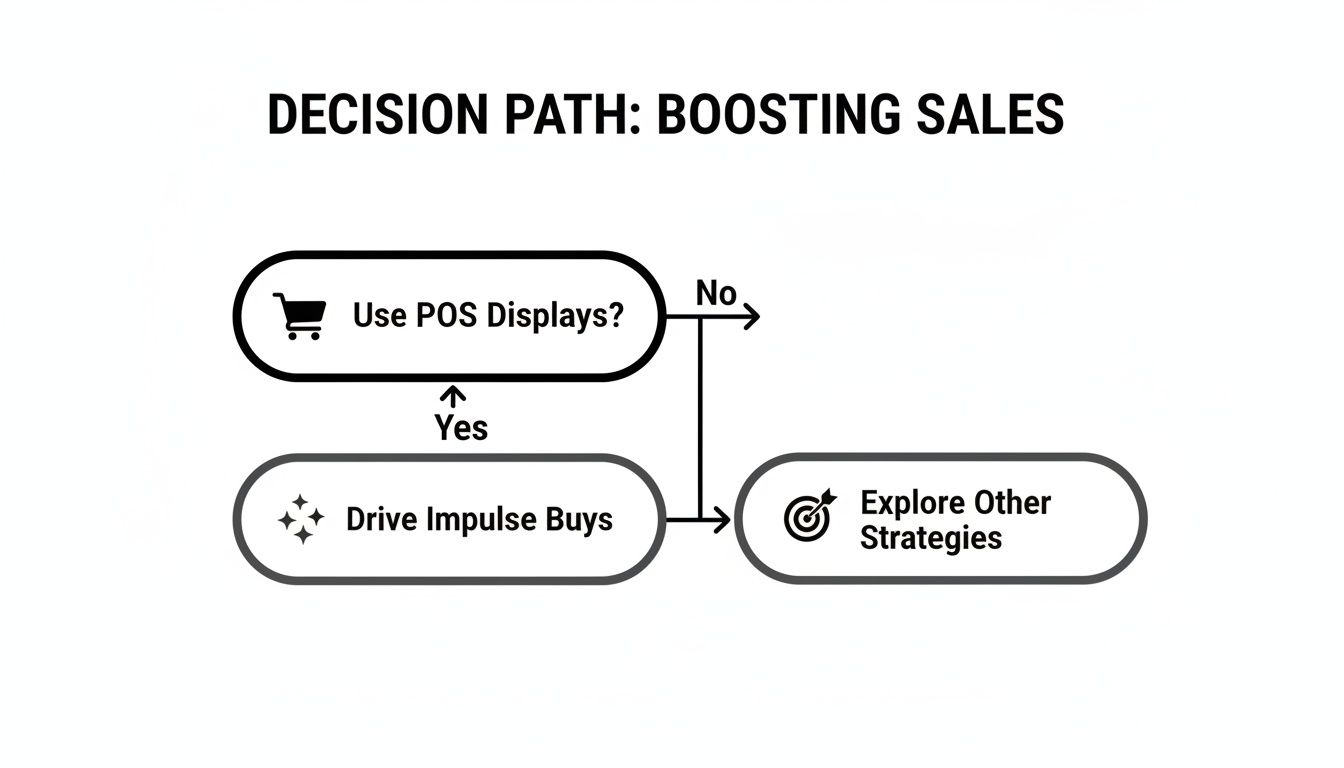
This path shows a clear strategy: increased sales often come from capturing those spontaneous purchase decisions, and well-placed displays are the perfect tool for the job.
Comparing Common Point of Sale Display Types
To help you visualize which tool is right for which task, this table breaks down the most common POS display types. Think of it as a quick-start guide to matching the display to your specific need.
| Display Type | Best For | Typical Placement | Common Materials |
|---|---|---|---|
| Counter Display | Small, impulse-buy items like candy, lip balm, or gift cards | Directly on or next to the cash register or service desk | Acrylic, cardboard, PVC, wood |
| Freestanding Display | New product launches, seasonal promotions, and high-margin items | In open, high-traffic areas, main aisles, or store entrances | Corrugated cardboard, wood, metal, rigid plastics |
| Endcap Display | Major promotions, high-volume sellers, and new product lines | At the very end of a retail aisle, facing a main walkway | Integrated shelving, corrugated cardboard, mixed materials |
| Shelf Talker | Highlighting a specific benefit, price, or award on a crowded shelf | Attached directly to the front edge of a standard retail shelf | Laminated paper, thin vinyl, plastic |
Each of these formats serves a distinct purpose, from shouting about a new product to whispering a final suggestion at the point of purchase.
Counter Displays for Impulse Buys
Think about the classic checkout line experience. Those small, compact units right by the cash register are counter displays. Their power comes from one thing: being in the right place at the right time, just as a customer is about to complete their purchase.
These are perfect for:
- High-Margin, Low-Cost Items: Candy, gum, lip balm, and travel-sized sanitizers are prime examples.
- "Grab-and-Go" Products: Things that require zero thought, like batteries or a phone charger.
- Complementary Add-Ons: A display of gourmet chocolate bars next to a coffee shop register is a perfect match.
Because they sit in a crowded, high-value spot, an effective counter display has to be tidy, visually interesting, and easy to shop from.
Freestanding Displays for High-Impact Promotions
A Freestanding Display Unit (FSDU), often just called a floor display, is a standalone structure you can place almost anywhere. These are your showstoppers, built to interrupt a shopper's journey and grab their full attention.
FSDUs are absolute workhorses for seasonal campaigns or major product launches. Just imagine a vibrant, pumpkin-shaped display loaded with Halloween candy in October or a sleek, branded stand showing off a new line of energy drinks.
Their larger footprint gives you more room for creative branding, telling a story, and holding more product. They’re the right choice when you need to make a big splash. To make that splash even bigger, it helps to follow the steps to choose the right promotional products that will fill your display and connect with your audience.
Endcap Displays for Maximum Visibility
Endcaps are the displays sitting at the end of retail aisles, and in the world of retail, they are prime real estate. Because they face the store’s main walkways, they get far more foot traffic and eyeballs than any product buried mid-aisle.
Retailers typically save these premium spots for:
- New Product Launches: Putting a new line of snacks or sauces on an endcap guarantees it will be seen.
- High-Volume Sellers: Placing popular, fast-moving items here makes them easy for shoppers to find and grab.
- Major Promotions: A "Buy One, Get One Free" deal announced on an endcap is a classic strategy that still works wonders.
Shelf Talkers to Cut Through the Clutter
Finally, never underestimate the power of a shelf talker. These are the small signs or tags that clip right onto the shelf edge, directly in front of your product. In a packed aisle where dozens of similar items are fighting for attention, a good shelf talker can be the deciding factor.
Use them to call out a specific feature ("Gluten-Free"), announce a sale ("Now 20% Off!"), or show off an award ("Voted Best Tasting"). They are a low-cost, high-impact tool for making your product stand out in a sea of lookalikes. And if you need to grab attention before customers even walk in, our guide to outdoor A-frame signs can help you capture that crucial curbside interest.
Designing Displays That Stop Shoppers in Their Tracks
A great point-of-sale display does more than just hold products. It’s a silent salesperson that tells a story, sparks curiosity, and creates an undeniable urge to buy. The difference between a display that blends in and one that moves merchandise comes down to thoughtful, strategic design.
Think of your display as a miniature billboard in a crowded city. You have just a few seconds to cut through the noise of a busy retail floor and make a real impression. Effective design isn't about being the loudest; it's about being the clearest and most compelling, turning a passive browser into an active buyer right then and there.
Establish a Clear Visual Hierarchy
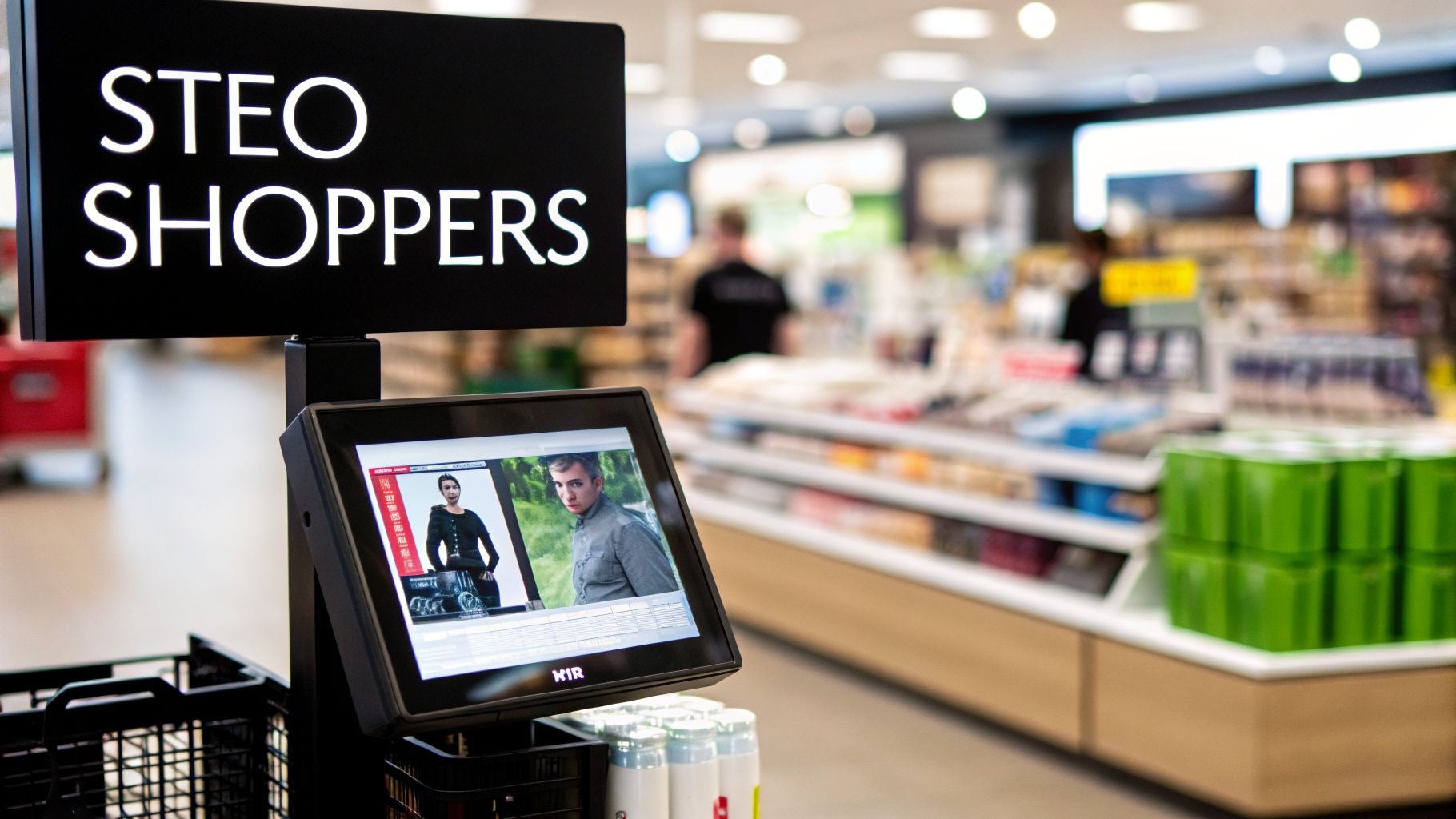
Visual hierarchy is the secret to guiding a shopper's eye. Without it, a display is just a jumble of words and images that people will instinctively ignore. Your goal is to lead them on a split-second journey, starting with the biggest hook and ending with a clear action.
- Lead with the Headline: Make your main message the biggest and boldest thing they see. It has to grab their attention instantly.
- Showcase the Product: The product itself should be the hero. Make sure it's well-lit, easy to grab, and the clear focal point.
- Provide Key Details: Keep supporting info, like price or key benefits, smaller but still clean and easy to read.
- End with a Call to Action: Tell them exactly what to do next with a command like "Buy Now" or "Try a Sample."
For instance, a display for a new protein bar might scream "NEW!" at the top, feature a mouth-watering shot of the unwrapped bar, list "20g Protein" in a clean bullet point, and finish with a simple "Grab One Today!" at the bottom. This path ensures the whole message lands, even in a single glance.
Use Color and Branding to Your Advantage
Color isn’t just decoration; it’s a powerful shortcut to emotion and brand recognition. In fact, research shows color can boost brand recognition by up to 80%. Use your brand’s primary colors to create an instant connection with shoppers who already know you. For new customers, use color psychology to set the right mood.
A well-designed display uses color with purpose. Bright reds and yellows create urgency, making them perfect for clearance sales. Blues and greens feel calm and trustworthy—ideal for wellness or health products.
But more than anything, be consistent. Your POS displays should feel like a natural extension of your brand. If your packaging is minimalist and clean, your display should echo that. If your brand is playful and bold, the display needs to match that energy. This consistency is what builds trust and makes your brand unforgettable.
Keep Your Messaging Bold and Simple
Shoppers at the checkout counter are not looking to read a novel. They're usually in a hurry, distracted, and making snap decisions. Your message has to be so clear that it can be fully understood in three to five seconds.
Actionable Messaging Tips:
- Focus on One Key Benefit: Don't drown them in features. Pick the single biggest reason someone should buy your product and make it the star. "Quenches Thirst Fast" is far more effective than a list of ingredients.
- Use Strong, Action-Oriented Words: Verbs like "Discover," "Enjoy," and "Get" are engaging and subconsciously prompt the shopper to do something.
- Make it Legible: This is non-negotiable. Choose a clean, bold font with high contrast between the text and background. If a shopper has to squint, you've already lost them. Knowing the fundamentals of how to make signs that are crisp and readable is a baseline skill here.
Create a Compelling Call to Action
The final, and arguably most critical, piece of the puzzle is your call to action (CTA). This is the part that tells the shopper exactly what to do next. Without a clear CTA, even the most beautiful display can fail to actually sell anything.
A great CTA is direct, simple, and creates a sense of immediacy. Instead of a vague "Learn More," use something specific and low-risk like "Take a Free Sample" or "Buy 2, Get 1 Free." It gives the shopper an obvious next step. Make your CTA pop visually, maybe with a contrasting color or by placing it inside a button-like shape. Once you master these principles, you'll be creating displays that don't just look great—they deliver real, measurable results.
Strategic Display Placement for Maximum Sales
Even the most stunning point-of-sale display will just collect dust if it’s hidden in a low-traffic corner. Location isn't just one more detail to check off a list; it's the entire foundation of your display’s success. Getting placement right is what ensures your investment gets seen, grabs attention, and—most importantly—converts browsers into buyers.
Think of your retail store as a network of roads. Some are busy highways packed with shoppers, while others are quiet side streets. Your job is to place your display right at the busiest intersections, turning a simple product showcase into a powerful, hard-working sales engine.
Identifying Your Store’s Hot Spots
Every single retail space has its own hot spots—the areas where the flow of customers naturally bottlenecks. The most obvious and powerful of these is the checkout counter. Shoppers waiting in line are a captive audience, often looking for a distraction or a last-minute item they forgot. This is prime real estate for impulse buys.
But the checkout isn’t the only valuable spot. Other key locations include:
- Store Entrances: The first few feet inside the door, where shoppers adjust to the store’s environment and are open to suggestions.
- Main Aisles: These are the major arteries that guide customers on their journey through the store.
- Endcaps: The high-visibility spots at the end of aisles that face the main thoroughfares, impossible to miss.
Once you’ve mapped out these high-traffic zones, you can start making smart decisions about where your displays will make the biggest impact.
Mastering the Psychology of the Checkout Line
The checkout line is a unique psychological space. Your customers have already finished their main shopping trip, their wallets are out, and they are mentally prepared to spend money. This makes them incredibly receptive to low-cost, high-convenience impulse purchases.
To truly get this right, it helps to understand the science behind store layout. Digging into topics like what is a planogram in retail reveals just how much strategic product arrangement influences buying decisions.
The goal at the checkout is to offer a simple solution or a small indulgence. Things like phone chargers, snacks, or travel-sized products work perfectly because they require almost no mental effort from the shopper.
Practical Tips for Effective Merchandising
After you’ve picked your hot spots, success all comes down to execution. A well-placed display that’s poorly maintained will still fail.
Best Practices for Display Management:
- Use Endcaps for High-Impact Features: Save these premium spots for new product launches, seasonal promotions, or your absolute best-sellers to guarantee they get seen.
- Keep It Well-Lit and Fully Stocked: A dark or half-empty display looks unappealing and quietly suggests the products are unpopular. Good lighting and regular restocking are non-negotiable.
- Maintain a Tidy and Organized Presentation: Clutter is the enemy of a sale. Make sure products are neatly arranged and easy for customers to grab without toppling the whole display.
- Ensure Clear Pathways and Accessibility: Your displays should never create a bottleneck or block an aisle. There must be enough room for everyone, including those with strollers or mobility aids, to move freely.
The data backs this up. With the number of digital displays growing, studies show that 68% of shoppers make buying decisions based on compelling signage. This draws a direct line between smart placement and actual sales.
Ultimately, your merchandising strategy should make the customer's journey better, not harder. By putting the right displays in the right places—and keeping them looking pristine—you turn every corner of your store into an opportunity. And while POS displays are perfect for in-aisle selling, don't forget the power of your storefront. You can check out our guide on retail window display ideas to learn how to draw customers in before they even step inside.
Innovations in Display Technology and Materials
The days of the simple cardboard standee at the checkout are numbered. The world of point-of-sale displays is seeing a massive shift, driven by smarter technology and what modern shoppers actually want. Today's best displays are no longer passive props; they're interactive tools that create a better experience and show customers you share their values.
This isn't happening by accident. It's a direct response to how people shop. Studies show that a huge 72% of consumers prefer stores offering personalized experiences, and 66% actively choose to buy from eco-conscious brands. To meet this demand, the market for dynamic POS displays has exploded into a $15 billion industry. You can read the full research about modern shopper demands on marketresearch.com.
The Rise of Interactive and Digital Displays
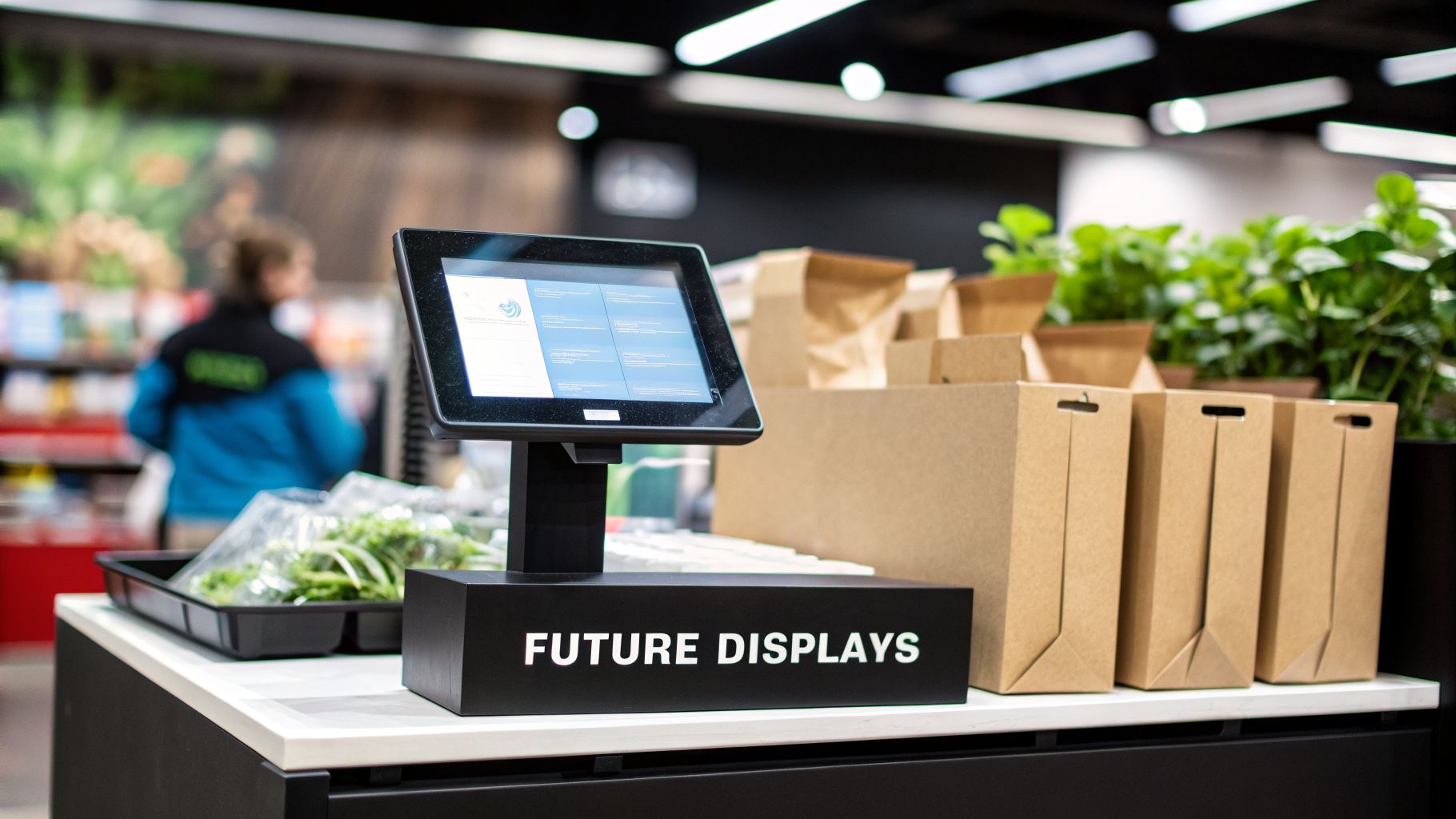
The single biggest change we're seeing is the jump from static print to dynamic screens. These displays are turning the checkout line from a place of idle waiting into a final, powerful touchpoint in the customer's journey. They can do things a traditional sign simply can't.
- Dynamic Content: Instead of one printed message, a screen can cycle through multiple promotions, feature new arrivals, or even show off real customer reviews.
- Personalized Offers: By tying into a loyalty program, the display can serve up an offer that's specific to the person standing right there.
- Data Collection: Every tap on the screen gives you priceless information about what offers and products are actually grabbing your customers' attention.
Imagine a customer is buying a pair of running shoes. At the counter, the screen shows them a special offer on high-performance socks. That's not a pushy sales tactic; it’s a helpful, relevant suggestion. If you're curious about this tech, you might be interested in our deep dive into digital menu boards, which work on many of the same principles.
A well-placed QR code on a traditional counter display can instantly bridge the gap between physical and digital. A shopper can scan it to see product reviews, watch a how-to video, or sign up for a brand’s newsletter, extending the conversation long after they’ve left the store.
Embracing Sustainability in Materials
Running parallel to the tech boom is a powerful demand for sustainability. More and more, brands are realizing that the materials they use for their displays send a clear message. Choosing an eco-friendly option is no longer a fringe benefit—it’s a smart business move that builds trust with today’s shoppers.
This shift has pushed the industry to get creative, bringing a whole range of responsible materials to the forefront that look great and do right by the planet.
Popular Eco-Friendly Display Materials:
- Recycled Cardboard: Still a champion for a reason. Corrugated cardboard made from post-consumer waste is light, affordable, and completely recyclable.
- Bamboo: This is a fantastic alternative to traditional wood for more permanent fixtures. It’s a fast-growing, renewable resource that brings a touch of natural elegance.
- Reclaimed Wood: Using salvaged wood gives a display a warm, authentic character that you can’t fake. Plus, it keeps perfectly good material out of the landfill.
When you choose materials like these, you’re doing more than just shrinking your environmental footprint. You’re showing customers your brand is tuned in and committed to the same things they are, which builds the kind of loyalty that lasts.
Nailing Your Multi-Store Rollout and Proving Its Worth
Getting a new promotion live across a national chain is a serious logistical challenge. Think of it like conducting an orchestra—every instrument has to play in perfect harmony. The goal is to ensure every single location gets the exact same high-quality point of sale displays, on schedule and ready to capture sales.
For any brand with a big retail footprint, this consistency is everything. A shopper needs to have the same powerful brand experience whether they’re in a store in Miami or Seattle. That’s why so many businesses now rely on a single, dedicated partner for their multi-store rollouts.
A centralized partner acts as your mission control, managing the entire project from start to finish. They handle fabricating every display to the same exacting standard, then coordinate the complex shipping and installation across dozens—or even hundreds—of locations. This approach sidesteps the headaches and inconsistencies that pop up when you’re juggling multiple local vendors.
Measuring the True Value of Your Displays
Once your beautiful new displays are set up and working in the wild, the real work begins: proving they’re actually moving the needle. Without solid data, your marketing budget is just a shot in the dark. To show the real value of your investment, you need to tie your displays directly to business results by tracking the right Key Performance Indicators (KPIs).
The first step is to set a clear baseline. Before you install a single new display, you need to collect data on sales for the products you'll be featuring, as well as the foot traffic in those specific store areas. This "before" picture is the benchmark you’ll measure everything against.
Key Metrics to Track for POS Display Success
To get the full story of your campaign’s performance, you only need to focus on a handful of powerful metrics. These numbers will help you calculate your real Return on Investment (ROI) and make a rock-solid case for the project to company leaders.
Essential KPIs for Display ROI:
- Sales Lift: This is the clearest measure of success. Track the percentage increase in sales for the promoted products after the displays are installed. Did that new endcap for a soda brand drive a 15% spike in sales for that category? That's your sales lift.
- Foot Traffic Patterns: Use your in-store analytics to see if the new displays are changing how shoppers navigate your store. Are more people lingering at the checkout counter now that you've added eye-catching displays there?
- Dwell Time: For more interactive or digital displays, measure how long shoppers actually spend looking at or engaging with them. Longer dwell times almost always signal a higher intent to buy.
- Customer Engagement Rates: If your display has a QR code or an interactive element, track how many people are scanning or tapping. This is a direct measure of how well your call to action is working.
Tracking these metrics isn’t just about getting a final grade on your campaign. It’s about uncovering actionable insights. If one type of display is crushing it while another is falling flat, you now have the data to go all-in on what works for your next big promotion.
By carefully tracking these KPIs, you can stop hoping your displays work and start knowing exactly how much value they deliver. This data-first approach lets you fine-tune your strategy, get more out of your budget, and build a powerful argument for future in-store marketing investments.
Common Questions About Point of Sale Displays
Even after you’ve settled on a strategy, a few practical questions always pop up when it's time to actually get your point of sale displays out there. Let's tackle some of the most common ones we hear from retailers and marketing teams so you can move forward with confidence.
What Is the Difference Between POS and POP Displays?
This is easily the most common point of confusion, but the distinction is simple once you think about the customer's journey.
Think of a Point of Purchase (POP) display as a signpost anywhere in the store. Its job is to influence the purchasing decision while the customer is still shopping—like a big, eye-catching endcap that convinces them to try a new brand of coffee.
A Point of Sale (POS) display, however, has a much more specific mission. It lives right at the checkout counter, the exact spot where the sale happens. Its only goal is to trigger one last impulse buy. That small rack of gum, batteries, or gift cards right by the register? That's a classic POS display.
In short, POP displays guide the entire shopping trip, while POS displays are closers, designed to capture one final sale at the finish line.
How Long Should a Temporary Display Last?
The lifespan of a temporary display all comes down to the goal of your campaign and the materials you choose. There's no one-size-fits-all answer.
A simple corrugated cardboard display for a short-term promotion, like a Valentine's Day special, is only designed to be in place for two to four weeks. But if you're promoting a seasonal item, like a new summer seltzer, a more durable display might be designed to last for two to three months. The key is to match the display’s sturdiness to the timeline of your marketing push.
What Are the Most Common Mistakes to Avoid?
Most of the missteps we see with point of sale displays fall into a few predictable traps. Steering clear of these will instantly put you ahead of the game.
- Complicated Messaging: A shopper at the checkout is rushed and distracted. Your message has to be powerful and simple. If they can’t understand it in under five seconds, you’ve already lost them.
- A Messy, Empty Display: Nothing kills an impulse buy faster than a half-empty or disorganized display. It makes the product look unpopular or neglected. Keep your displays clean, tidy, and fully stocked.
- Poor Placement: Even moving a display a few feet away from the main checkout line can make it invisible. You have to be ruthless about placement—it needs to be directly at the counter or in the queue where customers have no choice but to see it.
At On Display Signs, Inc., we specialize in creating effective point of sale displays that grab attention and drive sales. From initial design to multi-site rollouts, we manage every step to ensure your brand stands out. Contact us today for a free consultation.