A deadline usually creates the need for corrugated plastic signs.
A store needs grand opening signs by Friday. A contractor has to mark site access and safety notices before crews arrive. A church needs parking and entry directions for a weekend event. In each case, the sign has to be affordable, readable, fast to produce, and tough enough to survive outside without becoming a headache.
That is where corrugated plastic signs earn their keep. They are the practical middle ground between flimsy indoor boards and more expensive permanent materials. They print quickly, travel well, and handle short-term outdoor use better than many buyers expect.
They are also far from a niche product. Plastic signs, including corrugated plastic, represent 95 percent of all signs in the United States, a shift tied to their lower maintenance and faster production compared with older sign materials, according to 3A Composites USA’s history of sign materials.
Most buyers know corrugated plastic signs as yard signs. That description is too narrow. In practice, they cover promotions, wayfinding, construction communication, temporary branding, event logistics, and site-by-site campaigns. If you are evaluating outdoor event signs, this material often belongs on the shortlist because it solves several problems at once.
The Go-To Solution for Temporary Business Signage
A good temporary sign needs to do three jobs. It has to get noticed, stay intact long enough to matter, and cost little enough that using several signs still makes sense.
Corrugated plastic signs do that because the material is simple and efficient. Think of corrugated cardboard, then replace paper with plastic. You keep the ribbed internal structure that gives the sheet stiffness, but you lose the weakness that cardboard has around water.
Why buyers keep choosing it
For a commercial buyer, the appeal is not abstract. It is operational.
- Fast deployment: These signs are straightforward to print, trim, pack, and install.
- Low hassle outdoors: Rain is usually not the issue that ruins them first.
- Easy distribution: Teams can ship them to multiple locations without the handling concerns that come with heavier rigid panels.
- Flexible use cases: One material can cover directional arrows, sale messaging, lot signs, and temporary notices.
A temporary sign does not need to behave like a monument sign. It needs to show up, do the job, and leave without wasting budget. Corrugated plastic fits that role well.
Where it works best
This material is especially useful when the message has a time limit. Seasonal sales. Leasing promotions. Construction updates. Event routing. Temporary parking directions. Retail clearance. New location openings.
Practical rule: If the message will change before the sign physically wears out, corrugated plastic is often the right material.
This is the core buying logic. You are matching the lifespan of the material to the lifespan of the message.
What Exactly Are Corrugated Plastic Signs
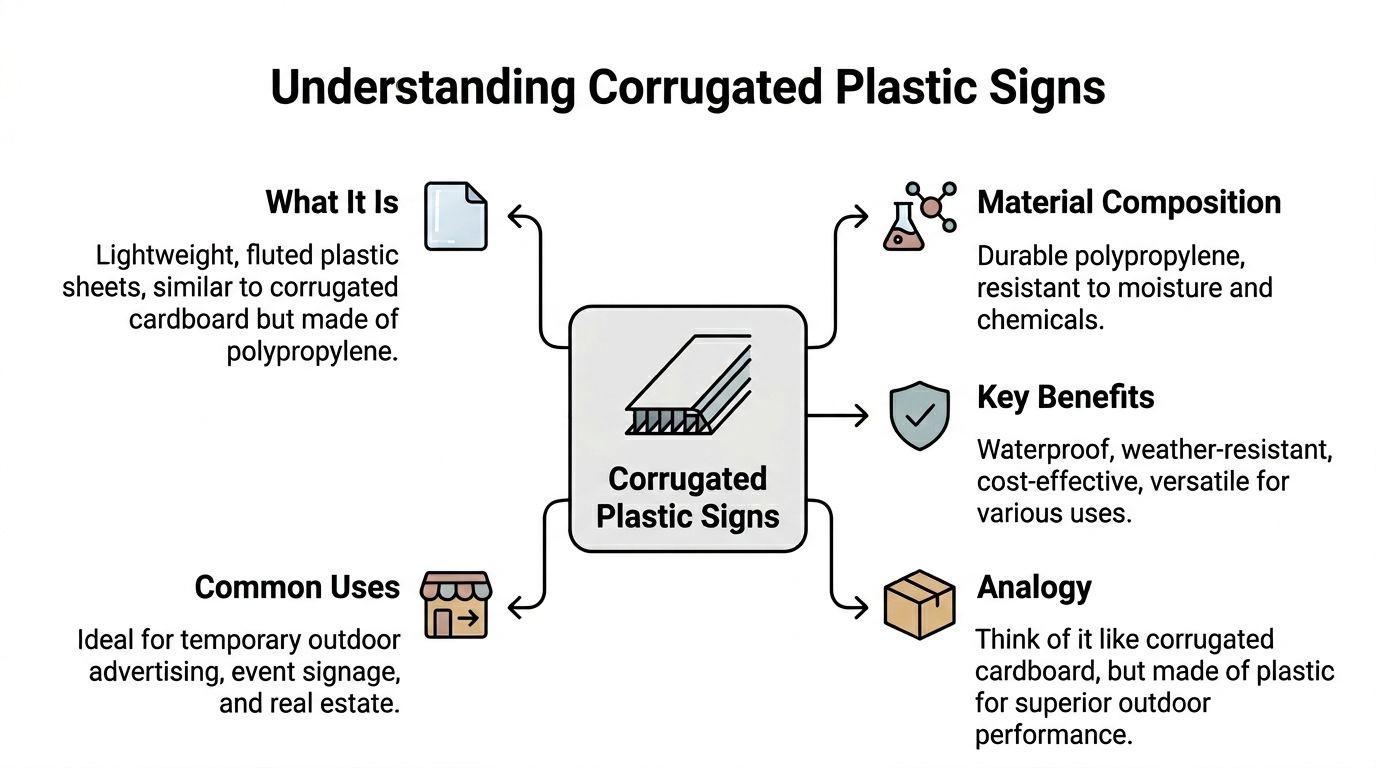
Corrugated plastic signs are made from twin-wall fluted polypropylene. “Twin-wall” means the sheet has two flat outer surfaces with hollow channels between them. Those channels are called flutes.
If that sounds technical, the easiest comparison is a cardboard box. Cardboard gets stiffness from its corrugated center. Corrugated plastic signs use the same idea, but with plastic instead of paper, so the sheet stands up better outside.
Why the flutes matter
The flutes are not just a manufacturing detail. They are the reason the material works.
According to Coropak’s guide to corrugated plastic, corrugated plastic provides up to 5 to 10 times greater flexural strength per unit weight than solid PVC sheets, because the air-filled flutes act like I-beams that resist bending under wind load. That is why a panel can feel surprisingly rigid without being heavy.
For a buyer, that means two things happen at once:
- the sign is light enough to move, stake, hang, or ship easily
- the sheet still has enough backbone to avoid looking limp in normal use
That balance is why it shows up so often in temporary outdoor programs.
Coroplast versus corrugated plastic
You will hear people use Coroplast as if it means the material itself. In practice, many buyers, printers, and installers use “Coroplast” the way people use a brand name to describe a product category. The safer way to think about it is this: corrugated plastic is the category, and Coroplast is a commonly referenced brand within it.
That distinction matters most when you are comparing expected outdoor life and print quality. Not all sheets behave the same way.
When it is the smart choice
Corrugated plastic signs are a smart choice when you need a sign that is:
- Temporary but not flimsy
- Outdoor-ready without moving into premium material pricing
- Light enough for multi-site distribution
- Easy to mount with standard stakes, frames, or grommets
For many commercial jobs, that combination beats more “premium” options that are unnecessary for the duration of the campaign.
Where it falls short
It is still a utilitarian material. That is the trade-off.
A corrugated plastic sign does not usually deliver the same polished, permanent impression as aluminum composite or a fabricated panel. On close inspection, the fluted construction can influence how refined the face feels, especially on minimalist designs with large light areas.
If the sign has to project permanence, architectural quality, or a long-term brand presence, a different substrate may be the better call. If you are comparing options for tougher exterior use, this overview of the best material for outdoor signs is a useful next step.
Consider this perspective: corrugated plastic is the pickup truck of temporary signage. It is built to work, not to impress in the showroom.
Common Business Applications and Strategic Uses
The reason corrugated plastic signs stay relevant is simple. They solve very different problems without requiring a different material each time.

Retail promotions and roadside visibility
A retailer running a weekend sale usually does not need a sign that lasts for years. They need signs placed where drivers and foot traffic will see them. Corrugated plastic works well for roadside promos, parking lot callouts, and directional signs pointing shoppers to an entrance, overflow parking area, or pickup lane.
This is also where quantity matters. A single sign rarely carries the whole campaign. Several signs placed along the path of travel usually do more than one oversized panel in the wrong location. Corrugated plastic makes that approach realistic because buyers can deploy multiple units without committing to a permanent-material budget.
For buyers comparing formats, this gallery of types of outdoor signs for business helps frame where corrugated plastic fits versus more permanent systems.
Construction sites and industrial properties
On construction jobs, signs take abuse. Mud, wind, handling, temporary fencing, changing logistics, and crews moving equipment all test a sign fast.
Corrugated plastic signs work well here because they can carry several kinds of messaging at once:
- Site direction: delivery entrance, trailer parking, visitor check-in
- Project identity: developer, contractor, leasing, coming-soon messaging
- Basic notices: temporary rules, detour instructions, traffic flow
Safety communication deserves special attention. Construction managers often mix temporary corrugated signs with more formal compliance signage. If your team is refining that system, this guide to workplace safety signage is useful for sorting what belongs in temporary versus permanent use.
Churches, schools, and event wayfinding
Weekend events create a recurring signage problem. The message matters intensely for a short window, then disappears until next time.
That makes corrugated plastic a practical choice for:
- guest parking
- children’s check-in directions
- overflow entrance routing
- special event branding
- campus wayfinding
For churches and schools in particular, signs often need to be stored, reused, and brought out by volunteers. Lightweight panels are easier to carry and less likely to create setup friction.
Real estate and site marketing
Real estate teams use corrugated plastic signs because they need speed and flexibility. Listings change. Leasing messages change. Open house schedules change. A broker can place a simple panel quickly, and the sign can be moved, replaced, or updated without much operational drag.
The same applies to commercial developments. “Future tenant,” “now leasing,” and directional lot signs often need to appear early, before permanent sign packages are approved or installed.
Political campaigns prove the point
One of the clearest examples of sign influence comes from politics. According to Printing LP’s summary of Electoral Studies Journal research, the presence of lawn signs leads to a 1.7 percentage point increase in vote share.
Commercial buyers should not read that as a politics-only lesson. The practical takeaway is broader. Repeated visibility in the physical world changes behavior. It nudges recognition, reinforces memory, and keeps a message in front of people who may never click an ad.
Field lesson: The best corrugated plastic sign programs do not rely on one sign design. They use a small family of signs, each matched to a location and a job.
Choosing the Right Sign Specifications
Many disappointing corrugated plastic signs were not bad products. They were bad specifications. The material was asked to do a job it was not set up to handle.
The main choices are thickness, print method, and finishing. Get those right, and the sign usually performs as expected.
Thickness should match the job
Thickness affects stiffness, handling, and how the sign feels in use.
A lighter sheet is common for standard yard-sign style applications. It works well when the sign is modest in size and supported correctly. A thicker sheet makes more sense when the panel is larger, sees more handling, or needs extra stability.
Use this simple decision framework:
| Need | Better fit |
|---|---|
| Short-term yard signs, directional arrows, event stakes | Standard corrugated plastic sheet |
| Larger site signs, heavier-duty field use, repeated handling | Thicker corrugated plastic sheet |
The mistake buyers make is upgrading thickness by default. Thicker is not automatically better. It adds bulk, changes how the signs pack, and can be unnecessary for brief campaigns. Match the sheet to the placement and support method.
Print method affects durability and appearance
For most commercial orders, direct UV printing is the practical standard because the ink cures directly onto the sheet surface. That keeps production efficient and supports outdoor use.
Artwork matters just as much as hardware. If the design file is weak, even a good substrate will print like a compromise. For teams creating their own layouts, this plain-English guide on the importance of 300 DPI resolution is worth reviewing before you submit art.
A few practical print notes matter in the field:
- Bold contrast travels farther: Drivers will read high-contrast text before they notice fine detail.
- Simple layouts hold up better: Temporary signs fail when designers cram in too much copy.
- Photos can work, but not every job needs them: A product shot may help retail signage. For a directional or leasing sign, text usually does more work than imagery.
Finishing changes how the sign gets used
Finishing is where a sign becomes install-ready.
Grommets for hanging applications
Add grommets when the sign will be zip-tied to fencing, attached to posts, or suspended. Without reinforced holes, the panel may be more vulnerable during installation and removal.
H-stake compatibility for yard placement
For ground placement, flute direction and cut size need to match the stake setup. If the flutes are wrong for the installation method, setup gets awkward fast.
Rounded corners for handling and appearance
Rounded corners are a small detail, but they help in busy environments. They reduce sharp edges and give the finished piece a cleaner look, especially for customer-facing events.
Die-cut shapes when visibility matters
Custom shapes can help a temporary campaign stand apart. Used well, they add recognition. Used poorly, they add production complexity without improving readability.
Practical rule: Spend money on readability before you spend it on novelty. A plain sign that people can read beats a clever shape that gets ignored.
If your team is ordering multiple versions across locations, a provider that handles printing on Coroplast can help standardize specs so every site receives a sign that installs the same way.
Installation Mounting and Local Code Guidance
A well-printed sign can still fail in the field because of a bad mount, bad placement, or bad assumptions about local rules.

Match the mount to the environment
The usual mounting options each solve a different problem.
- Wire H-stakes: Good for lawns and soft ground where quick placement matters.
- Grommets with zip ties: Useful for chain-link fence mounting around jobsites or event perimeters.
- A-frames: Better when you need portable placement on hard surfaces and want the sign brought in daily.
- Post mounting: Works when the sign needs a more fixed presentation and the site allows it.
Do not choose hardware in isolation. A windy roadside edge, a church lawn, and a fenced warehouse property do not place the same demands on a sign.
Flute direction is not a minor detail
Flute direction directly affects performance. According to Sign Outlet Store’s corrugated plastic sign guidance, portrait orientation with vertical flutes can improve stability in gusts by 25 to 40 percent compared with horizontal orientation.
That matters because the flutes act like the internal rails of the panel. When they are oriented correctly for the mounting method, the sign is better able to resist bending in wind. When they are not, the sign is more likely to flex the wrong way, loosen, or fail early.
For staked signs, this is one of the most common preventable mistakes.
Installer tip: If the sign is going in the ground, confirm flute direction before production, not after delivery.
Placement problems that shorten sign life
Even when the material is right, poor placement can sabotage results.
Common field errors include:
- Setting signs where landscaping blocks the message
- Placing them too close to traffic for safe reading
- Installing at uneven heights across a multi-site program
- Mounting in spots where maintenance crews or vehicles hit them repeatedly
Signs should face the line of travel and meet the viewer where attention naturally falls. In retail, that may be vehicle approach. On a campus, it may be pedestrian flow. At a construction site, it may be the truck entrance.
Local code is part of the job
Temporary signage often triggers local rules about size, placement, setback, duration, or permit requirements. Buyers sometimes learn that only after signs are printed.
That is why municipalities remove signs, issue warnings, or reject placement plans that seemed harmless. The material is temporary. The compliance risk is not.
If your project spans multiple locations, code review becomes even more important because each jurisdiction may define temporary signs differently. This overview of sign permit requirements is a practical reference point before ordering a large run.
One practical option for regional and national programs is to work with a vendor that can coordinate specifications, installation planning, and permitting support. On Display Signs, Inc. handles fabrication, permitting, installation, and multi-site sign programs as part of its broader project management work.
Comparing Alternatives to Corrugated Plastic
Corrugated plastic signs are useful, but they are not the right answer for every job. Buyers get better results when they compare them against other materials instead of assuming the cheapest rigid panel is always the smart buy.
Where corrugated plastic wins
Corrugated plastic is strongest when the campaign is temporary, the quantity is moderate to high, and the install needs to stay simple. It is light, practical, and efficient for signs that must be moved, shipped, or replaced without much friction.
Its outdoor life is also better than many low-cost buyers expect. According to Inscriptu’s corrugated plastic material guide, genuine Coroplast signs have a 1 to 2 year outdoor lifespan, can outperform generic alternatives by up to 30 percent because of stronger UV stabilizers, and 4mm sheets maintain over 95 percent of their tensile strength after the equivalent of 2 years in Florida.
That does not make corrugated plastic a permanent sign material. It means quality material can stay serviceable long enough to deliver strong value in the right role.
Where other materials make more sense
Some jobs call for a different substrate.
Aluminum composite makes more sense when the sign needs a more polished appearance and longer service life outdoors.
Solid PVC can work when a smoother, more finished face is part of the visual priority, especially in protected conditions.
Vinyl banners are useful when the message is large-format, temporary, and better suited to hanging than staking or panel mounting.
The key is not to compare materials by purchase price alone. Compare them by how long the message needs to remain active, how often the sign will be handled, and what visual standard the site requires.
Sign Material Comparison
| Material | Best For | Cost/Sq. Ft. | Outdoor Lifespan | Weight |
|---|---|---|---|---|
| Corrugated plastic | Temporary outdoor promotions, yard signs, directional signs, site notices | Lower-cost option | 1 to 2 years for genuine Coroplast | Lightweight |
| Aluminum composite | Long-term exterior business signs, premium site branding | Higher than corrugated plastic | Longer-term outdoor use | Heavier |
| Solid PVC | Smoother rigid signs, protected outdoor or indoor applications | Varies by thickness and finish | Moderate outdoor use, project-dependent | Moderate |
| Vinyl banner | Fence signs, temporary promotions, large hanging graphics | Lower-cost option for large formats | Temporary outdoor use | Very lightweight |
Total cost is not just purchase price
A cheaper sign that has to be replaced too soon can cost more in labor, shipping, and reinstallation. A more expensive panel can also be wasteful if the message changes quickly.
That is why corrugated plastic signs sit in a useful middle zone. They are cost-effective when the campaign is time-bound and the site does not demand a premium architectural finish. They stop being the right choice when the sign needs to look permanent or stay in place as part of the property for the long haul.
Buying test: Ask one question before choosing the substrate. Will the message expire before the sign should? If yes, corrugated plastic often makes sense. If no, consider upgrading.
Frequently Asked Questions About Corrugated Plastic Signs
Are corrugated plastic signs recyclable
Often, yes. Corrugated plastic is polypropylene, and many buyers choose it in part because it can be routed into recycling streams where local facilities accept that material.
The practical issue is not the sheet alone. Hardware, inks, tape, zip ties, and attached accessories may need to be separated first. For commercial programs, build a simple retrieval plan before installation so used signs do not end up scattered across sites.
What is the best way to prepare print-ready artwork
Keep the file simple and disciplined. Use high-resolution images, convert fonts when required by your printer, and leave enough safe margin so important text does not sit too close to the edge or grommet area.
For temporary outdoor signs, the bigger mistake is usually messaging, not software. Buyers try to fit too many words into a panel that people will only see for a moment. Short copy, strong contrast, and one clear call to action usually outperform a crowded layout.
Can corrugated plastic signs print photographs well
Yes, but the sign still has to suit the viewing distance and the job. Product images and lifestyle photos can reproduce well on corrugated plastic when the artwork is strong and the print process is appropriate.
That said, photos are not always the best use of the space. If the sign is viewed from a moving vehicle or from across a parking lot, a photo may add less value than a bold headline and directional cue.
How should signs be stored between uses
Store them flat in a dry area and avoid bending the panels under heavy stacks. Keep hardware bundled separately so metal parts do not scratch the printed face.
If the signs are part of a recurring event, label the stacks by location or use case. That saves time later and reduces the common problem of volunteers or field crews grabbing the wrong signs on setup day.
If you need corrugated plastic signs for retail promotions, jobsite communication, church events, or multi-location rollouts, On Display Signs, Inc. can support the full process from material selection and print production to permitting, installation, and ongoing sign management.