If you own a business in Portland, you’ve probably sat at a red light on McLoughlin, crawled along I-5, or waited through another slow merge near the Ross Island Bridge and looked around at a lot of blank vans, pickups, and delivery vehicles. Every one of those empty panels is unused ad space moving through the exact neighborhoods where customers live, work, and buy.
That’s why portland vehicle wraps keep coming up in serious signage conversations. For the right business, they’re not just a cosmetic upgrade. They turn a necessary operating asset into a branded presence that works during service calls, deliveries, site visits, and routine driving.
Why Your Portland Business Needs Mobile Advertising
A plain work van doesn’t stay invisible because people don’t see it. It stays invisible because it gives them nothing to remember. A wrapped vehicle does the opposite. It gives passing drivers, pedestrians, and customers in parking lots a name, a color system, and a service category they can connect back to later.
In Portland, that matters more than a lot of owners realize. Dense traffic, mixed residential and commercial corridors, and constant local movement create repeated exposure. A vehicle parked at a job site in Sellwood in the morning and driving to a warehouse in Northwest later that day isn’t just transporting tools or inventory. It’s carrying your brand through multiple buying environments.
What a wrap does in practical terms
A vehicle wrap is a printed graphic system applied to the vehicle exterior so your company name, service message, colors, and contact information travel with the vehicle. From a project manager’s perspective, the key point isn’t the film itself. It’s the function.
A strong wrap helps a business do three things at once:
- Build recognition locally: People may not call the first time they see your van, but repeated exposure matters.
- Create legitimacy: A branded service vehicle looks established. That changes how prospects judge your business before anyone speaks to them.
- Support other channels: If someone later searches your name after seeing your truck in traffic, your digital presence needs to be ready. That’s why wrap visibility works best alongside solid local online business marketing.
Vehicle wraps also stick in memory. Vehicle wraps achieve 97% recall rates among viewers, which is why they remain such a durable out-of-home marketing tool according to Cascade Wraps vehicle wrap statistics.
A good wrap doesn’t try to say everything. It helps the right person remember who to call when the need shows up later.
Why Portland streets make wraps work
Portland businesses often spend heavily on channels that disappear the moment the campaign ends. Wrapped vehicles behave differently. They stay visible while your team is already doing billable work.
That’s especially useful for businesses with local routing patterns such as:
- Home service companies: Electricians, HVAC firms, plumbers, and remodelers move through neighborhoods where trust and recognition drive response.
- Retail and food distribution: Delivery vehicles reinforce brand familiarity beyond the storefront.
- Commercial trades and suppliers: Site visits put branded vehicles in front of contractors, tenants, and property managers.
If you’re trying to understand where wraps fit inside a broader brand system, it helps to look at how vehicles function within signs in advertising. They don’t replace permanent signage. They extend it into the streets where attention is already available.
Calculating the Business Case for Vehicle Wraps
The business case gets clearer when you stop thinking about wraps as a one-time graphic purchase and start treating them like a long-life visibility asset. Portland business owners already pay for vehicles, fuel, insurance, and labor. A wrap adds marketing output to miles you’re driving anyway.
That’s the primary advantage. The vehicle already exists. The route already exists. The workday already exists.
What the numbers mean for an owner
In Portland, a single wrapped vehicle can generate between 30,000 and 70,000 visual impressions daily, and the average wrap cost translates to about $0.04 cost per thousand impressions, according to Fleet Wrap HQ’s Portland vehicle wrap data.
That number matters because it changes the conversation from “What does the wrap cost?” to “What does ongoing visibility cost over the life of the asset?”
If you’re reviewing marketing spend with a partner, finance lead, or operations manager, ask the practical questions:
- Will this vehicle be on the road consistently? A parked fleet doesn’t market much.
- Does the service area match your customer geography? A wrap works best when driving patterns overlap with target buyers.
- Will the design stay relevant long enough to justify the install? Frequent rebrands weaken the economics.
A simple way to judge value
A wrap usually makes the most sense when your business has repeat local movement and a clear service category. Think roofing, HVAC, restoration, janitorial, pest control, food distribution, property maintenance, local retail delivery, and church transportation.
The economics tend to be weaker when:
- The vehicle is rarely seen: Limited route exposure lowers the practical value.
- The brand message is unclear: If people can’t tell what you do in a glance, impressions get wasted.
- The business changes offers often: Wraps reward consistency, not weekly campaign shifts.
Practical rule: If the same vehicle serves customers across Portland every week, leaving it unbranded is usually the more expensive choice over time.
For many owners, wraps sit in the same budget discussion as storefront signs, monument signs, and directional systems. That comparison is useful because each serves a different purpose. If you’re pricing visibility assets side by side, this overview of the cost of signage for business helps frame where mobile branding fits.
How owners usually miscalculate ROI
The most common mistake is expecting a wrap to act like direct-response digital advertising. That’s not its job. A wrap is better at creating repeated local recognition, supporting word of mouth, and making your vehicles look like part of an organized company instead of a loose collection of work trucks.
A second mistake is evaluating only lead volume. Wraps also improve first impressions at the curb. When a branded vehicle arrives at a residence, church campus, warehouse, or retail location, the company appears more established before the technician steps out.
That doesn’t show up neatly in a dashboard, but it affects trust, close rates, and referrals in practice.
Selecting the Right Wrap Type and Material for Durability
Most business owners start with design. In practice, coverage choice and material choice are what protect the investment. If the wrong film goes on the wrong vehicle, or if the owner expects one type of application to behave like another, the project usually disappoints long before the graphics wear out.
The first decision is coverage. The second is material. The third is whether branding alone is enough, or whether protection should be part of the specification.
Coverage choices that fit real fleets
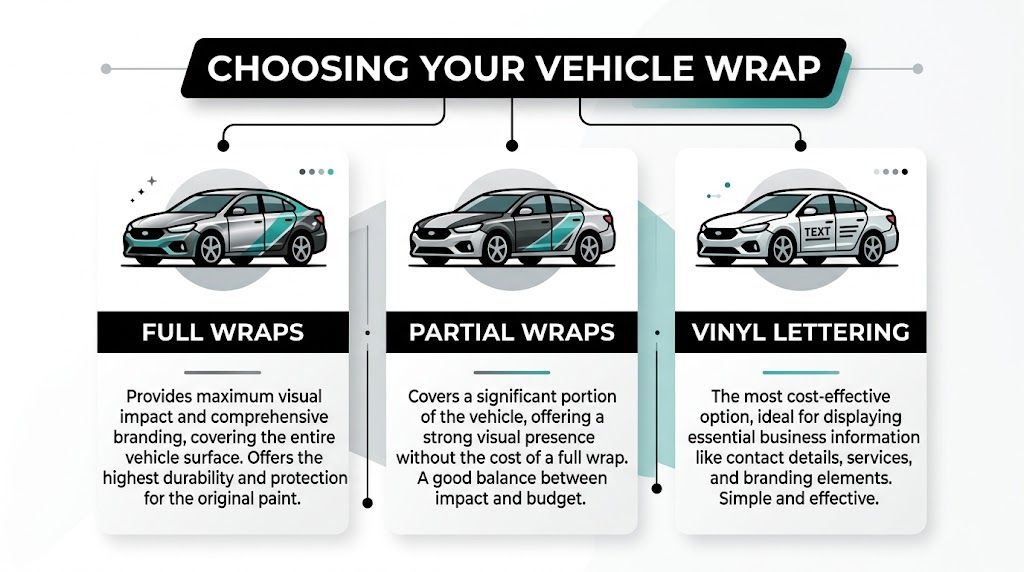
Full wraps create the strongest visual presence because they convert the entire vehicle into a coordinated branded surface. They’re usually the right choice when the vehicle itself is part of the company’s image, or when maximum recognition matters across multiple neighborhoods and job types.
Partial wraps work when budget matters but you still need a deliberate branded look. On many cargo vans and box trucks, a well-designed partial can still carry the message effectively if the layout uses the available panels intelligently.
The last category is simple cut graphics or lettering. Those can work for very basic identification, but they don’t deliver the visual authority of a more complete system.
| Wrap Type | Coverage | Typical Cost Range | Best For |
|---|---|---|---|
| Full Wrap | Entire vehicle exterior | Varies by vehicle size, material, and design complexity | Maximum brand visibility and cohesive presentation |
| Partial Wrap | Selected major panels | Lower than a full wrap, depending on layout and coverage area | Businesses balancing impact and budget |
| Vinyl Lettering | Minimal coverage, usually text and logo elements | Most economical option | Basic identification on service vehicles |
If you’re comparing providers and need a starting list of local vinyl sign and decal providers, use it as a vendor discovery tool. Then ask each shop deeper questions about fleet consistency, installation standards, and material specs rather than stopping at price.
Vinyl versus PPF
Here’s where many Portland vehicle wraps projects get oversimplified. Vinyl and Paint Protection Film are not interchangeable products.
Premium vinyl is built for branding and color change. It’s the standard choice when the main objective is visibility. Paint Protection Film, or PPF, adds a protective layer with self-healing properties and is worth considering for vehicles that take real road abuse.
According to Executive ENM’s vehicle wrap material overview, PPF with self-healing properties can reduce long-term maintenance costs by 40-60% by protecting against rock chips and UV damage. That changes the conversation for fleets that spend a lot of time on highways, construction routes, or industrial corridors.
If your vans spend most of their lives in neighborhoods, premium vinyl may be enough. If they spend their lives on rougher roads or near active sites, adding protection can save headaches later.
A short explainer helps clarify how these applications look in practice:
What works and what usually doesn’t
Good material selection starts with route conditions, replacement cycle, and ownership plans. If you replace vehicles frequently, a simpler branding approach may be enough. If you keep vans in service for years and want them looking consistent, better films and better installation standards usually pay off.
Use this practical checklist when specifying materials:
- For curved modern vans: Ask for premium wrap films designed to conform cleanly around contours, recesses, and handles.
- For rough-duty fleets: Consider whether a PPF-first strategy makes sense before layering branding elements.
- For long-term outdoor exposure: Prioritize durability over the cheapest quote.
- For procurement reviews: Ask the shop to explain why the chosen material fits the vehicle body and service conditions.
Material choice also needs to align with your broader exterior branding standards. This guide to the best material for outdoor signs is useful because the same principle applies across signage categories. The right material depends on exposure, lifespan, and maintenance realities, not just appearance on day one.
Understanding the Vehicle Wrap Process from Design to Installation
A wrap project goes wrong long before installation if the business owner hands over a logo and says, “Make it look good.” Good wraps come from good briefs. That means deciding what the vehicle needs to communicate in a glance, where it will operate, and how long the design has to stay relevant.
The process is straightforward when it’s managed correctly. It usually breaks into design, production, installation, and inspection. Problems happen when one of those stages gets rushed.
Design has to follow the vehicle
A strong concept on a flat proof can fail on an actual van. Door seams split phone numbers. Handles interrupt logos. Body lines distort text. Rear doors create awkward breaks right where contact details need to stay readable.
That’s why design should start with the exact vehicle make and model. The layout needs to fit panel geometry, not a generic rectangle.
The best designs for business vehicles usually keep priorities in this order:
- Company name first: If people can’t identify the brand instantly, the wrap loses value.
- Service category second: Spell out what you do in plain language.
- Contact path third: Phone number, website, or both, but only if they remain readable at a distance.
- Supporting visuals last: Photography, patterns, and textures should support the message, not bury it.
A lot of owners also benefit from understanding the production side, especially how artwork becomes cut and printed pieces. This short overview of what a vinyl plotter is helps explain why file prep, contour accuracy, and production method affect the final result.
Installation quality decides lifespan
Many low-bid jobs fail. Professional installation methodology accounts for up to 70% of a wrap’s longevity, including proper temperature control and extreme surface cleanliness, according to WrapCo PDX’s installation standards.
That should change how you vet vendors. Ask less about “how fast can you do it” and more about process discipline.
Specifically, good installers manage:
- Substrate temperature: The wrap surface needs to stay in the proper range during installation.
- Surface preparation: Dirt, wax, residue, and contamination ruin adhesion.
- Panel handling: Stretching film incorrectly around recesses and edges causes failure later.
- Post-install curing: Vehicles need the proper rest period before returning to full service.
Most premature wrap failure doesn’t happen because the owner chose the wrong color. It happens because prep, heat, or tension was handled poorly.
What to expect from a competent shop
A professional wrap vendor should be able to walk you through the full schedule without guessing. They should explain who handles design approvals, what condition the vehicle must arrive in, how long it will be down, and what the final inspection includes.
When I review wrap programs from a signage management perspective, I want to see these basics in place:
- Vehicle condition review: Existing paint issues, body damage, or prior graphics should be addressed before production.
- Proof approval discipline: One final approved layout for each vehicle type prevents expensive last-minute changes.
- Installation notes by unit: Fleet work gets easier when each vehicle has a documented scope.
- Delivery checklist: The business should receive care instructions and a clear sign-off process.
Certified Portland installers reportedly achieve 95%+ first-pass quality rates, which is exactly why process matters. A wrap that goes on correctly the first time avoids rework, downtime, and brand inconsistency.
Navigating Portland’s Vehicle Signage Rules and Regulations
Most wrap conversations in Portland focus on graphics, finish, and price. The legal side gets ignored until someone receives a notice or asks why a branded vehicle can’t stay parked in the same promotional spot every day.
That’s a mistake. A wrapped vehicle can cross from legitimate business transportation into sign regulation territory depending on how it’s used and where it’s parked.
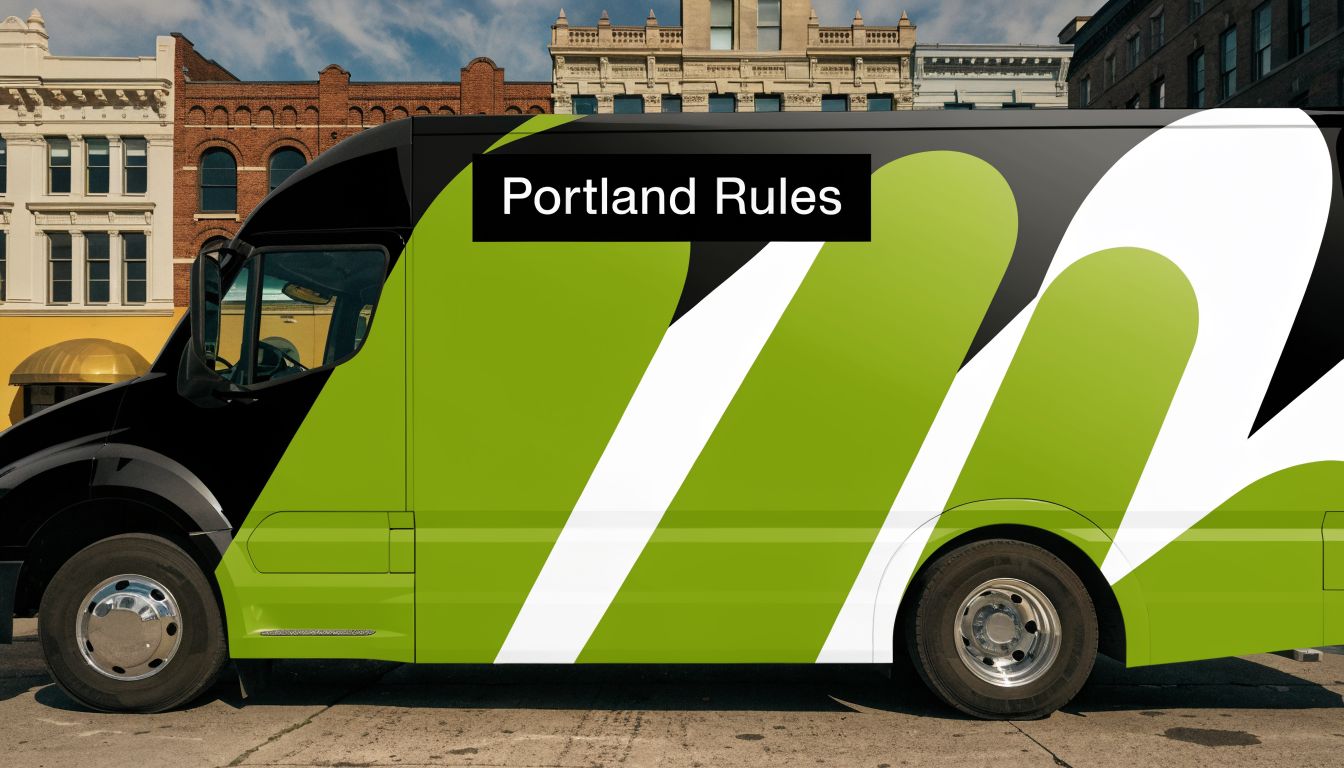
Why Title 16 matters
Under Portland Municipal Code Title 16, a wrapped vehicle that’s parked strategically for advertising can be treated as a sign rather than just a vehicle. According to Wrap Guys America’s Portland wrap page, many businesses don’t realize this until they run into enforcement, and fines can reach $1,000 per day.
The practical issue isn’t that wraps are illegal. It’s that usage matters.
A service van parked while technicians work inside a building is one thing. A wrapped vehicle positioned off-street mainly to act as a standing advertisement can become a different regulatory question.
Situations that deserve a permit review
If your Portland vehicle wrap strategy includes planned parking visibility, don’t assume the wrap itself is the only issue. Review the use case.
Watch for these scenarios:
- Promotional parking near a roadway: If the vehicle is being placed mainly for exposure, ask whether Title 16 applies.
- Off-street display near a business entrance: This can blur the line between transportation and signage.
- Long-term parking at a development site: Builders and commercial developers should be especially careful.
- Multi-vehicle staging on private property: Fleet presence can attract more scrutiny than a single active service vehicle.
If your business already deals with storefront, monument, or temporary sign approvals, the same discipline applies here. Understanding sign permit requirements helps owners ask better questions before they commit to a vehicle placement strategy.
Compliance is part of the marketing plan. If the vehicle’s main job in that location is advertising, treat it like a permitting issue until proven otherwise.
What owners should ask before rollout
Portland businesses don’t need to become code experts, but they do need a process. Before you roll out wrapped vehicles, especially across multiple sites, verify who is responsible for compliance review.
Use a short internal checklist:
- How will the vehicle be used? Driving, servicing, delivering, or standing as a promotional object?
- Where will it be parked regularly? Public street, customer site, business lot, or development parcel?
- Who checks local interpretation? Someone on your side or a signage partner should confirm whether permitting is needed.
- What happens if enforcement questions the placement? Have a response path before the issue appears.
This is one of the biggest blind spots I see in mobile branding programs. Owners plan the artwork carefully, then improvise the parking strategy. In Portland, that can turn a smart advertising asset into a preventable problem.
Planning and Executing Fleet Wraps for Multi-Site Businesses
Fleet wraps are not just “the same wrap, more times.” Once a business moves beyond one or two vehicles, the job becomes a coordination exercise involving branding standards, operations, scheduling, and inspection discipline.
The challenge gets bigger when the fleet includes different body styles. A logo that looks balanced on a Transit van may crowd awkwardly onto a pickup or disappear on a larger box truck if the design system wasn’t built to flex.
What consistency actually requires
For multi-site businesses, consistency starts with a master program, not with individual vehicle art files. The best fleet rollouts create a repeatable system that defines hierarchy, color usage, panel priorities, and placement rules before any single unit is scheduled.
That usually means documenting:
- Approved layouts by vehicle class: Cargo van, pickup, service body, box truck, and any specialty unit.
- Brand hierarchy: What must appear on every vehicle, and what can be optional.
- Operational constraints: Which vehicles can be down at the same time without hurting service.
- Inspection standards: How the team approves each finished unit before it returns to the field.
Downtime is the hidden cost
Businesses tend to focus on design and install pricing. The larger cost in a fleet project is often downtime. A truck sitting in a bay instead of on a route affects deliveries, service calls, and labor planning.
That’s why experienced fleet managers stagger installation windows and group vehicles by role rather than by convenience. Wrap high-visibility lead vehicles first. Test the design in real use. Then schedule the rest in waves that operations can absorb.
A practical rollout sequence looks like this:
- Finalize one brand standard for all units.
- Approve vehicle-specific proofs.
- Confirm parking, access, and compliance needs by location.
- Build an installation calendar around operational peaks, not around shop availability alone.
- Inspect each vehicle against the same standard before sign-off.
Why one point of coordination matters
Multi-site work breaks down when design, printing, permitting questions, and local installation scheduling live with different people. A single project manager or central coordinator reduces revision drift and keeps one version of the truth moving across the entire program.
That matters for commercial developers, warehouse operators, churches, regional retailers, and service companies with distributed teams. When each location improvises its own vehicle branding, the result looks fragmented. Customers notice that faster than most internal teams expect.
The businesses that do fleet wraps well treat them like an extension of a signage program, not a one-off graphics purchase.
Final Considerations and Frequently Asked Questions
Before approving a wrap project, narrow the decision to four things: what the vehicle needs to do for the brand, how long the graphics need to stay relevant, what operating conditions the vehicle sees every week, and whether the installer can execute consistently.
If those four points are clear, most other decisions get easier. If they’re fuzzy, the project tends to drift toward either overspending or under-specifying.
A practical pre-approval checklist
Use this as a final review before you sign off:
- Define the job of the vehicle: Is it a lead generator, a credibility builder, a fleet consistency tool, or all three?
- Match coverage to the objective: Full wraps create stronger presence. Simpler treatments may be enough for identification-only needs.
- Specify materials based on use: Highway mileage, rough routes, and long service life justify stronger material choices.
- Verify installation standards: Process quality affects how the wrap performs over time.
- Review parking and usage plans: In Portland, placement can trigger regulatory questions.
- Plan for maintenance: A wrap only keeps selling the brand if it still looks clean and intentional.
The best wrap decisions happen before production starts. Clarity at the brief stage is cheaper than correction after installation.
Frequently asked questions
How long does a vehicle wrap installation take
The exact timeline depends on vehicle size, design complexity, condition of the surface, and shop scheduling. In practice, owners should expect the project to include more than just installation time. Design approvals, production, prep, install, and post-install curing all affect the schedule.
The safest way to plan is to ask the installer for a unit-by-unit downtime estimate and build around your operating calendar, especially for fleet vehicles that generate revenue daily.
Will a wrap damage my original paint
A professionally specified and installed wrap generally protects the underlying finish rather than harming it. The bigger risk usually comes from poor paint condition before installation, neglected body damage, or low-quality removal later.
If a vehicle has repainted panels, chips, rust, or weak clear coat, tell the shop before production. The wrap can only bond as well as the surface underneath allows.
What’s the practical difference between a wrap and a decal
A wrap is a broader graphic treatment designed around the vehicle body. It often covers large panels or the full vehicle and creates a unified branded appearance. A decal is usually a smaller applied graphic or text element used for identification, labeling, or limited branding.
For business use, the difference is not just visual. It’s strategic. A wrap is meant to carry the brand presence. A decal usually supplements it.
Should every business vehicle be wrapped
Not always. The best candidates are vehicles that operate consistently in your target market and appear in places where prospects or customers already notice them. If a vehicle is rarely seen, cycles out quickly, or serves a highly limited internal function, a simpler identification approach may be more sensible.
For many companies, the smartest move is to start with the most visible units rather than wrapping everything at once.
How much information should go on the vehicle
Less than most owners want. Put the brand name first, then the clearest service description, then a simple contact path. Too much copy turns the vehicle into a moving brochure no one can read.
Good wraps are designed for fast recognition, not long-form explanation.
What should I ask a wrap vendor before approving the job
Ask practical questions, not just creative ones:
- Which material are you specifying, and why for this vehicle?
- How are you handling body seams, recesses, and rear-door messaging?
- What prep standards do you use before installation?
- What condition must the vehicle be in when it arrives?
- Who signs off on the final proof?
- How will installation downtime be scheduled for business continuity?
Are wraps enough on their own
Usually not. Wraps are strongest when they reinforce an existing brand system that includes a solid website, good local visibility, and consistent signage at the property level. They create familiarity. Other channels convert that familiarity when the customer is ready.
That’s why the best-performing wrap programs usually come from businesses that already know their message and market clearly.
If you’re evaluating portland vehicle wraps for one van or a regional fleet, treat the project like a branding asset with operational consequences. The design matters. The material matters. The installer matters. In Portland, the compliance plan matters too.
If you need a national signage partner that can coordinate design consultation, fabrication, permitting, installation, and multi-site rollout support, On Display Signs, Inc. offers end-to-end project management for businesses that need consistent execution across locations.