Think of your exterior directional signs as the first handshake with every visitor. They aren't just there to point the way—they're the essential guides that turn a potentially confusing property into a welcoming space, setting the tone for the entire customer experience long before anyone reaches your front door.
Why Signs Are a Critical First Impression
Stop thinking of your property as a single location and start seeing it as a journey. Whether it's a sprawling corporate campus, a busy shopping center, or a large industrial park, every visitor arrives with a destination in mind. Your exterior directional signs are their very first interaction with your brand, and this moment can either build confidence or create instant frustration.
Picture this: you're driving to a big medical complex, already anxious about an appointment, and you're met with a maze of poorly marked parking lots and confusing building entrances. The stress is immediate, and your perception of the facility is already negative. Now, imagine that same property with clear, well-placed signs guiding you effortlessly from the main road to the right parking lot and straight to the correct entrance. That seamless experience communicates competence, professionalism, and care.
The Psychology of Clear Wayfinding
Good directional signage does a lot more than just point people in the right direction; it quietly manages visitor anxiety. When people feel lost, that frustration gets transferred directly onto their perception of your business. By providing clear guidance, you remove that friction.
This simple act of helping people get around has a huge impact on how they see your organization. The whole point is to offer clear, unambiguous guidance, ensuring effective navigation to desired places and directions for every single person who arrives.
Well-designed exterior directional signs act like a helpful concierge for your property. They anticipate questions, provide immediate answers, and make every visitor feel confident and welcome from the moment they arrive.
Building Brand Trust Instantly
The quality of your signage is a direct reflection of your brand. Faded, damaged, or confusing signs suggest neglect and a lack of attention to detail. On the other hand, clean, modern, and easy-to-read signs immediately establish a sense of professionalism and credibility.
This isn't just a feeling; it’s backed by real consumer data. A staggering 79% of people directly connect high-quality signage with superior products or services. For any business in a competitive market, that first impression can be the deciding factor. It proves that investing in clear wayfinding is an investment in your brand’s reputation.
Choosing Materials and Illumination for Lasting Impact
Think of your exterior directional sign as a long-term investment that’s constantly exposed to sun, rain, and freezing temperatures. Picking the right materials isn't just about looks—it’s a business decision that directly affects how long your sign lasts, what you'll spend on maintenance, and how people see your brand over time.
For instance, a busy logistics hub might need rugged, non-lit aluminum signs for its loading docks, where sheer durability is the only thing that matters. On the other hand, an upscale commercial complex will likely spring for elegant, internally lit pylon signs to project a premium image and stay visible around the clock.
Durable Materials for Exterior Directional Signs
The foundation of any great sign is the material it's made from. Different options bring unique strengths to the table in terms of weather resistance, toughness, and visual appeal. Knowing the difference is key to making a smart choice.
-
Aluminum: This is a crowd favorite for a good reason. It is strong but lightweight, completely rust-proof, and holds up incredibly well against corrosion. It’s also versatile—you can paint it, add different finishes, or apply vinyl graphics, making it perfect for post and panel signs or monument sign bases.
-
High-Density Urethane (HDU): If you love the classic look of wood but hate the upkeep, HDU is your answer. It’s a rigid, waterproof foam that won't rot, warp, or crack like real wood. You can even sandblast or carve it to create a beautiful, textured look, which is perfect for businesses going for a rustic or traditional vibe.
-
Acrylic: Known for its modern, almost glass-like appearance, acrylic is excellent for weather resistance. Its best feature is how it interacts with light. Since it’s translucent, light passes through evenly, making it the go-to material for vibrant, eye-catching lightboxes and channel letters that really pop after dark.
To help you visualize the trade-offs, here’s a quick comparison of these common materials.
Exterior Sign Material Comparison
| Material | Durability/Weather Resistance | Typical Cost | Best For |
|---|---|---|---|
| Aluminum | Excellent. Resists rust and corrosion, making it ideal for long-term outdoor use. | Moderate | Versatile applications like post and panel signs, building directories, and monument sign components. |
| HDU | Excellent. A waterproof wood alternative that won’t rot, warp, or crack. | Moderate to High | Carved, sandblasted, or dimensional signs that require a traditional or rustic aesthetic without wood’s maintenance. |
| Acrylic | Very Good. Excellent weather and UV resistance, though it can scratch. | Moderate to High | Illuminated signs, including lightboxes and channel letters, where a sleek, modern look is desired. |
These materials are the workhorses of effective wayfinding. To get a better handle on what might be right for you, we put together a guide on the pros and cons of various exterior sign materials to help narrow down the perfect fit.
Illuminating Your Message for 24/7 Visibility
Lighting is what turns your daytime guides into round-the-clock brand ambassadors. Good illumination makes sure your message is clear and easy to read, no matter what time it is or what the weather is doing. Today, the clear winner in sign lighting is LED (Light-Emitting Diode) technology.
LEDs are popular for their bright light, incredible energy efficiency, and seriously long lifespan—often rated for 50,000 hours or more. That means lower power bills and far less maintenance hassle compared to old-school fluorescent or neon lights.
When you're thinking about illumination, the goal isn't just to be seen, but to be seen clearly. Modern LEDs deliver bright, even light that makes your sign easy to read and strengthens your brand presence without creating that awful, blinding glare.
The quality of your signage has a direct impact on how people perceive your business. Don't just take our word for it—the data backs it up.
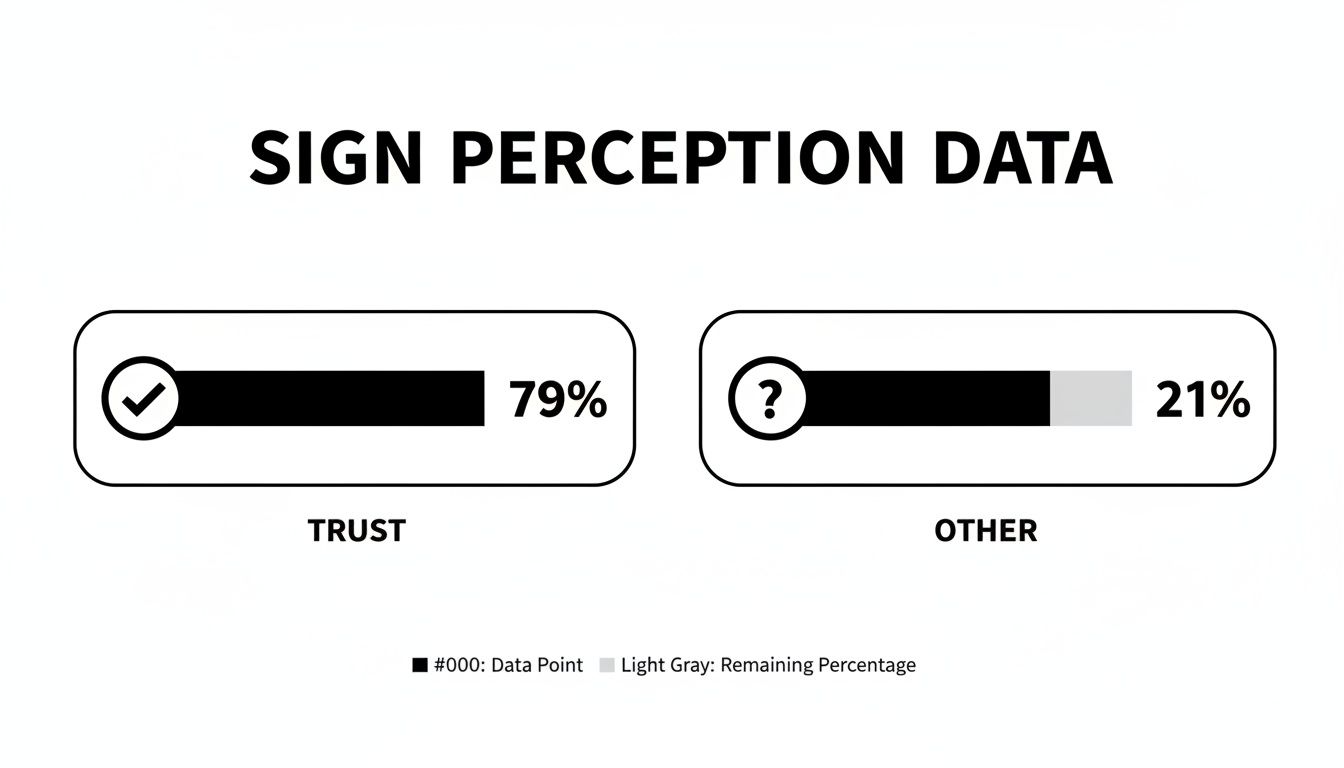
This just confirms what we see every day: a professional, well-maintained sign is directly tied to a business’s credibility and the quality people expect from it.
Making the Right Choice for Your Brand
The perfect mix of material and lighting comes down to your specific needs, your environment, and your budget. A simple, unlit, powder-coated aluminum sign might be the ideal, durable solution for a park trail system. At the same time, a sprawling hospital campus absolutely needs internally illuminated monument signs with acrylic faces to help patients and visitors navigate safely at any hour.
By taking the time to weigh these factors, you can ensure your exterior directional signs will do their job and make a lasting positive impression for years to come.
Designing Signs for Clarity at a Glance
The best exterior directional signs are masters of the split-second message. They have to grab a driver's attention, deliver a clear instruction, and send them on their way without a moment of hesitation. This isn't about artistic flair; it's about raw, unfiltered function. Readability and instant understanding have to win out over everything else.
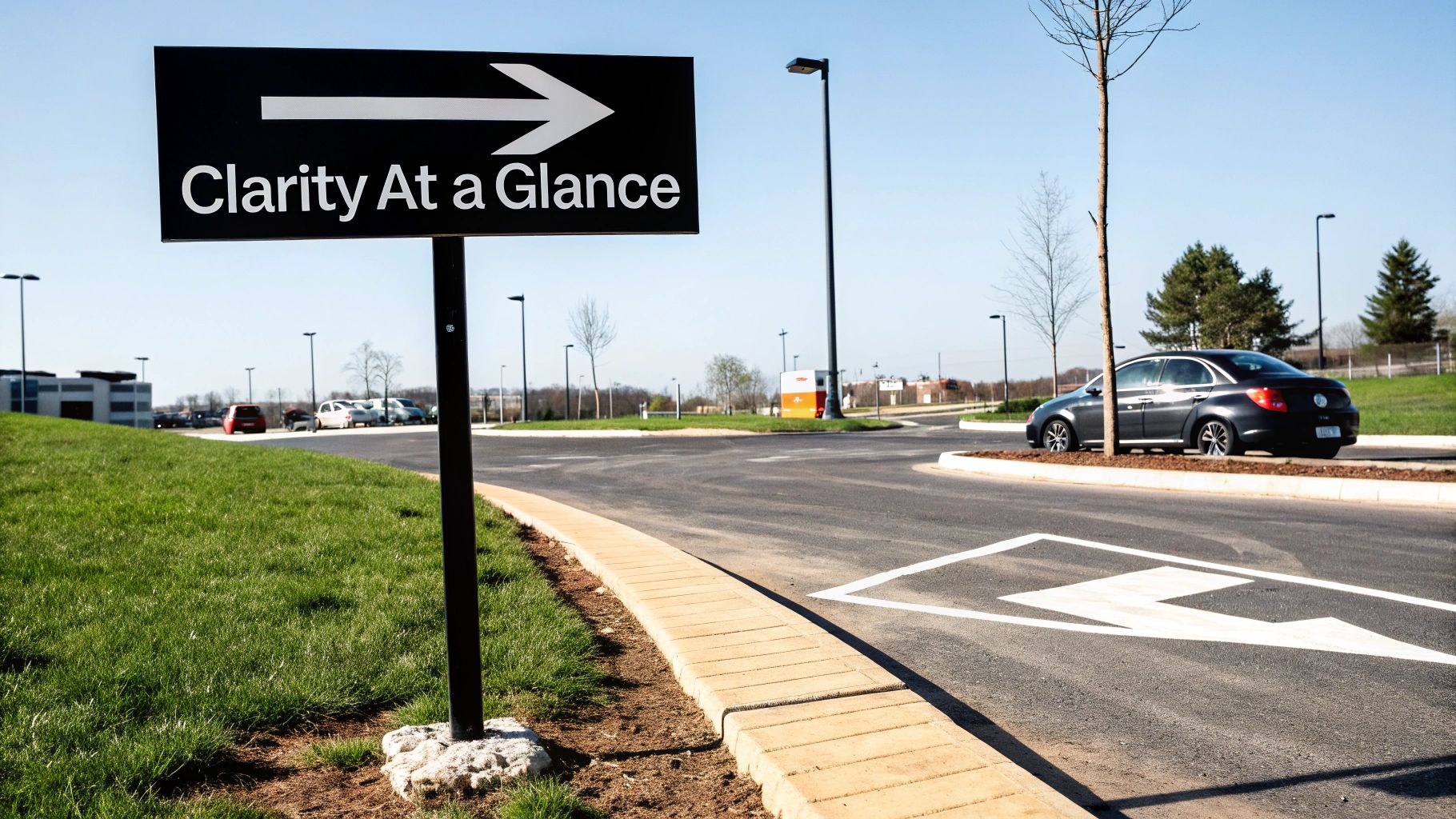
Think about a highway sign. You don't have time to decode a fancy font or squint at small text when you're moving at 60 mph. Your property’s signs work on the exact same principle. Simplicity is key to preventing confusion, wrong turns, and frustrated visitors.
The Science of a Split-Second Read
A great directional sign isn't a matter of opinion—it’s based on the science of how our eyes and brains process information on the fly. Three core elements have to work together perfectly to get that instant message across.
-
Typography: The font you pick is a workhorse, not a show horse. Stick with clean, no-nonsense sans-serif fonts like Helvetica, Futura, or Arial. They don't have the little decorative flourishes (serifs) you see on fonts like Times New Roman, which makes every letter sharp and easy to identify from a distance.
-
Color Contrast: This is completely non-negotiable. High contrast is what makes text pop. The classics work for a reason: white on black, black on yellow, or white on blue create a powerful visual divide between the words and the background, ensuring your sign is readable in bright sun, overcast skies, or at dusk.
-
Scale and Hierarchy: Not all information on a sign is equally important. The main destination—like "Shipping & Receiving"—needs to be the biggest and boldest element. The directional arrow should be the next thing the eye sees, followed by any secondary information in a smaller font. This visual pecking order guides the viewer's eye exactly where you want it to go.
Finding Those Key Decision Points
A perfectly designed sign in the wrong place is just as useless as a poorly designed one. The whole goal is to place your signs at key decision points—the exact spots where a visitor has to make a choice. There's no substitute for walking the property yourself.
An effective wayfinding system feels intuitive. The signs almost seem to appear a split second before the question—“Where do I go now?”—even forms in a visitor’s mind.
Put yourself in your visitors' shoes. Where do people slow down? Where do they look confused? You'll find these decision points at:
- Main property entrances to separate visitor traffic from delivery trucks.
- Intersections inside a parking lot to direct people to the right building or parking area.
- Forks in pedestrian walkways.
- Approaches to a building to point people toward the main entrance instead of a service door.
Thinking about the big picture of your navigation system is a huge help here. You can dig deeper into how all the pieces fit together by exploring what wayfinding signage is and how it shapes the entire visitor journey.
Keep It Simple, Keep It Consistent
Clutter is the absolute enemy of clarity. When you overload a sign with text, logos, or competing arrows, it just becomes visual noise that people will ignore. You have to be ruthless in editing down to the bare essentials for that specific location.
Actionable Tips for Clutter-Free Design
-
Use Universal Symbols: A big, bold arrow is understood by everyone, everywhere. The same goes for symbols for parking, restrooms, or accessibility. They communicate faster than words and reduce text clutter.
-
Limit the Information: One sign should ideally point to one or two destinations. If you need to direct people to five different places, use a series of signs instead of cramming it all onto one panel.
-
Create a Visual Language: Every single directional sign on your property should feel like it belongs to the same family. Use the same fonts, colors, and sign shapes throughout. This consistency builds instant recognition, making it easier for people to follow the entire system as they move around.
When you nail these fundamentals—readability, smart placement, and simplicity—you create a directional system that just works. The result is a smooth, stress-free experience for every visitor that reflects the competence and professionalism of your entire organization.
Navigating ADA Compliance and Local Sign Permits
Once you've settled on the perfect design, there’s one more crucial phase: making sure your exterior directional signs are actually legal. This isn't just bureaucratic red tape. Failing to get the rules right can bring your project to a screeching halt, hit you with expensive fines, and create a frustrating experience for visitors.
The legal side of signage really boils down to two key areas: the Americans with Disabilities Act (ADA) and your local town or city's sign codes. Both exist for good reason—one ensures everyone can safely access your property, and the other maintains community safety and aesthetics. While navigating this can feel like a headache, understanding the basics helps you avoid major problems down the road.
Understanding ADA Requirements for Exterior Signs
Stop thinking of ADA rules as a restrictive checklist. Instead, see them as a practical blueprint for creating a welcoming space for everyone. The core idea is simple: make sure your signs are accessible to people with visual impairments. While most of the nitty-gritty details apply to indoor signs, the core principles absolutely extend to exterior signs, especially those marking entrances or permanent spaces.
Some of the most important ADA factors to keep in mind are:
- Non-Glare Finish: Your sign needs a matte or non-glare finish. Anything glossy can create reflections that make it impossible for some people to read.
- High Contrast: This is a recurring theme for a reason. The ADA requires a strong contrast between the text and the background to ensure legibility for all.
- Proper Mounting Height: Signs identifying specific rooms must be mounted at a consistent height—usually with the centerline at 60 inches from the ground—so they are easy to find and read by touch.
- Location: Predictability is key. These signs are typically installed next to the door on the latch side, creating a reliable system people can count on.
Ensuring accessibility isn't just about avoiding penalties; it's about communicating that your business is welcoming to every single person. ADA compliance is a fundamental aspect of creating a truly inclusive environment for all visitors and employees.
The rules can get surprisingly specific. To get a full picture of how these standards will impact your project, it’s worth diving into a complete guide to ADA sign compliance and its requirements.
The Local Sign Permitting Process
Before you can break ground on any major exterior sign, you will almost certainly need a permit from your local municipality. This is the city’s way of ensuring your sign fits into the community—regulating its size, height, lighting, and how far it’s set back from the road.
Every city has its own quirks, but the permitting journey usually looks something like this:
- Initial Code Research: First, you have to dig into the local sign codebook. This is where you'll find the hard numbers on maximum height, total square footage, and placement rules for your specific property.
- Plan Submission: You'll submit a detailed package to the planning department, including professional sign drawings, material specifications, and a site map showing exactly where the sign will go.
- Review and Approval: City planners will go over your application with a fine-toothed comb to make sure it ticks every box. They might come back with required changes before giving you the green light.
- Permit Issuance: Once everything is approved, the city issues the official permit, and only then can installation work begin.
- Final Inspection: After your sign is installed, an inspector will likely visit the site to verify that the final product matches the approved plans exactly.
This process can be a minefield of delays and confusing paperwork. A professional sign partner handles this entire workflow, using their experience to anticipate problems and ensure your signs get approved without the headaches.
Proper Installation and Long-Term Maintenance
It doesn't matter how great your exterior directional sign looks if it's installed poorly. Think of installation as the critical final step that turns a well-designed sign into a lasting, functional landmark. It's what ensures your sign can stand up to the elements and do its job for years to come.

The real work starts way before a shovel ever hits the dirt. A professional site survey is absolutely essential for identifying underground utilities, checking soil conditions, and locking in the best sight lines. This is the planning that prevents dangerous and expensive surprises down the road.
From there, the approach changes depending on the sign. Big monument and pylon signs need serious foundation work, with concrete footings engineered to handle the sign's weight and local wind loads. Even for smaller post and panel signs, secure mounting is what stops them from leaning or coming loose.
Ensuring a Secure and Safe Installation
A professional installation is all about structural integrity and safety. When you have signs near traffic or pedestrian walkways, there's no room for error. A wobbly or poorly secured sign isn't just an eyesore; it's a major liability waiting to happen.
Here’s what a professional install always includes:
- Foundation and Footings: For any large sign, this means excavating to the proper depth and pouring reinforced concrete footings that anchor it securely.
- Secure Mounting: Post and panel systems need corrosion-resistant hardware that can withstand weather and tampering, keeping the panels level and tight.
- Electrical Safety: Any illuminated sign requires meticulous electrical work. A licensed pro needs to handle all connections to make sure they're waterproof, grounded, and up to code.
A professional sign installation isn't just about putting a sign in the ground. It’s a combination of engineering, safety protocols, and craftsmanship that guarantees your sign will stand strong and function correctly from day one.
The complexity here really highlights why you shouldn't DIY this part of the project. To get a better sense of what's involved, you can learn more about the complete commercial sign installation process and see why expertise is so crucial.
A Practical Maintenance Checklist for Longevity
Once your sign is up, the job isn't over. A little proactive maintenance is the best way to protect your investment and keep your directional signs looking sharp. It’s simple stuff, but it goes a long way in preventing small issues from turning into big, expensive fixes.
Here's a straightforward checklist to keep things in top shape:
- Regular Cleaning: At least twice a year, give your signs a gentle wash with mild soap and water. This clears off dirt and grime, keeping your colors bright and easy to read.
- Inspect After Storms: High winds and heavy rain are tough on outdoor signs. After any bad weather, take a quick walk around your property to check for loose panels, cracked faces, or leaning posts.
- Check Electrical Components: For illuminated signs, make a habit of checking that all lights are working properly. If you see any flickering or dim spots, it's time to call for service.
- Clear Surrounding Landscaping: Keep trees, bushes, and weeds trimmed back so they don't block the view of your signs or damage their structure.
Following these simple steps will ensure your exterior directional signs continue to represent your brand well, guiding everyone who visits your property for years to come.
Calculating the True ROI of Your Signage Investment
Stop thinking of exterior directional signs as just another expense. That’s a common mistake. Instead, see them for what they really are: a hard-working asset that delivers a measurable return on investment (ROI) around the clock. Your signage is a powerful business tool that works 24/7 to guide customers, smooth out your operations, and build your brand.
It’s not hard to connect a well-planned sign system to your bottom line once you know what to look for. The upfront investment will depend on things like the sign’s size, the materials you choose for durability, whether it’s illuminated, and the design's complexity. But as soon as that sign is in the ground, it starts generating real, trackable value.
Moving Beyond Cost to Tangible Business Benefits
The real worth of good wayfinding becomes obvious when you see how it directly impacts your operations and the customer experience. A clear, intuitive sign system doesn't just point the way—it solves problems before they even happen, creating a ripple effect of positive results.
- Increased Foot Traffic: For any retail business, a clear sign can be the one thing that convinces a potential customer to turn into your parking lot instead of driving by. Get it right, and you’ll see more visitors.
- Enhanced Operational Efficiency: In a logistics hub or manufacturing plant, every second is money. Signs that direct delivery trucks to the right loading docks cut out confusion, speed up turnaround times, and keep the whole supply chain running without a hitch.
- Improved Safety and Reduced Liability: On a sprawling corporate or healthcare campus, clear signs for emergency exits, visitor parking, and specific buildings are non-negotiable. They keep traffic flowing safely and help first responders find their way in an emergency.
The global signage market, where exterior directional signs are a huge player, is expected to explode from USD 52.7 billion in 2025 to USD 97.3 billion by 2035. That massive growth is happening for a reason. Businesses recognize that clear wayfinding can slash visitor confusion by up to 30% in busy areas and even boost customer visits by 25% for locations with prominent highway-facing signs. You can dive deeper into this trend by checking out the full market research on Future Market Insights.
How to Calculate the ROI of Your Signs
Figuring out the ROI for your signage means looking at both direct and indirect benefits. It's not as simple as tracking a digital ad, but you can absolutely measure its impact by focusing on a few key metrics that tie directly to revenue and cost savings.
One of the most powerful examples is how a major sign at a business entrance can drive traffic. Check out our guide on business monument signs to see how these installations act as powerful customer acquisition tools.
An effective exterior directional sign system pays for itself by cutting down on wasted time, preventing missed opportunities, and strengthening how people see your brand. It’s an investment in a seamless customer experience, and that always pays off.
A Practical ROI Scenario
Let's look at a large medical clinic that invests $15,000 in a new wayfinding system to guide patients from the main road to specific department entrances.
- Before: Their front desk staff was spending about 2 hours every day giving directions over the phone or to lost patients wandering the lobby. With an average staff wage of $20/hour, this was costing the clinic $40 a day—that’s roughly $10,400 a year in lost productivity.
- After: The new signs are so clear that patient confusion plummets, cutting the time staff spend giving directions by 75%. This saves the clinic $7,800 in labor costs in the first year alone.
- The Result: The sign system pays for more than half of its initial cost in just the first 12 months from direct labor savings. And that's not even counting the value of less patient frustration, fewer missed appointments, and the polished, professional image the clinic now projects.
This simple example proves that when you look past the price tag, the return becomes crystal clear. Effective exterior directional signs aren't just markers; they are strategic assets that actively help your business become healthier and more profitable.
Answering Your Directional Sign Questions
Even when you have a great plan, a few practical questions always pop up once you get into the details of a wayfinding project. Getting these sorted out early on helps you move forward with confidence, making sure you make the right calls for your property and your budget.
Here are some straightforward answers to the questions we hear most often.
How Long Do Exterior Directional Signs Typically Last?
This really comes down to the materials you choose, your local weather, and how you take care of them. A professionally made sign from aluminum or HDU (High-Density Urethane) is a fantastic long-term investment that can easily last 10 to 15 years, and often even longer.
And if your sign is illuminated, today's LED components are incredibly tough, frequently rated for more than 50,000 hours of runtime. The single best thing you can do to get the most out of your signage system is proactive upkeep, like giving it a regular clean and checking on it after a big storm.
What Is the Most Important Design Factor for a Directional Sign?
Readability. Period. If a sign can't be read and understood in a split second from where it's meant to be seen, it has failed. Nothing else—not the colors, not the logo—matters if people can't get the information instantly.
Effective directional signage prioritizes function over flair. The goal isn't to be artistic; it's to communicate essential information with absolute, immediate clarity to prevent visitor frustration and confusion.
The best way to nail this is with a simple combination of design fundamentals: big, clean sans-serif fonts, high contrast between the text and the background, and a simple, uncluttered layout.
Can I Install My Own Exterior Directional Signs?
While you might be tempted to DIY a small, simple sign, we strongly advise against it for any professional application. This is a matter of both safety and compliance.
Professional installers make sure your sign is structurally sound, perfectly level, and meets all local building and electrical codes—which is absolutely vital for avoiding any liability problems down the road. For more complex signs like a pylon or monument, you need specialized equipment, engineered footings, and expert knowledge that only a pro team has, guaranteeing it's secure and built to last.
Ready to create a seamless and professional experience for your visitors? The team at On Display Signs, Inc. manages every detail, from design and permitting to expert installation, ensuring your directional signage is clear, durable, and effective. Start your project with us today!