A lot of Tucson business owners reach the same point. The building is open, the frontage is clean, the monument or wall sign is doing its job, and yet the property still feels unfinished.
What’s usually missing isn’t another promotional message. It’s a vertical marker that reads from farther away, moves with the wind, and tells people the business is established. In flags tucson az projects, that matters more than many owners expect. A good flag display can add presence, reinforce trust, and make a site easier to identify from the street.
The catch is that Tucson is not forgiving. Sun fades cheap fabric fast. Monsoon winds punish weak stitching. Planned developments and city rules can turn a simple idea into a delayed install if nobody checks the site first. The businesses that get this right usually make the same move early. They treat the flag as part of the property plan, not as an afterthought.
More Than Just a Flag A Tucson Business Story
A Tucson owner standing in front of a new office or storefront often has the same reaction. The sign is up, but the place still doesn’t feel anchored.
That’s where a flag can change the whole read of the property. It adds motion, height, and a sense that the business belongs where it is.
Why flags feel different in Tucson
In Tucson, a flag doesn’t sit in a cultural vacuum. The city has a long, visible history tied to territory, identity, and place.
Tucson has witnessed exactly five flags flying over it throughout its history: the Spanish flag from 1775 to 1821, the Mexican flag from 1821 to 1853, the Confederate Stars and Bars for 80 days in 1862, the United States flag starting in 1853, and the Arizona state flag since 1912, according to the Pima County Public Library history of flags over Tucson.
That history matters for a business owner because it changes the meaning of the display. Flying a flag in Tucson isn’t just decorative. It taps into a local tradition of marking presence and belonging.
A strong flag display says more than “we’re open.” It says “we’re established, visible, and part of this city.”
What that means for a commercial property
A medical office might want a formal civic look. A church may want a respectful, permanent display near the entrance. A warehouse may need a pole placement that helps drivers locate the site before they reach the driveway.
Those are different goals, but the principle is the same. The best flag installations solve both identity and navigation.
Poorly chosen displays do the opposite. A faded flag on a short pole near a busy road can make a property look neglected. An oversized promotional flag in the wrong location can read as temporary, even when the business is not.
For Tucson businesses, flags work best when they carry two jobs at once:
- Brand presence: They help the property stand out without shouting.
- Local connection: They show respect for place, especially when the chosen flag fits the business and the site.
That’s why the first question isn’t “Should we add a flag?” It’s “What message should this property send every day from the street?”
Choosing the Right Flag for Your Tucson Business
The right flag depends on the message you want people to read in a few seconds. Most business owners narrow it down to four practical choices. The U.S. flag, the Arizona flag, the Tucson city flag, or a custom branded flag.
One flag can work. A coordinated group often works better, especially on larger properties.
The U.S. flag
The American flag is the most formal option. It signals permanence, order, and a broad public-facing identity.
This is often the right call for:
- Professional offices: Law, finance, healthcare, and property management locations benefit from a formal presentation.
- Industrial and warehouse sites: It gives a large site a clear front door and a more established look.
- Churches and schools: It fits institutions that want a respectful, familiar display.
The trade-off is branding. The U.S. flag builds trust, but it doesn’t identify your company by itself. On many sites, it works best as part of a group rather than as the only flag.
The Arizona state flag
The Arizona flag is a strong regional choice. It tells customers you’re rooted in the state, not operating as a generic outpost.
For developers, contractors, and real estate groups, the state flag often helps reinforce local credibility. It can also pair well with the U.S. flag when a business wants a civic, stable appearance without looking overtly promotional.
If your property sits in a planned commercial area, this option is also worth considering because it may fit more comfortably within rules that distinguish between civic flags and purely promotional displays.
The Tucson city flag
The city flag is a smart choice for businesses that want a distinctly local touch. Tucson’s official city flag, adopted on January 5, 1951, features a seal designed by Mary Crowfoot with the 1949 city skyline and Mission San Xavier del Bac, reflecting Tucson’s blend of modern growth and deep-rooted heritage, as described on the Flag of Tucson page.
That makes it especially useful for:
- Local retail shops
- Hospitality properties
- Community-focused organizations
- Businesses wanting a “Tucson, not just Arizona” identity
The downside is legibility at distance. The Tucson flag’s value is symbolic and civic. It won’t carry your business name, and its seal detail isn’t meant to function like an ad.
The custom branded flag
A custom company flag does the direct marketing work. It can carry your logo, color system, and a cleaner visual message from the road.
That’s the practical choice when the goal is traffic capture, site identification, or brand reinforcement. It’s often part of a bigger exterior package with wall signs, monument signs, or banners. If you’re comparing display formats, this guide to types of outdoor business signs helps sort out where flags fit best.
Practical rule: Use custom flags when you need recognition. Use civic or patriotic flags when you need authority. Use both when you want a complete property presentation.
A simple way to decide
If you’re unsure, ask which of these matters most:
Trust first
Choose the U.S. flag, often paired with Arizona.Local identity first
Choose the Tucson flag, sometimes paired with Arizona.Brand visibility first
Choose a custom flag, but make sure the site and local rules support it.Balanced message
Use a small flag group with one civic flag and one branded flag.
What doesn’t work is guessing. A flag should match the property type, not just the owner’s personal preference.
Selecting Flag Materials Built for the Sonoran Desert
Material choice is where many Tucson flag projects go wrong. Owners spend time choosing artwork and pole style, then buy fabric that isn’t built for the site.
In Tucson, the fabric has to survive two constant pressures. Intense sun exposure and wind that keeps working the fly end of the flag day after day.
What the climate does to a flag
A flag can look great on day one and fail early for predictable reasons. The color fades, the edge starts to feather, the stitching opens up, or the body of the flag becomes too weak to carry itself cleanly.
For Tucson’s 3,300+ annual sunshine hours and high-wind monsoon seasons, heavyweight SolarGuard nylon offers stronger UV resistance, and reinforced stitching with four vertical rows can help prevent edge fraying at velocities up to 60 mph, reducing replacement rates by up to 40% compared to standard polyester, according to the Flag of Tucson SVG reference.
That’s why the cheapest flag is usually the most expensive option over time.
Nylon versus 2 ply polyester
Most commercial buyers end up comparing nylon and 2-ply polyester. Both have a place, but they don’t perform the same way.
| Flag Material Comparison for Tucson Climate | Nylon | 2-Ply Polyester |
|---|---|---|
| Appearance | Bright color and crisp movement | Heavier look with more visual weight |
| Light wind performance | Excellent flutter | Needs more wind to move cleanly |
| High wind durability | Good when upgraded and reinforced | Better choice for punishing wind exposure |
| UV resistance | Strong, especially in heavier outdoor grades | Good, but quality varies by manufacturer |
| Typical best use | Office, retail, churches, formal displays | Open commercial corridors, industrial sites, exposed lots |
| Common mistake | Buying lightweight nylon for a harsh site | Assuming all polyester is automatically heavy-duty |
What usually works best
For many Tucson commercial properties, heavyweight nylon is the best balance. It presents well, flies nicely, and can hold up when the product is built for outdoor use.
For exposed sites, 2-ply polyester can be the better workhorse. Think industrial parks, wide setbacks, or locations that take full wind without shielding from nearby buildings.
Use this as a practical filter:
- Choose nylon if presentation matters most and the site has moderate exposure.
- Choose 2-ply polyester if the property sits in an open area where durability matters more than elegant movement.
- Upgrade stitching and headers before upgrading artwork. Structural details usually decide how long the flag lasts.
The Sonoran Desert punishes weak seams before it punishes weak design.
If you want a useful non-signage comparison for how desert conditions shape material survival, this short piece on How Do Cactus Survive in the Desert is a good reminder that endurance in Tucson always comes down to adaptation.
Material decisions that save money later
A few buying habits consistently pay off:
- Ask for reinforced fly-end stitching: Commercial flags often fail here first.
- Match the fabric to the site, not the catalog photo: A sheltered courtyard and a roadside parcel need different products.
- Keep a replacement flag on hand: Waiting until a flag is shredded makes the property look neglected.
- Coordinate fabric choice with the rest of the exterior package: If you’re comparing long-life outdoor substrates in general, this overview of the best material for outdoor signs helps frame the same durability trade-offs across a property.
A flag in Tucson is a wear item. The goal isn’t to eliminate wear. The goal is to slow it down and avoid preventable replacement cycles.
Flagpole and Placement Best Practices
A strong flag on a weak pole still looks wrong. So does a quality pole in the wrong spot.
Most visibility problems come from one of two issues. The pole is undersized for the building, or the placement forces the flag into visual clutter from trees, lighting, utility elements, or neighboring signs.
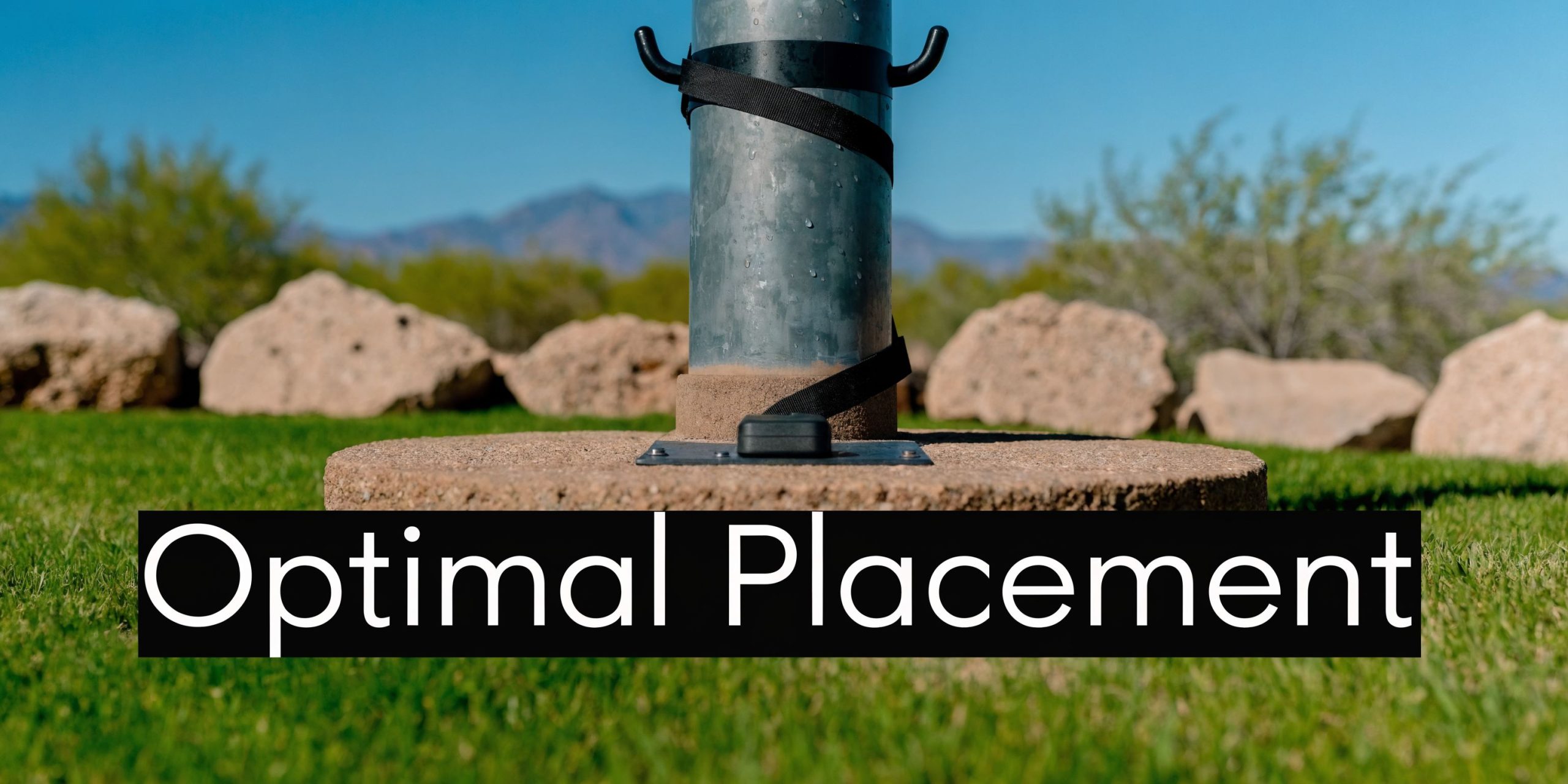
Match the pole to the property
A flagpole should feel proportional to the building and visible from the approach path most customers use.
On a small office site, a wall-mounted display may be enough. On a larger parcel with road frontage, a ground-set pole near the main entry often creates a stronger landmark.
Common commercial options include:
- Ground-set poles: Best for permanent, formal installations near entrances or along main frontage.
- Wall-mounted poles: Good for tighter sites where a full pole isn’t practical.
- Vertical banner poles: Better for seasonal messaging or campus-style wayfinding than for formal flag presentation.
Aluminum is a common commercial choice because it balances appearance, corrosion resistance, and handling. Steel can make sense in some engineered applications, but it usually brings more finish and maintenance considerations.
Put the display where people can read it
The best placement isn’t always the most obvious patch of dirt. The display should support the property, not block it.
Good placement usually does three things:
- Marks the entrance clearly
- Stays clear of drive aisles and sight lines
- Avoids fighting with primary building signage
A flag that hides behind landscaping or sits too close to another tall element loses value fast. A flagpole shoved into an awkward leftover corner tends to make the site look improvised.
If the pole location feels like an afterthought on the site plan, it will look like one in person.
Planned communities and HOA reality
Some Tucson-area business sites sit in developments with private rules layered on top of city requirements. That’s where a lot of owners get surprised.
While Arizona statutes such as A.R.S. §33-1808 protect the right to fly certain flags, HOAs governing commercial developments can still regulate pole size, location, and the display of purely promotional flags, as explained in this update on authorized flags in Arizona HOAs.
That means you need to review more than municipal code. Check the CC&Rs, design review standards, and any landlord criteria before fabrication starts.
For businesses also using banners around the property, this guide on how to hang banners is useful because banner placement often intersects with the same sightline and mounting issues as flag displays.
A flagpole install is easiest when it’s treated like a site feature. Once concrete, hardware, and access are involved, moving it later gets expensive.
Navigating Tucson Flag Permitting and Wind Codes
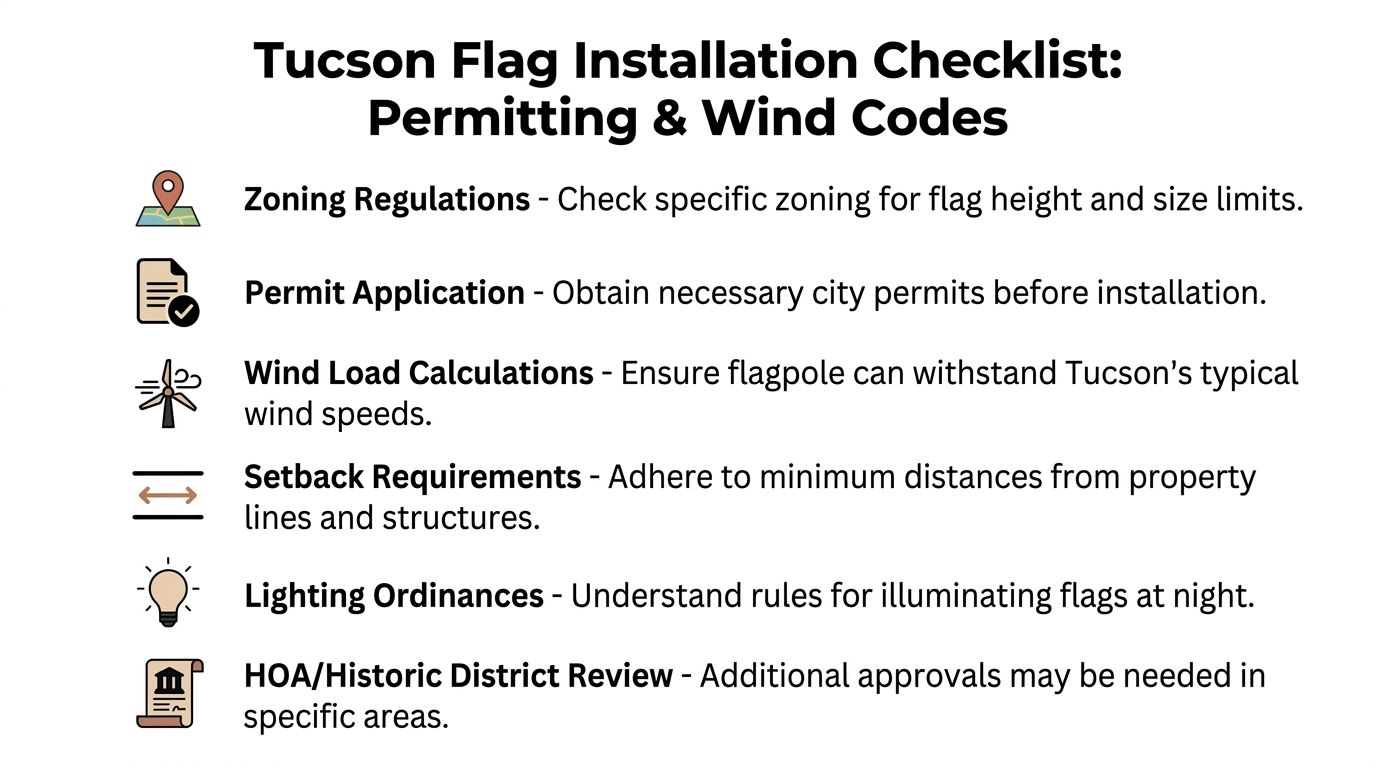
The phrase “it’s just a flag” causes a lot of permit trouble. In Tucson, the city may treat a display as a flag, a banner, or another temporary sign type depending on how it’s built and mounted.
That distinction matters because the rules affect size, height, duration, and whether the display counts against sign area.
The part of the code most owners need first
For temporary signage, Tucson Sign Code Section 7A.10.4 states that temporary flags and banners are generally limited to 60 sq ft per face and 8 ft in height, while pole-mounted banners up to 90 sq ft are exempt from permanent sign area calculations, according to the City of Tucson sign standards document.
That one rule shapes a lot of practical decisions. A business may think it’s ordering a simple promotional flag package, while the city may see a temporary sign installation with very specific limits.
What business owners should check before ordering
A clean process starts before design approval. Confirm how the city classifies the display, where it will sit on the parcel, and whether any private site rules apply.
Use this field checklist before fabrication:
- Confirm zoning first: Different sites can carry different limitations on size, placement, and display type.
- Identify the display category: A civic flag on a permanent pole and a promotional banner system may not be treated the same way.
- Measure the face area carefully: Don’t estimate. A display that exceeds the allowed area can trigger redesign or removal.
- Check height and setbacks: Even a small display can create problems if it crowds traffic views or site circulation.
- Review lighting plans: Night illumination can add another layer of review.
- Verify private approvals: HOAs, landlords, and design review committees can slow a project even when city approval looks straightforward.
What usually causes delays
The biggest problems aren’t complicated engineering questions. They’re simple assumptions.
Owners assume a temporary banner is the same as a flag. They assume a landlord approval replaces city review. They assume a prior tenant’s display means the same configuration is still allowed.
Those assumptions create expensive rework. New hardware, revised submittals, and rescheduled installation crews can turn a simple project into a drawn-out one.
Field note: The permit process usually goes smoother when the installer and the permit preparer are looking at the same drawings, site photos, and mounting details from the start.
A plain English view of compliance
If you’re planning flags tucson az displays for one site or several, think in layers:
| Compliance layer | What to verify |
|---|---|
| City code | Size, height, temporary versus permanent classification |
| Site conditions | Wind exposure, access, visibility, structural mounting conditions |
| Private controls | HOA rules, landlord criteria, planned development standards |
| Operations | How the flag will be changed, maintained, and illuminated |
This is one reason many owners ask for help before they buy hardware. It’s easier to confirm the path than to unwind a noncompliant install. If you need a broader primer on review steps, this page on sign permit requirements is a practical companion.
The right approach is simple. Treat the flag display as a regulated exterior improvement, not as a last-minute accessory.
Budgeting Your Flag Project from Install to Replacement
Most flag budgets are too narrow at the start. Owners price the flag itself and forget the rest of the system.
The true cost sits in the full package. Pole, footing or mounting hardware, installation access, possible lighting, and the maintenance cycle that starts the day the flag goes up.
Where the money goes
A commercial flag project usually includes these cost buckets:
- The flag: Better fabric and stronger finishing cost more upfront, but they usually hold up better in Tucson conditions.
- The pole or bracket system: A permanent ground-set pole is a different investment from a wall-mount assembly.
- Installation labor: Access, site conditions, and coordination with property operations affect labor more than many buyers expect.
- Lighting and electrical work: Night display can change both budget and permitting.
- Replacement inventory: Keeping one spare on hand is often cheaper than waiting through a reorder while the pole sits empty.
The biggest budgeting mistake is treating replacement as an exception. In Tucson, replacement is normal ownership.
Build a maintenance plan before the first install
A flag display looks best when someone owns the upkeep. If nobody is assigned to inspect it, wear gets noticed only after customers notice it first.
A workable maintenance routine usually includes:
Visual checks after windy periods
Look for fly-end fraying, torn stitching, and hardware wear.Routine hardware inspection
Check halyard condition, clips, pulleys, and any wall-mount anchors.Cleaning and appearance review
A dirty or twisted display makes the whole property feel less cared for.Scheduled flag replacement
Replace before the display looks tired, not after it fails.
Cheap now often means expensive later
Buyers often get trapped here. A low-grade flag can appear to save money, but if it fades fast, tears early, or looks weak in the wind, the site pays for it in replacement labor and lost presentation.
That same logic applies across exterior branding. If you’re comparing long-term ownership costs for signs and related display systems, this guide to the cost of signage for business helps frame the bigger budgeting picture.
Don’t budget for purchase only. Budget for ownership.
The best commercial flag budgets are boring in a good way. They account for installation, allow for maintenance, and leave room for timely replacement. That’s what keeps the display looking intentional instead of worn out.
How to Choose a Tucson Flag and Installation Partner
A flag project looks simple until all the variables show up. Site lines. Wind exposure. pole location. landlord approval. code classification. Access for installation. Long-term maintenance.
That’s why vendor choice matters. You’re not just buying fabric and hardware. You’re hiring judgment.
What a qualified partner should know
A good flag and signage partner should be able to answer practical questions without guessing.
Look for these capabilities:
- Local code fluency: They should understand Tucson sign rules well enough to spot problems before submittal.
- Material judgment: They should recommend fabric and finishing based on site exposure, not just price.
- Mounting and structural awareness: They should know when a wall mount works and when a ground-set pole is the safer call.
- Project coordination: They should be able to align fabrication, permitting, and installation so the schedule doesn’t drift.
- Maintenance thinking: They should discuss replacement cycles and service access before the install happens.
If the conversation stays focused only on artwork and size, that’s a warning sign.
Questions worth asking before you hire
Ask direct questions and listen for direct answers.
- How do you evaluate wind exposure on a Tucson site?
- Who handles permit coordination if the city asks for revisions?
- What fabric and stitch construction do you recommend for this property, and why?
- How do you handle projects inside planned communities or landlord-controlled sites?
- What happens when the first replacement flag is needed?
A serious partner won’t treat those questions as a nuisance. They’ll treat them as the project.
Why broader facility experience helps
Flags don’t live in isolation. They sit on active commercial properties where maintenance, access, scheduling, and vendor coordination all matter.
That’s one reason it helps to understand the broader value of hiring a facility service company. Even though a flag project is specialized, the same lesson applies. The best outside partners reduce friction for the owner, the site manager, and the tenant.
The right installer solves problems you never have to hear about. The wrong one creates problems you have to manage yourself.
A Tucson flag partner should be able to think like a signage expert, a site coordinator, and a compliance professional at the same time. That combination is what protects your budget and your timeline.
Make Your Brand Stand Tall in Tucson
A flag can do a lot for a Tucson property. It can sharpen first impressions, help people find the site, and make a business look more permanent from the street.
But flags tucson az projects only pay off when the details are handled correctly. The wrong flag sends the wrong message. The wrong fabric wears out early. The wrong location weakens visibility. The wrong permit assumptions can stall the job before installation even begins.
The decisions that matter most
The strongest projects usually get four things right:
- Message fit: The flag matches the role of the property. Formal, local, branded, or a combination.
- Desert durability: The material and finishing are chosen for Tucson sun and wind, not for a showroom sample.
- Site planning: The pole and placement support visibility instead of competing with the building.
- Code awareness: The display is reviewed as a regulated exterior element, not treated casually.
That combination creates long-term value. It also keeps owners from repeating the same costly cycle of rushed ordering, premature wear, and avoidable reinstallation.
What works and what doesn’t
What works is a flag display that feels intentional. It belongs to the building, fits the site, and still looks good after real exposure.
What doesn’t work is buying on impulse. That usually shows up as undersized poles, weak material, poor hardware, or promotional displays that clash with local rules.
A good flag display doesn’t need to be flashy. It needs to be right.
Why getting it right is worth it
Businesses in Tucson compete for attention in a bright, visually busy environment. A well-planned flag creates vertical presence that many standard signs can’t deliver on their own.
It also communicates care. People notice when a property is maintained. They also notice when a faded, torn, or poorly placed flag suggests the opposite.
If you’re planning a new site, refreshing an older property, or coordinating multiple locations, treat the flag as part of the exterior identity system. That’s where genuine return comes from. Not from novelty, but from consistency, visibility, and staying power.
If you want expert help planning, permitting, fabricating, or installing a commercial flag display, On Display Signs, Inc. can help manage the project from start to finish. Their team handles signage and flag programs nationally, including design guidance, local code coordination, installation, and long-term maintenance support for single sites and multi-location rollouts.