At its core, a high-visibility sign is a visual tool engineered to grab attention when it matters most. They’re designed to be impossible to ignore, using a powerful combination of bright colors, bold text, and often reflective or illuminated materials to cut through the noise, day or night.
The goal is simple: communicate critical information instantly, whether it’s guiding customers, warning of a hazard, or preventing a costly accident. For instance, a bright red octagonal "STOP" sign at a parking lot exit is a practical high-visibility sign that uses shape and color to give an immediate, actionable command.
Why High Visibility Signs Are a Business Imperative
Think of high-visibility signs as your business's silent guardians. Like a lighthouse cutting through a storm, their main job is to provide clear, unmistakable guidance to steer people away from danger and toward safety. They work around the clock, directing traffic in a busy parking lot, marking hazards in a warehouse, or showing the way out during an emergency. An actionable insight here is to walk your property and identify blind corners or potential slip hazards; these are prime locations for new signs.
But this is about more than just ticking a compliance box. Investing in the right signage is a core strategy for operational excellence. It’s a proactive step that shields your business from liability by showing a clear commitment to keeping people safe.
The Clear Return on a Smart Investment
The impact of proper signage is both measurable and significant. High-visibility safety signs are a cornerstone of any modern workplace safety program, and for good reason—research shows that their correct use can slash workplace injuries by 25-40% in industrial settings.
This importance is reflected in market trends. The global safety signs market is projected to climb from $2.43 billion in 2024 to an estimated $4.04 billion by 2033, and you can dig into more safety signage market data from Precedence Research.
Beyond the safety stats, the return on your investment shows up in other powerful ways.
High-visibility signs deliver value across three key areas of your business: protecting people, ensuring you meet legal standards, and actively boosting your commercial success.
Core Benefits of High Visibility Signage at a Glance
| Benefit Category | Impact on Your Business | Practical Example |
|---|---|---|
| Workplace & Public Safety | Drastically reduces accidents, injuries, and liability risks. | A bright yellow "Wet Floor" A-frame sign prevents a slip-and-fall lawsuit. |
| Regulatory Compliance | Meets federal and local standards (OSHA, ADA, MUTCD), avoiding fines. | ADA-compliant restroom signs with tactile text and Braille ensure accessibility. |
| Brand Visibility & Trust | Makes your business easy to find and creates a professional, caring impression. | An illuminated pylon sign on a busy highway draws in nighttime travelers. |
| Operational Efficiency | Improves navigation and directs workflow, saving time and preventing confusion. | Clearly marked aisles and loading dock signs in a warehouse speed up fulfillment. |
Investing in these signs is not just a defensive move; it's a smart offensive strategy that pays dividends in safety, reputation, and revenue.
A well-placed sign is more than just information; it's an instruction. It directs behavior, prevents confusion, and creates a safer, more efficient environment for everyone. This makes it a fundamental asset, not an expense.
Ultimately, effective high-visibility signs contribute directly to your bottom line. They minimize the financial headaches caused by accidents while simultaneously working to increase customer traffic and reinforce your brand. This dual benefit makes them a non-negotiable part of any successful business.
Decoding the Rules for Compliant Signage
Diving into signage regulations can feel like trying to read a legal document, but getting it right is fundamental to protecting your business and keeping people safe. These standards aren't just arbitrary rules; they're the official playbook for creating high-visibility signs, built on decades of safety data to prevent accidents and guarantee accessibility.
For any business with a factory floor, warehouse, or construction site, the rules from the Occupational Safety and Health Administration (OSHA) are the law of the land. They are non-negotiable, spelling out the exact colors, words, and symbols needed to warn your team about potential hazards.
A practical example is OSHA's requirement for a red sign with white text to signal immediate danger, like a high-voltage box. An actionable insight is to audit your facility's hazard signs: a yellow sign with black text should be used for cautions, like the classic "Slippery When Wet" A-frame. Getting this color-coding right ensures any worker can instantly understand the level of risk.
Navigating Public-Facing Signage Rules
The second your sign is visible from a public road, a whole new set of rules kicks in. The Manual on Uniform Traffic Control Devices (MUTCD) is the authority for any sign that interacts with traffic. This is a huge deal for any business with a parking lot, a busy storefront, or an entrance near a public roadway.
MUTCD standards make sure a stop sign in your lot looks and functions exactly like one on a city street, preventing driver confusion and accidents. If you don't comply and someone gets hurt on your property, you're facing a serious liability problem.
Beyond traffic, making your facility accessible is just as important. The Americans with Disabilities Act (ADA) ensures everyone, regardless of physical ability, can find their way around your space safely and with dignity.
ADA compliance is about more than just avoiding fines; it’s about creating an inclusive and welcoming environment for every customer and employee. It demonstrates a commitment to equal access and responsible business practices.
Some of the most common high-visibility signs that fall under ADA rules include:
- Restroom Signs: Must include tactile text, standardized pictograms, and Braille.
- Room Identification Signs: Permanent spaces like offices or exam rooms need signs with raised characters and Braille.
- Directional and Wayfinding Signs: Must have high-contrast, non-glare finishes and easy-to-read fonts to guide all visitors effectively.
To really get this right, you need to see how signage fits into your broader safety and compliance best practices for facility managers. When your signs support your overall safety strategy, everything works better together.
Understanding Retroreflectivity Levels
One of the most critical—and most misunderstood—parts of sign compliance is retroreflectivity. Think of it as the brightness setting for your sign at night. Instead of just scattering light, retroreflective materials shoot light directly back to its source, like a car's headlights. This makes the sign appear to light up in the dark.
Different situations demand different "brightness" levels, which are graded by the American Society for Testing and Materials (ASTM).
- ASTM Type I (Engineer Grade): This is your baseline, perfect for signs in areas with low traffic and slow speeds, like parking lots or building signs. A practical example is a "Reserved Parking" sign in a small office lot.
- ASTM Type IV (High Intensity Prismatic): A big step up in brightness, this grade is used for traffic control signs on most local roads. Think of the "Speed Limit 25" signs in a residential neighborhood.
- ASTM Type IX (Diamond Grade): This is the top-tier material, reserved for critical signs on highways where drivers at high speeds need to see them from far away, such as "Exit 1 Mile" signs.
Choosing the right grade is a balancing act. You have to meet the legal minimums for safety, but you don't want to overspend on a high-performance grade you don't need. An actionable insight is to request a site assessment to determine the most cost-effective and compliant solution for your property. If you need help, you can learn more about sign permit requirements in our detailed guide.
Choosing the Right Materials and Technology
Picking the right foundation for your high-visibility signs is like choosing the engine for a truck. The paint job might look great, but it's the technology and materials underneath that give it power, performance, and a long life on the road. Getting this choice right is what makes sure your sign not only passes inspection but actually delivers the impact you paid for.
The decision really starts with the environment. A sign baking in the desert sun has totally different needs than one weathering a rainy coastal city. From there, you can factor in your budget, the effect you’re after, and your operating hours to nail down the perfect solution.
Retroreflective Sheeting: The Backbone of Nighttime Visibility
Retroreflective sheeting is the undisputed workhorse for any non-lit, high-visibility sign. Think of it like a cat's eyes in the dark—it doesn't have its own light source, but it’s engineered to catch the light from a car's headlights and bounce it straight back at the driver. This is what makes a sign seem to light up as you approach it at night.
This technology is a massive win for safety. On our roads, retroreflective signs have boosted nighttime visibility by a staggering 400-1000% over standard paints. The proof is in the numbers: U.S. highways using these signs have seen 22% fewer nighttime crashes.
But not all retroreflective materials are built the same. They come in different grades, each offering a unique balance of brightness and durability, so you can match the material to the job.
- Engineer Grade: This is your go-to for low-speed, low-traffic areas like parking lots or private property signs. It's a solid, budget-friendly choice where extreme, long-distance visibility isn't the top priority.
- High Intensity Prismatic (HIP) Grade: A major step up in brightness and durability, HIP is the standard for most official road signs on public streets. It gives drivers the clear, advanced warning they need.
- Diamond Grade: This is the top-tier material, offering the absolute best brightness, even from wide angles. You'll see it used in critical situations—highway interchanges, high-risk work zones, and complex intersections—where instant recognition can save lives.
An actionable insight is to choose the right grade by balancing compliance, safety, and budget. While Diamond Grade is the peak of performance, Engineer Grade is often perfectly sufficient and far more economical for many on-site business signs. For more guidance, our guide on the best material for outdoor signs dives even deeper.
Illuminated Signs: For 24/7 Impact
When you absolutely need your message to stand out around the clock—no matter the weather or time of day—illuminated signs are the answer. Unlike retroreflective signs that need an external light source, these signs produce their own light, making them impossible to miss.
An illuminated sign isn't just for visibility; it’s a beacon for your brand. It shouts that you’re open and ready for business, creating a powerful, professional look that works for you long after you've locked up for the night.
The most popular and effective technology powering illuminated signs today is the Light Emitting Diode (LED). LEDs are incredibly bright, energy-efficient, and have a super long lifespan, making them perfect for anything from crisp channel letters on a storefront to large digital message boards.
Practical Examples of Illuminated Signs:
- A restaurant on a busy street uses front-lit channel letters to make sure its name is sharp and clear to evening traffic, pulling in hungry customers.
- A 24-hour clinic installs an LED cabinet sign with its logo, acting as a reassuring and easy-to-spot landmark for late-night patients.
- A corporate campus uses an internally illuminated monument sign at its main entrance, creating a high-end, professional look while guiding visitors after dark.
This flowchart helps you figure out which set of rules—and therefore, which materials—apply based on your sign's location.
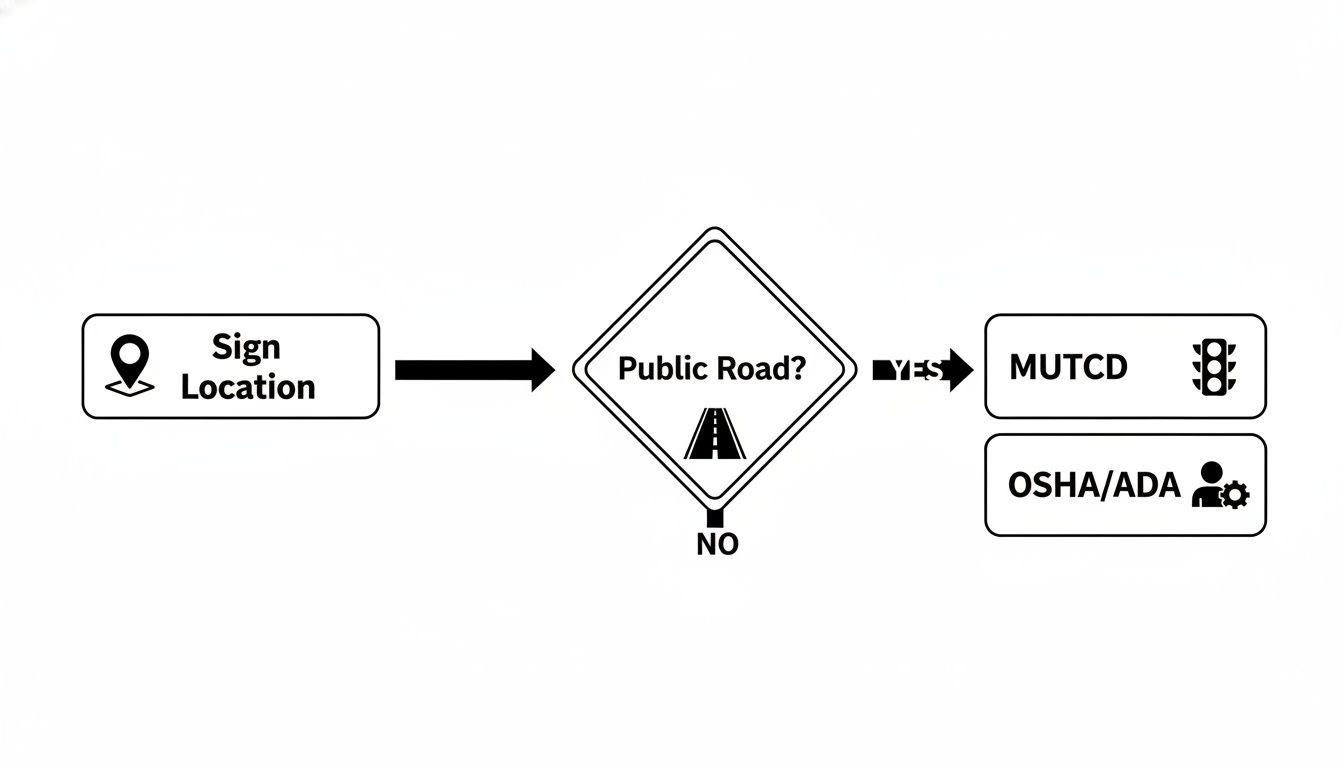
As you can see, signs meant for public roads fall under MUTCD, while on-site signs for your property are governed by OSHA and ADA. Knowing this distinction is the first step in choosing the right materials for the job.
Strategic Design and Placement for Maximum Impact
A brilliant, top-of-the-line sign in the wrong spot is just expensive decoration. While premium materials and advanced technology give a sign the potential for impact, it’s thoughtful design and strategic placement that actually deliver it. Get these two elements right, and you ensure your message isn't just seen—it's understood and acted on.
Think of it this way: a sign's design is the message, and its placement is the delivery. If the message is garbled or the delivery fails, the entire effort is wasted. It all starts with designing for absolute clarity and legibility from the exact distance your audience will be.
Core Principles of High Impact Design
The foundation of any great high-visibility sign is a design that communicates its point instantly. This is no place for complex artistry or clever ambiguity; it's all about speed and comprehension.
Here’s what really matters:
- Legible Fonts: Stick with simple, bold, sans-serif fonts like Helvetica or Arial. The font size has to be large enough to be read clearly from the maximum expected viewing distance—a non-negotiable factor for both critical safety warnings and brand advertising.
- High-Contrast Colors: Color is a powerful tool for grabbing attention and conveying meaning in a split second. Following ANSI Z535.1 standards—like black text on a yellow background for caution or black on white for general info—creates an immediate, instinctual understanding of a sign's purpose.
- Simple Icons: Pictograms and symbols cut through language barriers, making them essential for safety and directional signs in diverse environments. A universally recognized symbol for "no parking" or "forklift traffic" communicates far faster than words ever could.
When you combine these elements, you create a visual language that’s incredibly quick to process. That’s the real job of a high-visibility sign. If you want to go deeper, you can learn more about how to apply the principles of environmental graphic design in our in-depth guide.
Finding the Perfect Placement
Once you’ve nailed the design, placement becomes the make-or-break factor. The goal is simple: position the sign directly within the natural sightlines of your audience, whether they're a driver on the highway, a customer in your store, or an operator on a forklift.
An ideal location prevents both accidents and confusion. In a warehouse, for example, signs marking pedestrian walkways should be at eye level. But overhead signs showing aisle contents must be high enough to be seen over tall stacks of pallets.
A sign’s effectiveness is directly tied to its context. The same "Caution" sign that saves a life when placed before a blind corner becomes useless if mounted too high, too low, or after the hazard has already passed.
An actionable insight is to put yourself in the shoes of the person you need to reach. Where are they looking? What obstacles—like parked trucks, stacked inventory, or even the afternoon sun—might block their view? Answering these questions on-site is the key to getting placement right.
Practical Placement Examples:
- Retail Store: An illuminated storefront sign needs to capture maximum street traffic, which means factoring in the speed of passing cars and viewing angles from different lanes. A-frame sidewalk signs should be placed to catch the eye of pedestrians without becoming a tripping hazard.
- Construction Site: Safety signs warning of a "Hard Hat Area" must be posted at every single entrance to the site, without exception. Directional signs for delivery trucks should be placed well ahead of the turn, giving drivers plenty of time to react safely.
- Warehouse: Signs at aisle intersections warning of forklift traffic have to be visible from all directions. Loading dock signs with bay numbers should be large, illuminated, and clear of any obstructions from parked trailers.
By walking the site and methodically analyzing sightlines and potential obstructions, you can turn abstract principles into a repeatable process. This is how you ensure every single sign you install delivers maximum impact and value.
High Visibility Signs in Action Across Industries
The real power of high-visibility signs comes to life when you see them solving problems out in the world. While the core ideas of visibility and compliance apply everywhere, a sign’s job changes completely when it moves from a noisy construction site to a quiet suburban school. The best signage strategies are always built around a specific goal, whether that’s stopping accidents, pulling in customers, or just helping people find their way.
A sign that’s perfect in one spot can be totally useless in another. This is exactly why you need an approach that’s tailored to the specific environment and audience you’re dealing with. It’s the only way to get a real return on your investment.
Construction and Warehousing Safety
In high-stakes environments like construction sites and distribution warehouses, high-visibility signs aren't just helpful—they're non-negotiable safety equipment. The number one goal here is preventing accidents, with strict OSHA regulations setting the standard. These signs act as clear, constant warnings that shield workers from the daily risks of the job.
Here are some practical examples:
- Heavy Machinery Paths: Large, retroreflective signs create clear lanes for forklifts, loaders, and other heavy equipment. They’re placed at key intersections and pedestrian areas to stop collisions before they happen.
- Loading Dock Safety: Brightly colored signs warn everyone about drop-offs, list clearance heights, and give direct instructions for drivers to chock their wheels before anyone starts loading or unloading.
- Hazardous Material Storage: OSHA-compliant signs use specific colors and symbols to identify flammable, corrosive, or toxic substances, guaranteeing they’re handled correctly and that emergency teams know what they’re facing.
In these industries, a sign that fails isn’t just an inconvenience; it's a direct threat to someone’s safety. You can get a much deeper look into the rules that govern this space in our guide to construction site signage requirements.
Retail and Hospitality Customer Attraction
Switch over to retail stores and hospitality businesses, and the goal shifts from warning about hazards to engaging customers. While safety and ADA compliance are still absolutely essential, the main business objective is to grab attention, drive foot traffic, and create a smooth, positive experience that leads to sales and loyal customers.
In a crowded marketplace, a bright, professional sign does more than just show people where you are—it’s your 24/7 salesperson, catching eyes and inviting customers to come inside.
Here’s where they really shine in practical application:
- Illuminated Storefront Signs: Bright LED channel letters or a backlit cabinet sign makes sure a business pops on a busy street, especially after the sun goes down.
- Promotional Banners and A-Frames: High-contrast, temporary signs are perfect for announcing sales, special events, or new arrivals, catching the interest of people passing by.
- Clear ADA-Compliant Signs: Well-designed restroom, exit, and directional wayfinding signs with high-contrast, tactile lettering make a space feel welcoming and accessible for every single customer.
Commercial Properties and Institutions
For big properties like office parks, school campuses, or churches, high-visibility signs are all about creating an organized, professional feel. Here, the primary goal is efficient navigation and clear identification. A visitor’s first impression is often decided by how easily they can find their way around.
Effective signage for these locations often starts with large-scale monument signs at the main entrances. These ground-level structures identify the property and its anchor tenants, reinforcing the brand and creating a strong sense of arrival. When paired with a system of clear directional signs, they guide cars and people seamlessly, cutting down on confusion and frustration for visitors, employees, and parents alike.
In more dynamic places like conventions and trade shows, the right signage is crucial for directing crowds and standing out. In fact, for exhibit booths, advanced tools like modern dynamic LED Display Boards can make a massive difference in engagement and overall success.
The rise of digital signage is also making a huge impact. Digital high-visibility signs are changing both public safety and branding, with the global digital signage market expected to be worth between $28-32 billion by 2026. These signs work around the clock with message retention rates 90% higher than static signs, and data shows venues using them can see traffic jump by up to 28%. You can explore more digital signage statistics on jordanfeil.com to see the full picture.
Your Long-Term Signage Plan From Permit to Maintenance
Getting your new sign fabricated is an exciting milestone, but it's really just the beginning. To protect that investment and make sure your high-visibility signs keep working for you year after year, you need a solid plan that covers everything from permits to ongoing upkeep.
Thinking about the full lifecycle from the start is what separates a successful project from a costly headache. An actionable insight is to budget not just for the sign itself, but for permitting fees and professional installation from the outset.
The whole journey kicks off with permits. Let's be honest—dealing with local zoning codes, height restrictions, and setback requirements is often the most frustrating part of a signage project. One mistake here can lead to fines or even being forced to take the sign down. This is exactly why you partner with a pro who handles the red tape and guarantees full compliance before a single piece of metal is cut.
Professional Installation for Safety and Durability
Once the permits are cleared, all eyes turn to installation. This isn't a DIY job. For any large or illuminated sign, professional installation is non-negotiable for both safety and long-term durability.
Proper installation ensures your sign is built like a rock, ready to stand up to high winds, rain, and whatever else the weather throws at it. The pros also handle all the electrical work for illuminated signs, preventing fire hazards and guaranteeing your sign shines brightly and reliably. A correctly installed sign is a safe sign—period.
To see just how many moving parts are involved, check out our deep dive into comprehensive signage project management, which walks through the entire process.
A Simple Maintenance Plan to Protect Your Investment
With your sign securely in place, a simple maintenance routine is all it takes to keep it looking and performing its best. A good plan keeps your signs compliant, visible, and professional for their entire lifespan.
Your actionable plan should cover a few key tasks:
- Regular Cleaning: Dirt, pollen, and grime can quickly make even the brightest sign look dull. Schedule routine cleanings to keep the colors sharp and the reflective materials working. A practical step is to add this to your facility's quarterly cleaning checklist.
- Damage Inspection: Give your sign a quick once-over after major storms. Catching small cracks, fading, or other physical damage early prevents them from turning into big, expensive repairs.
- Electrical Checks: For any illuminated sign, periodically check the wiring and lighting components. A sign with burnt-out bulbs sends the wrong message and can quickly become a safety risk.
A well-maintained sign is more than just a piece of hardware; it is one of the smartest assets a business can own. It continuously works to improve safety, build brand visibility, and drive customer traffic, delivering a strong return on investment day after day.
Total Cost of Ownership and Return on Investment
Finally, it’s critical to look past the initial price tag and think in terms of total cost of ownership. This number includes the upfront cost plus permitting, installation, and long-term maintenance.
While a professionally managed project might look more expensive on paper at first, it saves you a fortune by avoiding code violations, emergency repairs, and replacing the sign prematurely.
The return on this investment is both clear and substantial. A well-managed, high-visibility sign reduces liability risks by improving safety. It boosts brand recognition, which drives more customers and sales. By protecting your investment with a smart plan, you ensure your sign remains a powerful asset that works for your bottom line for years to come.
Frequently Asked Questions About High Visibility Signs
When you're planning a new signage project, you're bound to have questions. Getting straight answers is the only way to make a smart, confident decision for your business. Let's break down some of the most common questions we hear about high visibility signs.
How Do I Know Which Retroreflectivity Level My Signs Need?
The right level all comes down to two things: how fast traffic is moving and how far away the sign needs to be seen. Think of it like a flashlight. You can get by with a wide, dim beam in your backyard, but to see down a long, dark road, you need a powerful, focused beam.
For a practical example, a sign on a highway where cars are moving fast needs a high-performance material (like ASTM Type IX) so drivers can spot it from hundreds of feet away. But for a simple parking lot sign where cars are crawling, a more budget-friendly standard grade will do the job perfectly. An actionable insight is to ask a sign professional to analyze your site to recommend the right material for both compliance and cost-effectiveness.
What Is the Difference Between an Illuminated and a Retroreflective Sign?
The real difference is where the light comes from. An illuminated sign makes its own light, usually with internal LEDs, so it’s an active light source. It’s the perfect choice for a retail store or restaurant that needs to shout "We're open!" to attract customers after dark.
A retroreflective sign, on the other hand, is passive. It uses a special sheeting that catches light from an external source—like car headlights—and bounces it directly back at the driver. This makes it the go-to solution for safety and traffic signs, especially in areas where running electrical power isn't practical.
Think of it this way: an illuminated sign is a beacon for your brand. A retroreflective sign is a silent guardian, ensuring safety rules are always seen and understood.
How Much Does a High Visibility Sign Project Cost?
The cost can vary dramatically depending on the sign's size, materials, lighting, and overall complexity. A basic reflective safety sign might only be a few hundred dollars, while a large, custom illuminated monument sign is a much more significant investment.
But instead of just looking at the upfront price, a key actionable insight is to think about the return on investment (ROI). A professional sign partner will help you weigh the total cost against the real-world benefits you'll get from better safety, guaranteed compliance, and a huge boost in brand visibility.
Ready to ensure your business gets seen and stays safe? The team at On Display Signs, Inc. manages your entire project, from design and permitting to installation and maintenance, delivering high-impact signage that works. Learn more about our comprehensive signage solutions.