When you start searching for a "local sign company near me," you’re looking for more than just someone to make a sign. You're searching for a partner who can turn your brand’s vision into a physical landmark.
The right company becomes an extension of your team, making sure your sign is built for impact, stands up to the elements, and sails through the permit process. Let's walk through how to find that perfect fit.
Why Your Choice of Sign Company Matters
Think of your sign as your hardest-working salesperson. It’s on the clock 24/7, making the first impression long before a customer ever walks through your door. A sharp, well-made sign communicates professionalism and quality. A cheap or poorly executed one? It can send the exact opposite message.
The difference comes down to finding a true partner versus a simple order-taker. A full-service sign company doesn't just build what you ask for; they guide you toward the smartest solution for your location, brand, and budget.
From Concept to Completion
An experienced local pro sees the entire picture, from the initial sketch to the final installation. They know firsthand how different materials, colors, and lighting will actually perform in your specific environment.
For example, they can provide the actionable insight that a tall monument sign is the right call to grab attention from that high-speed road out front, or if illuminated channel letters on the building itself would make a bigger impact for evening visibility in a busy entertainment district.
This hands-on expertise covers the critical details you might not think about:
- Material Selection: They’ll recommend durable materials like high-grade aluminum or impact-resistant acrylics that won’t fade or crack in the local weather, protecting your investment for years.
- Code Compliance: They navigate the maze of local zoning laws and permit rules for you, ensuring your sign is 100% compliant and won't get hit with fines or a removal order.
- Installation Logistics: They handle everything from the initial site survey to bringing in the right equipment, making sure the final installation is safe, secure, and perfectly placed.
A great sign company doesn't just sell you a sign; they solve a visibility problem. They anticipate challenges like tricky installation sites or strict landlord criteria and have a plan ready before those issues become expensive delays.
To help you vet potential partners, here’s a quick-reference table outlining the non-negotiables.
Essential Qualities of a Top-Tier Sign Partner
| Attribute | Why It's Critical for Your Project | Actionable Example |
|---|---|---|
| Local Code & Permit Mastery | Avoids fines, forced removals, and costly project delays. | The company has existing relationships with the city planning office, speeding up permit approvals. |
| Full-Service Capability | A single point of contact from design and fabrication to installation and maintenance. | You won't have to hire a separate designer, fabricator, and installer, which prevents miscommunication. |
| Material & Technical Expertise | Ensures your sign is durable, effective, and built with the right technology. | Recommending polycarbonate faces over acrylic in high-impact areas to prevent weather damage. |
| Transparent Process | You know what to expect regarding timelines, costs, and approvals at every stage. | Providing a clear project timeline upfront that includes milestones for design, permitting, and installation. |
Finding a team with these qualities means you’re not just buying a product—you're making a smart investment in your business's future.
The Value of Local Expertise
A local provider brings boots-on-the-ground knowledge that you just can't get from a distance. They understand the town’s specific regulations and aesthetic quirks, and they often have established relationships with city planning departments. That inside knowledge can be the difference between a smooth permit process and one that’s stuck in limbo for weeks.
They know the unique challenges of your area, whether it’s navigating historical district guidelines or meeting the strict requirements of a particular shopping center.
Ultimately, this partnership ensures your sign becomes a powerful asset. While it’s good to know the differences between providers, learning more about how national sign companies operate can also give you useful context. By choosing a partner who handles every detail, you can get back to what you do best—running your business.
Building Your Shortlist of Signage Providers
Starting a search for a "local sign company near me" can feel like you’re trying to find a needle in a haystack. The trick is to quickly shift from a wide-open search to a focused, methodical hunt. This is how you turn a massive list of names into a powerful shortlist of three to five serious contenders.
You're not just looking for any sign company; you're looking for the right partner. Someone with the local know-how to get your project done correctly, on time, and without any costly surprises.
Go Beyond Basic Searches
Just typing "sign company" into Google will get you a messy mix of national chains, online printers who've never set foot in your town, and true local specialists. To find the real experts, you have to get specific.
Think about what you actually need and search for that. For instance, instead of a generic search, try these much more targeted phrases:
- "Custom monument sign fabricator near me" if you need a structural, freestanding sign for a commercial property.
- "Commercial LED sign installation" to find companies with the licensed electrical and technical chops for illuminated displays.
- "Multi-location retail signage expert" if your project demands brand consistency across several storefronts.
This approach cuts through the noise. It helps you find companies that actively promote these skills because they’ve invested in local SEO best practices to be found by customers with specific needs just like yours.
Tapping Into Local Networks
Some of the best leads won't come from a search engine at all. They'll come from other local business owners who've already done this homework.
An actionable step is to look around your community. Whose signs do you admire? Take a close look for a small manufacturer's sticker on the side of a well-crafted sign—it’s a direct link to a proven local provider. Many great sign companies are proud to put their mark on their work.
Your local Chamber of Commerce or Business Improvement District (BID) can be an incredible resource. They often keep a vetted list of member businesses, and a quick call asking for a recommendation can point you toward reputable companies with a solid track record in the community.
Don't forget to talk to commercial real estate agents and property managers, either. They work with sign companies constantly for new tenants and property rebrands. Their insight is priceless because they see both the final product and how professional (or not) the company was to work with.
Vet Their Digital Footprint
Once you have a few names, it's time for some online recon. A sign company's website, especially its project portfolio, is its digital showroom. You’re not just looking for pretty pictures; you’re looking for proof.
As you click through their galleries, ask yourself these key questions:
- Do they show examples of signs similar to what you need? (If you're not sure what's possible, exploring the different types of signage is a great place to start.)
- Is their work concentrated in your industry, whether it's retail, healthcare, or real estate?
- Do they have case studies that talk about navigating tricky permits or overcoming installation challenges?
This initial digital check tells you if a company has the right experience before you ever pick up the phone. A strong portfolio that aligns with your project is the clearest sign that you've found a company worth adding to your final shortlist.
Critical Questions to Ask Before You Hire
Okay, you've got a shortlist of sign companies. Now it's time to dig deeper than just a pretty portfolio. This is where you separate the true professionals from the rest.
The initial conversation is your chance to see how they really operate. Asking generic questions gets you generic, canned answers. You want to ask questions that reveal their actual process and prove they've handled jobs like yours before.
The goal here is simple: find out how they work, not just what they can make. This is the single most important step to avoid surprises later, whether it’s a surprise bill or a surprise delay. Arm yourself with the right questions, and you’ll make a decision you feel good about.
Vetting Their Experience and Process
Start with questions that make them tell you a story about their real-world experience. Don't just ask, "Have you made a sign like this before?" That’s a simple yes or no.
Instead, try something that makes them think, like: "Can you walk me through a tricky project you did for a business in a historic district? Tell me how you handled their specific design rules and permitting." A question like that forces them to show their problem-solving skills and prove they know the local landscape.
Here are a few other essential questions to get the conversation rolling:
- Who is my single point of contact? If the answer isn't "a dedicated project manager," be wary. You need one person who is accountable for your project from start to finish.
- What does your design and proofing process look like? Find out how many revisions you get. A pro will give you detailed shop drawings and color-accurate proofs, not just a quick digital mockup.
- Do you build everything in-house, or do you farm it out? While some outsourcing is normal, a shop that handles its own fabrication has far more control over the quality and the timeline.
The global printed signage market is booming, expected to hit USD 45.69 billion in 2025 and grow at a steady 3% CAGR through 2034. That means competition for eyeballs is fierce, and your choice of sign partner matters more than ever.
A company that can clearly explain its workflow is a company that's organized. If you want to see what a smooth process looks like, take a look at our guide on signage project management.
Uncovering Technical and Logistical Capabilities
Now, let's get into the nuts and bolts. You need to know they have the right tools, materials, and safety standards to do the job right. Their answers here tell you everything about their commitment to building a sign that lasts.
Ask them why they recommend certain materials. A true partner won't just sell you something; they'll explain the pros and cons of aluminum versus steel, or why polycarbonate might be better than acrylic for your specific location and climate.
Drill down with these technical questions:
- What brands of LEDs and power supplies do you use? You want to hear name brands. They cost a little more upfront but come with better performance and longer warranties.
- Are your illuminated signs UL-listed? This is non-negotiable. It’s a critical safety certification often required by city code. If they say no, it's a massive red flag.
- Can I get a copy of your liability insurance and worker's comp? Never, ever work with a company that can’t produce a valid Certificate of Insurance. This is what protects you from any liability if an accident happens on your property.
It can be helpful to see how other service industries handle this vetting process. For example, the detailed questions in an article like What Do I Need to Know Before Hiring a Web Developer? offer a great framework for making sure you cover all your bases.
Clarifying Warranties and Post-Installation Support
Finally, the job isn't done when the sign goes up. You need to know what happens after the installation. A company that’s proud of its work will have clear, written warranties and a plan for service down the road.
Your warranty protects you from defects in materials or craftsmanship, so get the details in writing. A solid warranty usually covers parts and labor for one year on the sign structure, with a longer 3-5 year manufacturer's warranty on the electrical parts.
End the conversation with these questions:
- What exactly does your warranty cover? Ask for specifics—what’s included and what isn’t.
- If something goes wrong, what’s your process for a service call? You want to know they have a dedicated service team and a clear response time.
By asking these sharp, targeted questions, you turn a sales pitch into a real interview. The answers will give you a complete picture of each company's ability to deliver, helping you confidently pick the right local partner to bring your vision to life.
How to Compare Sign Company Proposals Accurately
Once the proposals start rolling in, it's tempting to skip right to the bottom-line price. But here's a hard-earned piece of advice: the cheapest quote is almost never the best investment. To really see what you’re getting, you have to dig into the details of each proposal and compare them line by line.
A professional company will give you a detailed quote; a vague one is an immediate red flag. It’s like buying a car—one might be cheaper, but does it have the same engine, safety features, or warranty? The same logic applies to your business signage.
Look Beyond the Price Tag
The biggest mistake we see business owners make is assuming all sign materials are the same. They absolutely are not. A proposal that’s 15% cheaper might be using thinner aluminum that will dent in the first hailstorm or a lower-grade vinyl that will fade and crack in a few years.
A true apples-to-apples comparison means looking for specifics. A great proposal breaks everything down so you can see exactly where your money is going. If a quote just says "illuminated channel letters," that’s not enough information. Push back and ask for the technical specs.
Here’s what you should be looking for in the fine print:
- Metal Thickness: For an aluminum sign, look for specs like .080 or .090 gauge. Anything less is a compromise that might not hold up to years of weather.
- LED Brands: The quote should name the brand of LEDs and their power supplies. Reputable brands come with better performance and solid 3-5 year warranties.
- Paint and Finishes: Look for high-performance automotive-grade paints, like AkzoNobel or Matthews, which are engineered to resist fading and chipping for years.
A savvy business owner knows that a sign's true cost isn't just its purchase price. The real cost includes maintenance, repairs, and its effective lifespan. A slightly higher initial investment in superior materials can save you thousands in the long run.
Understanding Timelines and Project Management
Time is money, and a project delay can be just as costly as a faulty sign. Each proposal should give you a clear, projected timeline that maps out every phase—from final design approval and permit application to fabrication and the final installation day.
Compare these timelines closely. Does one company have a much longer lead time? That could be a sign that they outsource their fabrication or are simply swamped with work. A company that handles everything in-house usually has far more control over the schedule.
You also need to evaluate the project management side of things. A dedicated project manager is your single point of contact who handles all the coordination with designers, fabricators, and city officials. This service is invaluable—it frees you up to run your business instead of chasing down permits and contractors.
Practical Scenario Comparing Two Proposals
Let’s walk through a real-world example. Imagine you received two quotes for a new monument sign for your commercial property.
Use this simple matrix to objectively evaluate quotes and see the true value beyond just the sticker price.
Sign Company Proposal Comparison Matrix
| Evaluation Criteria | Company A Proposal | Company B Proposal | Company C Proposal |
|---|---|---|---|
| Total Price | $18,500 | $21,000 | |
| Materials | 0.063" Aluminum, generic LEDs | 0.090" Aluminum, premium LEDs | |
| Warranty | 1-year parts & labor | 1-year parts & labor, 5-year on LEDs | |
| Project Management | Handled by the sales representative | Dedicated project manager included | |
| Permitting | Client is responsible for filing | Full service included in the price | |
| Projected Timeline | 8-12 weeks | 6-8 weeks |
At first glance, Company A looks like the winner, saving you $2,500. But when you look closer, you uncover hidden costs and major risks. The thinner aluminum is far more likely to get damaged, and the generic LEDs might start failing right after the short one-year warranty expires. Plus, you’re stuck handling the complicated and time-consuming permit process all on your own.
Company B, while more expensive upfront, offers much better long-term value. The thicker metal, premium electronics with a strong warranty, and included project management mean you’re buying peace of mind and a sign that’s truly built to last. This is the difference between a simple purchase and a smart investment. Understanding the true cost of signage for a business helps put these quotes into the right perspective.
The sign manufacturing industry in the US is a massive $16.4 billion market, according to research from industry experts at IBISWorld. That scale means there's a huge variance in the quality and service offered by the thousands of businesses out there.
By digging into these details, you can confidently choose the partner that offers the best return, ensuring your new sign is a powerful and lasting reflection of your brand's quality.
Understanding Permits, Timelines, and Installation
Dealing with the paperwork for a new sign can feel like the biggest headache of the whole project. But a good local partner makes this part easy. They know the ins and outs of local permits, zoning codes, and installation logistics, keeping your project on track and out of trouble with the city.
This is where you really see a sign company’s expertise in action. They don't just build you a sign; they navigate it through all the red tape to make sure it gets installed smoothly and legally.
The Non-Negotiables: UL Listings and Engineered Drawings
Before your sign even begins to take shape, it needs to be designed for safety and durability. For any sign that lights up, a UL listing is an absolute must-have. This is a safety certification that proves all the electrical parts have been tested to prevent fire or electrical hazards.
You’ll also need engineered drawings. Think of these as official blueprints stamped by a licensed engineer. They confirm the sign is strong enough to handle high winds and whatever else the weather throws at it. City permitting offices almost always require these drawings before they'll even look at your application.
A sign company that can’t provide a UL listing or proper engineered drawings is not a professional you should trust with your brand or your property. These aren't optional upgrades; they are fundamental requirements for a safe and legally compliant installation.
Getting a handle on these technical requirements is your first step. You can also dig deeper with our detailed guide on local sign permit requirements to see what’s needed in our area.
Decoding the Project Timeline
One of the first questions we always get is, "So, how long is this going to take?" While every project is different, having a general timeline helps set the right expectations from the start. Most delays, funny enough, don't come from the fabrication process—they come from unexpected permitting snags or waiting on client approvals.
This graphic breaks down the key stages you should focus on when you're comparing different sign proposals.
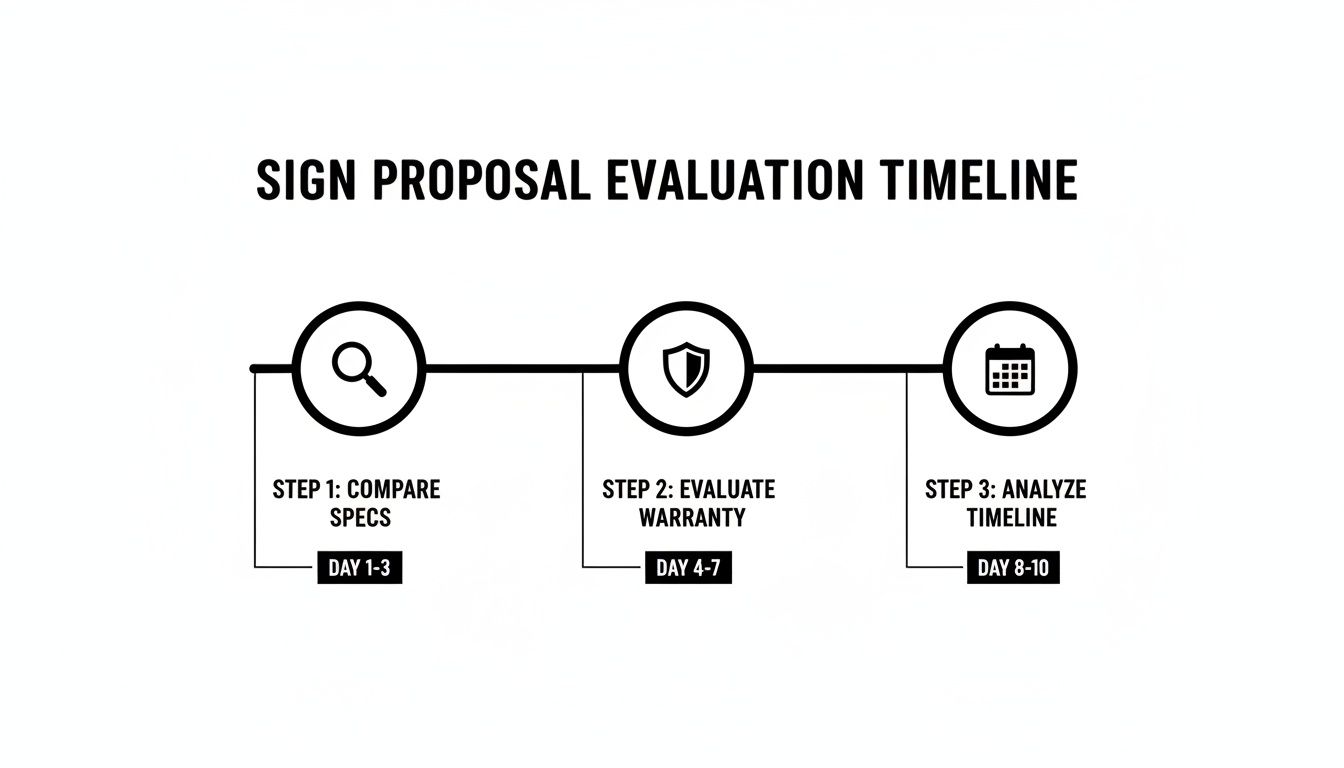
It highlights that looking at the specs, warranty, and timeline in order is the best way to make a smart choice.
Here’s how a typical project breaks down:
- Design & Engineering (1-2 weeks): This is where we go from initial ideas to final, engineer-stamped drawings, nailing down the concept, revisions, and materials along the way.
- Permit Submission & Approval (2-8 weeks): This is the wild card. A good sign partner handles all the city paperwork and follow-up, but the final approval time is entirely up to the municipality's schedule.
- Fabrication (3-5 weeks): Once we have the green light from the city, we start building your sign. The timeline here depends on complexity—detailed channel letters will take longer than a simple box sign.
- Installation (1-3 days): The last step is usually the quickest. Our crew shows up with all the right gear to get your new sign mounted safely and securely.
Key Factors That Drive Timelines and Costs
A few key variables can shift both the final price and how long the project takes. Knowing what they are ahead of time helps you budget properly and avoid surprises.
With 70% of consumers saying they notice storefront signs first, this investment is all about driving more traffic through your door. It's no wonder the global market for illuminated signs is expected to hit USD 33 billion by 2026, especially since modern LED tech can slash energy costs by up to 80%.
Here are the main things that affect cost and timing:
- Sign Height and Size: Taller signs, like pylon signs, need more substantial foundations and structural engineering. This adds to the cost and can mean a longer permit review.
- Illumination Complexity: There’s a big difference between simple, front-lit letters and a programmable digital message center. The more complex the lighting, the higher the cost and the longer the production time.
- Site Accessibility: Is the installation spot easy to get to? A tricky location with overhead power lines or uneven ground might require a bigger crane or special equipment, which will impact the installation budget.
By talking through these factors with your sign company upfront, you can map out a realistic plan that fits your goals and keeps unexpected costs from popping up later.
Answering Your Final Questions
Even after you’ve done your homework, a few questions are bound to pop up. Choosing a local sign company is a big commitment, and you need to feel completely confident before you sign on the dotted line.
To give you that final piece of mind, we’ve pulled together the most common questions we hear from business owners at this stage. Getting straight answers now is the best way to avoid any surprises later.
How Much Should I Budget for a Business Sign?
This is usually the first question on everyone's mind, and the most honest answer is: it really depends. The cost of a sign comes down to its size, the materials you choose, and how complex the design is. Think of it like buying a car—a basic model gets the job done, but a fully loaded one makes a much bigger statement.
For example, a simple, non-lit aluminum wall sign might run a few thousand dollars. At the other end of the spectrum, a massive, double-sided pylon sign with a digital message board is a serious investment.
Here’s a quick breakdown of what drives the final price:
- Illumination: Adding LED lighting to channel letters or backlighting a sign cabinet costs more because of the electrical components and specialized labor involved.
- Material Choices: Going with premium materials like heavy-duty aluminum, durable acrylics, or custom finishes will affect the budget but pay off in longevity.
- Installation Complexity: A sign that needs a crane, traffic control, and complex electrical work will naturally have a higher installation cost than one that can be mounted with a ladder.
A reputable sign partner will always give you a detailed, itemized quote. That transparency lets you see exactly where your money is going, from raw materials to labor, so you understand the true value of your investment.
What Is the Difference Between a Local and a National Sign Company?
This is a critical distinction, especially if you have plans to grow. A true local sign company lives and breathes a specific city or region. Their superpower is an intimate knowledge of local sign codes, the people in the permitting office, and the unique challenges of installing signs in their area.
A national provider, on the other hand, is built to manage projects across the country. They have the systems and networks to ensure a brand gets the exact same sign in Sacramento as it does in Savannah. This is essential for businesses like restaurant chains or national retailers that need absolute consistency.
The best national companies blend their wide reach with deep local expertise. They manage everything from a central point but know exactly how to navigate the permitting process in any town, giving you the best of both worlds.
What Is a Realistic Timeline for a Sign Project?
Good things take time, and custom signage is no exception. For a typical custom exterior sign, you should plan on a timeline of 6 to 10 weeks from the day you approve the project to the day it's installed.
Here’s how that time usually breaks down:
- Design & Consultation (1-2 weeks): This is where we finalize the design, lock in materials, and create the official drawings.
- Permitting (The Wildcard): This is the one part of the process no one can control. It could take a week in one city and several months in another, all depending on the local planning department's workload.
- Fabrication (3-5 weeks): As soon as the permit is in hand, our team gets to work actually building your sign.
- Installation (1-2 days): The final step is usually the quickest and most exciting part of the whole process.
Your project manager should give you a clear, written schedule upfront and keep you in the loop every step of the way, especially with permitting. Constant communication is key to managing expectations and keeping things moving.
What Kind of Warranty Should My New Sign Have?
A strong warranty is the clearest sign that a company believes in its own work. It’s your protection for the investment you’re making in your brand's visibility, so never sign a contract without getting the warranty details in writing.
For the sign's structure and craftsmanship, you should expect a minimum one-year warranty that covers both parts and labor. For all the electrical parts, like the LED lights and power supplies, a 3 to 5-year manufacturer's warranty is the industry standard. A company that’s proud of its work will have zero hesitation offering this guarantee.
Choosing the right sign partner is one of the most important steps in building your brand’s presence in the community. On Display Signs, Inc. is here to answer any other questions you have and walk you through the entire process, from the first sketch to the final installation.
Ready to bring your vision to life? Contact us today to start your project.