An outdoor advertising banner is so much more than a printed piece of vinyl. Think of it as your most reliable, hardworking salesperson—one who works 24/7 to grab attention, cut through the digital clutter, and drive real-world foot traffic to your door.
What Makes Outdoors Advertising Banners So Effective
In a world of skippable ads and overflowing inboxes, a physical banner offers something refreshingly tangible. It’s a bold, persistent presence. Don't see it as a cost; see it as a strategic investment in pure visibility. A well-designed banner announces your grand opening, shouts about a limited-time sale, or simply keeps your name top-of-mind for every single person who drives by.
This guide is your roadmap to turning a simple idea into a high-impact asset that gets noticed. Whether you’re a retailer, run a construction company, or organize events, understanding these fundamentals is the first step to making your message stick.
A Legacy of High-Impact Messaging
The idea of using large, physical media to capture public attention isn't new. In fact, its modern history kicked off back in 1835 when a printer named Jared Bell created a circus poster measuring over 50 square feet. The legacy grew, and in 1931, Coca-Cola famously used billboards to cement the image of the red-suited Santa Claus we all know today.
This long history proves a simple truth: big, bold messages work. That tradition continues with modern, durable banners that help everyone from local retailers to churches make a statement that can't be missed.
Actionable Insight: An effective outdoor banner acts as a real-world beacon. Its job is to interrupt someone’s daily journey with a message that is impossible to ignore, scroll past, or block.
Why Banners Are Essential for Businesses
A great banner does things that digital marketing just can't. It plants a flag in a specific geographic area, making it the perfect tool for any location-based business. Here’s why they’re so valuable:
- Targeted Local Reach: They engage the people who matter most—the commuters, shoppers, and residents in your immediate community.
- Cost-Effective Exposure: Compared to the recurring costs of other advertising, banners give you continuous exposure for a one-time investment, delivering an incredible return.
- Builds Brand Recognition: Seeing your banner day after day builds familiarity and trust, making your business the first one people think of when they need what you offer.
Of course, getting this right comes down to the quality of the print itself. You can learn more by reading this detailed guide on large format printing to see how these impressive visuals are brought to life.
Choosing the Right Material for Durability and Impact
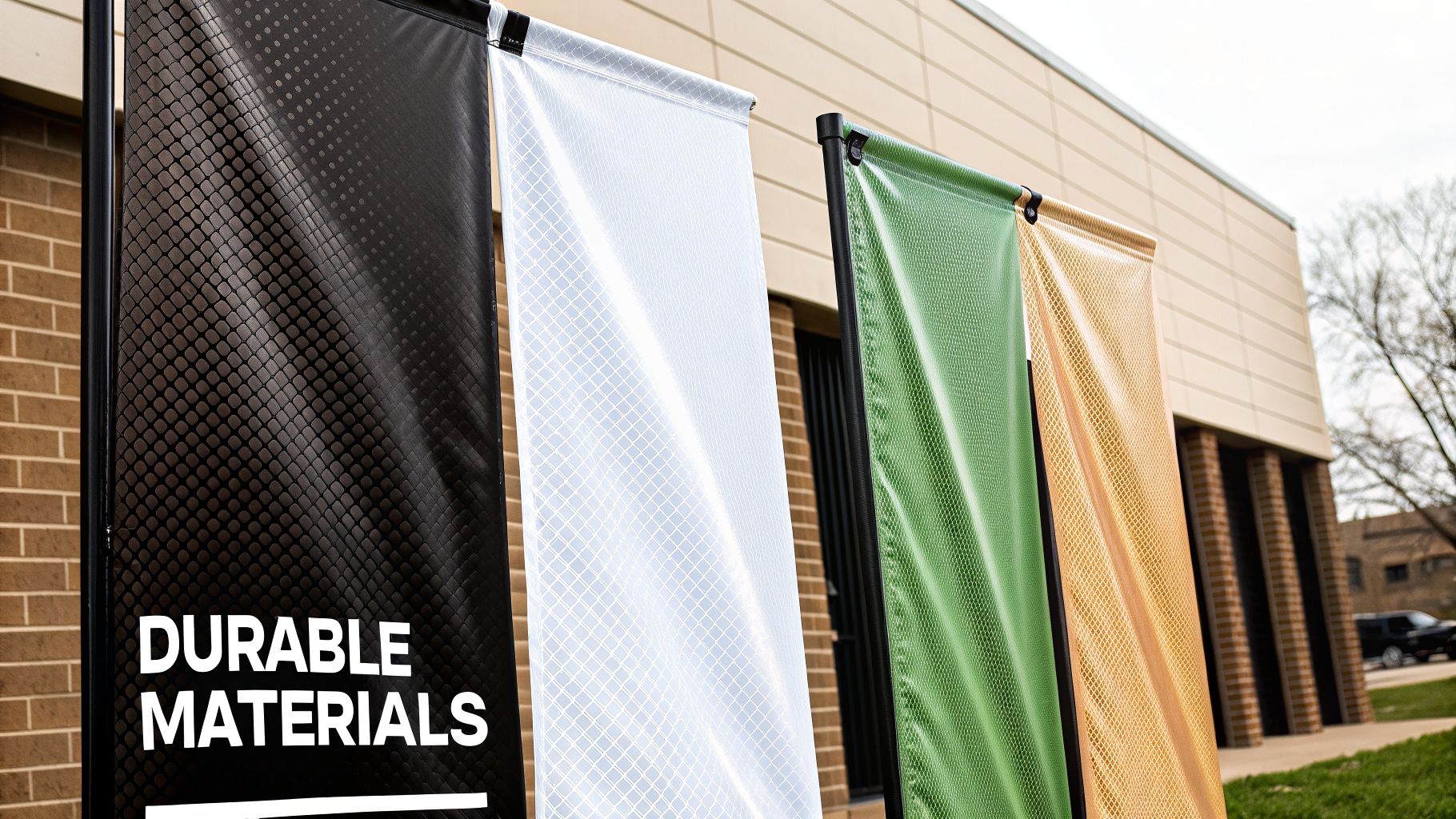
Picking the right material for your outdoor banner is a lot like choosing the right tool for a job. Using a delicate indoor fabric for a banner that’s going to live outside for months is a recipe for failure. This decision is the foundation of a banner that doesn’t just look good on day one, but continues to work for you through sun, wind, and rain.
Getting this right protects your investment. A durable, well-chosen banner keeps your message clear and professional, ensuring it has the staying power to make a real impact.
Vinyl Banners: The All-Purpose Workhorse
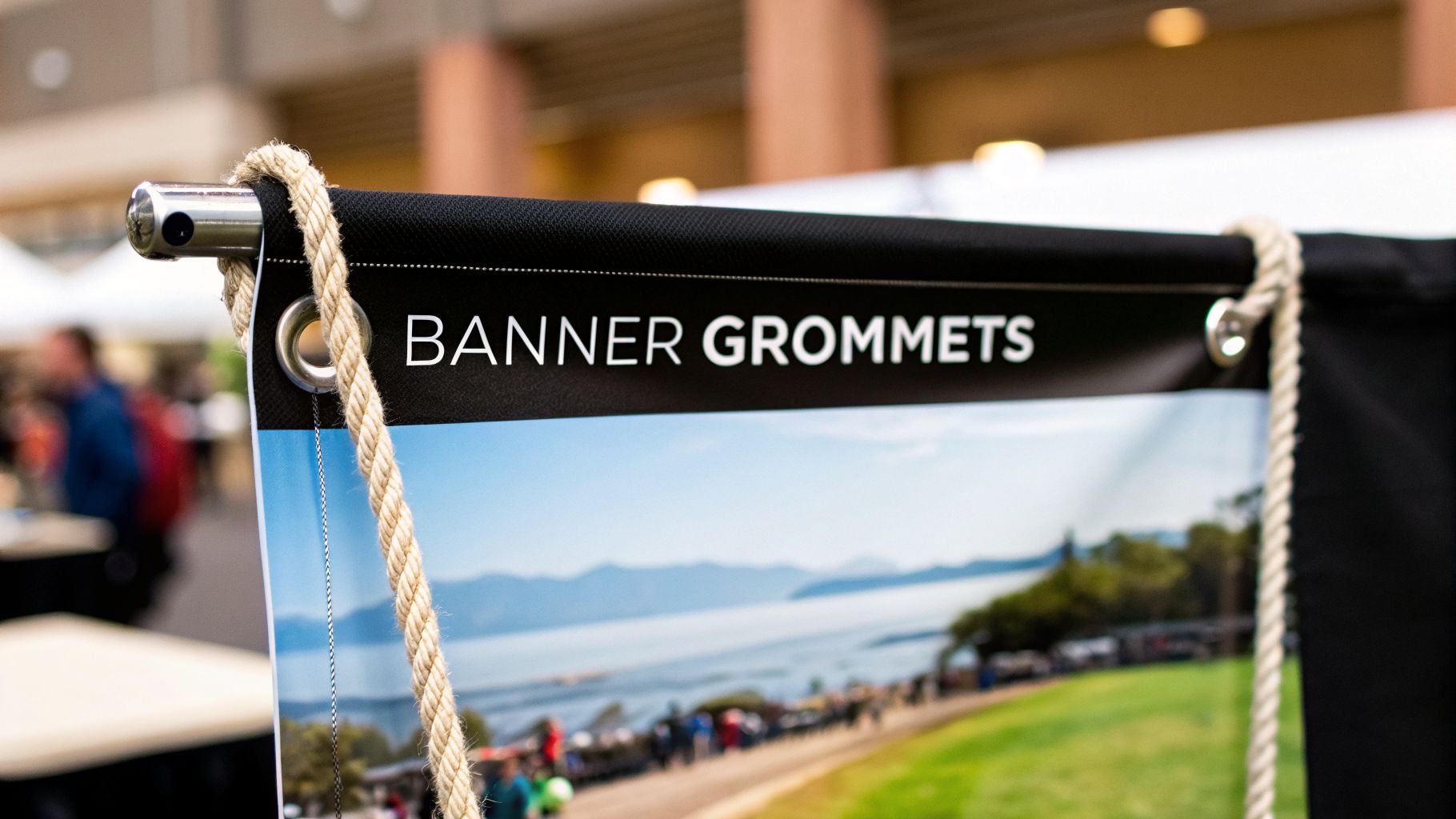
When you picture a classic outdoor banner, you’re almost certainly thinking of scrim vinyl. This is the tried-and-true workhorse of the industry for a reason. It’s built with an internal polyester mesh—the "scrim"—that gives it incredible tear resistance and strength, making it perfect for everything from grand opening announcements to event promotions.
Practical Example: A local restaurant hangs a 13 oz scrim vinyl banner on their building to announce a "Kids Eat Free on Tuesdays" special. It's durable enough to last for months but cost-effective for a temporary promotion.
13 oz Scrim Vinyl: This is the industry standard, hitting the sweet spot between toughness and cost. It’s the go-to for most short to mid-term outdoor uses.
18 oz Blockout Vinyl: If you need a double-sided banner, this is the only way to go. It has an opaque layer sandwiched in the middle that prevents any light from bleeding through, so the graphic on one side is completely invisible from the other. It’s a must-have for pole banners or any display that needs to be seen clearly from both directions.
Mesh Vinyl: Conquering Wind with Ease
Have you ever seen a big banner on a chain-link fence shredded to ribbons after a storm? That's what happens when solid vinyl meets high wind—it acts like a giant sail. Mesh vinyl is the smart solution, engineered with thousands of tiny holes that let wind pass right through it.
Practical Example: A construction company uses a large mesh banner on the site fence of a new project. The wind passes through, preventing the banner from tearing, while the printed rendering of the finished building generates interest and leads for the developer.
This simple, breathable design takes all the stress off the banner and its grommets. For any long-term banner going up on a construction fence, a sports field, or any wide-open, breezy location, mesh vinyl isn't just a good idea—it's essential for safety and longevity.
Fabric Banners: For an Elegant, Upscale Finish
While vinyl is the undisputed king of durability, some situations call for a more sophisticated touch. Fabric banners, usually made from polyester, offer a premium, glare-free matte finish that makes colors look incredibly rich and deep. They have a softer, more high-end feel that’s perfect for creating a classier atmosphere.
Practical Example: A luxury car dealership hosts an outdoor launch event for a new model. They use fabric banners with a deep, rich color palette to create a high-end, sophisticated backdrop that aligns with their premium brand image.
Fabric banners are lightweight and easy to transport, though they are best suited for short-term outdoor events where visual appeal is the top priority.
You can dive deeper into the pros and cons of these options in our guide on the best material for outdoor signs.
To help you visualize which material fits your needs, here's a quick comparison.
Outdoor Banner Material Comparison
| Material Type | Best For | Key Features | Weather Resistance |
|---|---|---|---|
| 13 oz Scrim Vinyl | General-purpose outdoor signs, events, and promotions. | Industry standard, strong, tear-resistant, cost-effective. | High (Waterproof, UV resistant) |
| 18 oz Blockout Vinyl | Double-sided pole banners and hanging signs. | Opaque layer prevents see-through, heavy-duty strength. | Very High (Waterproof, UV resistant) |
| Mesh Vinyl | Windy locations, fences, and large-scale building wraps. | Perforated design allows wind to pass through, reduces stress. | Excellent (Wind-permeable, waterproof) |
| Fabric (Polyester) | Upscale events, and high-end outdoor promotions. | Elegant matte finish, vibrant colors, lightweight, washable. | Moderate (Best for fair weather) |
Ultimately, the goal is to choose a material that ensures your message stays visible and effective for its entire lifespan.
Keep in mind just how many eyes are on the road. The average driver spends over 300 hours behind the wheel each year, making roadside banners and signs prime real estate for building brand awareness. It's this captive audience that fuels the outdoor ad industry, from traditional banners to dynamic flags. And if you're considering flags, knowing the best material for outdoor flags is just as critical to ensure they can handle the elements.
Designing Banners That Stop Traffic and Drive Action
You have about three seconds. That's the tiny window of opportunity your banner has to grab the attention of a driver, deliver a message, and spark an action. This requires a fundamental shift in thinking: you’re not designing a brochure; you’re designing a billboard.
Success comes from a "less is more" mindset. The fastest way to make your banner completely invisible is to cram it with too much text, too many images, or a complicated idea. The goal is to create one single, powerful impression that sticks.
The Three-Second Rule in Banner Design
Imagine you’re driving down a busy street, focused on traffic, your speed, and where you're going. A banner on the side of the road needs to cut through all that mental noise in an instant. This is why simplicity isn't just a design choice—it's a requirement for the banner to function at all.
To create a banner that works in this tight timeframe, every single element has to earn its place. If a word, image, or color doesn't directly support the main message, it's just noise. You have to be ruthless in your editing to make sure your banner communicates with speed and absolute clarity.
Master the Fundamentals of High-Impact Design
Creating a powerful banner really comes down to three things: font, color, and message. Get these right, and you'll have a banner that gets results instead of getting ignored.
Here are the non-negotiable principles for a design that works:
Bold, Legible Fonts: Your font choice is everything. Stick with thick, clean, sans-serif fonts like Helvetica, Arial, or Futura. Skip the script or decorative fonts—they might look nice up close, but they become unreadable from a distance. The text needs to be big enough to be seen clearly from your target viewing distance.
High-Contrast Color Palettes: Your banner needs to pop, and the best way to do that is with high-contrast color combinations. Think bold black text on a yellow background, or crisp white on a deep red. These pairings create instant visual clarity, making your message readable even in bright sun or on an overcast day.
A Single, Powerful Call-to-Action (CTA): What is the one thing you want people to do? Don't be vague with messages like "Visit Us Soon." Your CTA needs to be direct, urgent, and unmissable. Use strong, action-oriented language that tells people exactly what to do next.
For a deeper dive into creating visuals that command attention, check out this excellent guide on Mastering High-Impact Graphic Design Layouts for Yard Signs.
Real-World Examples That Work
Let's look at how this plays out in the real world:
- For a Grand Opening: A banner that just says "Grand Opening This Friday" in a massive font, with the address clearly listed below. That's it. Nothing else needed.
- For a Retail Sale: A bright red banner that screams "50% OFF EVERYTHING." The value and urgency are communicated instantly.
- For a Community Event: A banner with just the essentials: "Community Fair – Saturday, June 15th – Central Park."
In a world full of digital noise, there's a reason outdoor banners still work. A striking 75% of travelers recall seeing a billboard in the past month, and 55% felt highly engaged by its message. Even better, 71% say billboards stand out more effectively than online ads.
Actionable Insight: If you can't read and understand your banner's entire message in three seconds while driving past it, the design has failed. Test it by mocking it up and viewing it from 50 feet away for only three seconds.
Finally, keep your branding consistent but subtle. Your company colors and logo should be present, but they can't be the main event. The banner needs to feel like it’s from your business without making people squint to see the logo. For more inspiration, you can explore these inspiring sign design ideas to see how others nail this balance. Get these simple things right, and you’ll create a banner that stops traffic for all the right reasons.
Proper Installation for Longevity and Safety
A beautifully designed banner is only half the battle. The real work—and the real value—comes from a proper installation that keeps it looking great and working for you. Think of it like hanging a heavy mirror; you wouldn't just tap a nail into the drywall and hope for the best. You'd find a stud and use the right hardware to make sure it stays put.
It's the exact same principle with your banner. A sloppy installation will turn your investment into a sagging, torn liability in no time. Securing it correctly isn't just about appearances—it's about protecting your banner from the elements and making sure it represents your brand professionally.
Common Mounting Methods and Best Practices
The way you hang your banner depends entirely on where it’s going. There’s no one-size-fits-all solution, and trying to force one method to work everywhere is a recipe for a failed sign.
For Fences (Chain-Link): This is a perfect spot for outdoors advertising banners, especially mesh ones. The secret is to use bungee cords or heavy-duty zip ties through every single grommet. This distributes the tension evenly across the banner, preventing it from whipping in the wind and ripping at the stress points.
For Walls (Brick or Concrete): You'll need a more permanent approach here. This means drilling into the wall and using anchors with screws and washers. Don't skip the washers—they're critical for spreading the load and stopping high winds from tearing the grommets right out.
For Street-Side Poles: This is exactly what banners with pole pockets were made for. The banner simply slides over horizontal arms attached to a light pole or a dedicated stand, giving you that clean, taut look you see for city-wide events and promotions.
Of course, a great installation won't save a bad design. This quick visual breaks down the simple but crucial steps to creating a banner that works from a distance.
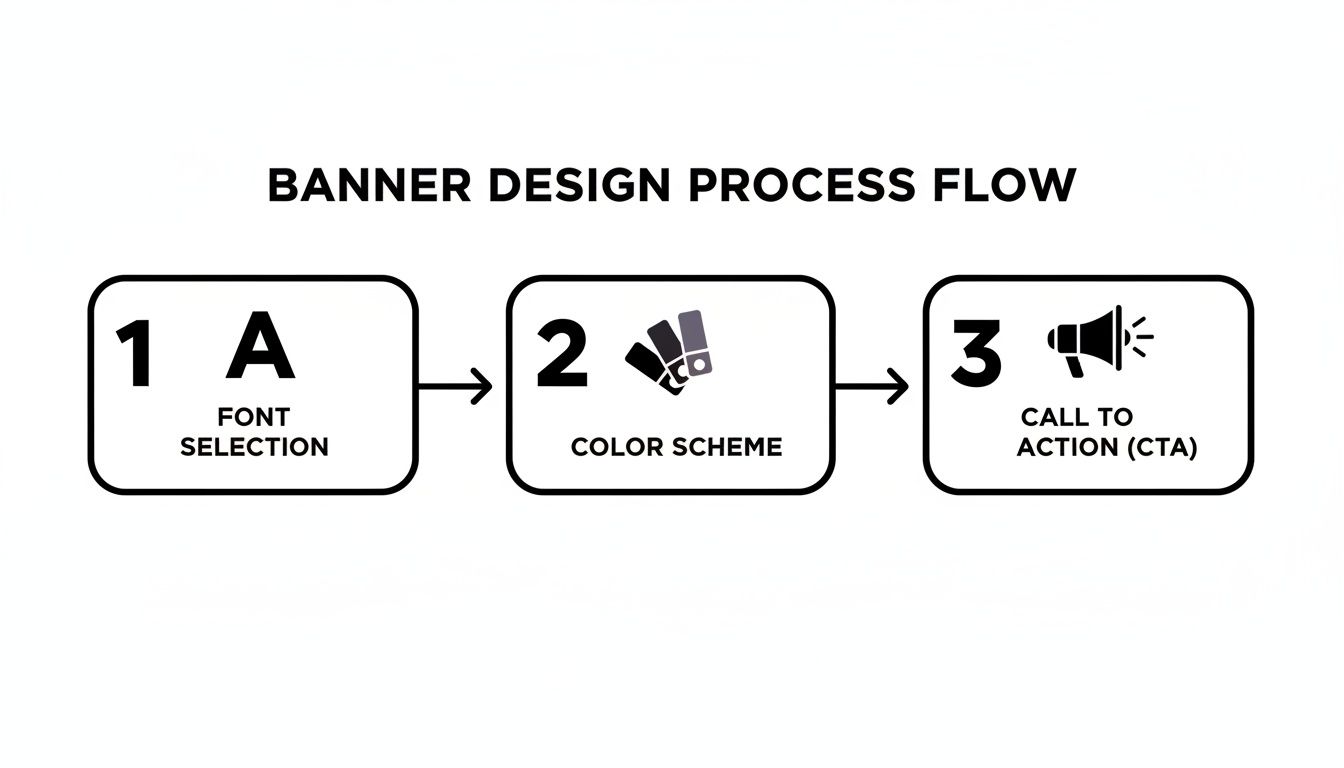
As you can see, the path to a readable, effective banner follows a straightforward process: readable fonts, colors that pop, and a call to action nobody can miss.
Wind-Proofing Your Banner Investment
Wind is the number one enemy of any outdoor banner. A solid vinyl banner acts like a giant sail, catching every gust and putting enormous strain on the material and the mounting points. Managing that force isn't just a good idea—it's essential.
We see people make this mistake all the time: they take a knife and cut "wind slits" into their banner. This is the fastest way to destroy it. While it might seem like a quick fix, you're actually shredding the banner's structural integrity, creating weak points that will be the first to rip and tear.
Actionable Insight: Instead of damaging your sign, choose the right material from the start. A mesh banner is always the better choice for fences, construction sites, or any other exposed location. Its perforated surface lets the wind pass straight through, dramatically reducing the stress and making it last far longer.
Knowing When to Call a Professional
While hanging a small banner on a ground-level fence is a manageable DIY job, many situations are best left to the experts. Knowing when to call for help isn't admitting defeat; it's a smart business decision that guarantees safety and a flawless finish.
You should always hire a professional for:
- High-Altitude Installations: Any banner going on a second story or higher. The pros have the lifts, safety gear, and insurance to work at heights safely.
- Large-Scale Banners: Huge banners that span entire walls or cross over streets require specialized tensioning to prevent sagging and ensure they are absolutely secure.
- Complex Mounting Surfaces: Attaching to a delicate historic facade or an uneven surface takes experience to get right without causing damage.
Bringing in a professional isn't just an extra cost—it's an investment in doing the job right. They'll make sure your banner is installed safely, looks perfect, and holds up for the long haul. For more hands-on advice, you can check out this guide on how to hang banners for different situations.
Navigating Local Sign Permits and Regulations
Ignoring local rules is one of the most expensive—and frustrating—mistakes you can make with outdoor advertising banners. Before you spend a dime on a beautiful new banner, you have to get a handle on the legal side of things. It’s a lot like building a deck; you wouldn't start buying lumber without first checking the building codes and seeing if you need a permit.
These rules, usually called sign codes or ordinances, aren’t just there to give you a headache. They exist to keep the public safe, maintain the look and feel of a community, and prevent a chaotic mess of visual clutter. But what’s perfectly fine in one town might get you a hefty fine just down the street in the next.
Why Sign Codes Vary So Much
Every city, county, and sometimes even specific shopping districts have their own rulebook for signs. This is exactly why a one-size-fits-all approach to banner advertising is bound to fail. A temporary "Grand Opening" banner might be perfectly fine without a permit for 30 days in one area, while another town limits you to 14 days and requires a formal application.
Actionable Insight: Never assume you know the rules, even if you’ve put up banners somewhere else before. Always check with the local government for every single new banner you install. It’s the only way to avoid fines and the hassle of having to take your sign down.
The regulations can get surprisingly detailed. Here are some of the most common restrictions you’re likely to run into:
- Size Limitations: Most places will have a hard cap on the total square footage of temporary signs you can display at one time.
- Placement and Setbacks: Codes almost always dictate how far a banner needs to be from the curb, property lines, and other signs.
- Duration: Banners for sales or special events are nearly always temporary, with strict time limits like 30, 60, or 90 days.
- Content Neutrality: While your right to advertise is protected, some areas have specific rules about what you can say, especially when it comes to advertising a business that isn't at that location.
Your Practical Checklist for the Zoning Office
To get straight answers, you need to ask the right questions. Before you even think about ordering that banner, call your local city or county planning and zoning office and run through this checklist:
- Do I need a permit for a temporary banner announcing a sale or event?
- What’s the maximum size my banner can be for this property?
- How far back from the street or sidewalk does my banner need to be?
- How long can I legally display my banner before I have to take it down?
- Are there any banned installation methods, like attaching banners to utility poles or fences?
Working with a seasoned sign company that handles this process for you is a massive advantage. Professionals who deal with sign permit requirements every day know exactly who to call and what to ask. That insider knowledge saves you from fines, delays, and wasted effort, ensuring your banners go up legally the first time.
Proven Banner Strategies for Your Industry
General advice on banners can only get you so far. The real magic happens when you stop thinking about a "banner" and start thinking about a "retail banner" or a "construction site banner." A strategy that packs a restaurant will fall flat for a real estate developer, so let's get specific and look at what actually works on the ground.
These are the proven, industry-specific plays that move beyond theory. They’re actionable ideas you can put to work right away to get real, measurable results.
Retail Banners That Drive Immediate Sales
For a retailer, a banner has one job: create urgency and get people through the door right now. You need to give someone driving by an irresistible reason to pull into your lot instead of continuing on their way. Success here comes down to bold, clear, and time-sensitive messages.
- Seasonal and Holiday Promotions: Think in sequences. A "Holiday Sale Starts Friday!" banner builds anticipation. A week before Christmas, you can swap it for a "Last-Minute Deals – 50% Off!" banner. This keeps your storefront looking fresh and gives customers a reason to keep checking back.
- Flash Sales and Limited-Time Offers: Nothing sparks action like scarcity. A bright red banner screaming "48-HOUR TENT SALE" or "TODAY ONLY: BOGO FREE" isn't subtle, and it's not supposed to be. It's a powerful, direct command that triggers an immediate response.
- New Arrival Announcements: Let your regulars know when the good stuff has landed. A simple, clean banner announcing "New Spring Collection Is Here!" is a fantastic way to bring back loyal customers who are excited to see what’s new.
Construction Banners That Build Your Brand
On a job site, your banner is doing double duty. It's not just marking territory; it’s your best brand-building and lead-generation tool. That chain-link fence isn't just for security—it's a massive, blank canvas. A large-format mesh banner is the perfect way to put it to work.
Actionable Insight: Your construction site banner is the best silent salesperson you have. While your crew is busy building, that banner is working 24/7 to showcase the final product, establish your credibility, and grab the attention of future clients who see your quality work firsthand.
Use your site banners to:
- Showcase the Finished Project: Don't just let people see a muddy lot for six months. Put up a vibrant, full-color rendering of the finished building. This transforms a disruptive construction site into an exciting preview of what's to come, helping the community—and potential buyers—visualize the end result.
- Generate Leads Directly: This is your chance to turn passing traffic into qualified leads. Add a clear call to action like "For Leasing Information, Call…" or "Your New Home Could Be Here. Visit OurWebsite.com."
- Promote Your Services: Make your company logo and contact info impossible to miss. Every person who drives by that site for months will see your name, building powerful brand recognition in the local market.
Real Estate Banners That Create Buzz
In real estate, it’s all about building momentum. Banners are the perfect tool to announce key milestones and build anticipation long before a property is even ready for a tour.
- "Coming Soon" Banners: A huge banner on a vacant lot proclaiming "Future Home of…" or stretched across an existing building announcing "Luxury Condos Coming Soon" is how you start generating buzz. It builds an email list of interested parties before you've even broken ground.
- "Now Selling" or "Now Leasing" Banners: Once you're ready to transact, it’s time to switch to a bold, action-focused message. This is the signal to the market that the waiting is over and the time to act is now, driving traffic directly to your sales office or website.
Event Banners for Wayfinding and Sponsorship
For any festival, conference, or community event, banners are the unsung heroes of logistics. They manage crowds, guide attendees, and fulfill crucial sponsor obligations, making the entire experience smoother for everyone.
Use them for simple, clear wayfinding—think "Parking This Way," "Registration ->," or "Main Stage." Good directional banners reduce confusion and make attendees feel taken care of. Just as importantly, use prominent banners to display sponsor logos throughout the venue. This gives your partners the visibility they paid for and helps ensure they'll be back to support you next year.
Frequently Asked Questions About Outdoor Banners
Even after you've mapped out the perfect banner strategy, a few questions always pop up before you pull the trigger. It’s completely normal. We’ve heard them all, so we’ve put together some straight answers to help you finalize your plan with total confidence.
How Long Will My Outdoor Banner Last?
The real-world lifespan of your banner comes down to three things: its material, the print quality, and how much of a beating it takes from the weather. A well-made 13 oz scrim vinyl banner, installed properly, can easily last 1 to 3+ years.
Of course, nothing lasts forever outside. Constant, direct sun will eventually fade the colors, and relentless wind puts a ton of stress on the seams and grommets. Picking the right material for your specific location is the single best thing you can do to get the most life out of your banner.
What Is the Most Common Mistake People Make with Banners?
Hands down, the biggest mistake we see is trying to cram too much information onto the banner. Your banner has just a few seconds to get its message across to someone driving or walking by. It’s a billboard, not a brochure.
Actionable Insight: A cluttered design is an ineffective design. When you use small fonts, too many colors, a complex logo, or multiple messages, you’re just creating visual noise that’s easy to ignore. The best banners have one clear message, a big and readable font, and a simple, powerful call to action.
Are Mesh Banners Better Than Vinyl Banners with Wind Slits?
For just about any windy spot, the answer is a definite yes. Mesh banners are engineered from the start with thousands of tiny holes that let wind pass straight through, which dramatically cuts down on that "sail effect" that can rip a banner right off its moorings.
Cutting "wind slits" into a solid vinyl banner might feel like a clever workaround, but it's a terrible idea. All you're really doing is creating weak points that are primed to tear and shred in the first big gust of wind. For any long-term use on a fence, construction site, or open area, mesh is the only professional choice.
Do I Need a Professional to Install My Banner?
It really depends on the size and location. If you’re hanging a smaller banner at ground level—say, a 3' x 6' banner on a chain-link fence—you can probably handle it yourself with some bungee cords. It’s a pretty straightforward job.
However, you should absolutely call in a professional for:
- Large-scale banners that need serious tension to look sharp and stay put.
- High-altitude placements, like on the side of a building or stretched across a street.
- Installations on tricky surfaces where a misplaced drill hole could cause real damage.
Professional installers have the right tools, safety gear, and insurance to get the job done right. It protects your investment, keeps you compliant with local codes, and saves you from the liability of a falling sign.
Ready to create an outdoor banner that gets noticed for all the right reasons? The experts at On Display Signs, Inc. manage the entire process for you, from design and material selection to permitting and professional installation. Get in touch today to start your project.