The booth space is booked. The show dates are on the calendar. Then the hard part hits.
If this is your first major Orlando event, you are probably staring at floor plans, shipping questions, graphic deadlines, and a display quote that only covers part of what you will spend. That is normal. Orlando rewards companies that plan early and punishes companies that treat the booth like a backdrop.
A good display does two jobs at once. It gets attention on a crowded floor, and it helps your team produce measurable business results. If your booth looks polished but your staff cannot capture qualified leads, route traffic, or follow up fast, the display failed. It failed in a nice-looking way.
That matters more in Orlando than in smaller markets. The venue scale is bigger, the attendee volume is bigger, and the margin for sloppy planning is smaller. For companies searching for trade show displays orlando fl, the key buying decision is not only what looks best. It is what gives you the best return once the show opens.
Navigating the Competitive Orlando Trade Show Scene
You get approval for an Orlando show and think, “Great, we finally made it into a serious event.” Then you see the exhibit hall map.
At that point, most first-time exhibitors realize they are not preparing for a hotel ballroom or a local chamber expo. They are entering one of the busiest trade show markets in the country. Orlando’s Orange County Convention Center offers a significant amount of exhibit space, and Orlando’s major venues hosted more than 71 events in Q4 2024 alone, drawing more than 1.1 million attendees, according to trade show statistics compiled for the Orlando market.
That scale changes everything.
A basic banner wall that worked at a regional event can disappear at the OCCC. A cluttered 10×10 can look smaller than it is. A booth with no clear message can lose visitors before your team says hello. On a floor this large, people make snap judgments. They decide whether you look established, relevant, and worth stopping for in a few seconds.
What first-timers usually underestimate
The first mistake is assuming “showing up” is enough. It is not.
The second mistake is focusing only on booth appearance. In Orlando, the display has to do practical work. It needs to:
- Stop traffic: Give people a reason to look from the aisle.
- Clarify your offer: Tell visitors what you do without requiring a long explanation.
- Support conversations: Leave room for demos, meetings, and lead capture.
- Survive logistics: Arrive on time, fit venue rules, and set up without chaos.
A small manufacturer, retailer, church team, or startup can still compete well in Orlando. But they need a display strategy that matches the event, the booth size, and the sales goal.
Tip: If your team cannot explain the booth goal in one sentence, the display plan is not finished. “Brand awareness” is too vague. “Book distributor meetings” or “demo the new product line” gives the booth a job.
Why Orlando forces better decisions
Large Orlando shows expose weak planning fast. Poor sightlines, unreadable messaging, flimsy materials, and bad traffic flow all become more obvious when your neighbors have invested properly.
That is why the smart question is not “What display can we afford?” The better question is “What display helps us compete on this floor and gives us the best shot at measurable return?”
Choosing the Right Display for Your Orlando Booth Space
A 10×10 at the Orange County Convention Center can waste money fast if the display type does not match the job. I have seen first-time exhibitors spend heavily on a custom booth that could not support demos, and I have seen others save on a portable setup that looked outmatched the moment the hall opened. The right choice is the one that helps your team attract the right visitors, run the conversation well, and justify the event cost after the show.
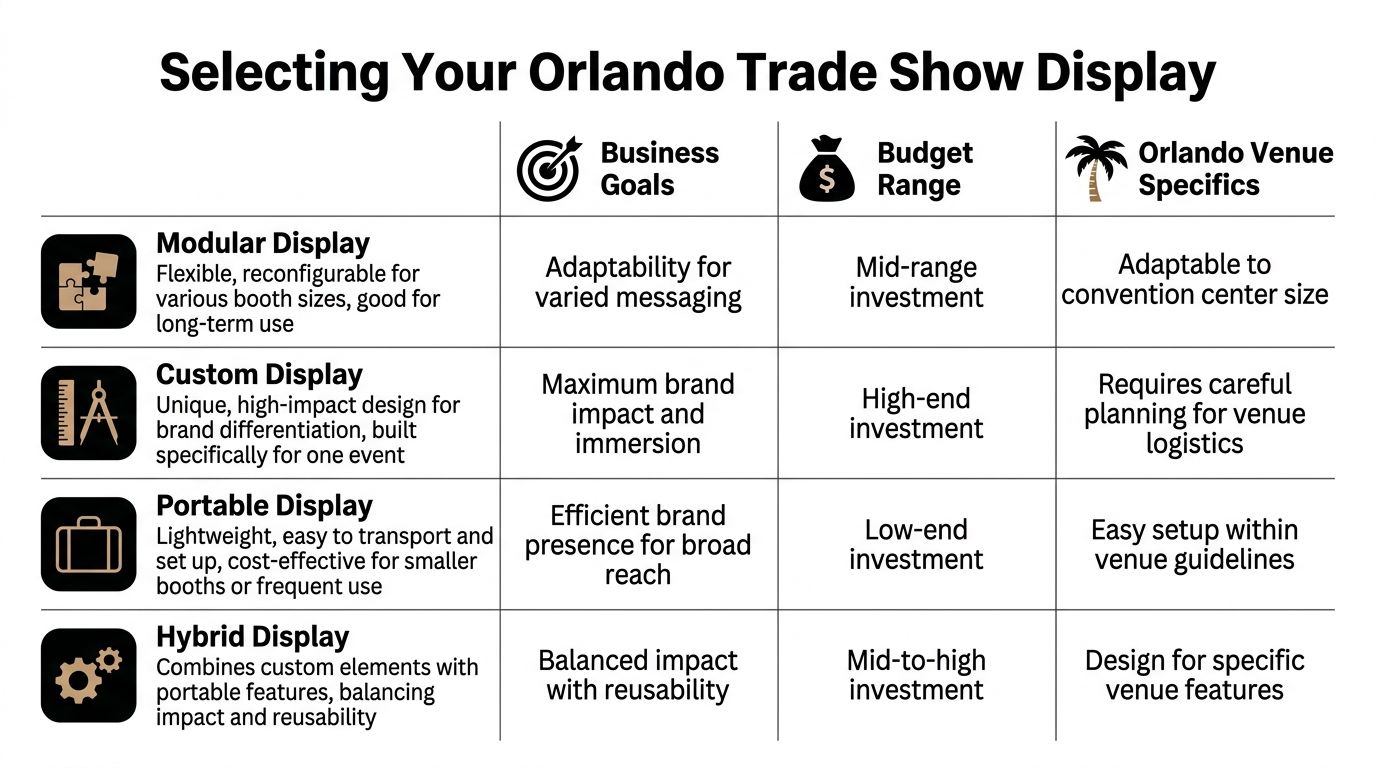
Portable, modular, custom, and hybrid
Use the display type that fits your booth schedule, staffing, and sales goal.
| Display type | Best fit | Where it works | Where it falls short |
|---|---|---|---|
| Portable display | Teams running small booths, local events, or frequent travel | Quick setup, lighter freight, lower ownership risk | At large OCCC shows, it can look too light if nearby exhibitors have stronger structures and lighting |
| Modular display | Companies using different booth sizes during the year | Reconfigures well, extends useful life, supports repeat use | Only works if each layout is planned in advance and still looks complete |
| Custom display | Brands with a major launch, flagship event, or complex demo need | Strong visual control, better integration of product and meeting areas | Higher fabrication cost, lower flexibility, harder to reuse if your footprint changes |
| Hybrid display | Teams that want a polished look without committing to full custom every time | Reusable core pieces with upgraded finishes and features | Easy to overcomplicate, especially if the design mixes too many unrelated parts |
When portable makes sense
Portable systems work best when the offer is simple and the team can win business through short conversations, samples, or a straightforward demo. A software company booking follow-up calls may do fine with a clean backwall, one monitor, and a lead capture counter. A product line that needs live testing, storage, and multiple staff zones usually will not.
Material choice matters here. Lightweight mounted graphics can keep costs down, but they also take abuse during packing, shipping, and repeated installs. If your team is comparing short-term graphic substrates, this guide to foam core board options and trade-offs helps you avoid choosing panels that look fine in the office and arrive damaged on show day.
Why modular is usually the safest long-term bet
For growing exhibitors, modular is often the best balance of cost control and performance. It lets you keep a consistent brand presence while adjusting for a 10×10 this quarter and a 10×20 later in the year. That matters in Orlando, where companies often test one event, expand into another, then need the booth to scale without starting over.
The savings only show up if the system is planned properly. A modular booth that looks sharp in one size and awkward in another will hurt results. Before approving a concept, check whether every version still gives you these basics:
- A clear focal point from the main aisle
- Branding that reads in a few seconds
- Space for demos, meetings, or product handling
- A defined lead capture point
- Storage that keeps clutter off the floor
That last point gets missed all the time.
If bags, literature, personal items, and giveaway stock end up visible, the booth feels cramped and cheap no matter how much you spent on graphics.
Buy or rent
Buy when you expect repeat use and want the cost spread across several events. Rent when you are testing a market, trying a larger footprint once, or need a better visual package than you want to store and maintain.
A simple filter helps:
- One show or uncertain event schedule: Rent.
- Several events with changing booth sizes: Buy modular.
- Major launch with high traffic expectations: Consider custom or hybrid.
- Small team with limited setup experience: Choose the option your crew can manage cleanly under show-site pressure.
Good design examples can help, but they should sharpen your decision, not distract you from it. These inspiring trade show display ideas are useful for comparing layout approaches, branding hierarchy, and interaction zones before you lock in a booth that has to earn its keep.
Budgeting Beyond the Booth The Total Cost of Exhibiting
The display quote is not your exhibit budget. It is one line in the budget.
That is where many first-time Orlando exhibitors get burned. They approve the booth, celebrate that the project is moving, and then get hit by service charges, handling, labor, utilities, and post-show storage that were never discussed in plain language.
What belongs in a detailed budget
Think in cost buckets, not just in booth hardware.
- Space cost: What the show organizer charges for the footprint.
- Display cost: Structure, graphics, counters, shelves, lighting, and any branded accessories.
- Material handling: The cost to move your freight from receiving to your booth and back out.
- Installation and dismantle: Labor for setup and teardown.
- Utilities and services: Electrical, internet, cleaning, and other venue services.
- Travel and staffing: Flights, hotels, meals, and team time.
- Storage and refurbishment: What happens to the booth after the show.
A lot of small businesses benefit from comparing exhibit spending with the rest of their annual promotion plan. This overview of a small business marketing budget is a useful reminder that trade show costs need to be judged against actual sales and pipeline goals, not treated as a standalone vanity expense.
The hidden expenses that surprise first-timers
Drayage or material handling surprises people because they think shipping a crate to the venue means the shipping bill covers delivery to the booth. It usually does not. Freight still has to be received, moved, staged, delivered, and sometimes stored.
I&D labor catches people when they assume their booth is “easy enough” for anyone to set up. Even simple displays can become expensive if setup windows are tight, the venue has labor rules, or the booth includes electrical, monitors, or suspended elements.
Electrical services are often purchased separately from the booth itself. If your display uses lighting, charging stations, demo equipment, or monitors, this line item matters more than most first-time teams expect.
Post-show storage gets ignored until the event is over and nobody has a plan for where the booth goes next. If you buy the booth, storage needs to be part of ownership math.
A simple budgeting method that works
Build your budget in this order:
Start with the business goal.
Is this event for lead generation, distributor meetings, product launch, or relationship maintenance?Set the display strategy.
Portable, modular, rental, custom, or hybrid.Add service layers.
Freight, handling, install, dismantle, utilities, cleaning, and storage.Add people costs.
Travel, lodging, meals, and time away from operations.Reserve a contingency line.
Orlando shows move fast, and last-minute changes are expensive.
Tip: Ask every vendor one blunt question: “What costs are not in this quote?” If they cannot answer clearly, keep asking.
What works and what does not
What works is a line-by-line budget with named owners. One person handles booth production. One handles show services. One handles freight and schedule. Even on a small team, assigned ownership prevents expensive misses.
What does not work is spreading responsibility across sales, marketing, and operations with no final decision-maker. That is how deadlines slip and surprise charges pile up.
Mastering Orlando Logistics Shipping Drayage and Venue Rules
Your freight shows as delivered. Your team lands in Orlando. The booth still is not on the floor.
That failure usually starts weeks earlier, when nobody owns the shipping plan, the paperwork, the target delivery date, or the install schedule. At the Orange County Convention Center, small misses turn into labor delays, storage charges, and a booth that opens late. If ROI matters, logistics cannot be treated as back-office admin. It affects lead volume, staff productivity, and how many selling hours you lose before the aisle traffic starts.
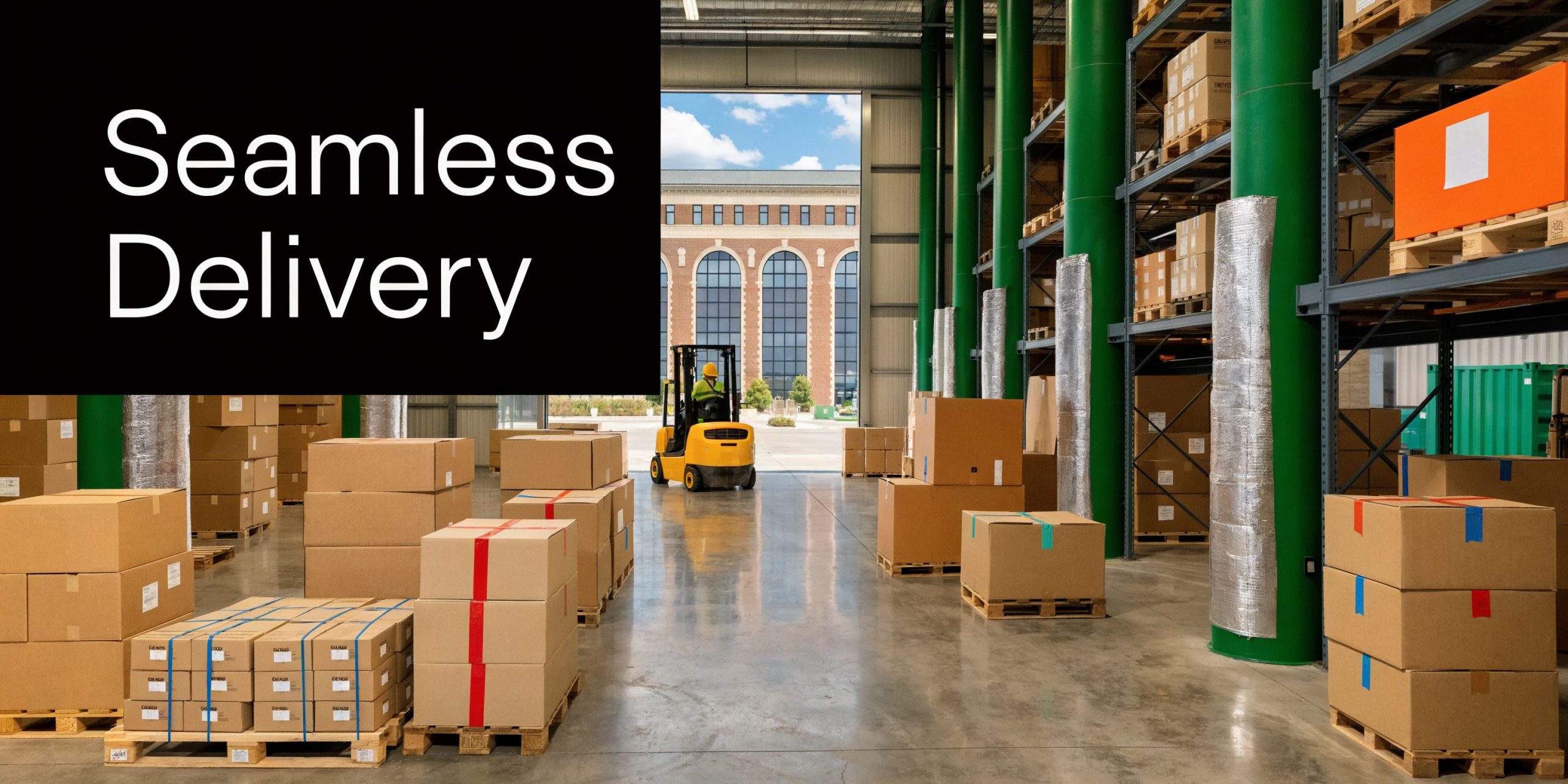
First-time Orlando exhibitors should learn four terms early: freight, drayage, advance warehouse, and direct-to-show. Confusing any of them leads to preventable costs.
What drayage means
Drayage, often called material handling, covers what happens after your shipment reaches the show receiving point. That usually includes unloading, short-term storage, delivery to your booth, removal of empties, and bringing your freight back after the event.
Freight shipping gets your crate to the venue or advance warehouse. Drayage gets it from there to your space.
Teams often book shipping and assume the hard part is done. It is not. A crate can arrive on time and still miss install if labels are wrong, paperwork is incomplete, or the move-in window was missed. That is why experienced exhibitors track bill of lading details, piece counts, carrier contacts, and booth numbers with almost obsessive care.
Advance warehouse or direct to show
You usually have two inbound options: ship to the advance warehouse or ship direct to show site.
For a first Orlando show, the advance warehouse is usually the safer call. Your freight arrives before move-in, gets checked earlier, and is more likely to be ready when labor starts. You pay for that extra buffer, but the cost can be justified if your booth includes custom elements, monitors, product samples, or anything that cannot be replaced overnight.
Direct-to-show can save time in some cases, especially for simple booths with tight schedules. It also leaves less room for error. If the truck misses its check-in window, arrives before the dock is accepting freight, or gets stuck in event traffic, your install crew can end up waiting on the floor. You still pay for that labor.
The final handoff creates the friction. The same operating reality shows up in logistics articles about understanding and navigating last-mile delivery challenges. Access limits, timing, handoffs, and site rules decide whether the shipment is useful when you need it.
Venue rules that cause the most expensive mistakes
The OCCC and show management do not care that a booth looked simple in the proposal stage. They care whether it meets the event rules, arrives on time, and can be installed safely within the assigned window.
These are the misses that create the biggest headaches:
- Labor assumptions. Some exhibitors assume their own team can assemble everything. Depending on the event, union labor rules, tool use, and setup scope may limit what your staff can do.
- Electrical mismatch. Floor ports rarely land exactly where the rendering suggests. If power drops were not coordinated with the actual layout, cords end up exposed, counters get moved, or demo stations go dark.
- Hanging sign delays. Overhead elements need approvals, engineering details, and deadlines met well before move-in.
- Bad crate planning. If the first items needed for install are packed last, your crew burns paid time digging through freight.
- Missing paperwork. Insurance documents, labor orders, shipping labels, and show forms all need one owner.
Modular booths get tripped up here more often than buyers expect. Flexibility helps, but only if the booth configuration matches the actual booth size, height rules, electrical plan, and install time allowed by the event.
A timeline that protects your opening day
The cleanest installs follow a simple sequence.
- Lock the booth specs early. Confirm exact dimensions, height limits, utility rules, floor order forms, and any rigging requirements.
- Freeze the layout before production finishes. Late graphic changes and late structural changes usually break the shipping plan.
- Build one master manifest. List every crate, case, graphic, monitor, cable, shelf, hardware pack, and giveaway shipment.
- Assign one logistics owner. That person handles labor orders, target dates, check-in details, and on-site issue decisions.
- Review unpack and repack instructions. Your dismantle costs drop when the crew knows what returns to storage, what ships to the next show, and what gets discarded.
Larger exhibitors often use methods borrowed from signage project management systems because trade show execution has the same core challenge: many moving parts, one deadline, no room for confusion.
After the booth arrives, a visual walkthrough helps teams catch issues before the floor opens. This short video is worth reviewing before your first Orlando install.
Tip: Pack a clearly labeled “first open” kit in its own case. Include touch-up graphics, cords, approved tools, cleaning supplies, spare fasteners, chargers, show-approved tape, and printed setup instructions. Keep that case accessible. If your crew has to tear through the main freight to find a missing power strip or connector, your install clock is already working against your ROI.
Designing for Impact and Selecting Your Orlando Vendor
A booth can be beautifully built and still underperform. That usually happens when the design team focused on appearance but ignored behavior.
Visitors do not study your booth like a brochure. They scan, decide, and move. Your display has to communicate the offer quickly, direct people where you want them, and support the kind of conversation your staff needs to have.
Design for booth performance, not decoration
Strong Orlando booth design usually gets three things right.
First, it presents a message people can understand from the aisle. Not your company history. Not a paragraph. Your core offer.
Second, it controls traffic flow. If a counter blocks entry, if a demo creates a crowd jam, or if a meeting table consumes the whole booth, the design is working against you.
Third, it gives your staff a reason to engage. A product demo, sample station, touchscreen, consultation zone, or scheduled presentation all create a natural opening.
The underserved issue in this market is ROI measurement. Many providers talk about visual appeal, but fewer address how display choices affect lead capture, visitor quality, and sales follow-up. That is the standard worth using when you review concepts. Ask which features are there to improve outcomes, not just looks.
What to ask before choosing a vendor
You are not hiring a printer. You are hiring a partner who needs to prevent mistakes before they become invoices.
Ask these questions in plain language:
- Who manages the project from start to finish
- Who handles Orlando logistics and venue coordination
- Can the booth be reconfigured for future shows
- What is included in the quote, and what is not
- Who owns the graphics files and production specs
- What happens if freight is delayed or damage occurs
- How are install and dismantle coordinated
A quality vendor should answer without vague promises. They should also push back when your timeline is unrealistic.
Why full-service support matters
According to this full-service exhibit management analysis, integrated exhibit management can reduce project complexity by 60 to 70 percent and achieve 15 to 20 percent cost savings. The same source notes that 35 to 40 percent of trade show booth failures stem from inadequate planning timelines, especially when custom work is attempted in less than 6 to 8 weeks.
That matches what experienced exhibitors see in the field. Bad booths are often not bad because the concept was weak. They fail because files came late, approvals dragged, freight planning slipped, or install details were left unresolved.
Key takeaway: If a vendor says they can “probably make it happen” on a rushed custom timeline, treat that as a risk signal, not a selling point.
A practical vendor scorecard
Use a simple scorecard before signing:
| Criteria | What good looks like |
|---|---|
| Orlando experience | Knows venue workflow, service ordering, and common pitfalls |
| Project management | One accountable contact, clear calendar, fast response |
| Design thinking | Layout supports demos, traffic flow, and lead capture |
| Production capability | Can handle graphics, fabrication, and quality control |
| Post-show plan | Has a clear process for dismantle, storage, and re-use |
If the vendor also handles large-format booth graphics, it helps to understand the print side of the equation before approving files. This resource on trade show display printing is useful for checking material, finish, and production decisions that affect final booth quality.
On-Site Success and Maximizing Your Trade Show ROI
By show week, most of the money has already been spent. The return depends on what your team does on the floor.
The first priority is a pre-open check. Turn on every light. Test every monitor. Verify power at every device. Confirm that graphics are clean, counters are stocked, lead capture tools are working, and giveaway items are where staff can reach them without creating clutter.
Train the booth staff like a sales team
A polished booth cannot save an unprepared team.
Give staff a short operating script:
- Opening line: A simple question that starts a useful conversation.
- Qualification filter: Who is a fit, and who is browsing.
- Demo path: What to show first and how long it should take.
- Capture method: Where the lead goes and what notes must be recorded.
- Follow-up owner: Who takes the next step after the event.
Do not let people stand in a row behind a counter waiting to be approached. Put them at the edges of the space and inside the booth where they can greet visitors naturally.
Track outcomes you can use later
The right metrics depend on your business, but the principle is simple. Track what the booth produced, not just how busy it felt.
Useful measurements include:
- Qualified leads captured
- Meetings booked
- Demo conversations completed
- Distributor or partner follow-ups assigned
- Sales opportunities opened after the event
For some brands, supporting event photography or branded backdrop areas can help create social and partner content during the show. If that fits your booth plan, this look at step and repeat signs gives a practical sense of when that format helps and when it is filler.
The fastest post-show wins
The best Orlando follow-up starts before your team leaves the venue. Clean the lead list, assign owners, and segment contacts by priority.
Then move fast. The companies that answer first usually have the advantage because trade show conversations fade quickly once attendees get home.
Tip: Send follow-up based on the conversation, not a generic “great to meet you” blast. Reference the product discussed, the problem raised, and the next action promised.
If you need a partner to handle trade show graphics, booth production, and broader signage coordination with one accountable point of contact, On Display Signs, Inc. supports national projects from design through fabrication and installation. Their team helps businesses create trade show displays that are built for visibility, logistics, and real-world performance.