Think of your outdoor sign not as a simple decoration, but as your restaurant's most effective salesperson—one that works for you 24/7. It’s the handshake before the hello, the critical first impression that has the power to turn passing traffic into paying customers before they even smell what's cooking.
Why Your Sign Is the Most Important Ingredient
In a crowded marketplace, your restaurant's ability to grab attention is everything. While a fantastic menu and great service are what keep people coming back, your outdoor sign is what gets them through the door in the first place. It's your silent greeter and your most hardworking advertisement.
A great sign does more than just state your name. It instantly communicates your brand's personality—are you a fun, casual spot for families, a chic cafe for a quick coffee, or an elegant destination for fine dining? This visual cue sets guest expectations and starts building a relationship on the spot.
Turning Eyeballs Into Foot Traffic
The link between quality signage and customer action isn't just a theory; it's a proven driver of business. A well-designed, highly visible sign is a magnet for new customers, directly influencing where people decide to eat.
We see this in action all the time. The numbers show that a sign is one of the most powerful tools for discovery and impulse visits.
Quick Guide to Outdoor Sign Impact
The data is clear: signs aren't just an expense, they are a direct investment in customer acquisition. Here’s a quick look at how powerful your first impression can be.
| Statistic | Impact on Your Restaurant |
|---|---|
| 76% of customers have visited a business for the first time based solely on its sign. | Your sign is your number one tool for attracting new, first-time diners who might otherwise drive right by. |
| 68% of consumers believe a business's signage reflects the quality of its products. | A professional, well-maintained sign builds immediate trust and signals the quality of the food and service inside. |
| Nearly 7 out of 10 customers have been deterred by poor or unappealing signage. | A cheap or broken sign actively turns potential customers away, making it a liability instead of an asset. |
| 60% of businesses reported a 10% sales increase after improving their signage. | Upgrading or adding a new sign is a reliable way to boost your bottom line by increasing visibility and foot traffic. |
Statistics sourced from studies by FedEx Office, the Sign Research Foundation, and the International Sign Association.
As these numbers show, neglecting your sign is like leaving money on the table. It's a fundamental part of your marketing that works tirelessly to bring people in.
More Than Just a Nameplate
Ultimately, your outdoor sign is a powerful extension of your restaurant's overall branding, creating a memorable first impression for every potential customer. It’s an investment in visibility and credibility that pays for itself around the clock.
The following sections will give you a complete roadmap to choosing the perfect sign. We'll cover everything from materials and permits to measuring your return on investment. Let's make sure your first impression counts.
Exploring Your Visual Menu of Sign Types
Just like a restaurant has a menu with different dishes for every appetite, the world of outdoor signs offers a visual menu of options. Each one is designed for a specific job. The goal isn't just to pick the biggest or brightest sign; it's about matching its function to your restaurant's brand, location, and the customers you want to attract.
Let’s walk through the most effective types to find the perfect fit for your restaurant.
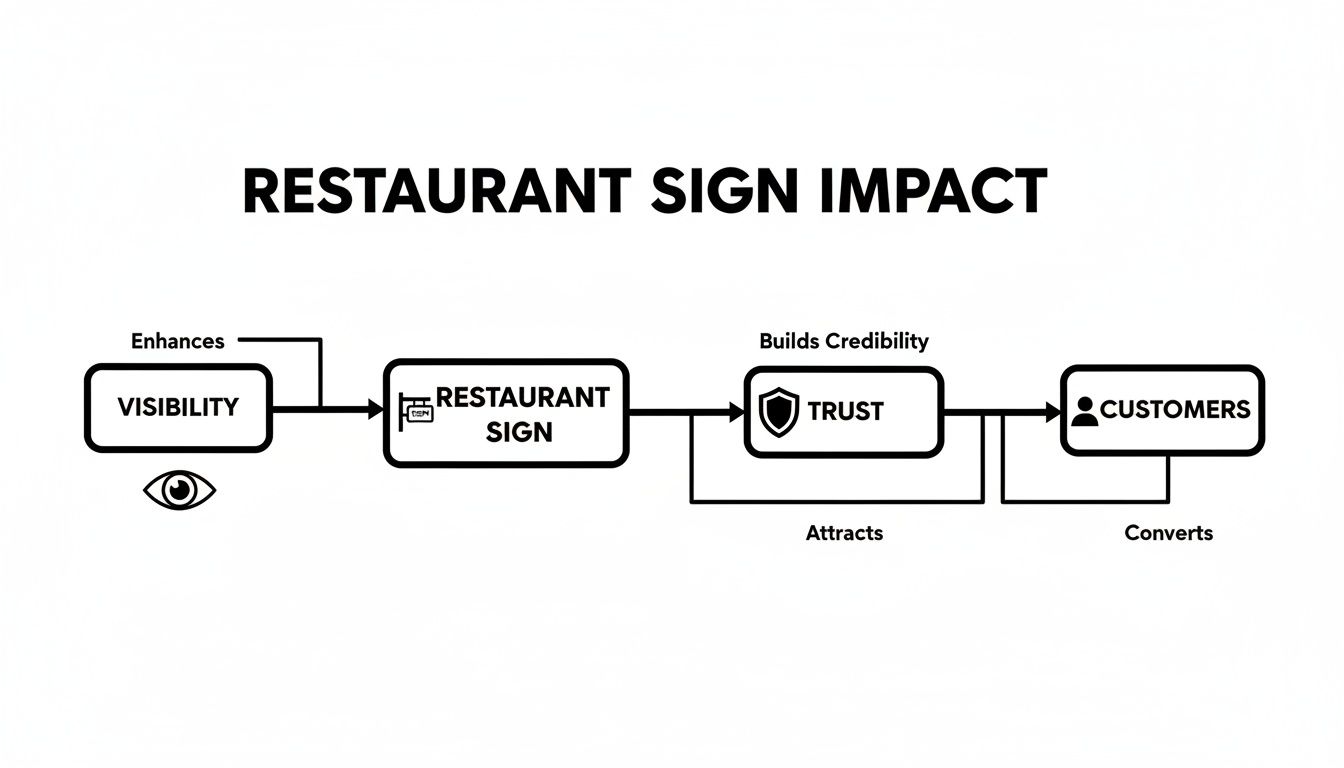
The path is clear: great visibility builds brand credibility, which directly pulls more customers through your door.
Main Attraction Signs for Your Building
These are the headline acts—the large-scale signs attached directly to your building. Their job is to grab attention from a distance and make it incredibly easy for both drivers and pedestrians to find you.
- Channel Letters: Think of these as the bold, 3D stars of the sign world. Each letter is built individually, often with internal lighting, creating a high-end, professional look that pops day and night. For example, a bustling fast-casual spot on a busy street needs illuminated channel letters to stand out from the crowd.
- Lightbox Signs: Also called cabinet signs, these are enclosed boxes with a glowing translucent face. They are a practical and cost-effective way to display your logo and name, offering fantastic visibility for any restaurant open after dark. For instance, a 24-hour diner can use a large lightbox to signal it's always open for business.
Your main building sign is your first handshake with every potential customer driving by. In fact, research shows that up to 76% of consumers say they’ve walked into a business they had never visited before based on its sign alone.
That number really drives home how a well-designed, prominent sign can generate brand-new business just by being seen.
Signs for Pedestrian and Close-Range Appeal
While a big building sign does the heavy lifting from afar, other signs are meant to engage people who are already nearby. These work on a more personal level, inviting pedestrians to stop, look, and step inside.
A blade sign is a classic example. It’s a sign that sticks out perpendicularly from your building, making it impossible to miss for people walking down the sidewalk. As a practical example, a small bistro tucked away on a side street can use a blade sign as a friendly "Hey, we're over here!" to anyone passing by.
An awning sign is another great option that blends branding with function. It gives your entrance some shelter while also displaying your restaurant's name. Picture a classic Italian trattoria with a striped awning and its name elegantly printed on the flap—it creates a charming, old-world vibe that's both inviting and useful.
For a deeper dive into these and other options, you can explore our guide on the many types of outdoor signs for business to spark even more ideas.
Freestanding Signs for Property Entrances
For restaurants set back from the road or located in a shopping center, a freestanding sign isn't just nice to have—it's essential. It acts as a formal welcome mat and a critical landmark at the edge of your property.
Two main types get this job done:
- Monument Signs: These are low-profile, solid-looking structures often made from materials like brick or stone to match the building's architecture. For instance, an upscale steakhouse would use an elegant monument sign with subtle backlighting at its driveway to signal quality, permanence, and class.
- Pylon Signs: These are the tall, towering signs you see along highways or in large retail centers. For a restaurant trying to pull in travelers from a major road, a tall pylon sign is an absolute must-have, rising above the visual clutter to announce you're open for business.
By understanding this visual menu, you can start to mix and match the right outdoor restaurant signs. You'll create a complete system that captures attention from far away, engages people up close, and guides everyone right to your front door.
Illuminated Versus Non-Illuminated Signage
Choosing whether to light your sign is one of the most fundamental decisions you’ll make for your restaurant. A sharp, well-designed sign looks great during the day, but what happens after sunset? It essentially vanishes, taking your visibility with it. This choice isn't just about aesthetics; it's about whether you want to attract customers during the most profitable dining hours.
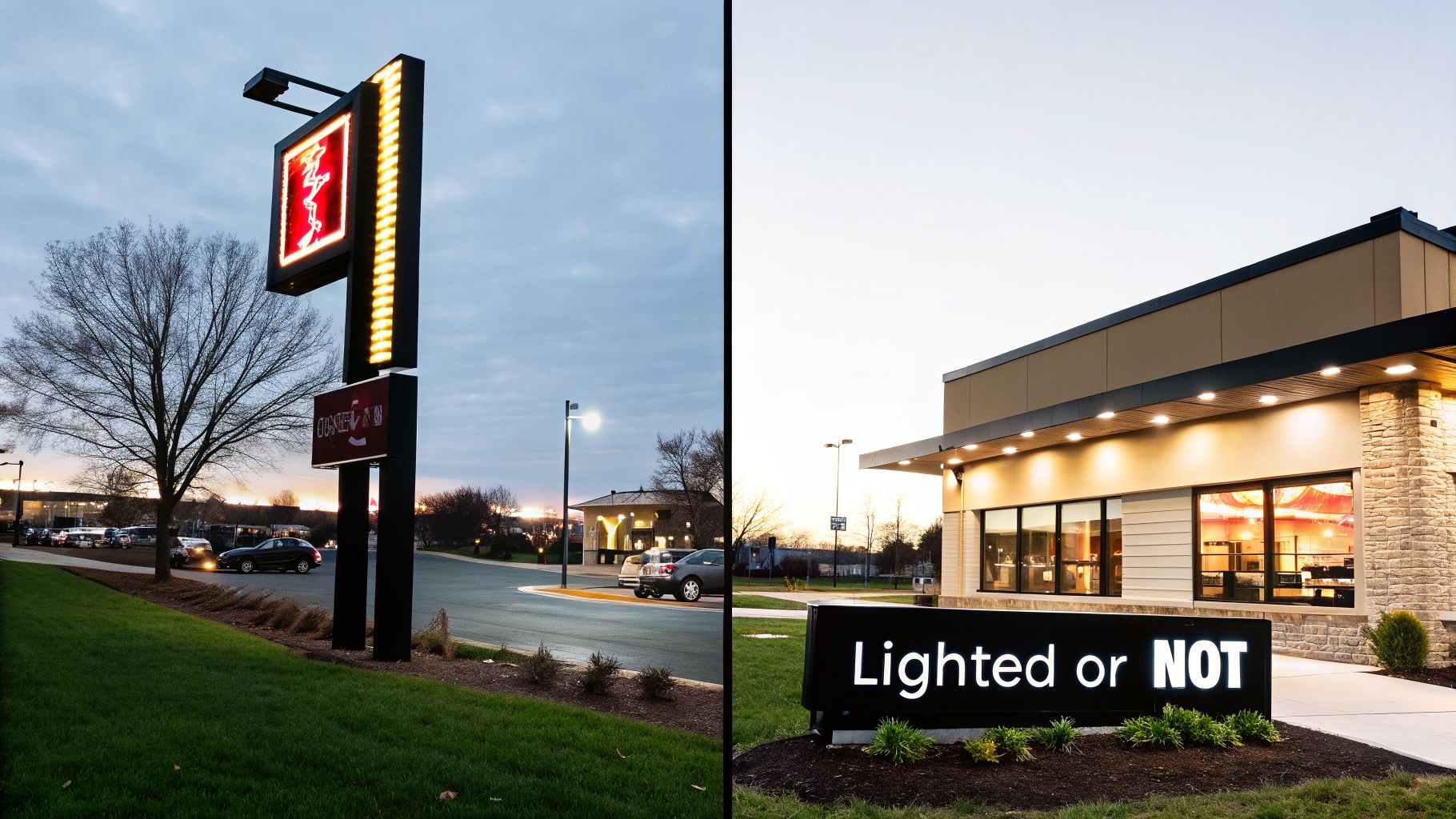
An illuminated sign acts like a beacon for the evening crowd. It’s a powerful, unmistakable signal that you’re open and ready to serve, catching the eye of anyone looking for dinner, a late-night snack, or drinks. It pulls your business out of the darkness and puts it front and center.
The Power of 24/7 Visibility
Think of it this way: a non-illuminated sign works part-time, but a lit one works around the clock. Even when your doors are closed, an illuminated sign keeps building brand awareness, making a lasting impression on everyone who drives by. Your restaurant stays top-of-mind, day and night.
This is absolutely vital in competitive areas. If your street is lined with other businesses, an unlit sign will just blend into the nighttime scenery. Meanwhile, your illuminated competitors will pop. You aren’t just selling food; you’re selling visibility, and after dark, light is the key ingredient.
For a restaurant, visibility equals profitability. An illuminated sign is your best tool for capturing the lucrative dinner and late-night crowd, turning your business into an inviting landmark when potential customers are actively seeking dining options.
This one feature can fundamentally change how customers see your restaurant's availability and appeal.
LEDs: The Modern Standard for Restaurant Signs
When you do decide to illuminate, LED (Light Emitting Diode) technology is the undisputed champion for modern restaurant signs. The days of fragile, buzzing neon tubes and power-hungry fluorescent bulbs are long gone. LEDs are simply superior in every way that matters.
Here’s why LEDs are the go-to choice:
- Energy Efficiency: LEDs use up to 80% less energy than older lighting like neon or fluorescents. That translates directly to lower monthly electric bills, helping the sign pay for itself over time.
- Longevity and Durability: Quality LEDs have an incredible lifespan, often rated for 50,000 to 100,000 hours of operation. They're also far more resistant to bad weather and vibrations, which means fewer maintenance headaches and repair calls.
- Creative Flexibility: From crisp, uniform light in channel letters to dynamic, color-changing effects, LEDs give you unmatched design freedom. You can hit your exact brand colors and create eye-catching looks that older tech could never achieve.
The industry has clearly made its choice. The signage lighting market is projected to jump from USD 30,125 million in 2024 to a massive USD 55,553 million by 2032. This explosive growth shows just how much businesses are embracing the superior performance and ROI of LED technology.
Is an Illuminated Sign a Good Investment?
An illuminated sign does have a higher upfront cost than a non-illuminated one, but it’s a mistake to see it as just an expense. It's a strategic investment in your restaurant's profitability. The return on that investment (ROI) comes directly from the extra customers you attract during the evening and night—often your busiest and most profitable hours.
Put simply: if a new lit sign brings in just a few extra tables each night, it can pay for itself surprisingly fast and start generating pure profit. For any restaurant that serves dinner or stays open past dusk, an illuminated sign isn't a luxury—it's a competitive necessity. For an in-depth look, learn more about the benefits of electric signs for business in our detailed guide.
Choosing Materials Built to Last
Think of your outdoor sign as a permanent handshake—it’s out there 24/7, making a first impression on every potential customer. It has to endure relentless sun, rain, wind, and whatever else the weather throws at it. Anyone can pick a material that looks great on day one; the real trick is choosing one that looks just as impressive on day one thousand.
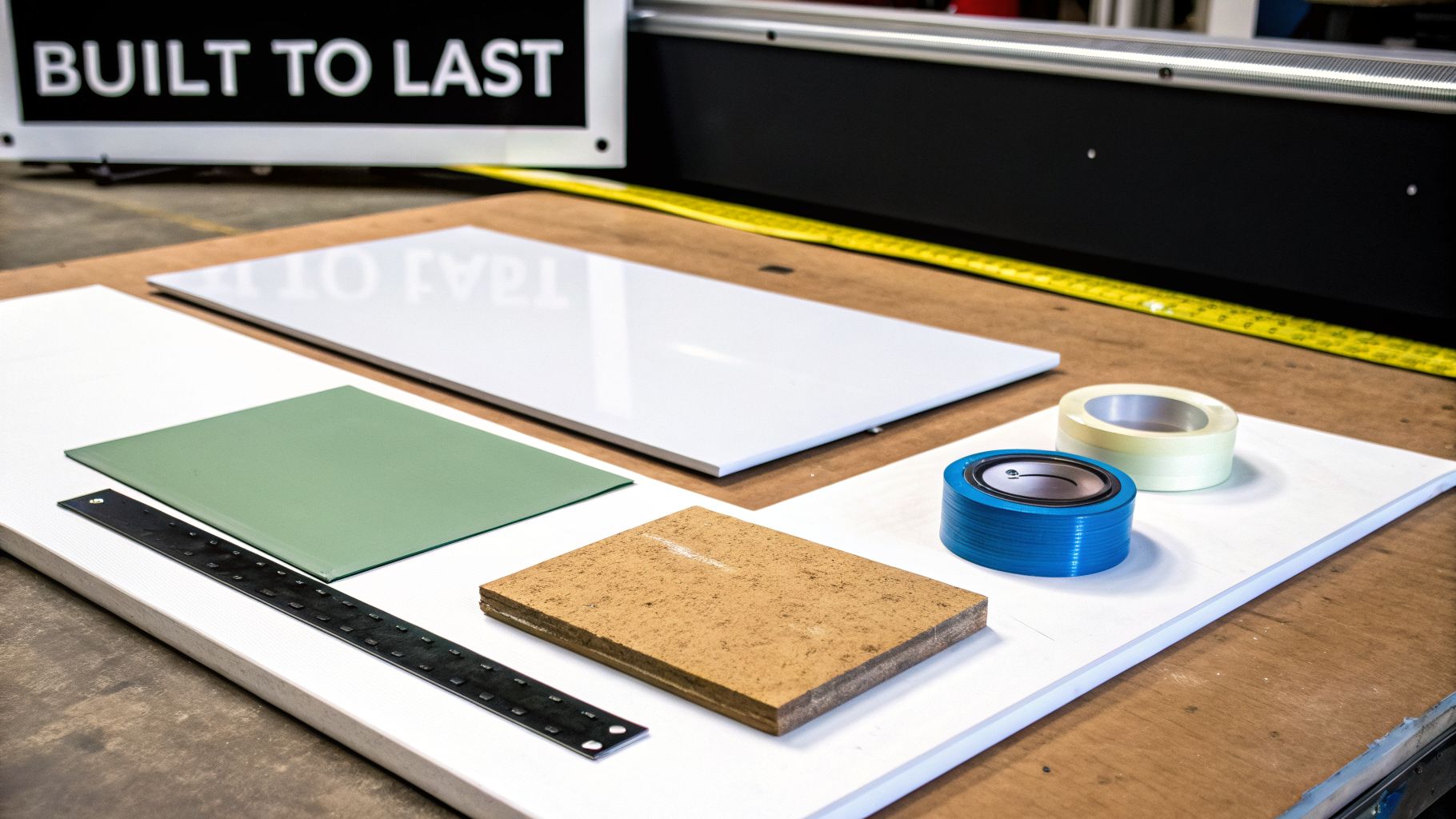
The materials you choose are a direct reflection of your brand's quality. Skimping here might save a few dollars upfront, but it almost always leads to costly repairs, faded colors, and a worn-out look that tells customers you don't care about the details.
Common Materials for Durable Signs
Every material strikes a different balance between look, longevity, and budget. The right one for you really comes down to your local climate, your brand’s vibe, and the type of sign you're building.
Aluminum: This is the undisputed workhorse of the sign industry, and for good reason. It’s strong, lightweight, and most importantly, it will not rust. If your restaurant is anywhere near the coast or in a particularly rainy area, aluminum isn't just a good choice—it’s essential.
Acrylic (Plexiglass): Known for its clean, modern look, acrylic is the go-to for the faces of illuminated signs like channel letters and lightboxes. It’s brilliant at diffusing light for a smooth, even glow and holds onto its color without fading, even in the sunniest climates.
High-Density Urethane (HDU): If you want the classic, carved look of wood without the maintenance nightmare, HDU is your answer. It’s a rigid, completely waterproof foam that won’t warp, crack, or rot. This makes it perfect for creating those beautiful, dimensional signs that communicate timeless quality.
Choosing a material isn't just a technical detail—it's a brand decision. A sign with peeling paint or rust sends a message that you cut corners, which customers may assume applies to your food and service as well.
This perception can turn people away before they even get to the door. Quality materials make sure your first impression is always the right one.
What to Look For in Quality Fabrication
Even the best materials can fail if they aren’t put together correctly. When you’re looking at a proposal or the finished product, it’s the small details in craftsmanship that tell you everything you need to know about its quality.
Key Quality Indicators:
- Clean Welds and Seams: On any aluminum sign, check that the welds are smooth and properly finished. Sloppy, bulky welds are a structural weak point and a dead giveaway of rushed, low-quality work.
- Durable Finishes: The paint is your sign's armor against the elements. You should be asking about automotive-grade paints and clear coats designed specifically to fight off UV fading and chipping.
- Proper Sealing: For any sign with lights, make sure every seam and access point is perfectly sealed. This is what keeps moisture and bugs from getting inside and wrecking the electrical components, which leads to flickering or dead signs.
Ultimately, investing in the right materials and expert fabrication means you get a sign you can set and forget. For a complete breakdown, you can learn more about how to pick the best material for outdoor signs in our helpful guide. A little foresight now saves you from major headaches and protects your brand’s reputation for years to come.
Navigating Permits and Legal Requirements
You’ve finalized the perfect sign design, but the job isn’t done just yet. The next step—navigating local laws and permits—is where many restaurant owners get tripped up. This isn't just bureaucratic red tape; these rules are in place for public safety, to maintain your town's aesthetic, and to ensure a fair playing field for all businesses.
Getting this part wrong can be a painful and expensive mistake. Think fines, frustrating delays, or even being ordered to tear down your brand-new sign. Handling the legal side with a clear plan is just as critical as picking the right materials to protect your investment.
Why You Need a Sign Permit
A sign permit is the official green light from your city or county to install your sign. Think of it like a building permit, but for your restaurant's most visible marketing asset. Municipalities use this process to ensure every new sign is structurally sound and fits within the community's standards.
During the permitting process, officials will double-check that your sign’s proposed size, placement, and lighting all fall within local zoning laws. This is what stops a business from putting up a sign so huge it blocks a traffic light or so bright it disturbs the neighborhood.
Securing a permit isn't just another box to check—it's a critical checkpoint that validates your investment is legal and safe. A sign installed without one is a major liability, and fixing that mistake is always more stressful and costly than getting it right from the start.
Common Zoning Code Restrictions
Zoning codes are the nitty-gritty rules that dictate exactly what you can (and can't) do with your restaurant's signs. They can vary a lot from one town to the next, but they almost always focus on the same core elements:
- Size and Height: Most ordinances specify a maximum square footage and height for your sign. This is often calculated based on your building's street frontage or the speed limit on the road out front.
- Placement (Setbacks): Codes will tell you exactly how far a sign must be set back from property lines, sidewalks, and other buildings. This ensures clear sightlines for drivers and pedestrians.
- Illumination: Many cities have strict rules on brightness levels, flashing animations, and even what hours your illuminated sign can be on, especially if you're near a residential area.
- Type and Quantity: Some districts might limit you to one primary sign per storefront or prohibit certain types altogether, like a tall pylon sign in a historic downtown.
Getting familiar with your local rules is a non-negotiable first step. While this article on food truck permit requirements is for mobile businesses, it offers a great look into how to navigate these legal waters. The best strategy is to work with a sign partner who deals with these codes every day. For a deeper dive, check out our guide on understanding sign permit requirements before you begin.
ADA Compliance for Accessible Signage
Beyond local codes, your signage must also comply with the federal Americans with Disabilities Act (ADA). While this might not apply to your main outdoor brand sign, it's absolutely essential for any signs that identify permanent spaces or direct customers—think entrances, exits, and restrooms.
Key ADA requirements include:
- Tactile Text and Braille: Signs that mark permanent rooms must have raised (tactile) letters and the corresponding braille translation underneath.
- High Contrast: To be easily readable, the characters need a non-glare finish and must contrast sharply with their background.
- Mounting Height and Location: These signs have to be installed within a specific height range and on the wall right next to the door, where they can be easily found and read by touch.
Making sure your wayfinding signs are ADA compliant isn't just about following the law; it's about making sure every single guest feels welcome and can navigate your space with dignity.
Your Step-By-Step Signage Project Plan
Taking a sign from a sketch on a napkin to a shining beacon on your restaurant can feel like a mountain to climb. But it doesn't have to be. With the right roadmap, the entire process becomes a series of simple, logical steps you can manage with confidence.
And you're not alone in making this investment. Businesses are spending more than ever on quality signs, with the global market expected to jump from USD 56.0 billion in 2026 to over USD 103.4 billion by 2036. That’s a steady 6.3% growth rate, proving just how critical this asset is. You can dig deeper into these signage market projections to see where the industry is heading.
Phase 1: Define Your Vision and Budget
Before a single sketch is drawn, you need to nail down your goals. What job does this sign need to do? Is it a landmark to catch drivers on a busy highway? Is it a welcoming sign to pull in sidewalk foot traffic? Or is it meant to whisper "luxury" to anyone who glances at your storefront?
The answers will shape everything that comes next. At the same time, you need a realistic budget. A great outdoor sign isn't an expense—it's a long-term capital investment in your brand's visibility. Make sure your budget covers the whole journey: design, materials, fabrication, permits, and professional installation.
Phase 2: Site Survey and Partner Selection
With your goals in hand, it’s time to bring in an expert. This is where you find a sign partner who can translate your vision into reality. The first, most critical step they’ll take is a site survey and code check.
Your sign partner should get their boots on the ground to:
- Take exact measurements of your building or property.
- Find the best electrical access points for any illuminated elements.
- Dig into the local zoning codes and permit rules for your specific address.
This is where you spot problems before they cost you time and money. It ensures your dream sign is actually buildable, legal, and a perfect fit for its environment.
A professional site survey and code check is your project’s insurance policy. It prevents you from investing time and money into a design that can't legally be built or installed, saving you from major headaches and wasted resources.
Phase 3: Design, Fabrication, and Installation
Now for the fun part. Armed with a solid plan, you can dive into the creative process. Your partner's designers will work with you to craft a sign that captures your restaurant's soul while respecting all the technical and legal rules discovered during the survey. Always, always ask for a final proof showing the exact colors, materials, and dimensions before you give the green light.
Once you approve that proof, your sign heads into production. When it's ready, the sign company takes over the logistics of installation. This is where having a dedicated project manager makes all the difference, turning a complex process into a seamless one. For more on how that works, see our guide on professional signage project management. They’ll coordinate schedules, bring in any needed equipment like bucket trucks, and make sure your new sign goes up safely and securely.
To help you visualize the entire workflow, here’s a breakdown of the key stages and the responsibilities at each step.
Signage Project Timeline and Key Decisions
| Project Phase | Your Key Actions | Sign Partner Responsibility |
|---|---|---|
| 1. Strategy & Budget | Define the sign's primary goal. Set a realistic all-in budget. | Provide initial cost estimates and feasibility feedback. |
| 2. Partner & Survey | Research and select a sign company. Provide site access. | Conduct a detailed site survey and local code check. |
| 3. Design & Approval | Collaborate on design concepts. Review and approve the final proof. | Create design mockups, recommend materials, and provide final proofs. |
| 4. Permitting | Sign off on permit applications. | Prepare and submit all necessary permit paperwork to the city. |
| 5. Fabrication | Wait patiently while your vision comes to life! | Manufacture the sign according to the approved specifications. |
| 6. Installation | Ensure the installation area is clear and accessible. | Schedule and complete the physical installation safely and correctly. |
| 7. Final Walk-Through | Inspect the final installed sign and confirm it meets your expectations. | Clean the site, test all components (like lighting), and hand over the keys. |
Following this structured process removes the guesswork and ensures you have a clear understanding of your role and your partner's role at every turn. It’s the surest path to getting a sign you’ll be proud of for years to come.
Your Top Questions About Restaurant Signs, Answered
Jumping into the world of restaurant signage can feel overwhelming, but it doesn't have to be. Let's clear up some of the most common questions restaurant owners ask so you can move forward with confidence.
How Much Does a Good Outdoor Restaurant Sign Cost?
This is always the first question, and the honest answer is: it depends. The range is huge. A simple, non-illuminated set of dimensional letters for a local cafe might run a few thousand dollars, while a towering, custom-lit pylon sign on a major highway is a serious investment.
The right way to think about it is as a marketing investment, not an expense. Your sign is your most loyal employee—it works 24/7, grabbing the attention of new customers and reminding regulars why they love you. It pays for itself over and over again.
What Is the Most Effective Type of Sign for a Restaurant?
For most restaurants, especially if you have a dinner service, an illuminated sign like channel letters or a lightbox is a no-brainer. If people can't see you after dark, you're invisible to the entire evening crowd.
But the "best" sign is rarely just one sign. A smart strategy often involves a combination. Imagine pairing bold channel letters on your main facade to catch drivers' eyes with a unique blade sign hanging over the sidewalk to draw in people on foot. That's how you capture attention from every angle.
How Long Will My Outdoor Sign Last?
The lifespan of your sign comes down to two things: the materials used and the quality of the craftsmanship. A well-built sign made from durable materials like aluminum and high-grade acrylics will easily last 10 years or more with basic care.
The lights inside have their own lifespan. The good news is modern LEDs are incredibly reliable, typically rated for 50,000 to 100,000 hours of use. That translates to years of bright, consistent illumination before you'd ever notice them dimming.
How Long Does the Permitting Process Take?
Here's where things can get tricky. Getting a sign permit can take anywhere from a few weeks to several months. The timeline is completely dependent on your local city or county—their specific rules, how busy they are, and how efficient their process is.
Because the permitting timeline is the biggest wild card in any sign project, you have to start the process as early as possible. Partnering with a sign company that knows the local codes inside and out is the single best way to avoid frustrating delays and get your paperwork approved the first time.
Getting ahead of the paperwork is the key to keeping your grand opening or rebrand on schedule.
Ready to create a first impression that turns heads and fills tables? The team at On Display Signs, Inc. manages every step of the process, from design and permitting to fabrication and installation. We help restaurants nationwide build signs that become local landmarks. Let us handle the details so you can get back to the kitchen. Learn more about our restaurant sign solutions.