
If you run service vans, delivery trucks, or sales vehicles in Nashville, you’ve likely had the same thought at a stoplight on I-40 or in a crowded commercial lot. A competitor’s branded vehicle gets noticed. Yours blends into traffic.
That’s usually the moment business owners start looking seriously at vehicle wraps Nashville TN companies offer. Not because wraps look flashy, but because an unbranded vehicle is unused marketing space you already own, insure, fuel, and send across town every day.
A professional wrap turns that asset into working advertising. Done right, it also protects paint, standardizes branding across multiple vehicles, and gives customers a cleaner first impression when your team shows up on-site.
Transform Your Fleet Into Mobile Billboards
A vehicle wrap is a large-format vinyl graphic system applied to a vehicle’s exterior by trained installers. It’s built to follow body lines, curves, recesses, and panel changes so the finished vehicle looks intentional, not patched together.
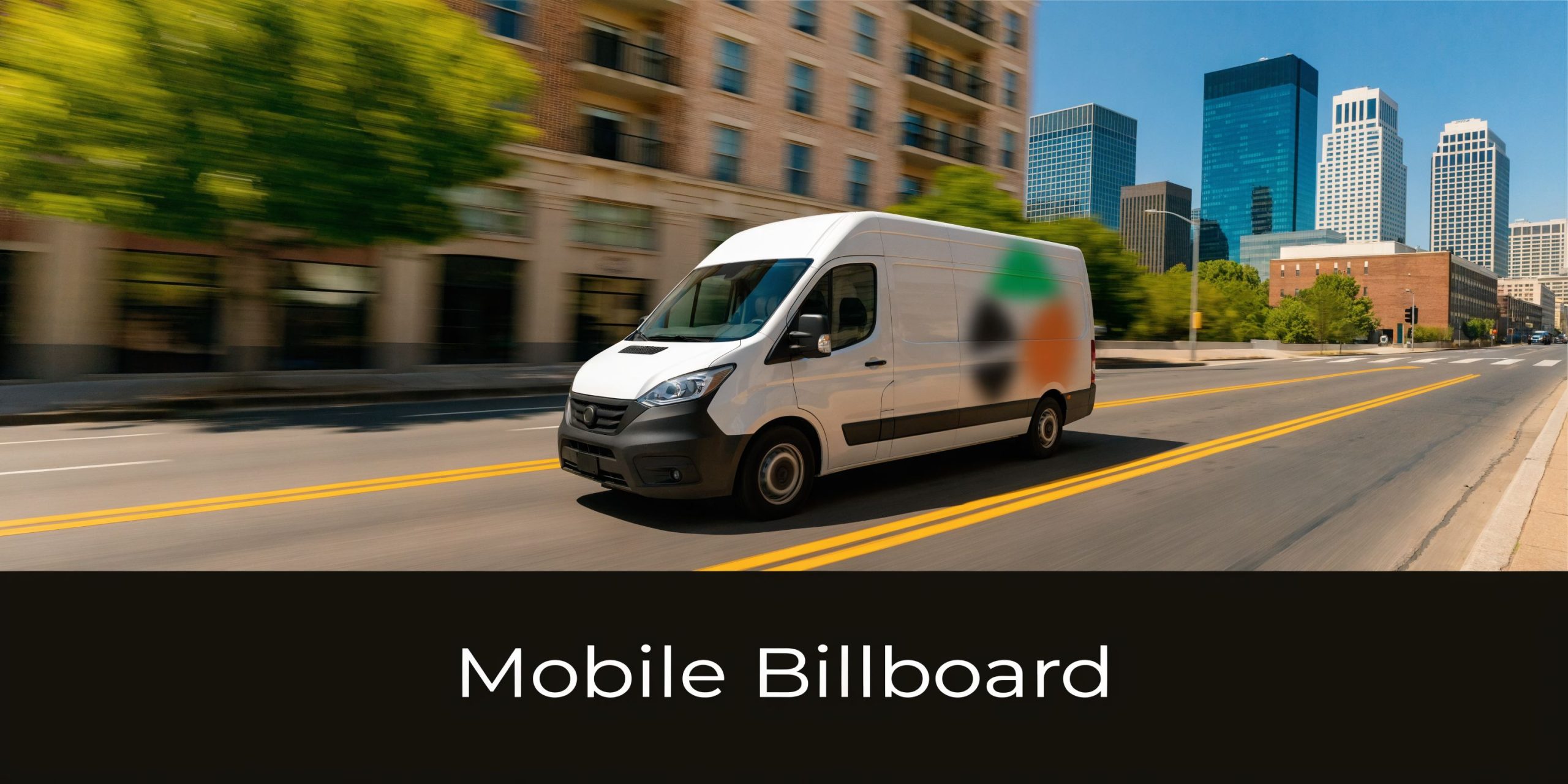
For Nashville businesses, the smart question isn’t “Should I decorate the vehicle?” It’s “What coverage level fits the way this vehicle is used?”
Full wraps for maximum presence
A full wrap covers most or all usable exterior surfaces with printed vinyl. This is the right choice when brand visibility matters every day, or when the vehicle itself needs to function as a traveling billboard.
Full wraps work especially well for:
- Service fleets: HVAC, plumbing, electrical, roofing, and restoration vehicles that spend all day in neighborhoods and commercial corridors
- Delivery operations: Vans or trucks making repeat stops where recognition builds trust
- Premium brands: Businesses that need a polished appearance at job sites, events, and customer driveways
In Nashville, professional vehicle wraps typically range from $2,000 to $7,000 depending on vehicle size, material, and design complexity, and they can operate as mobile billboards 24 hours a day, 7 days a week, for up to 5 years or longer with proper maintenance according to this Nashville vehicle wrap overview.
Partial wraps for tighter budgets
A partial wrap uses the vehicle’s paint as part of the design. That can be a smart move when you want strong street visibility without paying for full coverage.
A good partial wrap doesn’t look like a compromise. It looks planned. Strong use of contrast, panel placement, and readable branding can make a partial wrap feel larger than it is.
Practical rule: If your vehicle already has a clean paint color that fits your brand, partial coverage often gives you the best cost-to-visibility balance.
This matters for multi-vehicle fleets. A company may start with partial wraps on service vans, then move to full wraps for route trucks, trailers, or showcase units as budget opens up. If your operation includes enclosed trailers, the same branding logic often extends to trailer signage solutions so the full fleet looks coordinated instead of pieced together.
What doesn’t work
Several things consistently underperform:
- Tiny logos on doors: They disappear at traffic speed.
- Overloaded layouts: If drivers can’t understand who you are in a glance, the design failed.
- Inconsistent fleet graphics: Different fonts, color shifts, and mismatched layouts make a growing company look disorganized.
A wrap should identify the business quickly, clearly, and from multiple angles. That’s the standard.
The Unbeatable ROI of Vehicle Wraps in the Nashville Market
A Nashville service van can leave a warehouse in Antioch at 7 a.m., stop at a property manager’s site in Green Hills, cross town for a retail repair in The Gulch, and finish the day at a medical office near Brentwood. That route does more than move a crew. It puts a brand in front of drivers, tenants, facility teams, and purchasing staff all day.
That is why vehicle wraps tend to produce stronger long-term value than rented ad space for companies that already have trucks, vans, or trailers on the road.
What the numbers support
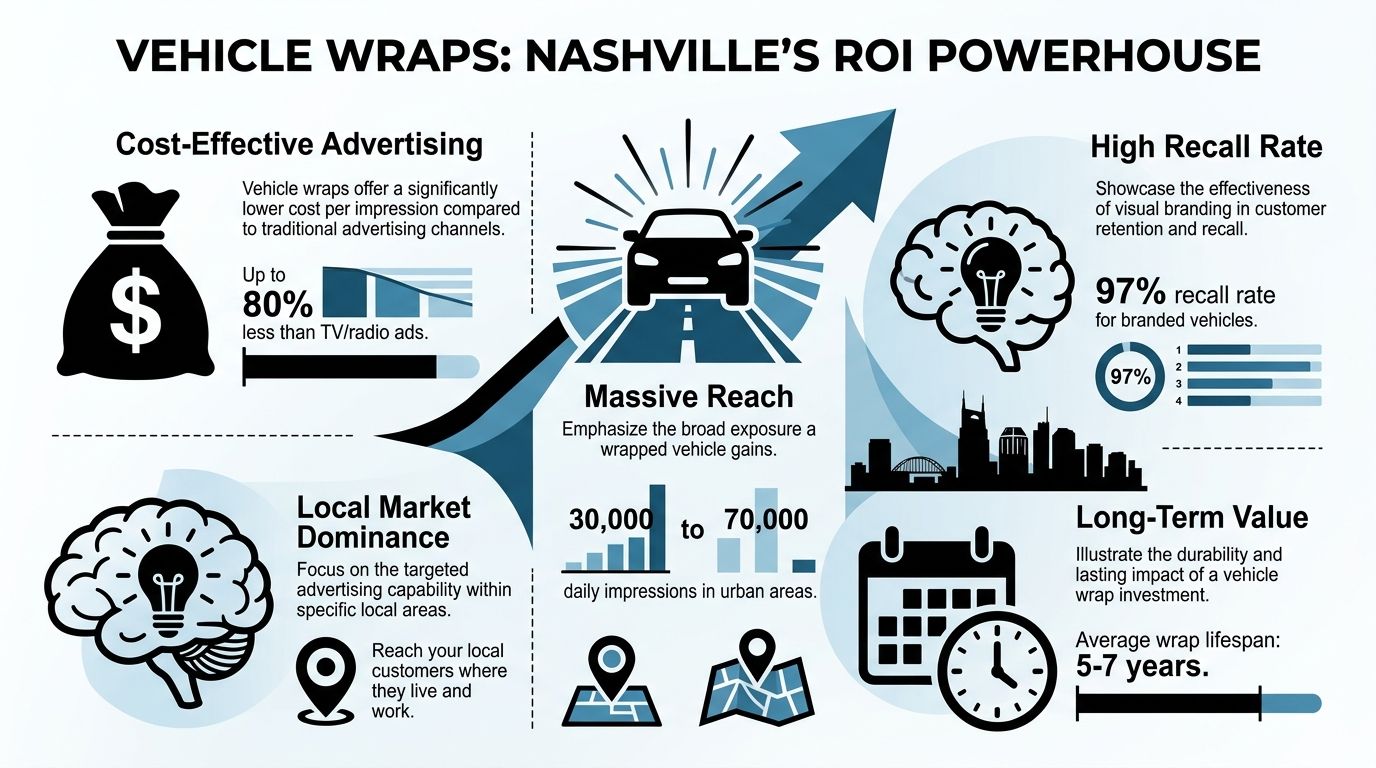
According to Wrapmate’s vehicle wrap results summary, a single wrapped vehicle can generate 30,000 to 70,000 daily impressions, and 66% of consumers take action after seeing a wrapped vehicle.
Those figures matter more in Nashville than many owners first expect. Service areas here are rarely confined to one corridor. Vehicles move between downtown, suburban office parks, industrial areas, and fast-growing residential zones in the same week, so the same wrap keeps showing up in different buying environments without a second media purchase.
For fleet operators, the return is not just about visibility. It is about using miles you are already paying for.
Why wraps often beat static local media
A wrap travels with your operation. That changes the math.
A billboard sits in one location. A wrapped fleet shows up at customer sites, on interstates, in neighborhood business districts, and in parking lots where decision-makers have time to read it. For plumbers, HVAC contractors, electricians, medical delivery groups, restoration firms, and multi-site service companies, that means ad exposure follows the actual revenue footprint.
Three business advantages stand out:
- Media spend becomes an asset purchase. You pay for production and installation, then use the graphic for years instead of renewing monthly ad placements.
- Routes create repeated local exposure. The same neighborhoods see the same brand again and again, which improves recall.
- Operations and marketing stay aligned. The vehicles serving accounts are the same vehicles building familiarity in the market.
A plain fleet vehicle is overhead. A branded one can help offset that overhead by producing awareness during normal service activity and while parked.
ROI gets stronger when rollout logistics are handled well
This is the part many wrap articles skip.
For a single owner-operator van, ROI is mostly a design and production question. For a fleet spread across Nashville and surrounding markets, ROI also depends on scheduling, downtime control, site access, driver consistency, and local code issues. A strong-looking wrap loses value fast if units are off the road too long, branch teams use mismatched graphics, or a location adds exterior branding that conflicts with landlord rules or municipal sign requirements.
That matters for multi-site businesses. The vehicle graphics may be one piece of a broader branding system that includes storefront signs, window graphics, trailers, and temporary jobsite signage. If those pieces are not coordinated, the company looks bigger on paper than it does in the field.
National providers and experienced regional shops earn their keep here by standardizing artwork, staging installs in waves, and checking compliance before rollout, especially when a fleet program ties into multiple properties and jurisdictions around the Nashville area.
Consumer response depends on clarity
Owners care about leads, not decoration. Good fleet wraps make the company name, service category, and contact path readable in seconds.
Use a simple field test:
| Check | If the answer is no | Result |
|---|---|---|
| Can someone identify the company fast? | Branding is too weak | Lost recall |
| Can they tell what you do? | Message is vague | Lower lead quality |
| Can they find you easily? | Contact path is unclear | Fewer inquiries |
That discipline also helps your digital channels perform better. A vehicle wrap often creates the first brand touch, then search behavior follows. If your company is tightening that connection, this guide to local business web marketing is a useful companion.
If you are comparing wraps against other visibility investments, review the broader cost of signage for business before setting the budget. That keeps the wrap program tied to your full branding and location strategy instead of treating it like a stand-alone expense.
Choosing Wrap Materials for Durability and Performance
Material choice decides whether a wrap still looks sharp years from now or starts failing at edges, recesses, and high-touch areas much sooner.
Business owners don’t need to memorize film chemistry, but they do need to know one practical distinction. Cast vinyl is the premium choice for vehicles. Lower-grade film may look acceptable on day one, then telegraph its limits once heat, washing, road grime, and panel tension do their work.
Cast vinyl versus cheaper alternatives
The easiest analogy is this. Cast vinyl is closer to a molded material. Lower-end film behaves more like something rolled flat and asked to stretch beyond what it wants to do.
That difference shows up fast on mirrors, bumpers, compound curves, channels, and riveted surfaces.
According to That’s a Wrap Nashville, premium cast vinyl films such as those from 3M are engineered to last 5 to 7 years and can elongate up to 130% during installation. That flexibility helps installers achieve a paint-like finish on complex contours instead of fighting tension and lift points.
Why laminate matters
The print film isn’t the whole system. A quality overlaminate protects the graphic from UV exposure, abrasion, and routine cleaning.
Without that top layer, wraps tend to age poorly. Colors dull faster. Surface scratches show sooner. The whole investment looks tired before the vehicle itself does.
A proper wrap system should be chosen based on:
- Vehicle shape: Flat box truck panels and curved cargo vans don’t stress film the same way
- Daily use: Route vehicles, contractor trucks, and church buses all face different wear patterns
- Parking conditions: Vehicles stored outdoors need stronger UV resistance than sheltered units
Material shortcut: If a shop can’t clearly explain what film and laminate they use, assume you’re comparing price without knowing the real product.
For owners who also care about preserving finish quality underneath, this overview of car paint protection products is worth reading because it helps separate cosmetic surface protection from full graphic wrap systems.
What good material selection looks like in practice
A well-specified wrap should look smooth over time, resist premature shrinkage, and remove cleanly when the branding changes. It should also match the vehicle’s role.
A sales SUV that carries executives has different expectations than a warehouse shuttle van. So does a fleet that turns vehicles over on a shorter replacement cycle versus one that keeps units in service for years.
If you want the short version, start with premium cast film, a proven laminate, and an installer who understands production tools and material behavior. Shops that understand how graphics are cut, weeded, and prepared usually explain those decisions better. If you want a behind-the-scenes view of that production side, this primer on what a vinyl plotter does gives useful context.
The Professional Wrap Process From Design to Rollout
Good wrap projects don’t begin in the install bay. They begin with discipline. Most problems that show up on the vehicle started earlier with weak design, poor measurement, missing approvals, or rushed scheduling.
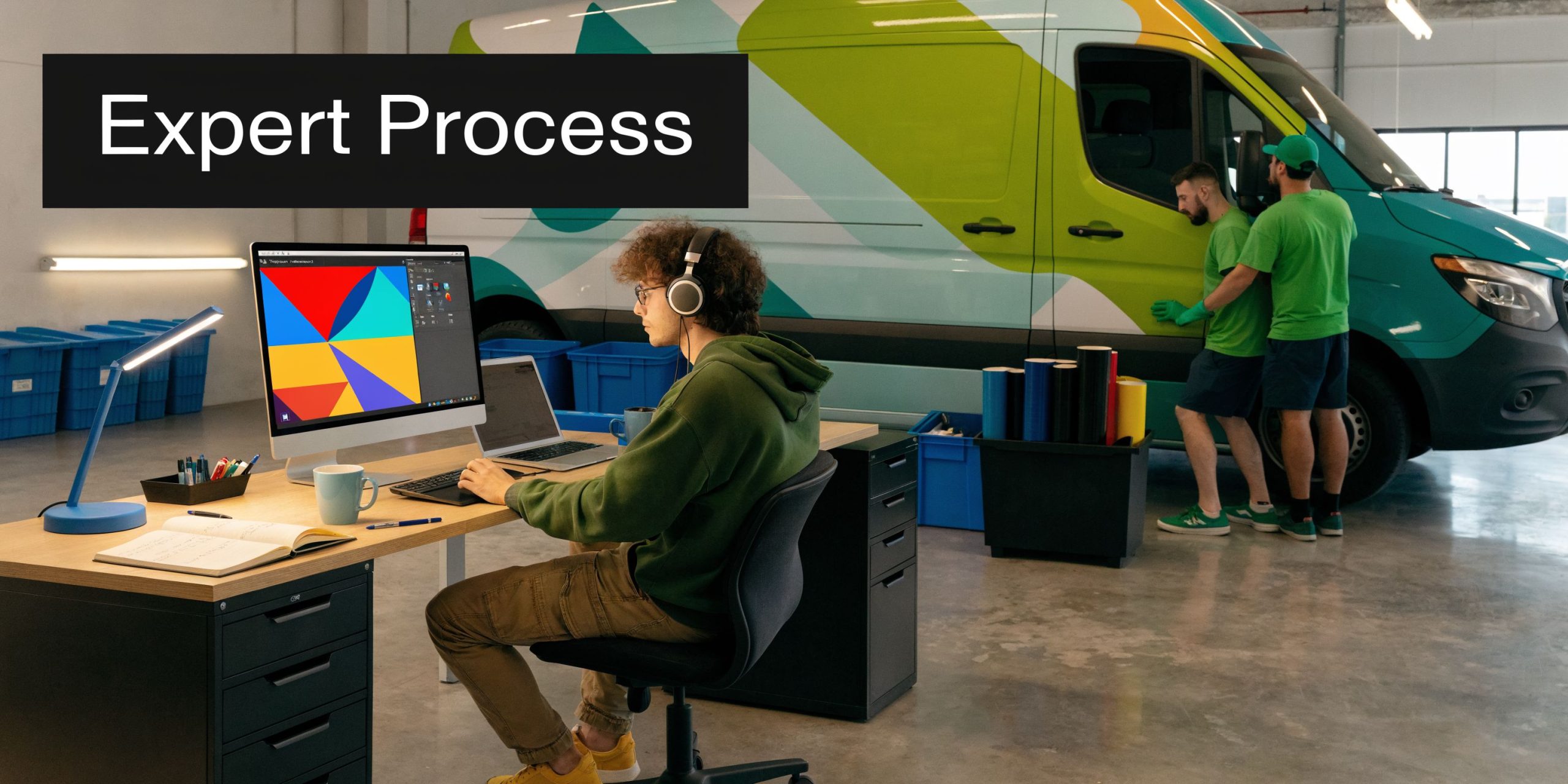
Discovery and design
A wrap design has to do more than look good on a screen. It has to survive panel breaks, handles, fuel doors, windows, and body contours.
That’s why the first conversations should cover things like:
- Where the vehicle travels
- Who needs to read it
- How quickly the message must register
- Whether branding has to scale across multiple vehicle types
A restaurant delivery car, a plumbing van, and a church shuttle need different design priorities even if all three want strong recognition.
Proofing before production
Once the concept is built, the client should review a scaled proof that shows how graphics land on each side of the vehicle. Experienced providers catch avoidable mistakes in these situations.
The usual problem areas are simple. Phone numbers cross seams. Logos disappear into window lines. Copy gets buried in door handles or wheel arches.
Clean proofs prevent expensive do-overs. If the shop wants approval without a detailed mockup, slow the job down.
Print, laminate, and prep
After approval, the design is printed on wrap vinyl and laminated. Then the installation team prepares the vehicle surface.
This step isn’t glamorous, but it matters. Dirt, wax residue, grease, and silicone contamination can compromise adhesion and shorten the life of the wrap.
A controlled process includes:
- Vehicle inspection for paint damage, rust, or problem areas
- Surface cleaning with wrap-safe prep methods
- Panel planning so seams fall in sensible locations
- Install timing that matches cure and handling requirements
Later in the workflow, it helps to see the application side in motion:
Installation and rollout realities
Installers apply the film carefully, heat and set the material, trim edges, and finish high-stress areas with close attention. For a single business vehicle, that may be straightforward. For a regional fleet, the process gets more operational.
Vehicles need to be pulled from service. Driver schedules may need to shift. Replacement units might be required for route continuity. If multiple branches are involved, color consistency and production sequencing become management issues, not just graphics issues.
The best wrap providers plan around downtime, not after it. That’s what separates a smooth rollout from a disruptive one.
How to Budget for Your Nashville Vehicle Wrap Project
Most pricing conversations go wrong because owners compare wrap quotes as if they’re buying the same product. They usually aren’t.
Vehicle type, coverage level, material choice, design complexity, and installation conditions all affect the final number. The cheapest quote can become the most expensive if the wrap fails early or the design underperforms.
What Nashville pricing typically looks like
In Nashville, a full vinyl wrap for a standard sedan averages $2,000 to $3,000, while larger SUVs or trucks can be $3,500 or more according to Metro Center Signworks. The same source notes that partial wraps can reduce costs by 40% to 60% while still retaining much of the advertising impact.
That gives owners a real decision point. Spend more for maximum coverage, or use partial coverage strategically across more vehicles.
Full vs. Partial Wrap Strategy Comparison
| Factor | Full Wrap | Partial Wrap |
|---|---|---|
| Visual impact | Strongest street presence | Strong if the layout uses paint color well |
| Coverage | Most usable exterior surfaces | Selected panels and sections |
| Budget level | Higher upfront investment | Lower upfront investment |
| Best fit | Flagship vehicles, route trucks, image-driven brands | Growing fleets, phased rollouts, budget-conscious campaigns |
| Design demand | Requires complete visual planning | Requires tighter design discipline to look intentional |
What changes the price
Some variables are obvious. Bigger vehicles cost more to wrap because there’s more surface area. Others catch owners by surprise.
Watch for these pricing drivers:
- Body complexity: Corrugations, rivets, deep channels, and difficult contours add labor
- Coverage choices: Full wraps require more material and more finishing work than selective coverage
- Design development: A fast adaptation of existing branding costs less than building vehicle graphics from scratch
- Fleet consistency: Multiple vehicle models often require separate layout adjustments
A box truck and a service van may carry the same logo, but they won’t use the same art file the same way. That production work has value.
Budgeting advice: Decide first which vehicles need maximum impact and which ones just need consistent branding. That usually leads to a smarter mixed-fleet strategy.
Budget as an operating decision
For many businesses, this doesn’t belong in the “nice to have” category. It belongs in the visibility budget alongside exterior signs, site graphics, and local digital marketing.
If you’re mapping spend across the year, this guide to a small business marketing budget is helpful because wraps work best when they’re planned as a long-life asset, not squeezed in as leftover spend.
One final practical point. Ask how downtime is handled. The wrap price matters, but the cost of having a service vehicle off the road matters too. Smart budgeting includes both.
How to Choose the Right Vehicle Wrap Partner
The wrong wrap partner can make a fleet job painful even if the graphics themselves look decent. That’s especially true for commercial clients with multiple vehicles, multiple locations, or internal approval layers.
The better question isn’t “Who can print this?” It’s “Who can manage this without creating avoidable problems?”

Questions worth asking before you sign
Start with installer quality and process control:
- Are installers certified on premium wrap films?
- What material brands and laminate systems are specified in writing?
- How are paint issues, body damage, or adhesion risks documented before install?
- What warranty applies to material and workmanship?
Then go deeper. Commercial wrap projects often separate strong providers from local-only shops based on these operational questions.
Ask these operational questions too:
- Can they handle a multi-vehicle rollout without brand drift between units?
- Do they manage scheduling so vehicles aren’t all out of service at once?
- Can they coordinate installs for out-of-town branches if the fleet expands?
- Who handles compliance questions before graphics go on the road?
Code compliance is where many jobs stall
For fleet clients, code and permitting aren’t side issues. They can affect timing, rework, and rollout costs.
According to this Nashville wrap market article, 68% of fleet operators in markets like Nashville face project delays due to unaddressed regulatory issues. That single figure explains why informed clients ask about compliance early.
A provider should be ready to discuss:
| Review area | Why it matters |
|---|---|
| Commercial graphics compliance | Reduces the risk of nonconforming fleet branding |
| Local code interpretation | Helps avoid rework after install |
| Multi-site coordination | Keeps branch locations from improvising their own solutions |
| Documentation and approvals | Gives facility, operations, and marketing teams one shared record |
If your fleet touches multiple municipalities, don’t assume one local install standard applies everywhere. That assumption causes delays.
What works for commercial buyers
The strongest partners think like project managers, not just installers. They ask for vehicle lists, branch addresses, usage schedules, branding files, decision-makers, and target deadlines early.
That matters for:
- Retail groups adding branded service or delivery vehicles
- Warehouses and distributors managing route equipment and support fleets
- Churches and schools that need clean branding and dependable scheduling
- Contractors who can’t afford random downtime during peak work periods
If your search starts with “who’s the best local sign company near me” make sure you’re evaluating project management capacity, not just local proximity. A nearby shop is convenient. A partner that can control compliance, scheduling, production consistency, and rollout execution is more valuable.
If your business needs a wrap program that goes beyond a single vehicle, On Display Signs, Inc. is built for that level of coordination. The team handles design consultation, fabrication, permitting, installation, and multi-site project management for businesses that need more than a basic print-and-apply job. If you’re planning vehicle wraps in Nashville or managing a fleet across multiple locations, reach out for a practical consultation that focuses on visibility, compliance, and rollout logistics.