A lot of buyers start the Arizona signage process the same way. They approve a storefront concept, send over a logo file, get a quick quote, and assume the hard part is over. Then problems show up. The sign face that looked fine in a mockup now needs material changes for brutal sun exposure. The city wants a permit package the client never planned for. The install date slips because the design that worked in one jurisdiction doesn't pass in another.
That gap between concept and field execution is where most sign projects in Arizona get expensive.
Arizona isn't a fringe signage market. The state's billboard and sign manufacturing industry employs 1,222 workers and is projected to grow at an average annual rate of 3.5% from 2021 to 2026, with Phoenix hosting more than 38 verified commercial signage contractors according to IBISWorld's Arizona industry profile. That sounds like plenty of choice. In practice, it means buyers still have to separate shops that can produce a sign from partners that can manage risk.
If you're sourcing from the outside, opening a location, rolling out multiple sites, or upgrading an older sign package, sign companies arizona should be evaluated like operational vendors. Design matters. Execution matters more.
Why Hiring Sign Companies in Arizona Is a Unique Challenge
A retail team secures a site in Phoenix, approves the sign package, and expects a routine install. Then distinct Arizona constraints show up. Landlord comments arrive late, the permit set needs revisions, the proposed materials are not a good fit for heat and UV exposure, and the installer discovers site conditions that were never documented in the quote.
That sequence is common here.
Arizona sign projects break down at the handoff points between design, permitting, fabrication, and field installation. A vendor can be excellent at one part of that chain and still create schedule and budget problems if they do not control the rest. For buyers opening on a fixed date, that distinction matters more than presentation quality or a fast first quote.
Arizona adds operational pressure early
The state creates a harsher operating environment for exterior signage than many buyers expect. Heat, sustained sun exposure, dust, monsoon weather, and large day to night temperature swings put pressure on finishes, lighting, adhesives, faces, cabinets, and attachment methods. A sign can look fine in a proof and still become a maintenance problem if the proposal was built around short-term cost instead of service life.
That is why procurement in Arizona should start with performance questions. Buyers comparing vendors should ask how the shop chooses substrates, coatings, illumination components, and fastening details for long exposure cycles. A useful baseline is understanding the best material for outdoor signs, then pressing each vendor on how those options hold up in Arizona conditions.
More vendors does not mean lower risk
As noted earlier, Arizona has plenty of sign capacity. That does not make selection easier. It creates a wider spread between shops that can manufacture a sign and partners that can manage a project from site review through final inspection.
I have seen the same pattern across multi-site programs. One company prices aggressively but pushes engineering and permit coordination back to the client. Another fabricates well but subcontracts installation with limited field oversight. A third understands local municipalities but struggles to keep national brand standards consistent across locations. Each model can work in the right situation. Each one can also create rework, missed opening dates, change orders, or warranty disputes if the scope is not defined upfront.
The real challenge is risk control
Arizona projects usually run into trouble for operational reasons, not creative ones. The sign concept is rarely the problem. Execution gaps are.
Common failure points include:
- Material mismatch: The specified face, finish, lighting, or mounting approach does not hold up well at the site.
- Permit delays: Drawings, engineering, landlord approvals, or code details are incomplete, so fabrication stalls.
- Scope confusion: Electrical work, crane scheduling, patch and paint, permits, and inspections are assigned late or to the wrong party.
- Fragmented accountability: The designer, fabricator, permit expediter, and installer all own part of the job, but no one owns the outcome.
Out-of-state buyers feel this first. They often assume they can source each piece separately and save money. In practice, every extra handoff creates another place for dimensions to drift, responsibilities to blur, and schedules to slip.
The Arizona challenge is not finding a company that can make a sign. It is finding one that can control field risk before it turns into delay, rework, and added cost.
Choosing Sign Materials Built for the Arizona Climate
Material selection decides whether your sign keeps its appearance or becomes a replacement project sooner than expected. In Arizona, that decision isn't cosmetic. It's operational.
A sign face that fades, warps, or starts showing edge failure hurts more than curb appeal. It affects opening schedules, rework budgets, and brand confidence across every site that uses the same package.
What to prioritize first
Start with performance, not with the rendering. Buyers should ask how each material behaves under sustained UV exposure, high surface temperatures, and storm conditions. If the answer is vague, the proposal isn't ready.
For most Arizona exterior projects, practical evaluation comes down to four questions:
- Will the face keep color well enough to protect brand standards?
- Will the substrate stay dimensionally stable under heat?
- Can the assembly handle seasonal wind and water exposure?
- Can the material be maintained without constant patchwork?
If you're comparing substrates and finishes, this guide on best material for outdoor signs is a useful starting point for discussing options with your vendor.
Arizona Sign Material Durability Comparison
| Material | UV Resistance (Fading) | Heat Tolerance (Warping) | Monsoon Durability | Typical Lifespan (AZ) |
|---|---|---|---|---|
| Aluminum | Strong when properly finished | Strong | Strong | Long, with good coating maintenance |
| Acrylic with UV inhibitors | Better than standard acrylic | Moderate to strong, depends on thickness and support | Moderate | Moderate to long |
| HDU | Good with proper finishing | Good | Good when sealed well | Moderate to long |
| Standard low-grade plastics | Weak to moderate | Weak to moderate | Weak to moderate | Shorter in harsh exposure |
| Painted steel | Good if coating integrity holds | Strong | Moderate to strong, depends on corrosion protection | Moderate to long |
Material trade-offs that matter in the field
Aluminum is a reliable choice for many cabinets, panels, and structural sign elements because it handles heat well and doesn't invite the same warping concerns common with weaker sheet materials. The trade-off is finish quality. If the coating system is poor, the substrate won't save the appearance.
Acrylic with UV inhibitors can work well for illuminated faces and certain dimensional applications, but buyers should ask about thickness, mounting method, and heat exposure at the exact orientation of the building. Thin acrylic in an aggressive exposure zone can become a callback issue.
High-density urethane (HDU) has a place in monument and dimensional sign programs where carved or textured appearance matters. It can perform well if properly sealed and coated. It is not a free pass. Poor finishing work shows up quickly in hard climates.
What usually doesn't work well
The biggest mistakes tend to come from substitutions that look harmless during quoting:
- Downgraded vinyl systems on exposed exterior surfaces
- Thin unsupported plastics used to hit a target price
- Inconsistent paint systems between fabrication batches
- Hardware selected for cost instead of weather resistance
A sign package is only as durable as its weakest component. Sometimes that's not the face material. It's the fastener, the edge treatment, or the coating prep.
Ask for performance language, not just brand language
A strong Arizona sign proposal should describe more than appearance. It should spell out substrate, finish approach, lighting components where relevant, and expected maintenance points. If a vendor can't explain why one material is better for your exposure condition than another, you're not comparing durable solutions. You're comparing guesswork.
For owners with multiple sites, standardization matters too. A material that performs acceptably at one shaded storefront may not hold up the same way on a fully exposed freestanding sign across town. The right standard isn't the cheapest one that can be fabricated. It's the one that can survive across the whole portfolio without constant exceptions.
Navigating Arizona's Complex Sign Permitting and Codes
Permitting is where many Arizona sign projects lose weeks. Sometimes months. Buyers often treat permit handling as paperwork. It isn't. It's a design control function that determines whether fabrication can move on schedule or sit idle while revisions pile up.
A code issue discovered after drawings are complete is expensive. A code issue discovered after fabrication starts is worse.
Why local code knowledge changes the whole project
Arizona municipalities don't operate as one unified sign environment. Every city applies its own rules, review habits, submittal standards, and interpretation patterns. A sign package that moves smoothly in one jurisdiction can hit avoidable friction in the next.
Phoenix makes the point clearly. Under the city's zoning rules, wall-mounted graphics are limited to 50 feet in width, and A-frame signs are limited to three feet in height, with a maximum area of 30 square feet in public street setbacks and no placement within three feet of curbs, according to the Phoenix zoning ordinance. Those aren't abstract legal details. They affect sizing, placement, and whether the approved concept is even buildable as drawn.
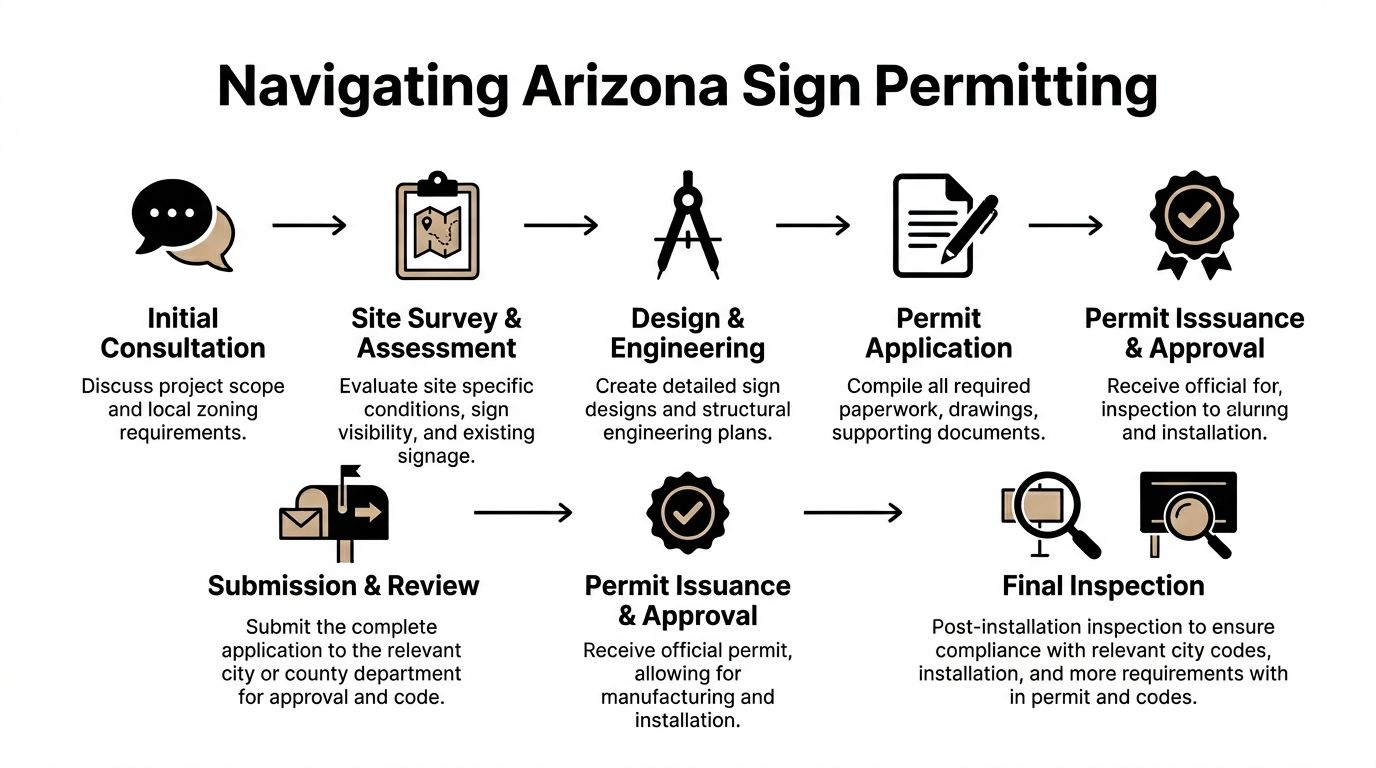
A useful reference for buyers sorting through approval steps is this overview of sign permit requirements. It helps frame what cities commonly want before production can proceed.
What a real permit process looks like
Permit success usually depends on a disciplined sequence, not speed alone.
- Site review happens first. The team confirms the exact building condition, storefront dimensions, setbacks, and existing sign conditions.
- Code review follows before final design lock. At this stage, experienced project managers stop bad assumptions from getting baked into the package.
- Engineering and drawing preparation come next. Depending on the sign type, the city may expect structural details, mounting information, or electrical documentation.
- Application assembly has to be complete. Incomplete submittals don't save time. They trigger review loops.
- Revisions need ownership. Someone has to track comments, respond cleanly, and keep the landlord, client, and fabricator aligned.
- Inspection planning can't wait until install week. Final sign-off often depends on field conditions matching the approved permit set.
Common sources of delay
The biggest Arizona permit delays usually come from preventable mistakes:
- Using a prototype drawing without local adaptation
- Missing landlord requirements in multi-tenant centers
- Submitting dimensions that don't match the field
- Treating illuminated signs like simple graphic installs
- Ignoring interior code issues for ADA or wayfinding packages
Interior signs can create their own compliance exposure. Buyers sometimes assume the permit burden applies only to the exterior sign. It doesn't always. Wayfinding, room identification, and accessibility-related signage need careful review if the project scope includes tenant improvement work.
What strong vendors do differently
The best sign companies arizona don't just "offer permits." They build permit logic into the schedule from the start. That means they ask questions that weaker vendors skip:
- Is this storefront in a city with strict design review?
- Does the landlord require separate approval before municipal submission?
- Does the sign need engineering before the city will accept the package?
- Who owns electrical scope, and when is that confirmed?
- Will the approved dimensions still work after field verification?
Permit handling isn't clerical support. It's project risk control.
If a company can't explain its review process, escalation path, and responsibility split for revisions, you're likely buying avoidable delay.
An Actionable Checklist for Vetting Arizona Sign Companies
The fastest way to choose the wrong vendor is to compare quotes without comparing process. In Arizona, the bid that looks competitive can hide outsourced fabrication, weak permit support, vague install scope, or no plan for post-install service.
Buyers need a vetting method that exposes those gaps early.
Start with fabrication reality
Many established Arizona sign providers differentiate themselves by keeping key production work in-house. As described by Davis Signs & Graphics, some firms maintain internal fabrication capabilities such as welding, CNC routing, and painting to control quality and schedule. That matters because every outsourced handoff adds another place where finish consistency, lead time, and accountability can break down.
Ask direct questions:
- What is fabricated in-house? Don't accept "we do everything" without specifics.
- Which sign types are outsourced? Channel letters, cabinets, monuments, and interior packages may not all be handled the same way.
- Who owns rework if field conditions force a change? This answer tells you how the vendor handles responsibility.
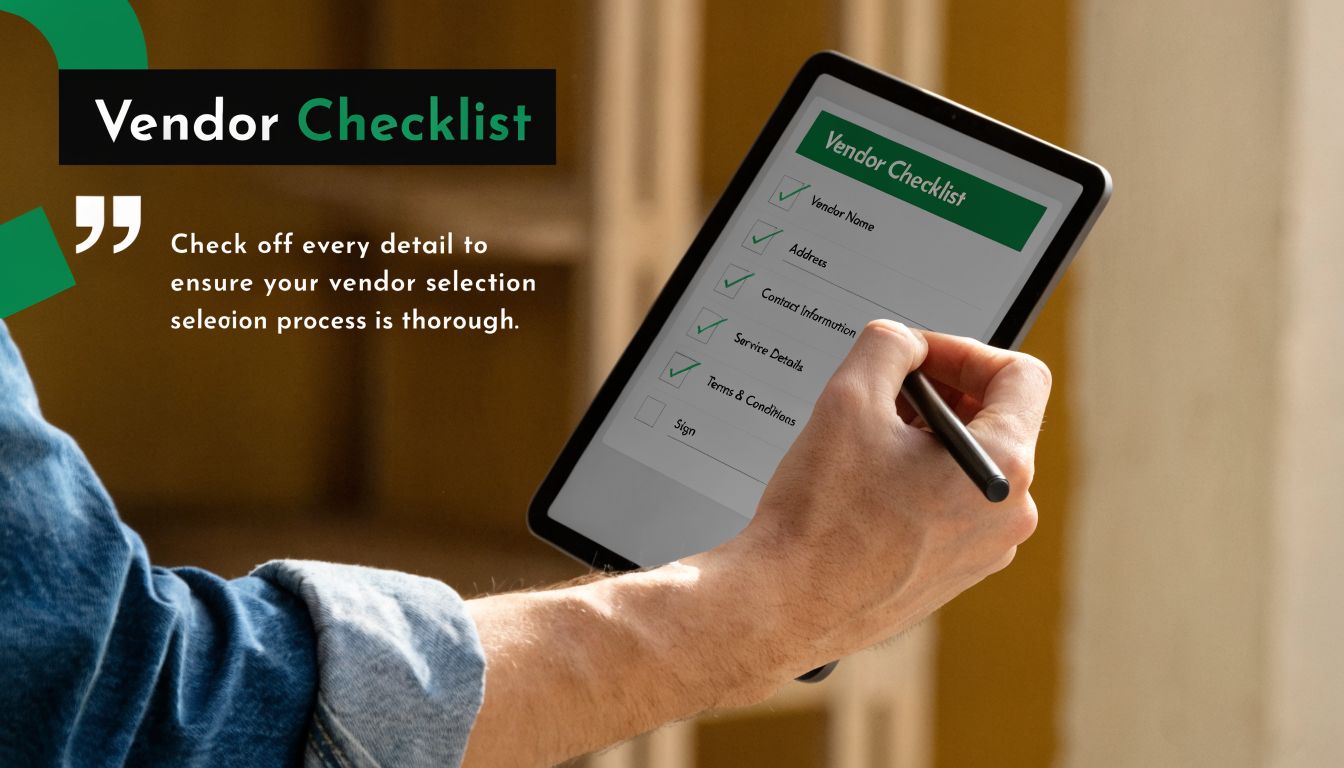
If you're comparing local options with broader providers, reviewing what a local sign company near me should offer can sharpen your checklist.
Verify risk controls, not just craftsmanship
A polished portfolio doesn't tell you how the company manages permits, site conditions, insurance documentation, or subcontracted labor. Those issues create significant financial exposure.
One useful distinction buyers often overlook is the difference between coverage and accountability. This plain-English explanation of bonded vs insured is worth reading because the terms get thrown around casually in vendor conversations. For a sign buyer, the point is simple. You want clarity on who is financially responsible if property damage, installation issues, or contractor failures occur.
Use this checklist during proposal review:
- Licensing and compliance: Confirm the vendor can legally perform or coordinate the work required for your scope in the jurisdiction involved.
- Permit ownership: Get a written statement on who prepares, submits, tracks, and revises permit packages.
- Field verification: Require confirmation that dimensions will be based on actual site conditions, not just lease plans.
- Electrical coordination: For illuminated signs, determine who handles circuits, disconnects, and on-site trade coordination.
- Closeout process: Ask what documentation is provided after installation and inspection.
Compare proposals line by line
Most sign proposals aren't comparable until you normalize them. One vendor may include permitting but not engineering. Another may include install but exclude lift work. A third may give a low number based on thinner materials or deferred electrical assumptions.
A useful apples-to-apples review includes these categories:
| Proposal Area | What to Confirm |
|---|---|
| Materials | Exact substrate, finish, lighting components, and mounting method |
| Permits | Whether fees, drawings, revisions, and submittals are included |
| Installation | Labor scope, equipment assumptions, and site access responsibilities |
| Schedule | What starts fabrication, what can delay install, and who owns updates |
| Warranty and service | What is covered, what is excluded, and how service requests are handled |
The best question to ask
Ask every bidder the same thing: "What are the three most likely reasons this project gets delayed or costs more than quoted?"
A serious project manager will answer directly. A weak vendor will stay vague, dodge the question, or talk only about design.
Strong sign partners don't promise a frictionless job. They identify where friction is likely and show you how they'll control it.
Executing Flawless Multi-Site Sign Rollouts Across Arizona
Single-location projects are hard enough. Multi-site programs multiply every weak assumption. A brand standard that works in one city can become a compliance problem in another. A material that fits one façade condition may need adjustment at the next site. Without centralized control, rollout quality starts drifting almost immediately.
For chains, developers, and regional operators, consistency doesn't happen by accident. It has to be managed.
A good operating model starts with a documented signage project management process. Without one, every site becomes its own mini-crisis.
Build a signage playbook before the first permit package
The strongest Arizona rollouts begin with a playbook that separates fixed brand elements from flexible local variables.
Keep these items standardized:
- Logo artwork and proportions
- Approved color references
- Primary sign types by site class
- Core material specifications
- Illumination standards where applicable
Allow these items to flex by jurisdiction or site:
- Overall dimensions
- Mounting details
- Landlord criteria
- Setback and placement constraints
- Engineering details tied to building conditions
This keeps the brand recognizable without forcing illegal or impractical prototypes into every municipality.
Centralize communication or pay for confusion
The operational mistake I see most often is fragmented communication. The brand talks to a designer, the local installer talks to the landlord, the permit runner talks to the city, and nobody owns the whole schedule. That setup creates contradictions fast.
Use one point of control for:
- Site surveys
- Design revisions
- Permit tracking
- Fabrication release
- Installation scheduling
- Inspection closeout
That doesn't mean one person physically performs every task. It means one project manager controls accountability and reporting.
The video below gives a useful look at how coordinated sign work is managed across locations.
Sequence matters more than speed promises
Arizona rollout failures usually come from compressing the wrong part of the timeline. Teams try to accelerate fabrication before approvals are stable, or they schedule installs before field conditions and electrical scope are fully confirmed.
The better approach is controlled overlap. Survey multiple sites early. Standardize art files once. Review municipal requirements individually. Release fabrication only when each site's permit and mounting details are dependable.
That feels slower at the front end. It usually produces a cleaner launch across the portfolio.
Long-Term Success with Installation and Maintenance
A sign isn't finished when the installer leaves. In Arizona, ownership starts the day the sign goes live.
That's where many buyers lose value. They budget carefully for design, fabrication, and install, then treat maintenance as optional. In a climate with punishing sun, airborne dust, and seasonal storm exposure, that decision shortens sign life and increases emergency repair risk.
Installation quality affects maintenance costs later
Good installation isn't just about getting the sign mounted straight. It affects water intrusion risk, lighting reliability, structural stability, and service access. A clean install package should account for field verification, mounting conditions, electrical coordination where needed, and post-install inspection.
If your team is reviewing execution standards, a page on commercial sign installation helps frame the practical issues that should be clarified before install day.
Arizona has a maintenance service gap
A challenge in the local market is the inconsistent emphasis on long-term service. An analysis of Arizona providers found that many companies focus on fabrication and installation, while very few market proactive, long-term maintenance contracts, creating a service gap for owners trying to protect signage in harsh conditions, as noted by Arizona Commercial Signs. In practical terms, many buyers can get a sign built more easily than they can get it serviced well over time.
That gap creates business risk for retail, churches, warehouses, and multi-location operators. If a lit sign goes partially dark, if hardware loosens, or if a monument sign takes weather damage, downtime starts affecting visibility immediately.
What a useful maintenance plan should include
A real maintenance plan isn't "call us if something breaks." It should define recurring care and response expectations.
Look for these elements:
- Scheduled inspections: Review faces, cabinets, mounting points, and visible wear before problems become failures.
- Cleaning standards: Arizona dust buildup changes appearance and can make older signs look neglected faster than owners expect.
- Lighting service: Illuminated signs need a plan for module, power, or component troubleshooting.
- Storm readiness and recovery: Pre-season checks and post-storm assessments reduce the chance that small issues turn into safety concerns.
- Repair priority: Multi-site operators should know how service requests are triaged.
A sign that represents the business every day should be maintained like any other visible operating asset. Waiting for failure is the most expensive service strategy.
Think in lifecycle terms
The right maintenance conversation starts during procurement, not after warranty questions appear. Ask who services the sign, what common failures are anticipated, how replacement parts are handled, and whether the company supports signs it didn't fabricate. Those answers matter as much as the install quote.
For Arizona owners, the long-term win isn't finding the lowest upfront number. It's building a sign program that stays presentable, compliant, and functional without recurring scramble costs.
Your National Partner for Success in the Arizona Market
A brand can approve artwork on Monday and still miss an opening date in Arizona if nobody owns permit scope, site verification, fabrication timing, and installer coordination from start to finish. That is a critical risk in this market. Delays rarely come from one big failure. They come from small misses between teams, and each miss costs time, change orders, and internal attention.
Arizona projects reward control. A qualified partner does more than produce signage. The job is to keep design intent, code requirements, field conditions, and schedule commitments aligned across every handoff. That matters most for developers, franchise groups, regional operators, and out-of-state brands that do not have time to manage separate designers, permit runners, fabricators, installers, and service vendors in multiple Arizona jurisdictions.
The provider mix in Arizona also creates a practical problem for buyers. Many local shops do solid fabrication or installation work, but fewer firms present permitting and code compliance as a primary service model, as reflected in the Arizona Sign Association member directory. For a buyer, that means compliance responsibility has to be assigned early and clearly. If it is left vague, the risk shows up later as redesign, resubmittal, or an installation crew standing by while paperwork catches up.
A strong delivery model usually includes:
- One accountable project lead for status updates, escalations, and schedule control
- Defined permit ownership before drawings and engineering move into production
- Fabrication review tied to approved specifications and actual site conditions
- Installation planning based on the permit set, access constraints, and local inspection requirements
- Service support after turnover so the sign stays operational and presentable
That structure protects more than the sign package. It protects store openings, tenant delivery dates, contractor coordination, and budget discipline.
For companies evaluating partners in Arizona, the key question is not who can fabricate a sign. It is who can protect your timeline, compliance position, brand standards, and total project cost at the same time. That is the role On Display Signs, Inc. is built to fill. Their project managers coordinate design, permitting, fabrication, installation, and ongoing service under one point of contact, which reduces handoff risk and gives multi-site brands a more controlled path into the Arizona market.