In today's competitive market, the right signage does more than just display your name; it communicates your brand's identity, guides customers, and drives sales. Understanding the different types of signage available is the first and most critical step toward creating a powerful visual presence that commands attention and delivers results. This is not just a list; it's a strategic blueprint designed to help you navigate the complex world of physical advertising and environmental branding.
This comprehensive guide explores twelve essential sign categories, moving beyond generic descriptions to provide actionable insights, practical examples, and expert tips for implementation. We will dissect everything from high-tech digital displays to foundational wayfinding systems, ensuring you have a clear picture of what works best for specific applications.
Whether you're developing a commercial property, launching a retail startup, managing a distribution warehouse, or enhancing a church campus, this breakdown will equip you to make informed decisions that improve customer experience and directly boost your bottom line. We'll examine the materials, maintenance considerations, and strategic uses for each type, arming you with the knowledge to select the perfect signage solution for your specific business goals. You will learn how to match the right sign to the right purpose, transforming a simple marker into a powerful asset for visibility and growth.
1. Digital Signage
Digital signage utilizes electronic displays like LED, LCD, or projection to showcase dynamic content, making it one of the most flexible and impactful types of signage available. Unlike static signs, digital displays can present a rotating loop of images, videos, text, and interactive elements. This technology allows for real-time content updates managed remotely, providing unparalleled adaptability for businesses with evolving promotions or information.
From a restaurant's digital menu board that switches from breakfast to lunch specials automatically, to flight information displays in airport terminals, digital signage commands attention. It's a powerful tool for retail stores, corporate lobbies, and public transit stations to communicate timely messages, promotions, and brand stories.
Implementation and Best Practices
To maximize the effectiveness of digital signage, consider both content strategy and physical placement. The primary goal is to capture and hold viewer attention quickly.
- Content Rotation: Keep individual messages brief. A practical rule is that content should rotate every 5 to 10 seconds to maintain engagement without overwhelming the viewer.
- Visual Clarity: Use high-contrast color schemes (e.g., light text on a dark background) to ensure readability from a distance. Actionable step: Before launching a campaign, test your content on the actual screen where it will be displayed to check for glare and legibility.
- Dynamic Integration: Enhance relevance by integrating live data feeds. A manufacturing facility could display real-time production metrics, while a corporate office might show live news, weather, and traffic updates to keep employees informed.
Key Insight: The true power of digital signage lies in its ability to be contextual. By scheduling content based on time of day, current events, or specific promotions, you can deliver highly relevant messaging that drives immediate action. For example, a cafe can promote iced coffee during a heatwave.
This signage type is ideal for environments where information changes frequently, such as restaurants with daily specials, retail shops with shifting sales, or transportation hubs with constant schedule updates. The initial investment is higher than for static signs, but the long-term flexibility and engagement potential often provide a significant return. Explore the possibilities by learning more about Digital Signage from OnDisplaySigns.com.
2. Wayfinding Signage
Wayfinding signage is a strategic system designed to guide people through a physical environment efficiently and without confusion. This essential category among the many types of signage encompasses a coordinated network of maps, directional arrows, identification signs, and informational markers. The primary goal is to help visitors orient themselves, navigate complex spaces, and reach their destinations with ease.
Effective wayfinding is crucial in large or intricate venues like hospitals, airports, corporate campuses, and shopping malls. A well-designed system reduces visitor stress, improves traffic flow, and enhances the overall experience by providing clear, predictable guidance at key decision points.

Implementation and Best Practices
Successful wayfinding signage relies on consistency and intuitive placement. The system should feel like a natural extension of the architecture, answering questions before they are asked.
- Place Signs at Decision Points: Install signs at building entrances, lobbies, hallway intersections, and near elevators or stairwells where people must make a choice about which way to go.
- Maintain Visual Consistency: Use a consistent hierarchy of fonts, colors, and symbols throughout the entire system. A hospital might use a specific color for cardiology and another for pediatrics across all related signs, making navigation intuitive.
- Simplify Information: Avoid clutter. Each sign should present only the information needed at that specific location. For example, a sign at an intersection should only point to major departments, not individual offices. Use universally recognized pictograms alongside text to overcome language barriers.
Key Insight: Great wayfinding is more than just signs; it's a complete navigational experience. It anticipates user needs and provides clear, sequential information that builds confidence as a person moves from their starting point to their final destination.
This signage type is indispensable for any large-scale facility where visitors are unfamiliar with the layout. The upfront investment in a professionally designed system prevents confusion, improves operational efficiency, and reflects positively on the organization. Gain a deeper understanding by reading more about Wayfinding Signage from OnDisplaySigns.com.
3. Monument Signage
Monument signage consists of freestanding, ground-level structures that serve as architectural statements at property entrances, marking a brand’s physical presence with permanence and authority. Often constructed from durable materials like brick, stone, or concrete, these signs are integrated into the landscape to create a sense of prestige. As one of the most substantial types of signage, they establish a landmark identity for corporate parks, residential communities, and institutional campuses.
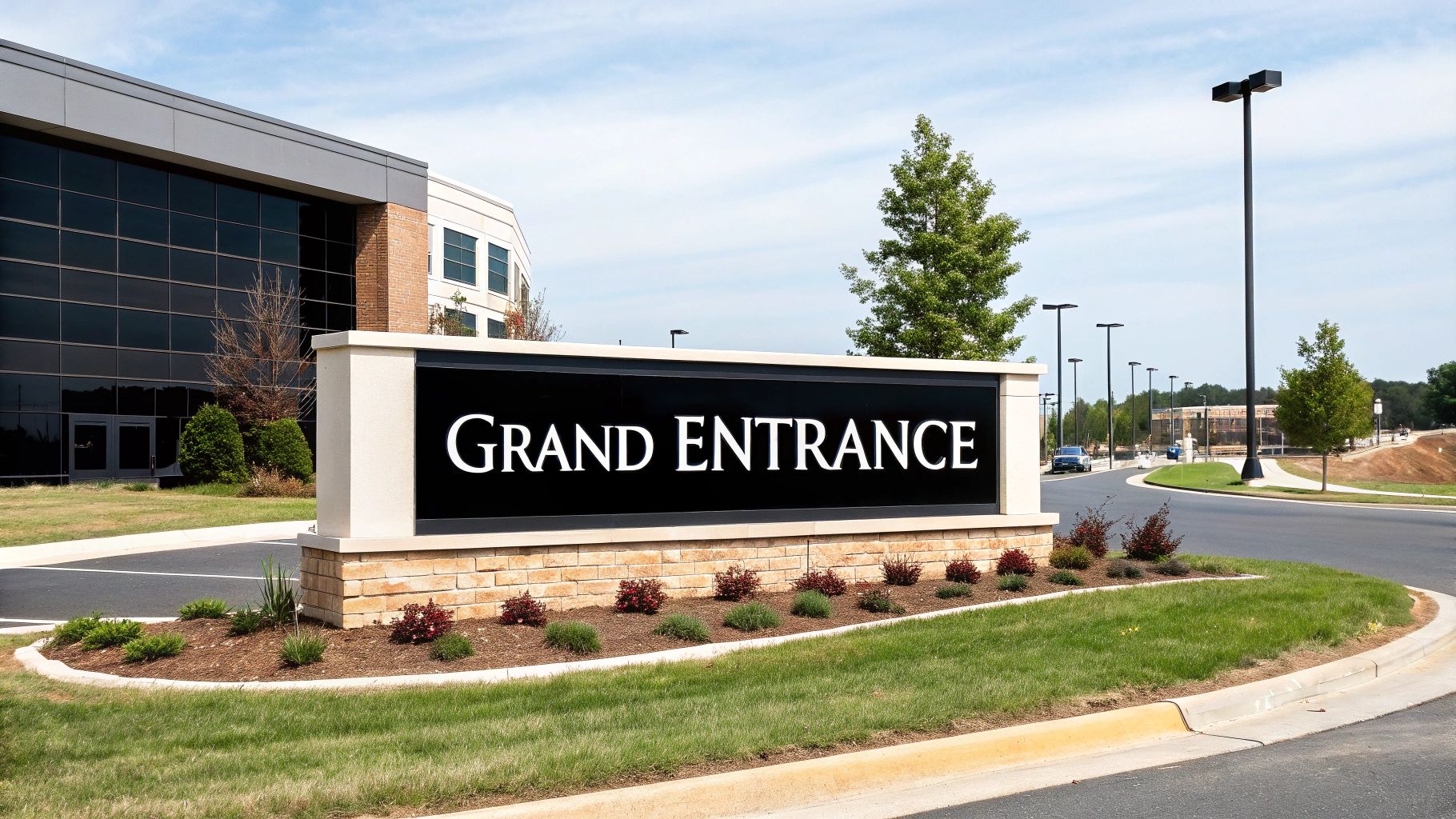
From the distinguished entrance of a university campus to the refined signage fronting a professional office building, monument signs communicate stability and quality. They are common fixtures for real estate developments, hospitals, and gated communities, where making a strong first impression is critical. Their low-profile design often aligns with local zoning codes that restrict taller pole signs.
Implementation and Best Practices
Effective monument signage requires a blend of architectural design, strategic placement, and regulatory compliance. The goal is to create a structure that is both visually appealing and highly functional.
- Zoning and Permitting: Engage with local building and zoning departments at the beginning of your project. These signs involve permanent foundations and often have strict requirements regarding size, setback from the road, and materials.
- Material Durability: Select materials that complement your building's architecture and can withstand local climate conditions. Practical examples include using brick to match a building's facade or using pre-cast concrete in areas with harsh winters.
- Integrated Lighting: Incorporate external ground lighting or internal illumination (for channel letters) to ensure the sign is visible and impactful 24/7. Proper lighting enhances security and extends branding into the evening hours.
Key Insight: A monument sign is more than just a sign; it's an architectural feature of your property. Enhance its impact by integrating professional landscaping around the base, using plants and hardscaping to frame the sign and draw attention to it.
This signage type is ideal for any organization seeking to project an image of permanence, professionalism, and prominence. While the initial investment in design and construction is significant, the lasting durability and curb appeal provide enduring value. Discover the options available by exploring monument sign solutions from OnDisplaySigns.com.
4. Banner Signage
Banner signage consists of flexible materials, typically vinyl or fabric, that are printed with graphics and text to serve as temporary or semi-permanent displays. As one of the most cost-effective and versatile types of signage, banners are ideal for promotions, events, and announcements. They can be hung from buildings, suspended between poles, or mounted on stands, offering high visibility in a wide range of settings.
From a massive "Grand Opening" banner draped across a new storefront to sponsorship banners lining a little league sports field fence, this signage type provides a powerful and portable way to broadcast a message. Their lightweight nature and simple installation make them a go-to choice for businesses and organizations needing to create a significant visual impact on a budget.
Implementation and Best Practices
Effective banner design and placement are crucial for capturing attention and withstanding environmental factors. The primary goal is to deliver a clear, concise message that can be read quickly from a distance.
- Material and Durability: For outdoor use, select a heavy-duty, weather-resistant vinyl material with reinforced hems and grommets. An actionable tip for windy locations is to choose mesh vinyl, as it allows air to pass through, reducing strain and preventing tearing.
- Visual Hierarchy: Use large, bold fonts and a high-contrast color scheme. Limit your message to a core headline of 5-7 words to ensure it is immediately understandable to passing drivers.
- Secure Installation: Ensure the banner is pulled taut and securely fastened using appropriate hardware like bungee cords or rope. A loose or sagging banner looks unprofessional and is more susceptible to wind damage.
Key Insight: The main advantage of banner signage is its ability to provide maximum impact for a minimal investment. Banners are a fast, scalable solution for time-sensitive promotions, making them indispensable for event marketing and seasonal retail campaigns.
This signage is perfectly suited for short-term needs like announcing a special sale, directing traffic at a festival, or publicizing a community event. While less permanent than other options, their affordability and quick production time allow for frequent updates and targeted messaging, offering excellent flexibility. Learn more about custom banner solutions from industry leaders like Vistaprint.
5. Directional Signage
Directional signage, also known as wayfinding signage, uses a combination of arrows, symbols, and text to guide people through physical spaces. These are one of the most functional types of signage, designed to enhance user experience by providing clear, concise navigational cues. Their primary purpose is to direct traffic flow, reduce confusion, and help visitors, customers, and employees find their destinations efficiently.
From simple "Shipping & Receiving" signs on a warehouse exterior to complex navigational systems in hospitals and airports, directional signs are essential for creating an organized and welcoming environment. In large facilities, they are critical for safety, operations, and customer satisfaction, ensuring people can move from point A to point B with minimal friction.
Implementation and Best Practices
Effective directional signage relies on strategic placement and intuitive design. The goal is to provide information exactly when and where a person needs to make a decision.
- Strategic Placement: Install signs at every key decision point, such as hallway intersections, lobby entrances, and parking lot forks. A practical example: place a "Deliveries This Way" sign with an arrow well before the actual turn-off, not right at it.
- Minimalist Text: Keep text to a minimum and let symbols and arrows do the heavy lifting. Use universally recognized icons (e.g., a restroom symbol or a truck icon for a loading dock) for quicker comprehension.
- Visibility and Contrast: Test signs for visibility from various angles and distances. Use high-contrast color combinations, like white text on a blue or green background, to ensure readability for all visitors, including those with visual impairments.
Key Insight: The best directional signage system is anticipatory. It answers a person's navigational questions before they even have to ask, creating a seamless and stress-free journey through your property.
This signage type is indispensable for any large or complex venue, including corporate campuses, healthcare facilities, distribution warehouses, and retail centers. While individual signs are relatively low-cost, a comprehensive system requires careful planning to be effective. The return on investment is measured in improved operational flow, enhanced safety, and a superior visitor experience.
6. ADA and Accessibility Signage
ADA and accessibility signage refers to specialized signs designed to comply with the Americans with Disabilities Act (ADA) and other accessibility standards. This critical category of types of signage ensures that physical environments are navigable and welcoming for people with visual or mobility impairments. It features specific elements like tactile text, braille, high-contrast colors, and non-glare finishes to communicate essential information effectively to everyone.
From restroom and exit signs in a corporate office to designated parking signs in a retail lot, ADA signage is a legal requirement for public accommodations and commercial facilities. Proper implementation demonstrates a commitment to operational excellence and helps all visitors, employees, and customers navigate a space safely and independently.
Implementation and Best Practices
Effective ADA signage goes beyond mere compliance; it requires thoughtful design and precise placement. The goal is to provide clear, consistent information that is easily understood.
- Follow Official Guidelines: Strictly adhere to the 2010 ADA Standards for Accessible Design for details on character height, font type, color contrast, and mounting location. For example, signs with tactile characters must be mounted on the wall adjacent to the latch side of the door, within a specific height range.
- Conduct Accessibility Audits: Regularly review your facility's signage to ensure it remains compliant and in good condition. Faded signs, incorrect placement, or outdated information can create barriers for individuals with disabilities and create liability.
- Integrate with Wayfinding: Ensure your ADA signs are part of a cohesive navigation system. For instance, directional signs should clearly point to accessible entrances and restrooms, not just general ones.
Key Insight: Accessibility is not just about meeting legal minimums. It’s about creating an efficient and safe experience for every person who enters your facility. Well-executed ADA signage is a foundational element of a truly functional environment.
This signage type is non-negotiable for nearly all public-facing businesses, including retail stores, healthcare facilities, warehouses, and office buildings. While the requirements are specific, partnering with a knowledgeable sign provider ensures your facility is compliant, safe, and welcoming. Learn more about ensuring your business is up to code with ADA Signage from OnDisplaySigns.com.
7. Illuminated Signage
Illuminated signage uses internal or external light sources to ensure visibility after dark, making it a critical asset for businesses operating in the evening or 24/7. This category includes a range of technologies, from classic neon to modern LED and fluorescent backlit options. These signs are designed to cut through the darkness, grabbing customer attention and reinforcing brand presence during all hours.
This powerful category of signage is essential for establishments like restaurants, bars, gas stations, and theaters, where nighttime visibility directly translates to revenue. Whether it’s a glowing theater marquee or the bright, welcoming sign of a convenience store, illuminated signs act as a beacon for potential customers, guiding them to the business’s doorstep.
Implementation and Best Practices
Effective illuminated signage balances visibility with aesthetics and efficiency. The goal is to create a sign that is both eye-catching and appropriate for its environment while being cost-effective to operate.
- Choose the Right Technology: Modern LEDs offer superior energy efficiency, longer lifespans, and a wider range of color temperatures compared to older options. This makes them a more sustainable and cost-effective choice for most applications.
- Context and Compliance: Be mindful of local ordinances regarding light pollution and brightness. Ensure your sign's intensity is suitable for the surrounding neighborhood and that you have secured all necessary permits before installation. A practical step is to consult your local municipality's zoning code before ordering a sign.
- Automate Operation: Use timers or photocell sensors to automate when your sign turns on and off. This ensures consistent operation, saves energy, and reduces manual effort for staff.
Key Insight: The impact of illuminated signage goes beyond simple visibility; it communicates operational hours and projects an image of accessibility and safety. A well-lit sign tells customers, "We are open and ready for you."
This type of signage is indispensable for any business that relies on evening foot traffic or wants to maintain brand visibility around the clock. While the initial cost and installation can be more complex than non-lit signs, the ability to attract customers after sunset often delivers a substantial return on investment. You can discover more options for Illuminated Signage from OnDisplaySigns.com.
8. Building/Wall Mounted Signage
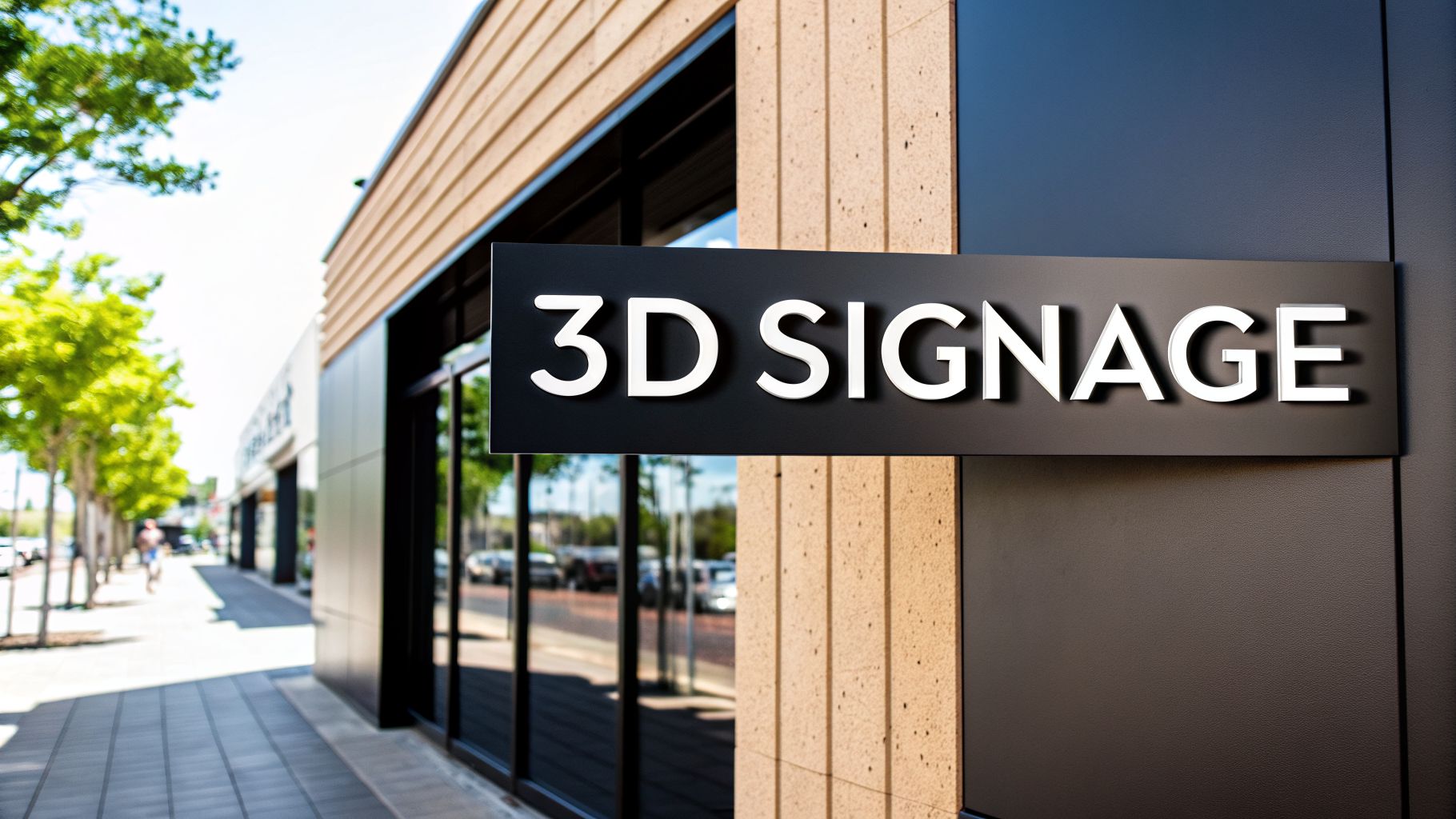
Building or wall-mounted signage includes any sign attached directly to the facade of a structure, making it one of the most fundamental types of signage for establishing a physical presence. This category encompasses a wide range of options, from illuminated channel letters that give a storefront a three-dimensional pop to classic flat panel signs, blade signs projecting from a wall, and large-scale murals. It is the primary means by which a business identifies its location and reinforces its brand identity.
From the bold logo on a corporate headquarters to the welcoming sign on a local retail shop, wall-mounted signs are essential for visibility and wayfinding. They serve as a constant advertisement, drawing the eye of passersby and clearly marking the entrance for customers, clients, and visitors at banks, hotels, and professional offices.
Implementation and Best Practices
Proper installation and material choice are critical for ensuring the longevity and effectiveness of building-mounted signage. The sign should complement the building's architecture, not clash with it.
- Structural Assessment: Before installation, a professional must assess the wall’s structural integrity to ensure it can safely support the sign’s weight and withstand environmental factors like wind. This is a crucial, non-negotiable step.
- Architectural Harmony: Select materials, colors, and a design that aligns with the building's existing aesthetic. For example, a modern aluminum sign suits a contemporary building, while a classic wood sign may fit a historic facade.
- Visibility and Lighting: Consider how the sign will look both day and night. Actionable advice: view mockups of your sign against a photo of your building in both daylight and nighttime settings. Options like halo-lit or face-lit channel letters provide excellent evening visibility.
Key Insight: Building-mounted signage is a direct extension of your brand’s physical identity. Its quality, condition, and design communicate a powerful message about your business’s professionalism and attention to detail before a customer even steps inside.
This signage is ideal for any brick-and-mortar business, from retail stores and restaurants to manufacturing facilities and corporate offices. While requiring professional installation and adherence to local zoning codes, a well-executed wall sign offers a durable, high-impact branding solution that can last for a decade or more.
9. Parking Signage
Parking signage is a specialized category of types of signage designed to manage vehicle traffic, communicate regulations, and ensure safety within parking lots and garages. This system of signs includes everything from directional arrows guiding drivers to available levels, to specific markers for reserved or accessible spaces, and informational panels detailing rates and hours of operation. Its primary purpose is to create an orderly, efficient, and user-friendly parking experience.
Effective parking signage is critical for managing flow in complex environments like airport garages, hospital campuses, and large shopping malls. Clearly marked entrances, exits, and payment stations prevent confusion and congestion, while regulatory signs enforce time limits and designated parking zones, maximizing space utilization and ensuring compliance with local ordinances.
Implementation and Best Practices
Successful parking signage hinges on clarity, consistency, and compliance. The goal is to provide drivers with all necessary information at the moment they need it, without causing distraction or hesitation.
- Placement and Visibility: Position directional signs well before decision points, such as turns or lot entrances, not within them. Use high-contrast colors (like white on blue for accessibility or black on yellow for warnings) and ensure signs are large enough to be read from a moving vehicle.
- Regulatory Compliance: Ensure all accessibility signs meet ADA standards for height, location, and design, including the International Symbol of Accessibility. This is not just a best practice; it's a legal requirement.
- System Cohesion: Implement a consistent system of symbols, colors, and numbering throughout the facility. A practical example is using color-coded levels in a garage (e.g., Level 1 is blue) and reinforcing that color on all directional signs pointing to it.
Key Insight: A well-planned parking signage system functions as an unspoken guide. It preemptively answers drivers' questions, reduces stress, and transforms a potentially chaotic space into a structured, easily navigable environment.
This signage type is indispensable for any property with dedicated parking, from small office buildings with reserved spots to multi-level public garages. While seemingly simple, its impact on customer experience and operational efficiency is profound. A thoughtful strategy prevents accidents, streamlines traffic, and ensures every visitor’s journey begins and ends on a positive note.
10. Interactive and Smart Signage
Interactive and smart signage elevates the user experience by inviting them to engage directly with the content. This advanced category of types of signage integrates technologies like touchscreens, motion sensors, QR codes, and augmented reality (AR) to transform passive viewing into an active, personalized interaction. Unlike traditional signs, these smart systems can respond to user actions, providing tailored information and creating memorable brand encounters.
From an interactive kiosk in a hotel lobby that allows guests to explore local attractions, to augmented reality displays in museums that bring exhibits to life, this technology bridges the physical and digital worlds. It is particularly effective in environments where customer engagement and detailed information are paramount, such as airports with real-time wayfinding or restaurants offering interactive menus with nutritional details.
Implementation and Best Practices
To successfully deploy interactive signage, the user experience must be intuitive, seamless, and reliable. The goal is to empower the user, not to create a technological barrier.
- Simplicity is Key: Design interfaces that are simple and easy to navigate with large, clear buttons. A practical test: if a user can't figure it out in 5 seconds, the design is too complex.
- Thorough Testing: Test the technology extensively with your target audience to identify and fix usability issues before a full rollout. Ensure the hardware is durable enough for public use.
- Data-Driven Improvement: Use analytics to track how users engage with the sign. This data can reveal which content is most popular and help you refine your strategy over time. For insights into companies offering solutions in this space, you can explore platforms of various interactive touch technology providers.
Key Insight: The value of interactive signage is not just in the technology itself, but in the data it generates. Analyzing user interactions provides powerful insights into customer behavior and preferences, allowing for continuous optimization of messaging and offerings.
This signage is ideal for businesses looking to create a "wow" factor, provide in-depth product information, or streamline customer service processes. While the upfront investment is considerable, the potential for increased engagement, data collection, and sales uplift makes it a compelling option for forward-thinking brands.
11. Fleet Graphics and Signage
Fleet graphics and signage transform company cars, trucks, and vans into mobile billboards, making them one of the most cost-effective types of signage for generating local brand awareness. These large, custom-printed vinyl graphics are professionally applied directly to a vehicle's surface. This method essentially turns every service call, delivery, or commute into a marketing opportunity.

From a single plumber’s van featuring a logo and phone number to an entire fleet of delivery trucks branded with a consistent color scheme, vehicle graphics are constantly working. They build brand recognition and trust within a service area, reaching thousands of potential customers daily across a wide geographic footprint simply by going about regular business operations.
Implementation and Best Practices
A successful fleet graphic is more than just a logo on a door; it’s a carefully designed piece of moving art. The key is to convey a clear message that can be understood in seconds.
- Design for Motion: Keep text minimal and bold. Focus on a clear logo, a primary service, a website, and a phone number. The design must be legible from a distance and while the vehicle is in motion.
- High-Contrast Visuals: Use vibrant, high-contrast colors to stand out in traffic. A design that looks great on a computer screen may become lost against the backdrop of a busy street if the colors are too subtle.
- Professional Installation: Always use a professional installer to apply the graphics. Proper application prevents bubbling and peeling, ensuring the graphic lasts and protects the vehicle's original paint.
Key Insight: Unlike a stationary billboard, fleet signage builds brand familiarity through repeated, non-intrusive impressions. A resident seeing your branded van in their neighborhood multiple times builds subconscious trust and top-of-mind awareness.
This signage type is essential for any business with a mobile workforce, including contractors, delivery services, and real estate agents. The one-time investment generates continuous advertising value for years, offering an exceptional return compared to recurring ad buys. Explore options for larger transport by learning more about signage for trailers from OnDisplaySigns.com.
12. Point-of-Sale (POS) and Promotional Signage
Point-of-Sale (POS) and promotional signage are strategically placed in-store graphics designed to influence purchasing decisions at the critical moment of choice. These powerful types of signage include everything from shelf talkers and promotional displays to pricing labels and product information cards. Their primary function is to directly impact customer behavior and boost sales by delivering persuasive, timely messaging exactly where transactions occur.
From a vibrant "Buy One, Get One" display in a grocery aisle to a simple, elegant chalkboard announcing the daily special at a cafe, POS signage works to capture attention and trigger impulse buys. It is a fundamental tool for retail environments, pharmacies, and fast-food restaurants to highlight promotions, convey value, and guide customers toward specific products.
Implementation and Best Practices
To maximize the effectiveness of POS and promotional signage, the focus should be on clarity, placement, and relevance. The goal is to provide a final nudge that converts a browsing customer into a buying one.
- Benefit-Focused Messaging: Keep copy concise and centered on the customer's benefit. Instead of just "Sale," use action-oriented phrases like "Save 50% Today Only."
- Strategic Placement: Position signs at eye-level on shelves, at checkout counters, or on endcaps to ensure high visibility. Test different locations to see what drives the most sales for a particular item.
- Price Clarity: Ensure all pricing is clear, accurate, and easy to understand. Ambiguity at the point of sale can lead to abandoned purchases and customer frustration.
- Regular Updates: Keep promotional content fresh and current. Outdated signs suggest a lack of attention to detail and can erode customer trust.
Key Insight: Effective POS signage isn't just about announcing a price; it's about closing the sale. By communicating a clear value proposition at the exact moment a customer is making a decision, you can significantly increase basket size and move specific inventory.
This signage is essential for any retail or service business aiming to influence final purchasing decisions. While individual signs are low-cost, their collective impact on revenue is substantial, making them one of the highest ROI marketing tools available for brick-and-mortar locations. Learn how to create compelling in-store promotions with POS Signage from OnDisplaySigns.com.
12-Point Comparison of Signage Types
| Signage Type | 🔄 Implementation Complexity | ⚡ Resource & Cost Considerations | 📊 Expected Outcomes | Best Use Cases | ⭐ Key Advantages |
|---|---|---|---|---|---|
| Digital Signage | High — network, CMS, integration | High upfront (displays, players); ongoing power & IT | Strong engagement, measurable analytics | Retail, airports, corporate lobbies, transportation | Dynamic content, remote updates, high engagement |
| Wayfinding Signage | Medium–High — planning & user testing | Moderate (design, fabrication, phased install) | Reduced confusion; better visitor flow | Hospitals, campuses, museums, airports | Improves navigation & accessibility, consistent UX |
| Monument Signage | High — permits, custom fabrication | High upfront, long lead times; low recurring cost | Long-term brand visibility and curb appeal | Corporate campuses, developments, hospitals | Durable, prominent presence; professional image |
| Banner Signage | Low — simple production & install | Low cost; fast turnaround; replacement needed | Short-term awareness; event/promo visibility | Events, promotions, seasonal retail | Cost-effective, flexible sizing, rapid deployment |
| Directional Signage | Low — straightforward design & placement | Low cost; quick to produce/install | Improved traffic flow; reduced user errors | Parking lots, malls, hospitals, offices | Clear, inexpensive, supports safety & ADA goals |
| ADA & Accessibility Signage | Medium — compliance-focused specs | Moderate (specialized manufacturing, audits) | Legal compliance; broader accessibility | Public buildings, healthcare, education | Ensures access, reduces liability, functional design |
| Illuminated Signage | Medium–High — electrical & permits | Higher install & energy costs; LED reduces OPEX | 24/7 visibility; stronger night impact | Retail, restaurants, entertainment, gas stations | Enhanced visibility, nighttime branding, ambiance |
| Building / Wall-Mounted Signage | Medium — structural assessment & permits | Moderate cost; variable by materials & size | Strong street-level identity and recognition | Storefronts, offices, hotels, medical centers | Cost-effective brand presence; customizable designs |
| Parking Signage | Low — simple fabrication & placement | Low cost; periodic maintenance & repainting | Better parking efficiency; clarified rules | Garages, lots, hospitals, malls | Inexpensive, improves flow, supports regulations |
| Interactive & Smart Signage | Very High — software, sensors, integrations | High development & maintenance; data infrastructure | High engagement, personalization, analytics | Retail, museums, airports, hospitality | Interactive experiences, data-driven targeting |
| Fleet Graphics & Signage | Medium — design + professional install | Moderate–high upfront; long-duration exposure | Wide geographic reach; high impressions | Service fleets, delivery vehicles, event promos | Mobile advertising, cost-effective per impression |
| POS & Promotional Signage | Low — quick design & print cycles | Low cost; frequent refresh required | Immediate uplift in impulse purchases | Grocery, retail, restaurants, checkout areas | Direct sales impact, flexible & easy to update |
Putting Your Signage Strategy into Action
Navigating the extensive landscape of signage can seem complex, but this comprehensive exploration of the primary types of signage has equipped you with a foundational understanding. From the commanding presence of a monument sign at your property's entrance to the legally mandated guidance of ADA signage, each piece plays a distinct and vital role. We've seen how digital and interactive signs are revolutionizing customer engagement, while classic illuminated and building-mounted signs continue to be cornerstones of brand visibility.
The central takeaway is that signage is not a single decision but a strategic ecosystem. An effective plan is never about choosing just one type; it's about layering and integrating multiple solutions to create a cohesive, branded experience. Your goal is to guide, inform, and impress at every touchpoint, transforming a simple visit into a seamless customer journey.
From Knowledge to Implementation: Your Next Steps
Understanding the options is the first step. The next is to translate that knowledge into a tangible, high-impact strategy. A successful signage project requires careful consideration of function, form, and feasibility.
1. Conduct a Comprehensive Site and Needs Audit:
Before you can choose the right signs, you must define the problems you need to solve. Walk your property from the perspective of a first-time visitor.
- Identify Friction Points: Where do people get lost? Are your entrances clear from the street? Is the parking lot confusing? These are opportunities for wayfinding and directional signage.
- Assess Visibility Gaps: Can your building be seen clearly day and night? Are you missing opportunities to capture attention from passing traffic? This points toward the need for illuminated or monument signs.
- Evaluate the Customer Experience: Once inside, is it easy to find restrooms, specific departments, or checkout counters? Are you effectively promoting key products or services? This is where ADA, POS, and digital signage become critical.
2. Develop a Unified Design Language:
Your signs are a direct reflection of your brand. A fragmented visual identity can create a confusing and unprofessional impression.
- Consistency is Key: Ensure that fonts, colors, logos, and materials are consistent across all types of signage, from the main pylon sign down to the smallest directional plaque.
- Material Matters: The materials you choose communicate a message. Sleek acrylic and brushed metal suggest modernity and professionalism, while rustic wood might convey a more traditional, welcoming feel. Align these choices with your brand's core identity.
Strategic Insight: Think of your signage as a team of employees. Your monument sign is the greeter at the door, your wayfinding signs are the helpful guides in the aisles, and your digital signs are the knowledgeable experts showcasing your best offerings. Each one must work together harmoniously.
3. Prioritize Compliance and Longevity:
Overlooking legal requirements and long-term durability is a costly mistake.
- Permitting and Regulations: Never underestimate the importance of local zoning laws and permitting processes. ADA compliance is not optional; it is a legal requirement that ensures accessibility for all. A professional sign partner will navigate these complexities for you.
- Invest in Quality: Opting for cheaper materials may save money initially but often leads to higher costs for maintenance, repairs, and replacements down the line. A well-fabricated sign is an investment that pays dividends through durability and sustained visual appeal for years.
Mastering the different types of signage moves you from simply labeling a location to actively shaping the customer experience. By thoughtfully selecting and integrating the right solutions, you create a powerful, silent salesforce that builds brand recognition, facilitates navigation, and drives business growth around the clock. Your signage is a critical asset; investing in a strategic plan is one of the smartest decisions you can make for your organization's future.
Ready to transform your understanding of signage into a powerful reality for your business? The experts at On Display Signs, Inc. specialize in designing, fabricating, and installing every type of sign discussed in this guide. Partner with us to create a cohesive and impactful signage strategy that elevates your brand and achieves your goals.